
Some McDonald’s workers will get a raise
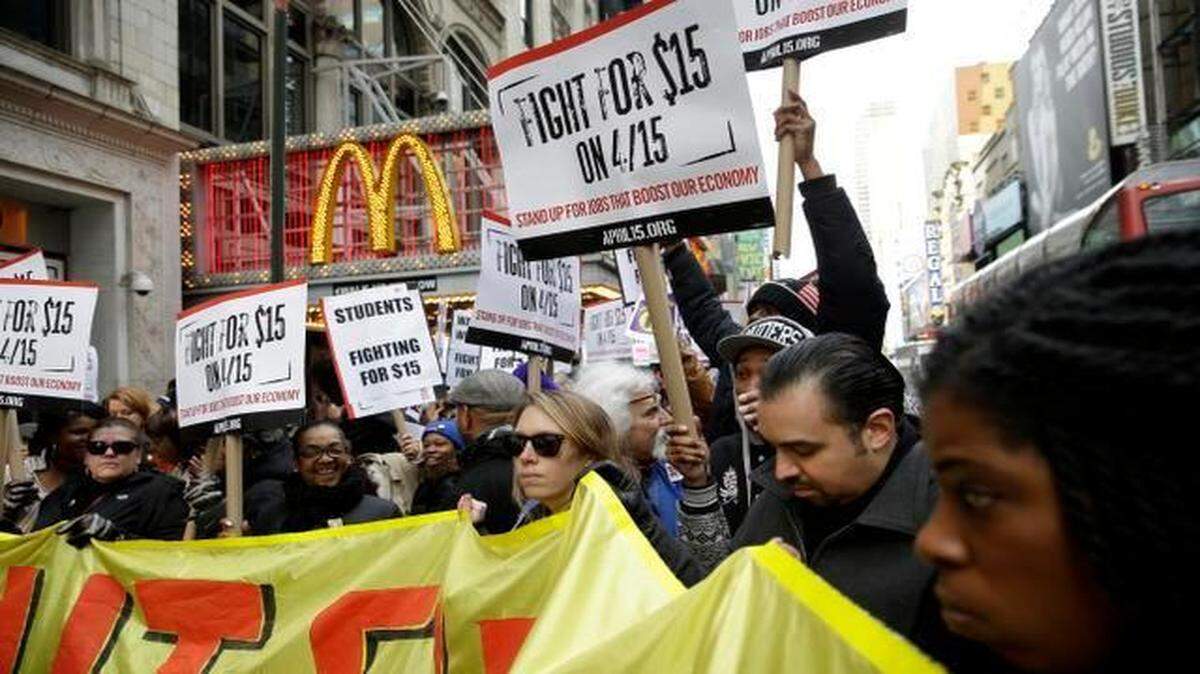
McDonald’s said Wednesday that it will raise wages and offer benefits to employees in the 1,500 U.S. stores it operates itself. The action occurred just a day after workers massed outside its stores to protest their low pay.
The company plans to increase wages by at least $1 over the local legal minimum wage, to an average of $9.90 an hour, by July 1 for 90,000 workers in stores under its direct corporate control. That average will increase to more than $10 in 2016.
The decision does not affect the 750,000 employees who work for the more than 3,100 franchisees who operate more than 12,500 McDonald’s restaurants around the country. But the move could add to pressure on franchise owners to lift wages in their restaurants as well.
Employees who have worked in company restaurants more than a year will also be eligible for paid time off, whether they work full or part time. An employee who works an average of 20 hours a week might accrue as much as 20 hours of paid time off a year, for example.
“We know that a motivated workforce leads to better customer service, so we believe this initial step not only benefits our employees, it will improve McDonald’s restaurant experience,” said Steven J. Easterbrook, who has been chief executive for one month.
McDonald’s said the move was the market at work and not in response to protests, which it has characterized as media events involving very few McDonald’s workers. Some other big employers, including Target, Wal-Mart, TJX and Gap, have announced wage increases.
The announcement was the boldest move yet by Easterbrook. He has moved quickly to introduce changes aimed at improving McDonald’s standing with consumers, this week alone announcing plans to offer breakfast all day and to revise a grilled chicken sandwich to remove ingredients such as maltodextrin and to use an “artisan” bun.
A McDonald’s worker tapped by the “$15 an hour and a union” campaign to respond said the corporate action wasn’t enough.
“Because we joined together and stood up, McDonald’s was forced to raise pay,” said Kwanza Brooks, a McDonald's worker in Charlotte, N.C. “Still, this is too little to make a real difference and covers only a fraction of workers. It’s a weak move for a company that made $5.6 billion in profits last year. We’re going to keep fighting until we win $15 and union rights for all fast-food workers and our families."
Brooks currently earns $7.25 an hour.
Another McDonald’s worker, Justin Javin Johnson, who earns $7.60 an hour at a franchise-owned store in St. Louis, said he thought the announcement might have been an April Fools’ Day joke.
“After two years of campaigning, McDonald's raises wages for less than 10% of their workers, and only 10% of the way toward a living wage?” Johnson said.
Michael Saltsman, research director at the Employment Policies Institute, agreed with McDonald’s stance that the action illustrated marketplace forces at work.
“The marketplace, rather than government mandate, is the best booster of employees’ wages,” Saltsman said, adding that it shouldn’t be taken to “mean that every other business is also able to raise prices sufficiently to cover the cost of a minimum wage hike.”
Christine Owens, executive director of the National Employment Law Project, which has supported the workers’ minimum wage campaign, said the raise “will still leave many hovering around the poverty line.”
“For a corporation that raked in nearly $5 billion in profit last year and compensated its CEO $13.8 million in 2013 — in a $200 billion industry with the greatest disparity between CEO and worker pay — McDonald’s can and should do much better,” Owens said.
The Star’s Diane Stafford contributed to this report.
This story was originally published April 1, 2015 at 4:34 PM with the headline "Some McDonald’s workers will get a raise."