
Why NLBM is launching $25 million campaign to move and expand Buck O’Neil’s vision
Days after Buck O’Neil finally was inducted into the National Baseball Hall of Fame last year, Negro Leagues Baseball Museum president Bob Kendrick hinted at the next frontier for the NLBM as he announced a “Thanks A Million, Buck” fundraising campaign.
The initiative was to raise $1 million for the Buck O’Neil Education and Research Center at the site of the Paseo YMCA, where the Negro Leagues were founded in 1920. But the ever-exuberant Kendrick couldn’t help but let it be known reviving the building was “just one aspect of growth that is on the horizon.”
“I’m sworn to secrecy,” he said, smiling and adding, “and you know I can’t keep a secret.”
When I took him up on the invitation later, Kendrick said, “Well, it’s no mystery that we’ve outgrown our current home. And it is leading us to now explore possibilities for growth.”
The exploration led to this:
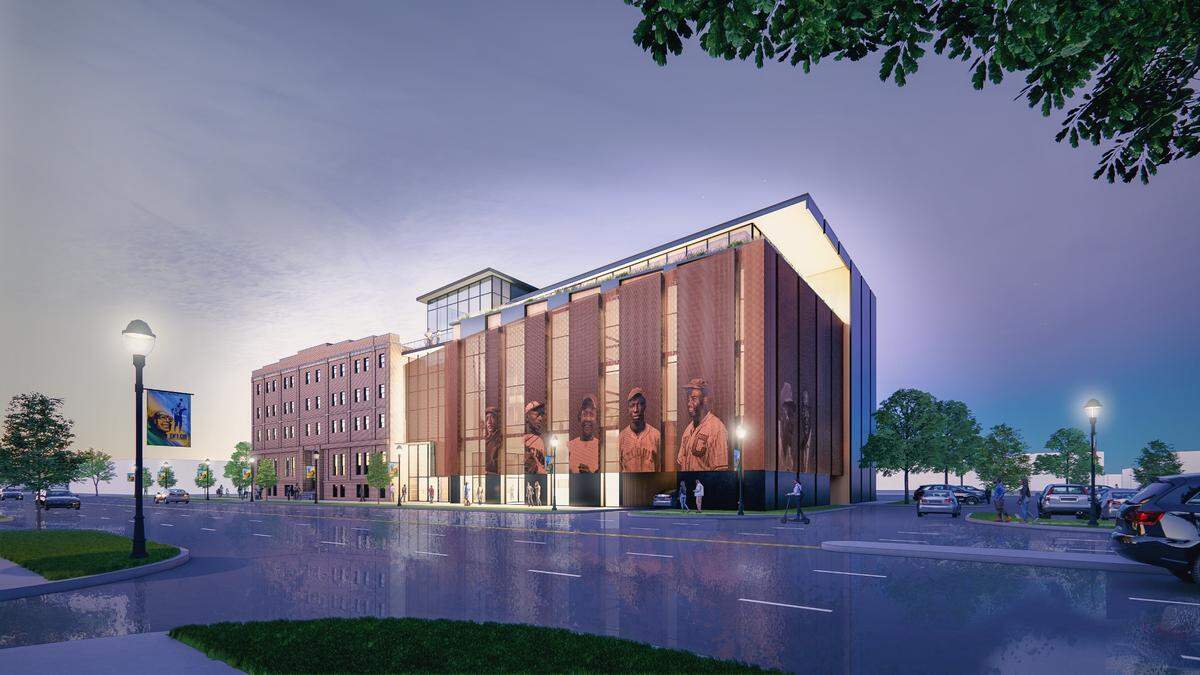
At a news conference with a host of local dignitaries Tuesday morning, the NLBM announced a “Pitch For The Future” campaign to make that growth a reality with an estimated $25 million project to build a new museum adjacent to the O’Neil Center at 18th and the Paseo.
“The vision is essentially build a Negro Leagues campus right there at the corner of 18th and Paseo,” Kendrick said in an interview with The Star, “and as I’m calling it, ‘the gateway into historic 18th and Vine,’ to have this magnificent structure welcoming people into the district. And to have it there where the history was made.”
With a million-dollar contribution, Bank of America was the first to step up to jump-start fundraising for what has become a must-see, world-class cultural pillar of Kansas City that Kendrick believes can become even more dynamic and appealing mere blocks away from its current contained space.
Exterior renderings prepared by Pendulum, a Black-owned architectural firm, depict a rooftop pavilion for special events in a building that Kendrick expects will look particularly “cool when it’s lit up at night.”
It wasn’t immediately clear how much larger than its current 10,000-square foot home the NLBM is seeking in a new building.
But Kendrick is cognizant of preserving such fundamental elements as the Field of Legends while he seeks an overall balance that reflects both tradition and the “cutting-edge way in which the Negro Leagues played the game.”
The Field of Legends is “extremely powerful, and you don’t want to lose that aspect,” he said. “That’s something that people really take to heart when they are making their way around the exhibit to get to the field. …
“So the question is, how do we combine technology and nostalgia and keep that very powerful, romanticized experience? I don’t want it to be overwhelmingly technologically driven because I think then you lose some of the nostalgic nature.”
Kendrick understands this is a daunting task. With a laugh, he thought of the words of Don Motley, one of the NLBM’s founders and longtime executive director:
“‘Son, you’ve got million-dollar ideas and a 10-cent billfold.’”
A more traditional fundraising model, Kendrick noted, would be to have half or more of the money in place before making this announcement.
Then again, nothing the museum has done has been traditional, he said with his endlessly contagious laugh. And he believes the community will embrace the cause.
That’s in part because of the impact it makes on about anyone who goes there. And also because of what by now should be an abiding sense of the stewardship that has enabled the NLBM to thrive — even through the chaos of COVID — and its demonstrable need for growth in all scales of its operations.
As for the inevitable naysayers and skeptics?
The very existence of the NLBM — and the Negro Leagues themselves — defied entrenched conventions, Kendrick reminds.
The now-beloved enterprise, after all, began in a one-room office 33 years ago with no money and against the grain. But it was sustained by heart and soul and faith — the essence of Buck — that it could and should be done in an area that had become largely neglected.
That’s why it’s vital to Kendrick to stay in the neighborhood now even as some have speculated the NLBM could prosper more as part of the downtown ballpark district that the Royals are pursuing.
Maybe, Kendrick said, the museum would entertain such a move if it were “self-serving.” But it’s always been about the greater good, he said. And he considers staying where the history is anchored to be a social and civic responsibility.
That being said, he added, he is hopeful that the NLBM will have a presence in any such ballpark district. By way of example, he said, the story of the Kansas City Monarchs is worthy of an entire museum and perhaps could be incorporated into that project if it comes to pass.
Meanwhile, this project is due now for a lot of reasons, Kendrick said.
Those include not only the narrow and congested spaces of the current version and the need to add staffing, but also the momentum from Buck’s selection to the Hall of Fame and the new visibility that’s emerged from the Negro Leagues’ place in the “MLB The Show 23” video game.
“I’m not sure that the museum’s going to get any hotter” as it is, he said.
In Cooperstown last year, Hall of Fame broadcaster Bob Costas reflected on Buck and the museum itself:
“Square foot for square foot,” he said, “(the NLBM) is about as good as it gets.”
He didn’t say it needed more square footage.
But it does.
Because compelling as it’s been, it can still be so much more.
“We feel that we’ve just scratched the surface of what we are capable of doing with this history,” Kendrick said.
This story was originally published May 2, 2023 at 10:30 AM.