
‘Acrobat without a trapeze’: Pelé’s legacy in Kansas City’s rise to World Cup host
.JPG "Brazil’s Pele leaps and scores past Venezuela goalkeeper Fabrizio Fasano during a 1969 match in Rio de Janeiro, Brazil.")
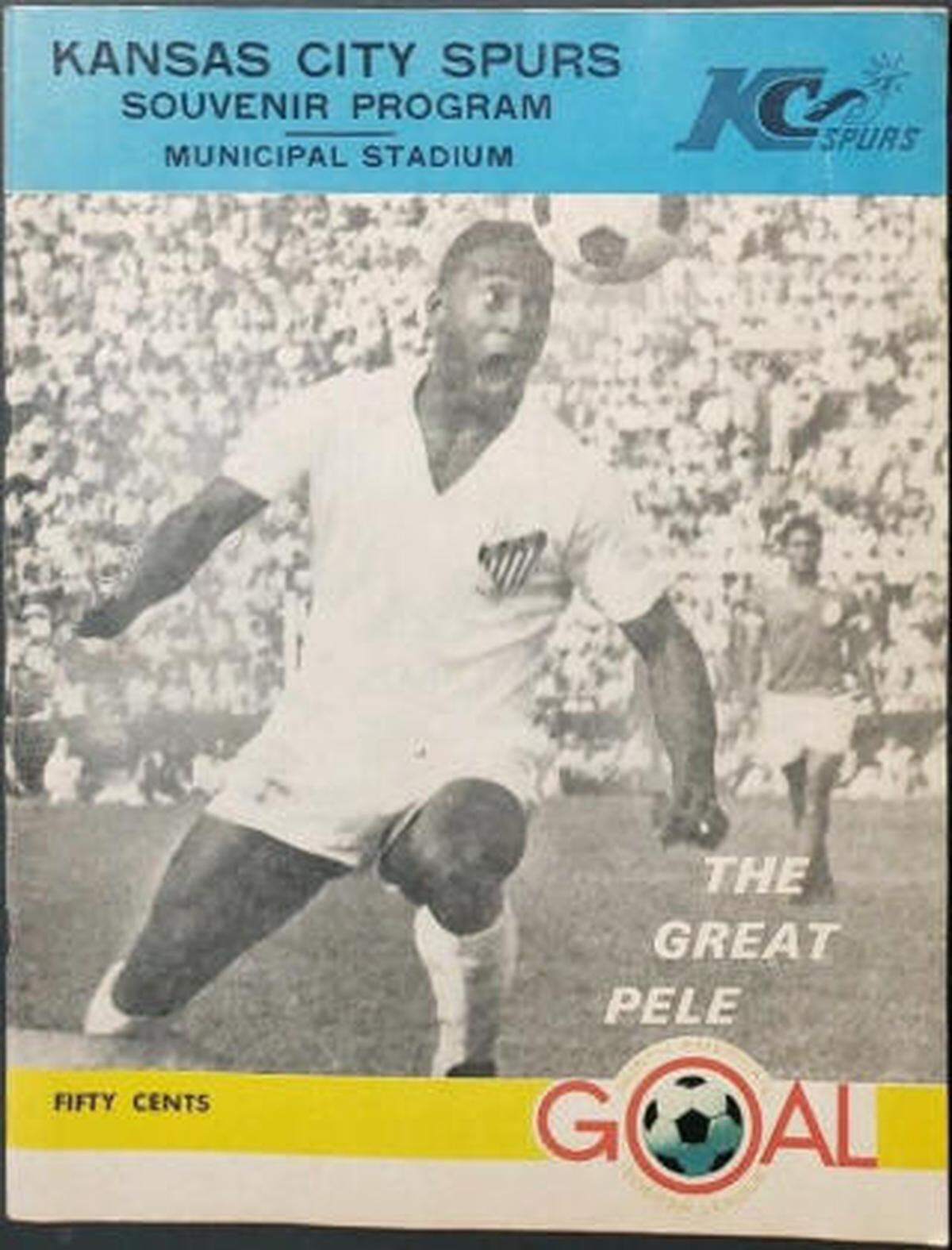
Following five days of what The Star called “intensive negotiations” in June 1968, the Kansas City Spurs of the fledgling North American Soccer League announced they had secured an exhibition match against Santos of Brazil for July 4 at Municipal Stadium.
It was resoundingly worth the effort, then and now, for one reason in particular: the appeal of the world-famous Pelé.
In the weeks to come, The Star would refer to him as “an acrobat without a trapeze” and the “sorcerer of soccer,” a phenomenon with the box-office luster of a certain Fab Four of the era who had played the same venue in 1964.
So much so that the competition itself swooned over him that night.
“When Pelé came onto the field with his team, Spurs players acted like teeny boppers at a Beatles concert,” The Star wrote. “They clustered around Pelé, the king, to rub shoulders with royalty.”
In the days before Pelé mesmerized a crowd of 19,296 fans whose tickets cost from one to five dollars, Spurs president John Latshaw suggested the game would be “one of the most significant things to happen to Kansas City sports.”
Latshaw couldn’t have known how right he was … and how much we’d have our own civic reasons to memorialize Pelé here in the wake of his death last week at age 82.
Not merely because of the moment itself in 1968, though it was indelibly thrilling for anyone who went.
People such as David Matson, who would go on to become the longtime president and CEO of Children’s Place. Before soccer was popular here, he had become fond of the game through his grandfather, an Austrian immigrant who told him seeing Pelé would be like watching Babe Ruth 50 years before.
To this day, Matson remembers how excited he was about what he still considers a once-in-a-lifetime treasure.
Or, for instance, Tom Turner, the former president of the Bishop Sullivan Center who had embraced the game as a child through a retired semi-pro player in his neighborhood who organized a team. He still cherishes being there that night.
‘It all ties in together’
But the significance of the night was much more substantial than the match Santos won 4-1 as Pelé had an assist and scored a goal when, per The Star, he “suddenly, miraculously” drove through a knot of three players to score.
Because the event both illuminated and amplified the burgeoning place of soccer in Kansas City and remains part of the tapestry of its popularity here now.
Thanks in large part to Chiefs founder Lamar Hunt, a fundamental force in how we got here from there and, in fact, to how Pelé came to play in the U.S. later and in Kansas City that night in 1968.
“It all ties in together,” my friend Michael MacCambridge, author of “Lamar Hunt: A Life In Sports,” said by email. “In the late ‘60s, Lamar fought to save the NASL, which allowed it to survive long enough for Pele to join the league in ’75, and convert millions of Americans to the game.
“That, in turn, planted the seeds for soccer to become what it is today, which is one of the five major American team sports. (And maybe not even the fifth one.)”
It’s a bit poetic that Pelé made his 1975 NASL debut for the New York Cosmos against Hunt’s Dallas Tornado team.
Following his postgame interview that night, according to the Irving Daily News, Hunt congratulated Pelé and presented him with a shirt inscribed, “The next Pelé is alive and living in Texas.”
The notion would become just as applicable around the country and right here, where his 1968 appearance still stands as part of the connective tissue of soccer’s emergence and arc:
From a year in which The Star was writing entire stories explaining the simplest rules of the game … to Kansas City last year being named one of the 16 North American cities to be named a 2026 World Cup host.
‘He brought the world to the United States’
More broadly, Pelé became essential to the national popularity of soccer in the U.S. today both through his transcendent career for Santos and by playing for the Cosmos from 1975-77.
“He is the reason why soccer is like it is in America right now; he’s the one who started it all,” said Alan Mayer, goalkeeper coach for the Kansas City Comets. “Nobody else probably could have done it besides Pelé.”
Competing against him in twice the NASL, Mayer witnessed his majesty in multiple ways. He was taken with Pelé’s grace and warmth off the field as much as his unrivaled play and felt it “an absolute honor and privilege to be on the same field with him.”
So when Mayer was with the San Diego Jaws in 1976, he suited up for an exhibition match against the Cosmos despite recently having suffered a torn meniscus that required surgery. That was out of sheer respect for Pele’,who arrived at the center of the pitch via helicopter.
“The place went bananas,” Mayer said.
Despite Mayer’s condition, coach Derek Travis asked him if he wanted to enter the game in the final 20 minutes. He didn’t hesitate. And you can only wish he had video of the moment he described after that, when Pelé had a free kick from about 25 yards out.
“I never even saw the ball; I heard something go by,” said Mayer, who said the ball ricocheted off the crossbar with such force that it went back well over Pelé’s head.
He later added, “The highlight of my career was to play against him.”
That was just part of his infectious influence from the global figure.
(Personal aside: In 1977, my mom was in China and somehow came home with his autograph on the back of a postcard. “Good luck,” he wrote. “Pelé.” And with that he had two more fans.)
“He’s the person who really connected people to the game,” said Brazilian-born Benny Feilhaber, the former Sporting KC midfielder who now is coaching Sporting KC II. “He connected people from different parts of the world and really to some extent introduced the sport to the United States.”
When Feilhaber was playing for the New England Revolution in 2012, Pelé came into the locker room. He’ll never forget speaking briefly with him in Portuguese.
But Pelé also spoke an international language.
“He brought the world to the United States, and he inspired all of us,” said David Ficklin, formerly the director of Kansas City’s World Cup bid and Sporting KC’s vice-president of development. “All of us who were in soccer from my generation were probably in soccer because of Pelé.”
Growing up in the Bay Area, Ficklin saw Pelé play for the San Jose Earthquakes in the mid-1970s and even attended one of his clinics in the Santa Cruz Mountains.
That’s just another snapshot of how Pelé helped grow the sport to what Ficklin calls “a critical mass of people.”
People like Ficklin who came to love the game and thus wanted to share it and grow it.
The groundwork laid by so many and each step along the way — from what FIFA saw here in the 1984 Los Angeles Olympics to the 1994 World Cup being awarded to the United States to the launch of the MLS in 1993 — can tangibly be traced back to the influence of Pelé.
“I hope he was very happy to see that the World Cup was awarded to the United States again,” Ficklin said. “And that he was able to change the course of our sporting culture.”
Lamar Hunt’s fascination
Hunt also changed our sporting culture in many ways, not the least of which was by spearheading the formation of the American Football League, founding the Dallas Texans and changing Kansas City forevermore by moving them here in 1963.
He also was driven to establish the Truman Sports Complex and Arrowhead Stadium, where World Cup matches will be contested in 2026.
But his passions extended all across the spectrum of sports, including from what he witnessed on ABC’s “Wide World of Sports” in 1966 from his home in Dallas.
As described by MacCambridge in his superb biography, Hunt was enthralled by the coverage of the 1966 World Cup final between England and West Germany. Most of all, he was taken with the internationalism of the game.
“Captivated with the excitement and pageantry,” as MacCambridge wrote, Hunt couldn’t “shake his fascination.”
“Over the next several months, he would begin to explore the ways he might transport the game, the atmosphere, and the unique culture of the sport to America,” he continued. “The goal would preoccupy him, to a great extent, for the rest of his life.”
As Hunt’s bio on the Sporting KC website puts it, Hunt “pioneered the sport’s growth in the United States.” That included becoming a founder of MLS and an instrumental force in the World Cup being granted to the U.S. in 1994. Hunt was inducted into the National Soccer Hall of Fame and bestowed its medal of honor.
Part of his legacy was the teams that arose in the NASL such as the Spurs, whose ownership group felt obliged to spend part of its introductory news conference in January 1968 explaining the game.
“It’s an easy game to watch …” Latshaw, the team president, said. “You have 45 minutes of solid action, a short rest, and 45 more minutes of action. There’s no timeout for huddles, etc. It’s strictly a game of action.”
One that was particularly welcome that year in Kansas City: The Athletics baseball team had freshly vacated, and the Royals were still a year away from their inaugural season, making the Spurs a welcome addition to the sports calendar. (The Spurs won the 1969 NASL title but were dissolved after the 1970 season.)
With no day bigger than that July 4.
When Santos and Pelé arrived at Municipal Airport the day before the game, Pelé conducted a 48-minute news conference on site that The Star’s Gib Twyman described thusly from the moment Pelé stepped off the rear of the plane:
“He is engulfed. Up come the cheerleading people, the press people, the greeting people, the autograph people, the airport people. And just people. Forward come the banners, the signs, the pads, pencils, cameras and microphones. Pelé smiles.”
Pelé would be asked through a translator what he thought of Kansas City.
“He says,” the translator offered, “it is a fine town.”
And a town, like thousands of others, where he was part of what became a movement.
“For the large crowd,” The Star wrote, “composed mostly of first-game or first-season soccer fans, the exhibition that followed the opening whistle was testimony to why the game is played in 137 countries and claims the world’s largest sporting audience.”
And some testimony, as it happens, to why we’re part of that now as never before.