
Read Kansas City Star columnist Vahe Gregorian’s beautiful eulogy to his father, Vartan
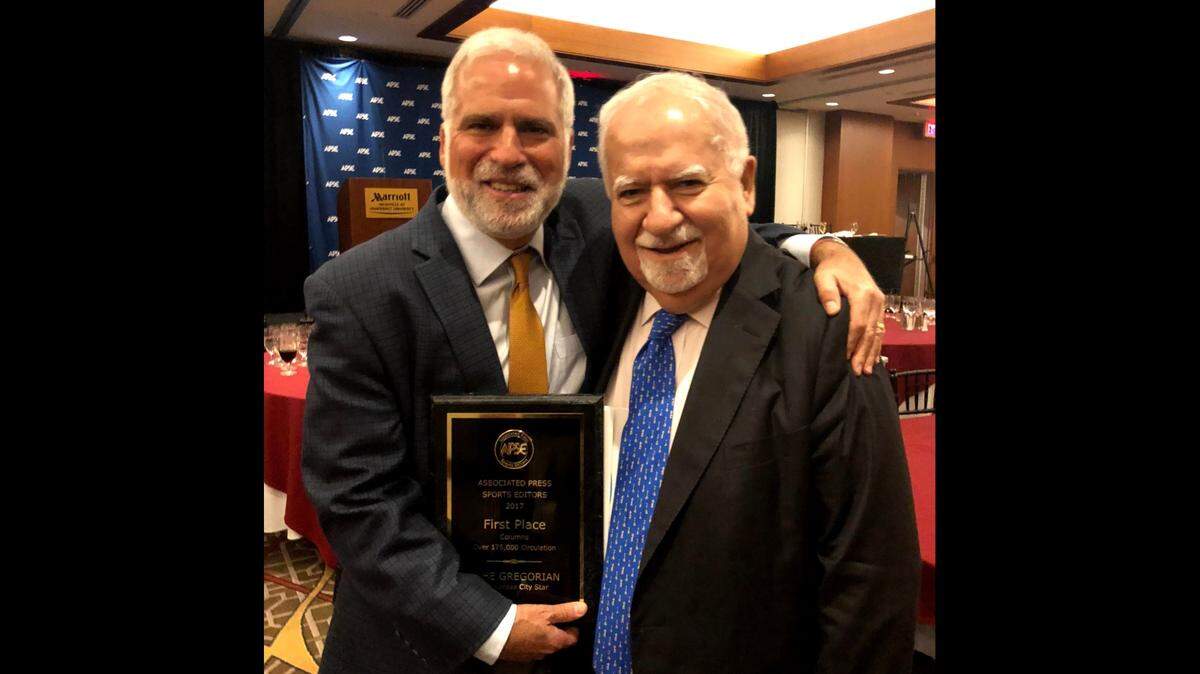
Thanks to all who have mourned and celebrated my father, Vartan Gregorian, who recently passed at age 87, with us through these hard days. You have uplifted us in so many ways with every kind gesture and warm thought.
We had a beautiful family funeral for him (Thursday) at St. Vartan Armenian Church in New York. I swear the choir sounded like angels. Because of the pandemic, we were compelled to limit the attendance.
But my brothers (Raffi Gregorian and Dareh Gregorian) and I want to post what I said about him (with their gracious input) in hopes of sharing him as we see him and know him:
On behalf of my brothers Raffi and Dareh, and with gratitude to St. Vartan Armenian Cathedral, we welcome you. A friend taught me that it is an honor to grieve with loved ones, and so we thank you all for being here today and we so appreciate all of those who are with us in spirit.
We all know my father to have been a vivacious man of letters, enlivened by the seven languages he spoke. That blend made for an endless catalog of sayings, some expressed with more clarity than others in English.
Eagles don’t eat worms, he liked to tell us. And just because a donkey is carrying gold doesn’t mean it’s a golden donkey. ... Do not have a hole in your eye, because envy is bottomless. ... Virtue is its own reward. ... When the caravan passes, dogs bark.
Each aphorism had deep meaning to him, even if we weren’t always sure just what his way of saying it meant, and that makes us smile today as we think of him.
But the words of his that most resonate now are ones we often heard in his speeches and interviews, such as the way he put it in 1985 when speaking with Ken Burns:
“We have to remember that the universe is not going to be seeing somebody like you again, in its entire history of creation. So it’s up to you to become a dot, a paragraph, a page, blank page, chapter in the history of creation.”
Quite unfathomably, his place in the history of creation came to be that of a beacon and a wonder of the world … if not among the stars themselves.
Told of my father’s death, one former colleague of his wrote that it struck him as a “category error, as if someone had told me that the Great Pyramid had died.” My dear Aunt Trudy said he was “not supposed to do that. Ever. He was for all of us part of the sun that shines.”
Quite fittingly, the many-splendored chapters of his life and enduring legacy, brimming with wisdom and warmth and exclamation points and adorned with dropped articles, will forever be entwined with the vast repository of the New York Public Library.
It’s also so telling that this illuminator, in the spirit of St. Gregory himself, spent nearly the last quarter century in voracious service to the Carnegie Corporation in its mission to “promote democracy, education, and peace across the globe.”
It was a labor of love that sprang from his soul. That work was so essential to him that it helped sustain him through the death three years ago of our mother, Clare, a unique marvel herself with whom he shared in an irresistible love story.
A “one-man swarm,” she called him, and sometimes I wish that had been the title of his autobiography. He thought about calling it “The Kindness of Strangers,” which would have been apt in its own way both for how it spoke to his own sense of fortune and how he treated so many.
Instead, he called it “The Road To Home.”
And how right that seems today as we consider not just the circle of his life but its meaning and infinite inspiration.
He was so many different things to an incalculable number of people, a philanthropist and philosopher and teacher and mentor to a galaxy of influential friends. He was a brother and an uncle and a father-in-law and a grandfather.
And, of course, a father, who tried to meet his three sons where they live … strange as that might have been for him at times. So he’d invite Raffi’s Highlander band to play in the provost’s office at Penn. Or go to a comic book convention with Dareh. And to a Bruce Springsteen show with us, where he sang out the only words he knew: “Born In The USA,” of all things. In the last few years, he even made it a point to watch Kansas City Chiefs football games and offer a colorful critique afterward.
In certain ways, you might even call him a healer.
When New York and the world wept in the wake of Sept. 11, 2001, for one of many instances, he served as chairman of the World Trade Center Memorial jury.
And he was a visionary. Again, one example: When Richard Stengel became CEO of the National Constitution Center, my father advised him to host immigration ceremonies at the Constitution Center.
As Stengel wrote for Time, he took his advice and found it magical to see so many families in their national dress crying for joy. He made it a regular event.
My father understood the meaning of that. His life embodied both the American dream and the immigrant’s essential role in it, standing as a profound reminder in these times of how those go hand-in-hand.
Like a modern Colossus, he bestrode both worlds … and yet somehow stood comfortably among all.
Indeed, the same man Stengel suggested “may have had more awards and honors than any living American” is much more importantly defined by the Armenian concept of “nekaragir”
My father once described nekaragir as “the embodiment of one’s own uniqueness as an individual: It embraces one’s dignity, honor and independence and one’s commitment to … moral and social values that forge ties among individuals, families, ancestors, generations and society and affirm our common humanity on the one hand and our uniqueness on the other.”
Even as he spent his life affirming the humanity of many around the globe, he was foremost a vital representation of being Armenian. He once said that to be Armenian is to be part of the Book of Job, “always being tested, always suffering, never giving up, part of it a defiance, part of it perseverance, part of it is fate, part of it is hope, part of it just struggling to be and become.”
As we stand here today in the comforting arms of St. Vartan Armenian Cathedral, we are reminded how his epic journey to be and become began decades ago in Tabriz with his ever-loving sister, Ojik, who along with her husband Varoujan graces us with her presence today and touches us with her unyielding love and support of her brother.
Amid harsh circumstances, the choir boy at St. Sarkis Church was recruited to work in the affiliated library. Books became his instruments of liberation, what he has called “a kind of helicopter that took me out of the village, gave me a new life, new perspective.”
Who knew the ride would take him to Beirut and Palo Alto and Afghanistan, from San Francisco State to the University of Texas to the University of Pennsylvania and the library and Brown University and Carnegie? And that he would make a meaningful difference to so many people around the world?
All despite an inauspicious beginning, even when he arrived in Beirut. Because of a miscommunication, when he left home as a teenager to continue his education there, well, his arrival hadn’t been as heralded as he’d anticipated.
The principal asked him, “What are you doing here?”
“I don’t know,” he replied. “I was sent here.”
And so he was, wasn’t he?
Not merely to become a man of renown but a man of consequence and a philanthropist in the purest sense of the term: the love of humanity, as it was derived from ancient Greek.
If he were standing here today, we’d surely hear him use another of his favorite terms and try to assure us that “this, too, shall pass.”
And while we know nothing like him will pass our way again, we also rest assured that he will live on. Not simply through his astounding achievements and words but the nekaragir that animates the canvas of his special place in history.
This story was originally published April 25, 2021 at 10:37 AM.