
Mellinger Minutes: Alex Smith’s KC legacy, Royals momentum, Britt Reid and more
The first time I met Alex Smith we sat in a crowded restaurant on the Plaza for two hours and exactly one person noticed. Well, one person came over to the table. It was a school-aged boy who just wanted to say hello and good luck. Smith thanked the boy.
Maybe others wanted to do the same but didn’t. Famous people in Kansas City often talk publicly of how “respectful” people here are at restaurants, that they’re given space. I’ve always wondered if that’s code for, “Please. if you see me out, let me eat dinner in peace,” but either way, only one person tangibly acknowledged that the man eating the burnt ends with the sportswriter and the PR guy was the quarterback upon which so much depended.
To tell you the truth, I didn’t know much about Alex before he came to Kansas City. I remembered he quarterbacked the undefeated Utah team that Urban Meyer turned into the Florida job, then went No. 1 overall in the draft better remembered for Aaron Rodgers’ awkward wait and then … not much.
He stunk and was injured in San Francisco before Jim Harbaugh came, then made it to the NFC Championship Game when the White Sox GM’s son dropped those punts. He was the guy who was benched by a concussion and Colin Kaepernick.
That is the entirety of what I knew about Smith — that and that new Chiefs coach Andy Reid had staked an outsized portion of his success in Kansas City on a quarterback who’d never thrown for more than 18 touchdowns in a season.
Then I started to learn more. That he was drafted before his 21st birthday, wholly unprepared for the 49ers’ organizational and coaching dysfunction that awaited him. Seven coordinators and systems in seven seasons.
The time he tried to play through a shoulder injury that caused him so much pain he had to sleep sitting up, while his toughness was publicly questioned by his coach, and the rehab from the eventual surgery made longer and more difficult because the doctor left a wire in the shoulder.
I learned more about him personally, too. That he was such an unassuming football player as a kid that his dad tried to talk him into quitting for cross country when he was 14. That he had just two scholarship offers out of high school, and is self-deprecating enough to say, “One of those was from my uncle, so I’m not sure if that counts.”
I learned that he carried guilt and anger and depression from his best friend’s suicide. That he earned an economics degree in 2 1/2 years, and built a foundation helping foster kids that became so successful and efficient it’s used as a model for others.
I learned enough to believe Smith might have more than he’d been allowed to show. That he’d be rejuvenated by a place that believed in him, and by a steady coach with a brilliant offensive mind and the willingness to bend to players’ strengths.
I started to believe that these three parties that had each experienced varying levels of failure and tragedy — the Chiefs, Reid, and Smith — might be able to help get the best out of each other.
Alex Smith announced his retirement on Monday. He will be remembered in different ways and in different places; 16 years can’t be fairly shorthanded. Nationally, he will be best remembered for the gruesome injury that nearly led to a leg being amputated, and then the recovery that ended with him leading a playoff push.
In Kansas City, we will remember him for more. He wasn’t always loved by fans here. Few athletes have had their local legacy enhanced more by leaving than Smith’s in Kansas City. He was a model professional when the Chiefs drafted his younger and more talented replacement, and even if Smith’s part in Patrick Mahomes’ development has been exaggerated — we know enough to know Mahomes would be good even if Smith went all Ben Roethlisberger on him — the process says so much about who Smith is as a man.
The Chiefs were a verified mess when Smith arrived. They’d gone 2-14 the season before, which included Jovan Belcher’s murder-suicide. The head coach and general manager had been fired. Fans were angry, with well-earned skepticism.
The Chiefs won their first nine games with Smith — they’d won nine total the previous two seasons combined — and made the playoffs. Two years later, they won their first playoff game in 22 years. They made the playoffs four times in Smith’s five years after four postseasons in the previous 16.
The success wasn’t all Smith’s, of course. The defense finished fifth, second, third and seventh in points allowed his first four seasons. He had Jamaal Charles his first two years, and Travis Kelce and Tyreek Hill at the end. Reid consistently put Smith in good situations.
But Smith had more than his share. His ball protection served the Chiefs well, and by the end Reid helped Smith expand his comfort zone. Smith and the Chiefs had good times together. The comeback against the Chargers. The 11 straight wins after hitting bottom in Minneapolis. Two division championships.
With Smith in Kansas City, the Chiefs won more games than every team in the NFL except the Patriots and Seahawks. He celebrated in that locker room a lot.
The end had to come. The Chiefs had outgrown Smith and, really, in some ways the NFL outgrew him. The Chiefs wanted to win Super Bowls, not just divisions, and the modern NFL requires a level of creativity, spontaneity, and dynamism that Smith lacked.
Smith is a good quarterback; championships require great. Smith left the Chiefs much better than he found them, and he helped grow a culture that allowed them to be better after he left.
In that way, he is among the more consequential players in Chiefs history. That’s easy to miss because the man who replaced him turns out to be one of the more consequential players in football history.
Smith accomplished something different in the NFL. He won just two playoff games, and never made it to a Super Bowl. He threw for 4,000 yards once, and never for more than 26 touchdowns.
But there is not a man who shared a quarterback room or a huddle with him who wouldn’t call Smith one of their most respected teammates. His comeback from that leg injury is legendary. The league should rename the Comeback Player of the Year award in his honor. He built the level of relationships that mean he can do anything he wants in football now, but is so smart and driven that he can do anything he wants outside of football, too.
Smith was a lifelong West Coaster who made a real home in Kansas City. He’ll come back here, too, because at some point the Chiefs will invite him to join their Ring of Honor. When that happens some in the stadium will have only vague memories of the Chiefs before Mahomes.
But the ones who remember will cheer Smith. They’ll cheer him as loudly as they cheer anything else that day.
This week’s eating recommendation is the Lulu’s rolls at (umm) Lulu’s, and the reading recommendation is the Trevor Lawrence piece by Mike Rosenberg. You’ve probably already seen one of Lawrence’s quotes pulled and dissected, but I’m linking the story here in hopes you’ll read the whole story if you haven’t already. I think if you do you’ll agree the national debate about what he said was manufactured, misguided, or perhaps both.
Thanks to everyone who’s listened to our Mellinger Minutes For Your Ears podcast, and here is a big warm invitation to start if you haven’t already. We’re out from behind the paywall and free on Apple or Spotify or Stitcher or wherever you get your shows.
Reminder: If you’d like to participate in the show — and I’d love for you to do that — please call 816-234-4365 and leave your first name, where you’re calling from, and almost literally any question.
Please give me a follow on Twitter and Facebook and, as always, thanks for your help and thanks for reading.
Before the season, I told you I believed this could be a good baseball team.
Another week or two of this — and I’m particularly interested in this series against the Rays, and then a 10-game stretch against the Twins, Cleveland and White Sox that starts a week from Friday — and I think we can believe this is a good baseball team.
The skepticism is natural. It’s earned. The Royals have broken hearts more often than they’ve beat the Mets in 5, and a 162-game season has a way of requiring authenticity.
The 2003 Royals were a mirage, and they ended up exposed. The 2010 Chiefs were a mirage, and they ended up in the playoffs.
This is not the 2003 Royals. I’m comfortable saying that. If you look at it, the Royals have more guys underperforming than over. Looksee:
Overperforming: Danny Duffy, 0.50 ERA.
Underperforming: Andrew Benintendi, Jorge Soler, Hunter Dozier, Adalberto Mondesi, Brad Keller, Mike Minor.
If you want, you can add Nicky Lopez to the over performing list and it’s still imbalanced. Sal Perez isn’t going to OPS .944 the entire season, but nobody is surprised he’s playing like one of the sport’s best catchers.
Now, the inconvenient truth is that the Royals will have to be better than they’ve been to maintain the record they have.
Their season run differential is even, which history would indicate is more of a .500 team than a first-place team.
It’s reasonable to expect the Royals’ record to be better than their run differential. The way they can pressure defenses on the bases — you’re seeing them be much more aggressive with stolen base attempts recently, for example — and particularly with the bullpen makes for the type of team that should do better in one-run games than blowouts.
One worry I’d have going forward is whether they can generate enough consistent offense. The Royals have won five games scoring four or fewer runs, which is tied for the most in the American League and second only to the Giants in baseball.
The other worry is whether the bullpen burns out. They had 52 relief appearances through their first 14 games, and I understand they’ve had some extra off days but there is the potential to over stress some guys, and here I’m thinking particularly about Kyle Zimmer, Josh Staumont and Greg Holland.
Football love to talk about complementary football, which is the offense turning a turnover into points or special teams picking up the defense or whatever. Well, keep an eye on how well the Royals can play complementary baseball — the offense scores enough that the bottom of the bullpen’s depth chart can protect a lead, or a starter goes 7 or 8 innings so a reliever or two can have the night off.
It’s too early to know that, and in the end the answer will be retrofitted for the result — they won so it must be because they pulled for each other, or they faded so that extra dimension must’ve been missing.
But I do think all the pieces are there. Whit Merrifield and Salvador Perez are the two best players, and each well-regarded and respected. Danny Duffy is as good of a teammate as there is.
It’s a nice mix of unselfish veterans and younger players who appear both hungry to establish careers and humble enough to work for it.
But if you look at it in the macro, it’s all there. The manager is inclusive and prioritizes communication. The front office has a well-earned reputation for making sure players feel supported. The most influential voices in the clubhouse are conscientious and respected.
You implied this in the question, but it’s impossible to separate this stuff completely. The better the team plays, the better the vibes will be in the clubhouse.
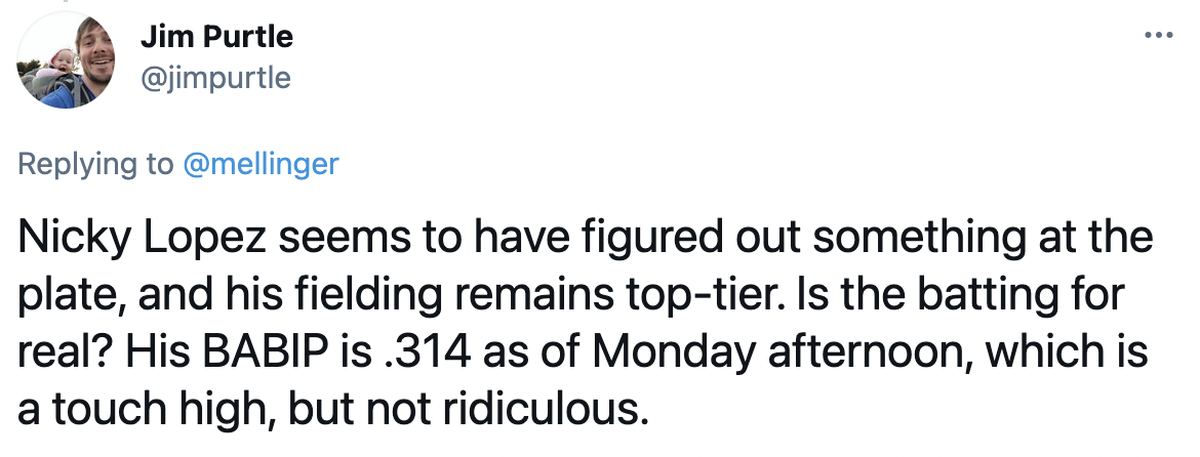
More than the BABIP, to me the better shorthand judgment with Lopez is going to be his strikeout rate.
He’s talked about this a few times, but he really got outside of himself last year. He tried to pull the ball more, get the ball in the air, and it was basically a disaster. His on-base percentage stayed below .300 with no benefit on his power. His strikeout ballooned to 21.4 percent.
He talked about this extensively before opening day, but he did it in code. He talked about “getting back to who Nicky Lopez is,” and the goofy first-person references aside, he was essentially talking about making contact and being a tougher out.
This is early, but he’s cut that strikeout rate down to 11.1 percentage — less than half the league average, and an AB/K rate in the top 20 in baseball.
Lopez is gifted with hand-eye coordination, and really strong as a situational hitter. He’ll benefit from hitting toward the bottom of the order, and is good enough defensively and with his legs to be a so-called “winning player” with on-base percentage around .330 even if he hits with no power.
You’d like him to take a few more walks, but his isn’t the type of hitting profile that pitchers are going work around.
So, to answer your question: yes, I believe there’s a good chance we’ll see a better version of Lopez going forward, as long as we all understand that better version is still probably a better fit lower in the order.
You know what, in some ways, maybe he’s sort of what the Royals hoped Omar Infante would be — not as much upside offensively, but better defensively. A guy you can win with, but not win because of.
This is absolutely one of them good problems, but I can’t believe the Royals will treat Mondesi any differently based on Lopez’s play or the team’s record.
Part of that is because I can’t believe the Royals weren’t going to be deliberate with him anyway. He’s too talented, there’s too much season left, and his injury history is concerning enough to make triple-sure he’s fully healed before putting him into the 162-game grind.
Mondesi is back on the field doing baseball-ish things, which is positive, but Dayton Moore saying Mondesi will stay in Kansas City for the start of the upcoming nine-game road trip is telling.
I know what happens when we mention Mondesi here, and I get it. Trust me, guys. I do.
But his return will be important for this team, and add some dynamism to how the Royals perform.
Just for the sake of this paragraph, lets lop off the ceiling to his bat. Let’s assume that at 25 he’s done getting better and is nothing more than the .265/.296/.444 hitter we’ve seen the last three seasons. That’s still a dang good player when he plays defense like Mondesi, and would you believe that even with all the injuries he’s stolen 11 more bases than anyone else in baseball the last three seasons?
I disagree with the Royals on some of the micro in how they’ve handled Mondesi. I believe he’s been given opportunities before they’re earned, including the presumed plan to bat him third.
But it’s all there with him. The Royals will be a better team when he returns, and you didn’t ask me about this specifically but this is how I’d line them up when Mondesi is healthy:
Merrifield, RF
Santana, 1B
Perez, C
Soler, DH
Benintendi, LF
Dozier, 3B
Taylor, CF
Lopez, 2B
Mondesi, SS
In this scenario, Isbel goes to the alternate site. I’m probably overthinking Mondesi, but I’d put him ninth based on the hope that it would clear his mind and the strategy that having Merrifield and Santana directly behind him would mean he’d see more strikes.
This is a small thing, and I get why the Royals have been hitting Benintendi second, but I like the idea of a pitcher having to grind through long plate appearances back-to-back with Merrifield and Santana.
You probably know that my default setting is to heed the small sample size warnings, but I’m willing to be vulnerable with Junis.
He’s not throwing the cutter a ton, but it’s a pitch you can throw to lefties and righties and appears to be helping his four-seamer and slider. It’s given him another weapon, and some margin to ditch ineffective pitches — he’s throwing fewer sinkers and changeups, for instance, according to FanGraphs.
Individual pitch tracking can be unreliable, but the point is he’s added a pitch and he looks like a new pitcher.
The other thing that offers faith is that Junis is the kind of worker and athlete you believe can make a transition like this. He’s always handled the volatility of big league pitching well — rarely discouraged, steadily focused, that kind of thing.
And he’s a top-shelf athlete — he slid in the draft and commanded an outsized bonus for the 29th round because he was a Division I basketball recruit.
All that stuff guarantees precisely nothing, and Junis is 28 years old, so his career needs to get going. But these are traits you can believe in, and project on.
Salvador Perez is hitting .322/.349/.629 since the start of last season. That covers 51 games.
Before that, he was a .266/.297/.442 hitter. That covered 942 games.
He would have to be more of what he is now, and less of what he was before Tommy John surgery, and you don’t see a lot of guys improve that much after they turn 30.
Now, catchers are viewed a little differently. Defense is more important there than other spots, and team accomplishments are well regarded. Perez obviously gains some traction there.
Yadier Molina is the obvious comparison. Perez will turn 31 next month. Let’s do the surface look here:
Perez — 993 games, .269/.300/.452, 101 OPS+, 157 HR, 192 2B, 1,008 hits, 6 All-Star games, 5 Gold Gloves, 3 Silver Sluggers, 1 World Series championship.
Molina through his age-31 season — 1,328 games, .284/.339/.402, 99 OPS+, 96 HR, 247 2B, 1,297 hits, 6 Gold Gloves, 1 Silver Slugger, 2 Top-4 MVP finishes, 2 World Series championships.
So, Perez is a bit behind Molina’s pace, but not prohibitively so. To be honest, I was mildly surprised that Perez’s offense compared that well — I would’ve thought the extra power would be wiped out by the lack of on-base.
Molina has performed well into his 30s. A slightly lower OBP has been made up by a little more power to keep his adjusted OPS (97) virtually identical.
The hardest part of Perez’s Hall of Fame push comes now. Much of this is the need to stay behind the plate. As soon as he becomes a first baseman or DH he loses a lot of his value, and many scouts have long expected that shift to come as Perez approaches his mid-30s.
He’ll also need to maintain productivity. We used Molina as the comparison here, but Joe Mauer is something of a warning. Mauer was also big — 6-foot-5 — and essentially done as a lineup when he moved from catcher after his age-30 season.
Mauer will still have an interesting Hall of Fame debate, but that’s because he has accomplishments that neither Perez or Molina can match — three batting titles, including the so-called modern Triple Crown in his 2009 MVP season.
Perez’s path will have to include staying behind the plate at least through the end of his new contract extension and maintaining offensive production. Being the face of the Royals’ next playoff push would be a nice help, too.
If you’re asking me today, I’m going to tell you that’s all too much to expect.
But it’s not out of the question.
I should say here that I haven’t been to a game as a fan yet. I’ve looked, but either the dates didn’t work or the seat quality/price balance has been out of my comfort zone.
But I have taken stadium laps every time I’ve been out, and have spent more time than usual looking around the stands.
My sense is that things are … fine?
The usable seats are distanced, regular reminders about masks are given … I’m not sure what else the team is supposed to do. The Little K, outfield experience, and Royals Hall of Fame are all closed.
The line between Abundance Of Caution™ and Covid Theater is in the eye of the beholder, but I’m not sure how useful the designated parking sections are.
Anyway, I’ve heard some complaints from fans, and to be sure the mask discipline is less than 100 percent.
But — at the risk of stepping in it and starting a big thing here — I also think people are outside and unless a concession stand line grows and sticks the chances of finding yourself next to a stranger for more than a moment are pretty low.
This is the easiest it’ll be, because the Royals hope to increase capacity as the summer goes on. More and more fans coming to the ballpark will be vaccinated.
I guess the place I land is here: if you are unvaccinated and (understandably) anxious about Covid, then there’s probably not a lot that is going to convince you to spend a lot of money to be in a big crowd again.
But if you’re wanting to get closer to normal, there’s enough here that you’ll probably feel fine (or better!) at a ballgame again.
I’m curious how long into the summer we keep The Streak of talking about this!
The situation is outrageous, and every day I think of something new to be frustrated about. At the moment, it’s that MLB got ahead of everyone in building his beautiful streaming platform and instead of using it to create more fans and hook existing fans even harder, the commissioner’s office has allowed it to become a bit of a punching bag.
It’s like they bought a Lamborghini, and instead of driving it let it rust, to the point that a neighbor kid graffiti’d NICE LEMON IDIOT on the hood.
The graffiti has not been cleaned.
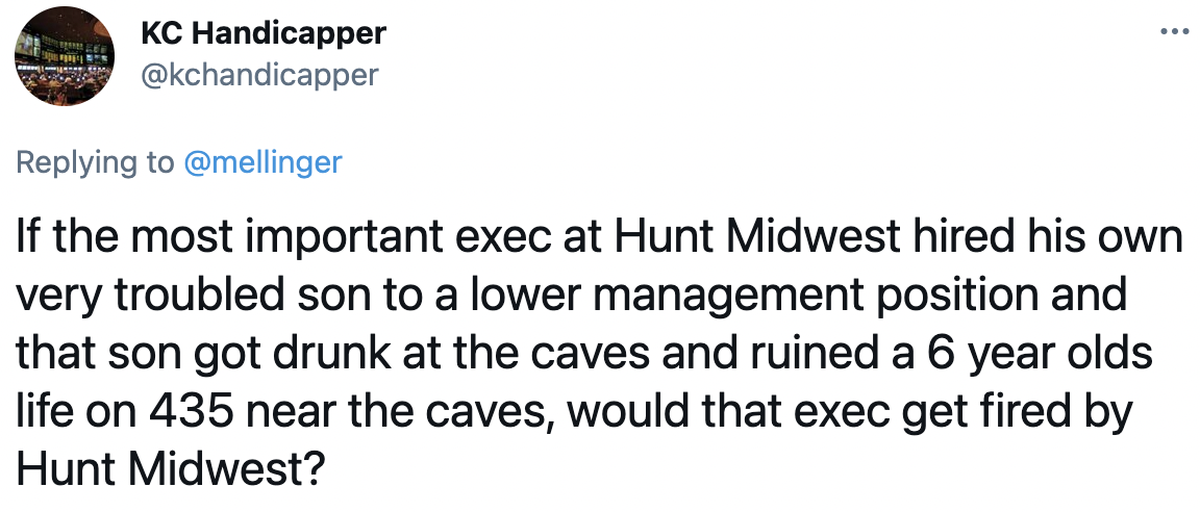
There is no happy ending to this story, but I’d make at least a few points here…
- The Chiefs, I’m told, have been cooperating fully including turning over anything police have asked for.
- We know that Britt Reid made a tragic error, and one for which he is being and should be aggressively prosecuted.
- There are enough things we don’t know publicly that definitive statements on much else are useless.
- The information is bound to come out, and when it does the Chiefs could look worse than you can currently imagine.
- It could also be found that Reid — like many with drinking problems, and many who suffer from substance abuse disorder — was really good at hiding his struggles.
- Speaking of substance abuse disorder, a lot of people are showing a massive misunderstanding and (just being real here) refusal to learn about what’s involved.
- Britt is a 35-year-old grown adult. Without knowing more than we know publicly at the moment, I’m not sure how logical it is to blame a 35-year-old grown adult’s problems on his parents and/or employer.
This is neither a condemnation or absolving of Andy Reid or the Chiefs. This is a plea for some sense, to resist this nonsensical desire to be first with some grand declaration based on hypotheticals.
At the moment, I care only about two parts of this story. The first is the 5-year-old girl, and the second is that the Chiefs are fully transparent with law enforcement.
That’s it. That’s what matters right now, not any demands that by definition cannot be made on facts.
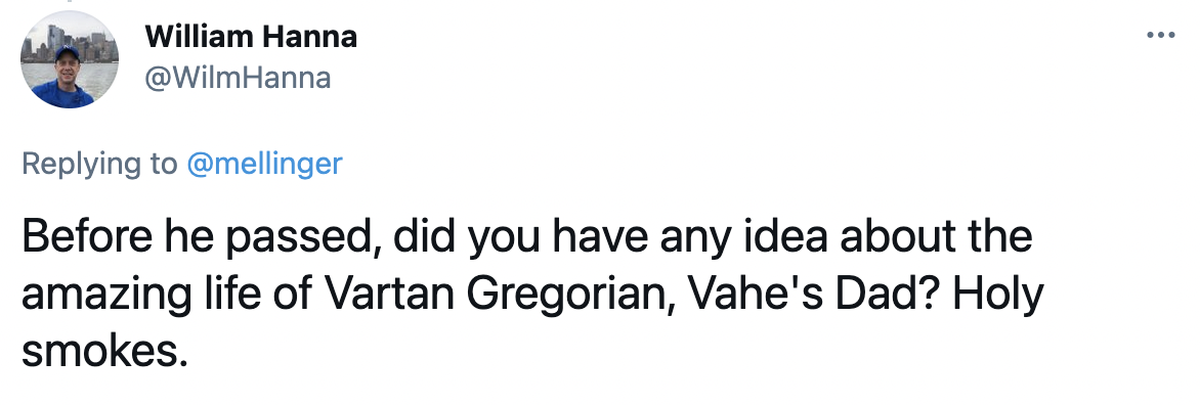
I did, yes.
Vahe is one of my dearest friends, and I am lucky to be able to say that. We met for the first time many years ago; I couldn’t have been more than a few years out of college, and reached out because I loved his work and wanted to know how he did it. I was genuinely blown away by his generosity — not just with how much time he took for me (a stranger at that point) but also how sincere he was in sharing his wisdom.
I bring that up to emphasize that impression he made on me. One conversation and I knew this man was different. Special. Many years later, when I got to know him more personally the impression was only confirmed.
His brothers are also well accomplished, and the more stories I heard of Vahe’s parents — he brings them up often, which I think is telling — the more I knew he came from special stock.
So I started to read up on Vartan, and I’m glad I waited to do that after I knew Vahe better because if I hadn’t I honestly might’ve been a little intimidated.
Just for a moment, forget the professional accomplishments. If Vartan was the least impressive professional in the history of America there would still be a long line of people telling you what a good man and strong friend he was.
Then, I mean, if you haven’t you really should read about what this man did with his life. As a friend put it, the man was president of an Ivy League university and it’s like the fifth-most noteworthy thing he did.
I guess what I’m telling you is that if you know Vahe, you would already know he came from extraordinary people.
All the same, you’re right, it’s jaw-dropping to read.
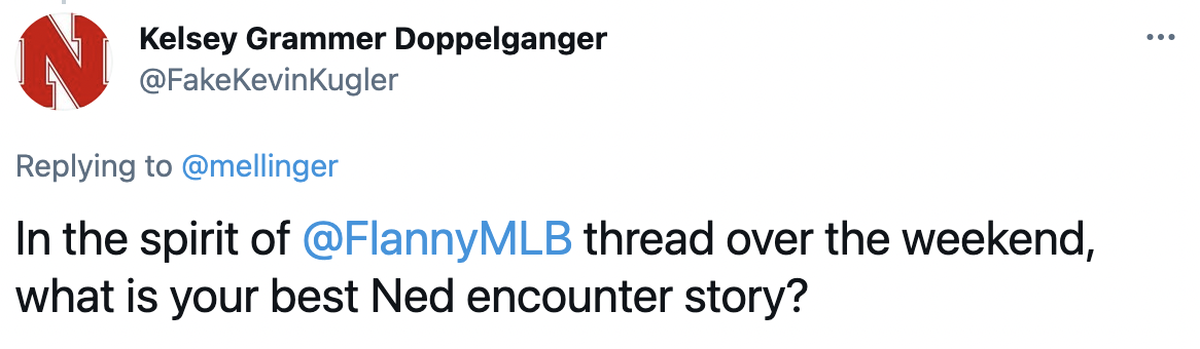
I basically invited myself to his farm once and, you know what, that’s a little dishonest so let’s try that again:
I 100 percent invited myself to his farm once.
This was in the offseason after the 2016 season. I was going to be in Atlanta for a Chiefs game — it turned out to be The Eric Berry Game — so I thought it’d be cool to go in a day or two early and see my favorite curmudgeon.
Flanny went through a lot of this, but Ned really changed after the 2014 Wild Card Game. He would never admit this — not even now — but he had some insecurities before that night. I don’t say that as an insult. The insecurity was a net-plus in his job performance. A lot of high-achievers are driven by a fear of failure, and I’ve always believed that Ned had a version of that.
Anyway, I thought it was a really interesting time for Ned. He’d loosened up after the team success in 2014 and 2015, which meant he was more likely to be open and engaging. He’d also done everything he could expect as a manager, and was building his dream house on his dream property — a strong acknowledgement that another part of his life awaited, if nothing else.
I’m telling you, it was a blast. He insisted on picking me up at a Starbucks near Atlanta. I told him that was unnecessary, that he could just give me the address and I’d plug it in. He told me that was useless, that his house was so remote there was no real address to plug, and after the hour-or-so drive in his truck I understood why.
It’s a gorgeous piece of the world, and Ned works hard to keep it that way. He has a small lake he keeps stocked, deer that he tracks, and all the country boy toys he could want — guns, tractors, trucks, everything.
I got the sense that Ned was amused at having me out of our mutual comfort zone (the ballpark) and fully into his. He never asked, but I’m quite sure he knew I don’t hunt, and that he’d be fully unsurprised to know I intentionally bought a house much closer to downtown than a farm.
All of this is context to the moment: we’re driving across his property when he cusses out loud and slams on the brakes. It’s another armadillo. Ned hates armadillos. HATES them. Ned is a conservationist by nature — don’t get him started on bees — but makes an exception for armadillos.
They dig his grass and mess with the corn and generally give him nothing but grief, which Ned wouldn’t care so much about except they also do diddly-poo in the way of attracting deer. So, Ned is something of an armadillo executioner. That’s why he slammed on the brakes and opened the console of his truck and cursed again.
“This is his lucky day,” Ned said. “I took my gun out of the truck to go to the airport the other day.”
I laughed, but a few seconds later he got that smirk on his face.
“You know,” he said. “I’m really pissed because I would have loved to have seen the look on your face when I shot that bastard.”
That’s the Ned I’ll always remember.
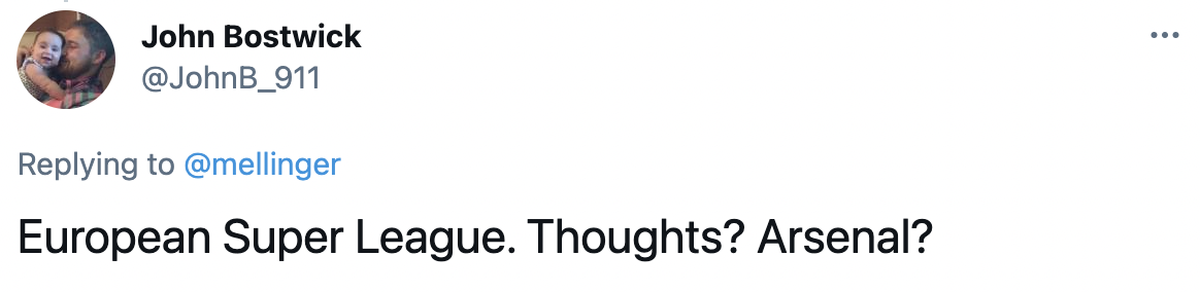
Well, I hate it. And as for Arsenal’s place, I mean, I feel like they’re about to be KU football. They’ve got no shot against most of these clubs.
But let’s step back a bit. Away from Arsenal. And look more about what this is. This is a giant leap away from what sports are supposed to be about, and a giant leap toward a chosen and select few walling themselves off from competition and the growth of the world’s most popular sport.
Rich teams have always had an advantage, but it’s never been baked in like this. The super league is a rejection of the competition between different countries and cultures.
As far as I can tell, this is motivated by already wealthy clubs taking the easy way out and selling their debt, and what is less attractive to a sports fan than that? The sport is moving away from competition as we all know it and toward becoming mere entertainment — less a competition we watch on TV, and more a reality TV show carefully scheduled and manicured.
My guess is they might get a short-term bump, because who is against seeing Liverpool play Real Madrid?
But that effect will wear off, and when you put the gates down to keep out the vast majority of clubs, you’re also putting the gates down to keep out millions of fans.
The potential consequences are awful. If FIFA doesn’t budge — and I assume it will, because FIFA is always open for business — then the World Cup loses its shine.
So, I hate it, but as much as I hate it for purely soccer reasons I also hate it because I wonder if it’s a model that could be copied by college football.
The analogy isn’t perfect, of course, but there are some similarities, perhaps most notably a few select programs at the top of the food chain that enjoy making money and would like to continue making money.
What’s to stop the top 20 or 30 college football programs — Alabama and Ohio State at the top, maybe Utah and Oklahoma State at the bottom — from breaking away and forming what would basically be a professional league model for colleges?
I’m not going to weep for anything that would be inconvenient or destructive for the NCAA, but at that point you’re shutting off a lot of dreams and fun.
A school like Oregon, for instance, goes from perennial winner and occasional contender to one just scrapping for .500.
The imbalance would presumably only grow, because without a draft the best schools would have first dibs on the best talent. Just like the soccer league, it would probably be good for small handful of programs at the very top, and be tangibly harmful for everyone else and the sport as a whole.
But, anyway, let’s move on to some happier news …
Uh-oh, they’re coming for me …
… BUT I WILL STAND MY GROUND …
… BECAUSE THEY CAN’T SILENCE US ALL …
… and, well, the truth is it’s probably better than being known as the guy who does the weekly 5,000-word timesuck in large part by outsourcing the topic ideas to his readers.
I do want to be clear about something, though. I’m typing these particular words on Monday, so maybe the forecasts are wrong, but it sounds like Tuesday will be slushy — not snowy.
The best weather is the 50s and 60s, and while I prefer 10 degrees to 100, I am also not a monster and so you will not FAKE NEWS me into a defender of slush the same way that I will not slander any of you as loving the days when the skin on your thighs sticks to your car seats and you have to wait a few minutes for the steering wheel to cool.
But, either way, I am unconcerned with your slander because by the time you read this I will be sitting in a house that smells of the chili on the stove and will soon be filled with the soundtrack of a BLAZING fire.
But, as long as we’re talking about weather forecasts …
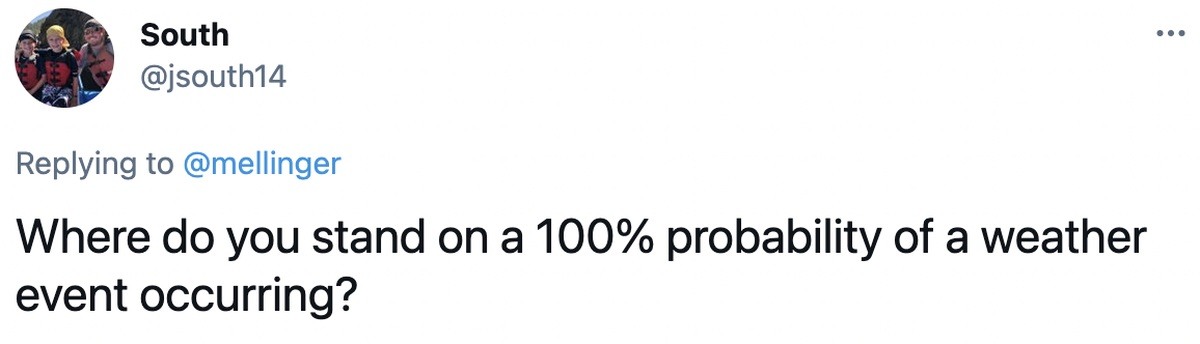
… this comes up because before my segment with the Border Patrol on Monday, KSHB’s Gary Lezak — who I like! — fiercely defended his *100 percent* forecast for snow before saying he might change that prediction later in the day.
Which is objectively preposterous.
No weather event is ever 100 percent unless it’s happening literally at that second, and to reinforce it I would move that any meteorologist who misses a *100 percent* forecast be forced to take and pass a remedial statistics course before being allowed back on air. Do it like MLB’s PED program, with repeat offenders banned for life.
I’m all for using the 100 percent thing ironically — sometimes I’ll even mix in a *million* percent call, as a homage to Terez — but Gary defended it past the point of irony.
It reminded me of a bigger pet peeve, and if you have kids maybe you can relate. There was a time that one of our sons was huge for his age. Just really, very, really-very tall. We go in for one of these checkups, and the doctor tells us he’s in the 108th percentile for height.
Immediately my wife tenses up, and prepares for embarrassment, because she knows I can’t help myself.
ME: 108, you say?
DOCTOR: Yes, he’s quite tall.
ME: But that’s not a thing. There is no 108th percentile.
DOCTOR: Yes, it’s right here on this paper.
ME: Right, but what does that mean?
DOCTOR: Well, they’re based on measurements of other kids the same age.
ME: Right, but then the highest you can be is 100. You can’t be taller than 108 percent of kids the same age. You can’t be literally off the chart because that just means you need a new chart and…
WIFE: OK, we get it, can you tell us more about quality sleep habits, Doctor?
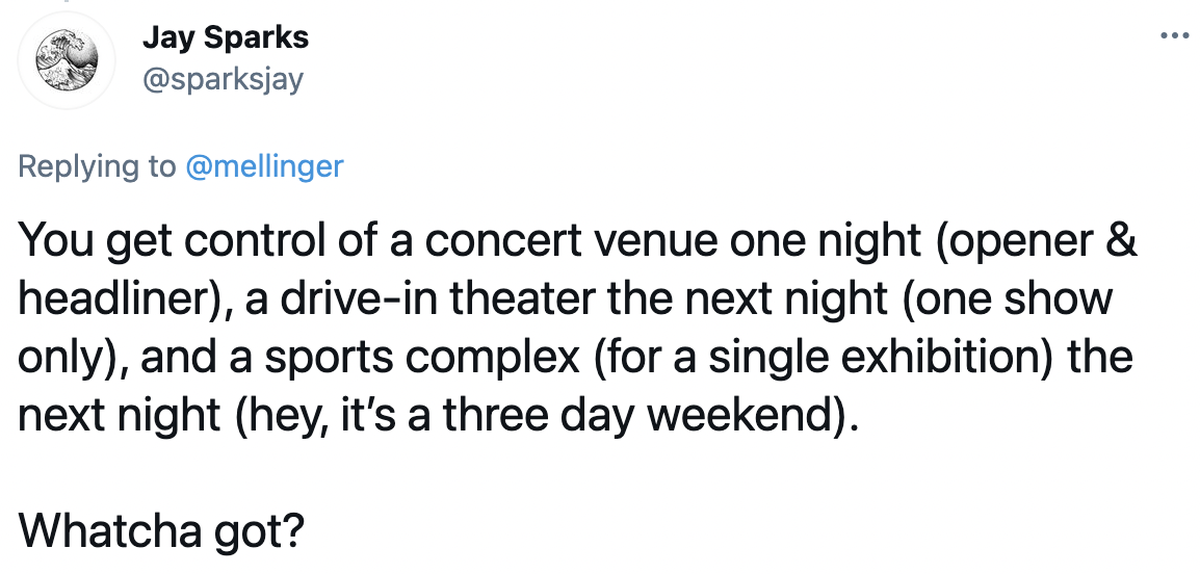
Patrick Sweany is opening for the Black Keys at Crossroads, I’m renting a flatbed and watching Dumb & Dumber with the fellas, and since this is all a hypothetical I’m lining up the 2020 Chiefs against the 2020 Bucs except the Chiefs get to sign a league-average left tackle and we’re playing the game in Hawaii because that sounds swell to me.
Full disclosure, my concert answer would’ve been different a week ago. I’d soured a bit on the Keys because they seemed hellbent on continuing to serve elevator-music pop instead of the stuff I fell in love with them for, but I have to say, the single off their upcoming album is promising.
This week, I’m particularly grateful for this slow but certain crawl back toward normalcy. Over the weekend, we were trying to map out our summer and it struck me how many things we’ll be able to do again — a fishing trip that got canceled last year, showing the kids Chicago, a trip with my oldest friends, camps, our gym’s pool will be open again. I’m proud how we’ve navigated the last 13 months or so, and realize we’re not out of it yet, but am so happy to get to make those types of memories again.