
Vlatko Andonovski’s unlikely path from Skopje to KC to leading U.S women’s soccer
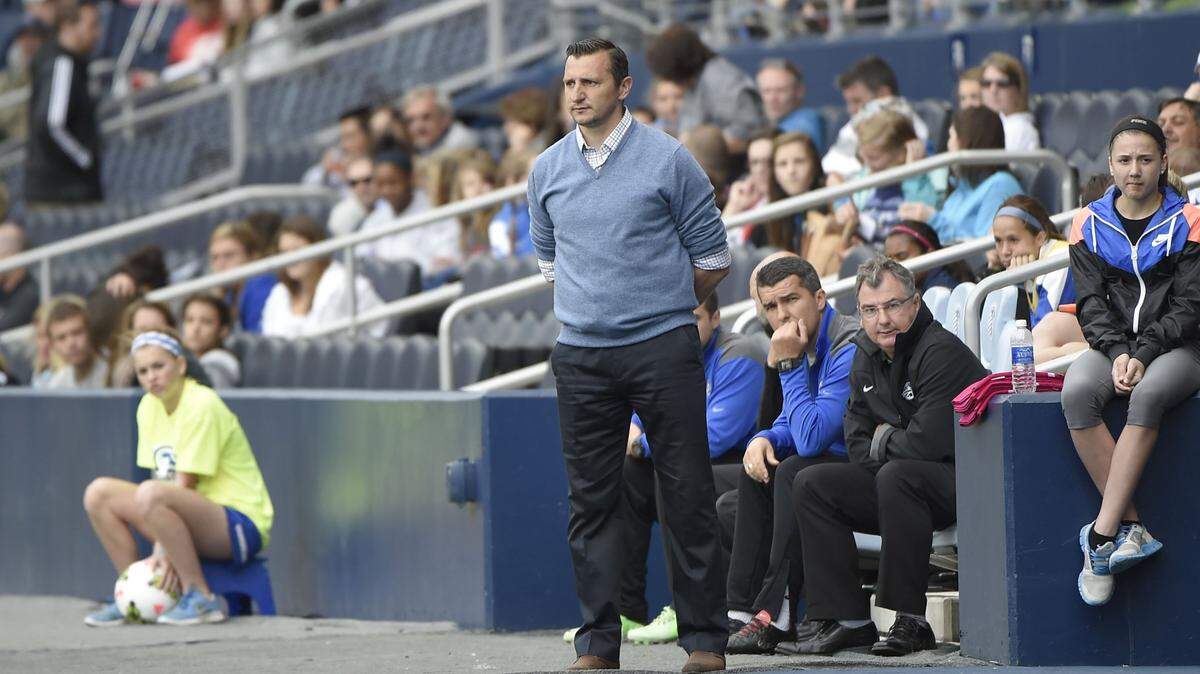
Born in the former Yugoslavia and growing up in the successor state now known as the Republic of North Macedonia, Vlatko Andonovski could have sensed that soccer would be in his future.
His father and brother played professionally, after all, and the game was the central topic in virtually every meal they ate. For that matter, he gravitated to a broader perspective of the game: Out on the streets, he was that self-proclaimed “pretty annoying” kid who wanted to organize everything and strategize to outsmart opponents.
It was not so much a hobby or a fascination or a profession in the making as it was what he called “a way of life” that would lead to his way in life.
“Now, looking back, I don’t feel like I had a choice,” he said Thursday.
Maybe he didn’t have a choice to some extent. But the way it unspooled, by way of his adoptive home of Kansas City, to become coach of the intergalactic stars of the United States Women’s National Team?
In hindsight, that was pretty implausible, a vivid reminder that it’s a small world and life can sure take you for a ride if you’re willing to seize it … or even be just a little open to it.
Starting with his inauspicious path to the United States and Kansas City.
On the occasion of his 24th birthday in September 2000, Dino Delevski, his friend from Skopje, called and tried to coax him into joining him playing soccer for the Wichita Wings — a proposition that came with a twist.
“At that point, I had no idea what indoor soccer was,” Andonovski said, smiling and recalling how he had been flourishing professionally and and with national teams at the time. “And when (Delevski) explained, I said, ‘You know, I’m sorry, but I don’t know how am I going to explain here to my family (and the) media (that) I’m leaving … to go and play soccer with walls? They’ll think that I’m crazy.”
But Delevski (later a star with the Kansas City Comets) proved persuasive, convincing him that he’d love it and could always go back a few months later.
Turned out, though, that soccer with walls led to an open field before him.
Instead of going home, he moved to Kansas City when the Wings folded a year later, the start of making this his home ever since: playing for and coaching the Comets; coaching youth soccer; graduating from Park University; coaching FC Kansas City of the National Women’s Soccer League to two championships and becoming a citizen here in 2015.
With his wife and three children remaining in KC, he even commuted back and forth while he was coaching Reign FC of the NWSL in Seattle the last two years — making the trips so often that he had memorized the flight schedule in between.
So he might have come here by chance, but he stayed here by choice.
“I absolutely love Kansas City. I love everything about Kansas City and I consider myself Kansas Citian,” he said, noting his family felt the same even after brief stints elsewhere around the country. “We knew that this is where we fit best. … I can’t pinpoint one (thing) because it’s everything about the city.”
Then there’s another unlikely twist in his story. In his childhood, he seldom witnessed girls or women playing soccer.
Whoops, check that: “It’s not that I (hadn’t) seen a lot,” he said.
He’d seen none, in fact, until arriving in Wichita. At a soccer complex to watch a youth game Delevski was coaching, he was mesmerized to see so many girls teams. “Brilliant,” he called that moment.
“I enjoyed watching them play. And maybe without even knowing, that’s how my love for coaching females developed,” he said, later adding that he never had any specific thought about whether to coach men or women. “But maybe inside of me, you know, maybe something was always shaping me … helped me drift toward the female side.”
Now he’s gone from relative anonymity to presiding over one of the most prominent and visible teams in the world. And it will be a considerable challenge to match what the team has done recently, winning the last two World Cups (and four of the eight) as its top players have ascended to international acclaim and influence.
Players like Megan Rapinoe, Allie Long, Becky Sauerbrunn and Lauren Holiday, among others he could have mentioned, are “superstars, rock stars.”
(For the record, Andonovski supports their fight for equal pay, saying it reflects the attitude they show on the field and “how they’re wired.”
But the stars also remain grounded. He knows from experience in working with them.
“One thing that I know about every single one of them is they all want to be the best version of themselves,” he said. “If they see that you can offer something to help them get better, and you care about them as individuals and as soccer players and developing as soccer players, they’ll do anything.
“They’re true professionals. They live their lives for this game … In fact, it’s easier to work with (such stars) than any other players.”
Indeed, that’s part of the profile U.S. Soccer was looking for when coach Jill Ellis retired.
“As one of the most accomplished coaches in the NWSL history, he’s proven he can help world-class players reach their peak, inspire his teams and win championships,” U.S. Soccer president Carlos Cordeiro said in October. “He is widely respected by players and leaders across our soccer community, and he has the work ethic and winning mentality to guide the greatest women’s soccer program in history into their next era of success.”
Andonovski understands the pressure of trying to keep a premiere program at the pinnacle. Then again, he also figures, “Who doesn’t want to coach the best team in the world?”
And he is embracing the notion that there is more to be accomplished, starting with the 2020 Tokyo Olympics: No women’s team, he noted, has ever won the Olympics a year after winning the World Cup.
To keep this one getting better, he said, he expects to be part of implementing both tactical and technical changes.
“To stay the best,” he said, “you have to keep evolving.”
Something reflected in his own improbable path to this point.
“I came here (thinking) six months, three months, whatever it was,” he said, laughing. “And I’m still here, my three months.”
This story was originally published December 20, 2019 at 5:00 AM.