
Trade that sent Zack Greinke to Milwaukee paved Royals’ road back to playoffs
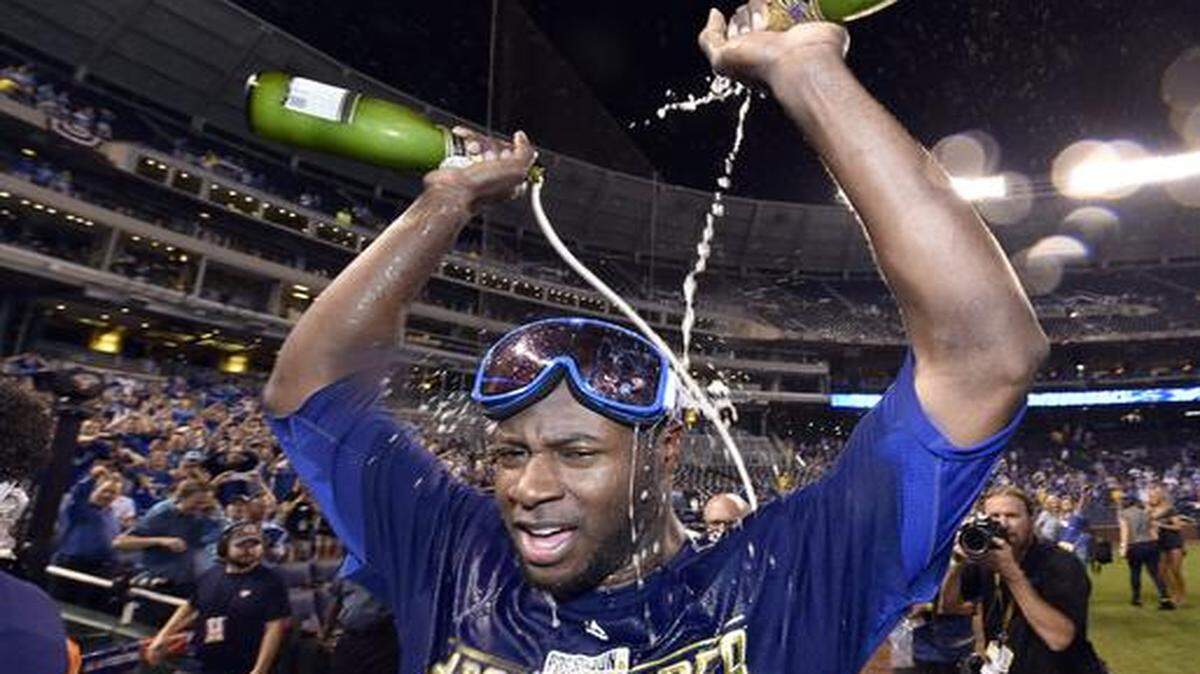
They talk about the trade every day.
The Royals’ success is introducing them to a new and much bigger audience, so there are a hundred stories being retold to people who never paid much attention before. That means Alex Gordon’s bumpy road to stardom. Salvador Perez’s emergence as the American League’s premier catcher. Yordano Ventura and his 102-mph fastball.
And, every day, questions about the trade.
It is talked about enough that we should probably call it The Trade, capital letters, and the impact of acquiring James Shields and Wade Davis is obvious to anyone who watches this team. It is not a coincidence that the Royals have had consecutive winning seasons for the first time since the strike in the two seasons they’ve had Shields and Davis, so it makes plain sense to present the Royals to a bigger audience through the lens of The Trade.
Thing is, we may be talking about the wrong trade.
Long before the Royals had the incentive and opportunity to trade for an ace, they had to trade an ace away.
We can talk about Shields and Davis and the winning Royals, but it’s entirely likely we’d be talking about another year without the playoffs if not for a trade made nearly four years ago that sent away a Cy Young winner for what we now see as two Gold Glove-caliber defenders at premium positions who also hit at the top of the order, and another piece that helped the Royals trade for Shields and Davis.
This is the trade that, as much as any other single transaction, shaped these Royals into the group that is now two wins away from the World Series.
“It did,” general manager Dayton Moore says. “You’re right, no question. That was a very important deal for us.”
On so many different levels.
The shape of this Royals’ playoff run actually goes back all the way to the spring of 2006, when Zack Greinke gave up baseball. He was one of the game’s brightest pitching prospects, but one day, he was throwing a bullpen and realized he wasn’t throwing strikes. Wasn’t even trying to throw strikes.
Every pitch he threw as hard as possible. No purpose to it. Later, he wondered if he was just trying to throw his arm out. He knew this couldn’t continue. So he walked away. Quit baseball. He thought about mowing lawns for a living. Thought about golf. Thought about doing a lot of things, none of them involving baseball, which he had come to resent.
A doctor diagnosed him with social anxiety and clinical depression. Medications helped. After a month or so, Greinke told the Royals he wanted to come back. They told him to take another week or two. Be sure. He did, felt the same way and slowly began a journey that would remake his career, and the Royals.
Moore took the GM job that summer, and one of his top priorities was to see where Greinke was mentally. His scouting staff recommended they go slow with him, put him in Class AA Wichita, a good team with players around his own age. Maybe that would help. Greinke felt free in the minor leagues. He was having fun, maybe for the first time in baseball.
Greinke came back to the big leagues in September 2006, as a relief pitcher. This helped, too. He liked the idea that he could pitch every day. He felt looser. His fastball went from 92 mph to 98 mph. His slider broke harder. All his pitches improved. By the end of the next season, in 2007, he was a starting pitcher again and his stuff was as good as anyone’s in baseball.
At the end of 2008, there was talk that he was the best starting pitcher in the game. The next year, he proved it, with one of the more dominant seasons in recent baseball history. In two years, he had gone from a relief pitcher nobody trusted to the game’s best starting pitcher. Then, in 2010, another year the Royals thought they’d be better ended in 95 losses. Greinke was miserable again. He wanted out, and the Royals realized they had no choice.
Having to trade a player like that stinks. Greinke wanted to win, and that he didn’t feel he could do it in Kansas City is a failure on the Royals’ place in baseball after four years of a new leadership group. But it also highlights a critical success for this front office, that they had a player of Greinke’s promise.
Without that, they would not have been able to make the trade that shaped this playoff run as much as any other single transaction.
“That’s the bigger story about where we are today,” says Gene Watson, the Royals’ director of pro scouting.
Of course, it’s one thing to have a player with a lot of trade value. It’s quite another to make the right trade.
Moore and his assistants looked other places first. Not to Milwaukee, and not just because the Brewers were among the 15 teams on Greinke’s no-trade list. Most notably, the Royals went deep into trade talks with the Nationals, even taking the unusual step of allowing Washington to negotiate a potential contract extension with Greinke.
The Nationals had Drew Storen, Danny Espinosa and Jordan Zimmermann and others to trade. But the Nationals were also on Greinke’s no-trade list, and he didn’t want to play there. His motivation of getting out of Kansas City was to win, and the Nationals were coming off a 93-loss season. They hoped they could change his mind with a large contract extension, but Greinke wouldn’t do it. The Royals left the winter meetings that year without a trade partner.
That opened trade negotiations for the Brewers, and even if this was neither Greinke’s nor the Royals’ first choice, they moved forward. Greinke saw the pieces of a roster he’d win 96 games with and get to the 2011 NLCS. The Royals saw a package of prospects and young big-leaguers that fit what the franchise wanted to be but had so far only been chasing.
From the time Moore took over the Royals, he preached the value of athleticism, defense and power arms. Making that plan work had proved a difficult challenge, with counterproductive detours through players such as Jose Guillen and Yuniesky Betancourt and Mike Jacobs.
With the help of Ned Yost, who’d taken over as Royals manager in May 2010 after managing the Brewers, Moore identified a package built around a dazzling defensive shortstop, a long-striding center fielder who was drawing comparisons to Torii Hunter and a young pitching prospect some scouts actually compared to Greinke. Yost remembers wanting to manage spring-training games with that shortstop and center fielder “just because they were so fun to watch.”
As is the case any time you deal with prospects, the package was loaded with risk. Alcides Escobar, the shortstop, had hit just .235 with poor plate discipline in his only full big-league season. Lorenzo Cain, the center fielder, always seemed to be hurt. And Jake Odorizzi, the pitcher, was, well, a pitching prospect in Class A. There is no riskier commodity than a low-level pitching prospect. The Royals also got a hard-throwing but erratic relief pitcher named Jeremy Jeffress in the deal, but the reaction from many within the industry was something like, Eh, I guess that’s the best they could do.
The Royals saw more. The plan all along was to grow starting pitching and power hitting through the draft and international signings, and to build around as much athleticism and the best defense the club could possibly find. There have been bumps, of course — most notably the power hitting, at least before this playoff run — but the athleticism and defense have become the Royals’ defining quality. Escobar and Cain are their defining athletes.
Advanced metrics back up their importance. Since the trade, Baseball-Reference’s version of WAR has Greinke worth 13.3 wins above replacement. Escobar, Cain and Odorizzi (whom the Royals used to trade for Shields and Davis) are worth a combined 20.1 wins.
It doesn’t always work out like this with trades, of course, but this is basically the real-life version of what the Royals hoped for when they made the trade.
“When we’re ready to win, we’ll need the kind of shortstop that Escobar is,” Moore said back then.
“(Cain) is going to be here when we win a World Series,” Yost said back then.
Cain is turning into a star. We can see that now. He led the team in hitting during the regular season (.301), and his teammates have become so used to his diving catches — two in a row that saved runs in the clincher against the Angels, running maybe 100 feet to rob J.J. Hardy in the gap in game two of the ALCS — that they’ve taken to looking at the hitter afterward. The frustration amuses them.
On a team built on defense, nobody made a better play this year than Escobar. You probably remember it. Cleveland. Jason Giambi at the plate. The Royals are shifting their defense, so Escobar is playing a few steps from second base. Giambi pops it up toward the seats behind third base. Escobar thinks the ball will go out of play, but starts running anyway, as fast as he can go, and at some point he realizes he has a chance. He runs 120 feet — at least — slides as he approaches the rubber warning track, makes the catch backhanded and spins from all the torque.
“I had to say ‘Wow’ after that one,” Escobar says.
In the middle of September, the Royals had lost five of seven games and fallen out of first place. The offense stunk, even by their standards. Yost would generally rather stick his head in an oven than change his lineup, but he decided to make a radical facelift in the middle of a pennant chase.
Every single spot in the lineup changed on Sept. 13, but the biggest difference was moving Cain and Escobar from the last two spots to third and leadoff, respectively. They’ve remained there in every game they’ve played since, and coincidence or not, the Royals have won 15 of 21 games, including the playoffs. They averaged exactly four runs before the switch, and 4.95 runs after.
As Escobar and Cain have gone, largely, so too have the Royals. Escobar had the go-ahead hit in the ninth inning of game two of the ALCS. Cain is hitting .370 in the postseason. Nobody inside the Royals’ organization would dream of being in this spot without their shortstop and center fielder.
Not even the ace pitcher and shutdown reliever the Royals got in that other trade — the one made with the inclusion of a pitching prospect the Royals got in the original trade.
To reach Sam Mellinger, call 816-234-4365 or send email to smellinger@kcstar.com. Follow him on Twitter: @mellinger. For previous columns, go to KansasCity.com.
This story was originally published October 12, 2014 at 7:27 PM with the headline "Trade that sent Zack Greinke to Milwaukee paved Royals’ road back to playoffs."