
Mellinger Minutes: the message in Isbel, Chiefs’ plans, and the future of sports on TV
Part of me wants to use the top here to go through the Chiefs offseason, but the short version is that they’re tracking the right way and we’ll go bigger when Russell Okung and Alejandro Villaneuva are each signed (here or somewhere else).
Part of me wants to use the top here to go big on Ben McCollum, who has built a basketball power at Northwest Missouri State that reasonable thinking people should not believe without proof — a record four-time NABC national coach of the year, 159-6 in the last four years, three national titles in the last four tournaments.
The short version is that he’s 39 years old, and has turned down Division I jobs already, presumably to wait for the right fit. We’re thinking he could jump to a Power Five school.
But baseball’s opening day is happening this week, which makes this opening week, so this space was probably always going to be about baseball, but especially so when the Royals essentially signaled that Kyle Isbel will make the opening day roster and Nicky Lopez will not.
This is significant, and that’s true whether Isbel OPSes .900 or .600.
Because think about what the Royals are telling you. They thought long and hard about jumping Bobby Witt Jr. from 37 games of Rookie League to the opening day roster. The reason they didn’t, essentially, was because they didn’t think he was ready to play regular big league second base.
Now they are signaling that Isbel will be the opening day right fielder, with Whit Merrifield playing his more natural second base, and the message is pretty clear:
The Royals are thinking about winning and nothing else.
Because they’ve been in spots where they might try to ride it out with Lopez at second base. They’d talk themselves into his (legitimately terrific) defense and character and say they need to give him time.
That’s all gone now.
The Royals aren’t giving up on Lopez — far from it.
What they’re doing is saying they’re not giving up a crumb of competitiveness to develop at the big league level.
Lopez can continue to work on an altered swing designed to cut down his strikeouts, but he’s going to do it at the alternate site, and eventually the minor leagues.
The other part of this that should be encouraging for Royals fans is that their team had a viable alternative. Isbel is 24, has impressed the club in three seasons in the minor leagues and by all accounts is ready for the opportunity. Spring training stats can be overblown, but he’s hitting .341/.417/.561.
It also helps that the Royals have a lot of flexibility with Hunter Dozier and Merrifield being able to play different positions.
I don’t know where the Royals will end up.They could make a postseason push, they could lose 95 games, and anything in the middle of those extremes is in play.
But at the very least we know what the club’s intentions are, and how those goals are being pursued. This is setting up to be the most interesting Royals season in years, and club decision makers are operating to take advantage.
The whole thing starts in two days. Finally.
This week’s reading recommendation is Jeff Passan on Juan Soto, and the eating recommendation is the shrimp chipotle at Jarocho.
Thanks to everyone who’s listened to our Mellinger Minutes For Your Ears podcast, and here is a big warm invitation to start if you haven’t already. We’re out from behind the paywall and free on Apple or Spotify or Stitcher or wherever you get your shows.
Reminder: If you’d like to participate in the show — and I’d love for you to do that — please call 816-234-4365 and leave your first name, where you’re calling from, and almost literally any question.
Please give me a follow on Twitter and Facebook and, as always, thanks for your help and thanks for reading.
Excited enough that I actually have thought about making the podcast nothing but like 30 minutes of raw sound from a ballpark with fans in it?
I won’t do that, because that seems really lazy, but you guys even just the few days at spring training ... it was just so dang fun to watch baseball with other humans.
Last summer, when baseball (finally) started I went to Cleveland for the season opener. And I’m glad I did. It was, in very weird ways, a game I will never forget. Progressive Field is downtown, and in normal times surrounded by a lot of fun.
On that day, the sounds were just so different — what sounded like a motorcycle drag race along a nearby street, a fire engine, one random and very loud fan walking behind the left field wall shouting LET’S GO INDIANS.
I watched that game from a suite on the second level — Cleveland’s case numbers were very low at the time, and I think they wanted no part of a Kansas City dirtbag — and when a player slid into second base it was as loud as if I was playing shortstop.
Want to know the truth? It was kind of cool. Felt like a private screening of a major league baseball game.
The novelty wore off pretty quick. Like after a few innings.
“Honestly, it sucked,” Merrifield said after the game. “It was an opening day and the atmosphere sucked.”
Opening day this year will be so different. We’re not all the way back. Won’t be packed. Fans will be distanced, capacity limited to 30 percent — about 10,000 fans.
But one thing we’ve learned from the NFL and MLS allowing limited fans is that 30 percent capacity can make for something like 75 percent of normal atmosphere. There is science behind this, and someone tried to explain it to me once, but I’m a sportswriter and not a scientist so all I can say is something stupid like “there is science behind this, and someone tried to explain it to me once.”
But, anyway. I’m not excited for science.
I’m excited for baseball, played in front of humans, with rooting interest.
I know I’m repeating myself here, and the pandemic is far from over, but man it’s amazing how much progress we’ve made in a year.
The 2004 game is the one that sticks out. That’s probably true for a lot of you, at least those old enough to remember.
Those were wild times. The 2003 team was one of the biggest flukes in modern professional sports history, but they were interesting, and at least for 4 1/2 months or so successful.
It had been so long since the Royals were good that a lot of Kansas Citians wanted to be lied to, and wanted to lie to themselves. Maybe Angel Berroa was good and maybe Ken Harvey really was an All-Star and maybe Mike Sweeney can stay healthy and I know it all sounds silly now but that’s where we were.
That opening day I had what Bob Dutton always called the worst assignment of the year — the A1, 30,000-foot atmosphere story.
Honestly, I have no distinct memory of what I wrote. I remember the game was bonkers. The Royals trailed 4-0 after the top of second, and 7-3 going into the bottom of the ninth.
The game was over, basically, but then the Royals went walk-walk-double to start the ninth and then Mendy Lopez hit what has to be one of the most famous and unlikely home runs in club history.
He was a pinch-hitter, a sort of Four-A player who’d been with four teams and was on his second go with the Royals. In seven seasons, he had hit five home runs. His sixth tied it in the bottom of the ninth in front of the biggest crowd at Kauffman Stadium the Royals would see all year.
“I never hit a ball that far in my life,” Lopez said after the game. “Opening day. It’s the biggest thing I ever did in my life in baseball.”
That’s a man who knew he’d peaked. He played 17 big league games after that, but loved baseball enough that he grinded through various minor leagues for nine more seasons.
So, yeah. I don’t remember what I wrote. What I do remember is that Dutton said it was the worst assignment of the year because editors who never watched baseball 364 days a year watched that game and all had an opinion about exactly what the story should be.
So that story, on that day, truly, it might’ve been the most edited story I’ve ever had in 20 years at the Star.
But, I also remember the 2012 Royals being booed 16 minutes into their home opener. I remember when an easy infield popup dropped to the turf, and afterward Zack Greinke said something like, “I was looking around and wondering where is everybody?”
I remember being in Chicago once for an opener, and it was probably around 40 degrees when a coach from the Dominican Republic walked by and said, “Back home, if it’s this cold, people die. Here we play baseball.”
I also remember being in Anaheim one year for an opener and seeing my social media timelines and even my email fill up with people just crushing Rex Hudler in his first game as the Royals’ color commentator. I mean, it was unanimous.
I happen to like Rex. He’s an acquired taste, but I’m glad the Royals gave him enough time for enough fans to acquire the taste.
I’m saying there’s a one in three chance of this?
We are squarely in #OptimismSzn in baseball, so that’s probably lower than a lot of you might say. The Royals have an interesting mix right now, and they make for a tantalizing pick as a 2021 breakout tam.
But it’s also true that you can talk yourself into just about any baseball team this time of year, and their success depends on too many ifs to feel overly confident about.
There isn’t much margin for error with the lineup or pitching. They have some nice positional versatility that can allow them to cover holes or injuries, but that group doesn’t have enough ceiling to afford many underperformances.
But you can see how this thing could click. They need their best players to be good — that’s Salvador Perez, that’s Adalberto Mondesi, and in a few months I think that could be Bobby Witt Jr.
That also means that Andrew Benintendi needs to be a consistent threat, and Jorge Soler needs to hit for power, and Hunter Dozier needs to be that breakout guy the Royals just extended him to be.
The foundational pieces are all here. I always want to couch this, because we don’t have as good a sense for this as we would in normal times, but it sure seems like this group enjoys being around each other. They pull for each other. That can be hard to accomplish without winning, and without a roster centered on young players with shared experiences in the minor leagues.
The Royals appear to have that here, and if that’s true, that’s a credit not just to the guys on the roster but also the front office and Mike Matheny.
That kind of thing may not matter as much as some fans and media like to say it does, but it makes at least some difference. And those are edges this team will probably need.
These things have a way of working themselves out. Someone will get hurt, or someone will struggle, and if not you have a problem that’s both welcomed and workable — 10 hitters for nine lineup spots.
The positional versatility is a true friend here, because you have a workable backup at every position:
- Carlos Santana and Hunter Dozier at first
- Whit Merrifield and Bobby Witt Jr. at second
- Adalberto Mondesi and Witt at short
- Dozier, Merrifield and Witt at third
- Benintendi and lots of people in left
- Michael A. Taylor, Merrifield, Witt in center
- Isbel, Jorge Soler, Merrifield, Dozier in right
Every team has a breaking point, and the Royals’ overall margin for error is smaller than other teams, but other than Perez and Mondesi I’m not sure there’s a major injury that would make you rethink what this team is capable of.
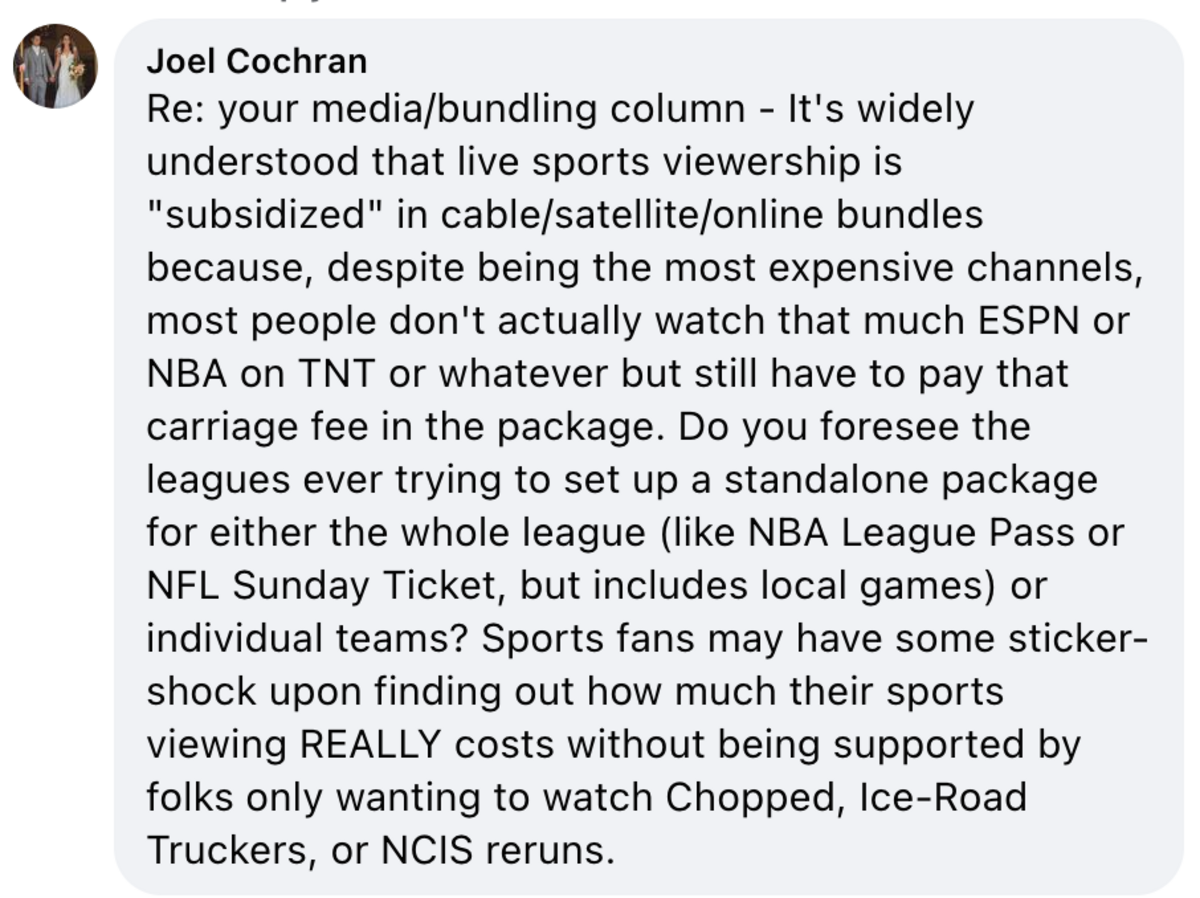
That could happen. Anything could happen. The most striking thing when you talk to people who live this stuff — working with networks, or production teams, or even with leagues or teams — is that none of them know what’s going to happen.
Sometimes they’ll make a guess, but they really don’t know.
The general plan seems to be to diversify, to try to prepare yourself for any of the possibilities. Teams and leagues going directly to consumers is one of those possibilities.
I am not going to pretend to know exactly how the numbers work. You’re right that (non-NFL) sports often have a smaller audience, but it’s a passionate audience. It’s an audience that’s willing to switch providers in a way that people wanting NCIS reruns just aren’t.
Live sports remains one of the most valuable pieces of programming in existence.
So, we could go through the numbers and make educated guesses about the smartest routes for more revenue but the truth is I do not care. And I suspect you don’t either.
What I do care about is the general health of a sport, particularly with young people.
Which is where I worry about the direct-to-consumer route.
Because no matter what the numbers say about what’s more profitable, there has to be a giant consideration about growing popularity. Direct-to-consumer stuff is great for passionate fans, but it’s pretty rotten when it comes to growing the game. That’s the stuff I think about.
And, look. I’m not (completely) naive. I realize it’s a lot easier for the sportswriter to prioritize distribution, while team owners and league executives are going to prioritize revenue. I get that.
But I do think shutting out young people from watching your games is a lousy way to grow a game that’s already struggling to lock in the next generation of fans.
It’s not just young people, either ...
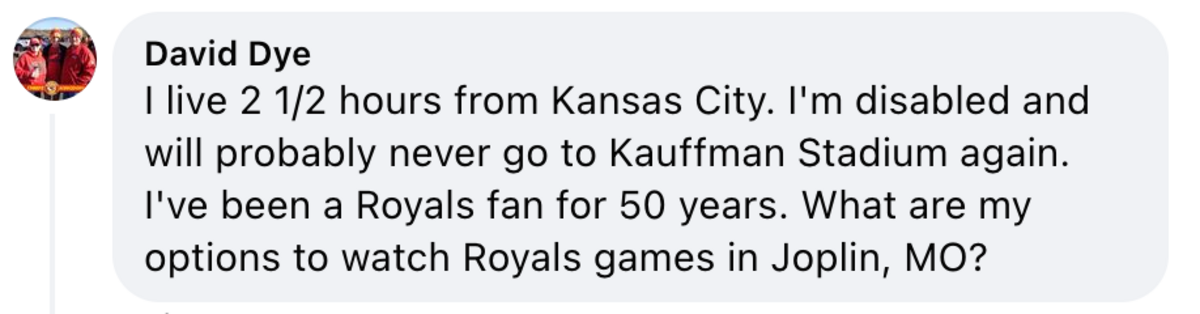
I mean, come on. What sensible explanation is there for making it harder for this man to watch games?
The answer is that David has two choices.
The first is that he can change cable or streaming providers, presumably away from something he’s comfortable with and likes and chose for a reason. He’ll probably end up paying more, too.
The second option is he can illegally stream the games.
That’s what baseball is doing to David: make a choice you don’t want, or do something illegal (which, presumably, you’d also rather not do).
Technology is too good now. We have to be better than this.
This is so easy to solve. Offer a Royals-only package, and give the money to Bally’s. Everybody wins. This doesn’t have to be this much of a problem.
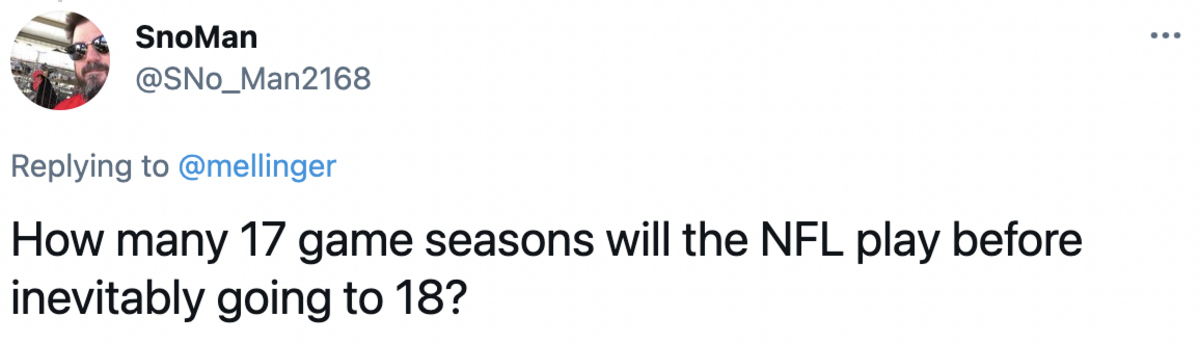
There are so many weird parts of this I’m not sure where to start.
Why did the players cave on a 17th game without getting more in return?
Why didn’t the owners offer an extra bye week so they can continue to pretend to care about player safety?
My suspicion is the owners held back a second bye week so they could use it as a bargaining chip on the next CBA, but that’s just because I’ve been trained to believe everything the NFL does is calculated and aimed toward giving players something small and immediate in exchange for something much bigger but delayed.
Because wouldn’t it be pretty sweet to have an extra bye week — that’s better for players, and I would argue better for networks because it’s an extra weekend they own America’s attention — and play the Super Bowl the day before Presidents Day?
Then we all get the holiday after the Super Bowl that everyone’s always whining about?
But the answer is they’ll play the fewest 17-game seasons possible before going to 18.
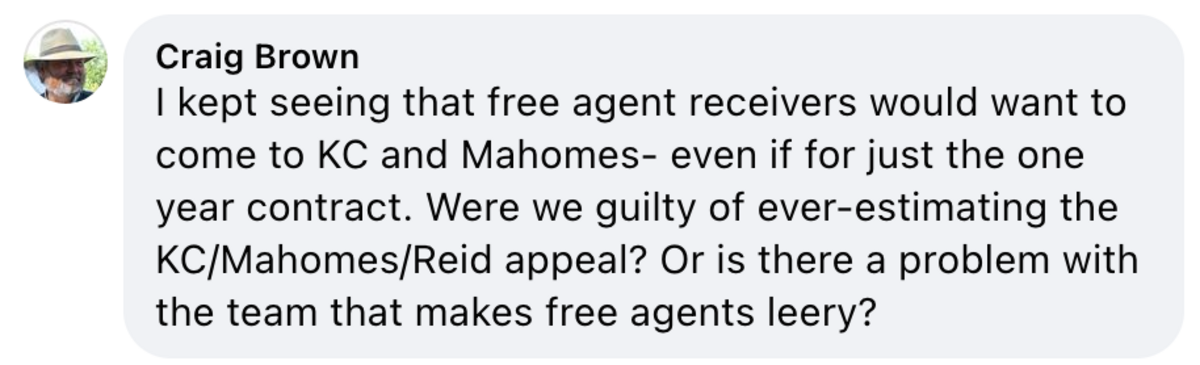
My view is that the focus is on the wrong thing here.
Let’s use Juju Smith-Schuster as the example. He likes it in Pittsburgh. He’s happy there. Knows the system, knows he’ll get volume, knows he’s in a good spot. He also wants to hit the market, and soon.
I believe a logical explanation would be that he always wanted to stay, is holding out hope that his long-term deal with come from Pittsburgh, and didn’t want to risk changing systems and terminology to be the No. 3 in a place where the No. 3 averaged 5 1/2 targets and 42 yards receiving last year.
That makes sense to me.
I’d be a lot more concerned if the Chiefs were losing out on offensive linemen despite having the best offer. That would be a red flag.
That’s not what’s happening here.
The Chiefs made a strong enough offer to Trent Williams that at one point he expected to be in Kansas City, but a team he enjoys playing for and feels some loyalty for matched or beat the offer.
I hope nobody expected free agents to take less to come to Kansas City. That will happen occasionally, same as it does in some other places. But it’s not the rule.
The Chiefs have a legitimately good thing going, with a core that helps each other and feels motivated for goals bigger than themselves. The proof in that is in contract structures and restructures and the way these guys interact with each other.
That’s a real thing, and part of what the Chiefs have going for them. So I’m not going to stress if a receiver doesn’t see a one-year stop in Kansas City to eat from the leftovers of Tyreek Hill and Tracis Kelce as a major problem.
The Chiefs need to be drafting those guys anyway.
It’s a great question, and I suspect the strongest argument for making the trade is that Kyle Shanahan is 41 and Andy Reid is 63.
Which is compelling!
Shanahan is a brilliant play designer, and despite being a key figure in two Super Bowl collapses you and I would both bet even money on him winning a championship or two as a coach someday.
But I would not make the trade, and the reason is that I am following the same rule that the Chiefs follow — do what’s best for Patrick Mahomes.
I believe that Reid is a terrific coach on his own merits, and that Mahomes is a superstar no matter who’s calling plays, but I also believe that each man makes the other better — each man helps amplify the other’s strengths, and diminish his weaknesses.
Maybe the Chiefs would find the same thing to be true with Shanahan, and the trade would be worth it with the extra years added on.
But that’s not a trade I would make. The reward does not outweigh the risk, because it’s not just about pairing Mahomes with some offensive genius — I’d want him paired with the right offensive genius.
Besides, whenever Reid retires, I’m assuming the Chiefs are going to be an attractive place for the next offensive genius.
Shanahan isn’t 1 of 1. There will be others. And the Chiefs will be a place they’ll want to coach.
I don’t know how many KU fans feel like that, but I do know it’s significant. Most of this is the natural cycle of things, because no matter what the specifics at a place like Kansas anything less than a Final Four is a disappointment.
But this year, with this team, when it comes to this specific topic, I think a lot about two specific things.
First, it would be such a different conversation if we had an NCAA Tournament last year. That’s true no matter how KU would’ve performed.
If KU — the consensus best team in the country — made a Final Four or won the championship then anybody saying Self has run his course would be laughed out of the chatroom.
Or, if KU lost early, we’d have recent evidence of another highly regarded team bounced too soon.
We’ll never have an answer, of course. Which makes it one of those perfect sports debates.
The second thing I think about is that this is all something like busywork until we have more clarity about the NCAA infractions case. Because no matter what, if KU has lawyered up in the right places and wins this case and in the process discredits the NCAA, then Self is going to be something like a king.
If the NCAA makes all or even one of the Level I infractions charges stick, then Self is going to have more than his tournament record to worry about.
I don’t, and here we’re getting into my motivation for writing about the distribution problem for Royals and Sporting games this season.
There will almost certainly be something of a honeymoon phase, where people who’ve been denied the ability to watch games in person sprint toward the nearest stadium.
But sports live in the real world, and in the real world people have developed other habits. They’ve found other ways to spend their time and money.
People have expanded their backyard outdoor space. They’ve bought a boat. They’ve gotten into hiking, or bike riding, developed weekly get togethers with family. They’ve read more, or cooked more, or worked in the yard more, or done any of the million other things there are to do in this world other than spend a lot of money to watch adults play a kids’ game.
They’ve realized they don’t need sports to be as big a part of their lives as it was before.
That’s what I think, anyway. There are a lot of us who can’t wait. A lot of us who will go to games with our credit cards ready to swipe. I am a paid writer, and I cannot find the words to describe to you how excited I am to watch a baseball game with a plastic helmet full of nachos and an overpriced domestic.
But sports empires are never built on us die-hards.
Sports empires are built on converting casual fans, and those casual fans have been forced to develop other habits.
Think about what happens when leagues have work stoppages. Fans drift away, right? This isn’t a perfect analogy, obviously, because the leagues had no control over the virus but some of the broad parameters are similar — sports experiences went away, people’s lives kept moving, so they found other ways to fill their days.
Teams and leagues have work to do here.
Yeah man, I loved it.
Now, first, let’s be honest. There is some of the same nostalgia here that shows up when you talk about that amazing and crappy apartment you lived in during college.
Because I’m not trading the job (and salary) I have now for covering high schools (and the salary that came with it) in my 20s. Unless I could actually make the whole trade, and go back to being in my 20s again, in which case let’s have a deeper conversation about this.
But I really did enjoy my time covering high schools. I enjoyed all the obvious stuff — you get to take more time on stuff, you get to know people better, they’re always happy to see you and have time for you.
I loved seeing what these games meant to people, and being able to tell the strange stories that came with it. I loved the people I worked with, and the Friday routine — pickup basketball in the morning, the Peanut in the afternoon, cover a football game that night, then meet up for beers after.
I even loved the logistics nightmare — finding the AD or janitor to let you into an office to borrow a phone line or ethernet cord to file your story, and the constant roulette game of which gate would be unlocked when you’re done, and whether you’d have to climb the fence to get back to your car.
I wish we could still cover high schools the way we used to. The economics of it just don’t make sense, I think we all understand that. People require salaries and benefits, and the audience for a Lee’s Summit West vs. Blue Springs South game just isn’t enough.
But I do think we’ve lost something collectively in the trade. I do believe newspapers are stronger when they’re embedded at the grassroots, and I do believe communities are stronger when they’re covered.
I know that high school sports is a GREAT place for sportswriters to begin — you learn self-reliance, relationship-building, how to find stories, etc.
I think about those days a lot, actually. I think about them a lot when I communicate — even all these years later — with some of my favorite people from those days.
Which is the point.
This week, I’m particularly grateful for how this paella turned out. I’ve always wanted to try it, and always thought for some reason it was too complicated. Turns out, it was just delicious, and all done on the grill which made the cleanup a lot easier.