
Mellinger Minutes: fans at Arrowhead this fall, plus actual football and Royals talk
The Chiefs plan to have some 16,000 people at their home opener in 23 days (!) and every game after that as conditions allow and there are a million reactions here.
- The first, and this cannot be stressed enough: God bless the souls of the people enforcing mask-wearing among fans at Arrowhead Stadium.
- “Look, Trevor, I paid $42,593 to be here watching the Chiefs with my five best friends. You can either walk away, or I can shove this mask right up your ....” — and that’s when Trevor walks away.
- Trevor, please call me after you quit. It’s a terrible job, but it would make for a great column.
- Like, what poor schmuck of a stadium worker has to go into the upper-concourse bathroom to make sure everybody’s distancing? And how quickly can he then change into a urine-free shirt?
- Tailgating lives! Sort of! You’re supposed to tailgate only with those who have tickets in the same pod you’ll be sitting in.
- The Chiefs will also have social-distancing measures in place, though, just being honest here, it’s hard to imagine them being well-enforced. I mean, we’ve all been to NFL games, right?
- Just thinking out loud here, but with a Super Bowl champion returning mostly intact and ticket sales severely limited, we are going to see some astronomical prices on the secondary market.
- Tickets will be available to season-ticket holders in order of tenure, then to Jackson County residents followed by the public. They can be purchased in pods of up to six, which means some folks who’ve kept tickets since Marty will have the following choice: attend the season opener Sept. 10 or ... sell the pod and buy a boat.
- A big, fast boat.
- You know, with that type of setup, and limited seating, and the increased hassle of travel ... well, let’s just say that mini-controversy last year when Packers and Vikings fans filled Arrowhead probably won’t repeat itself.
- What in the hell is the SEC going to do? Full capacity with halftime kiss cams?
- Jokes aside, at least for a minute, it’ll be an unforgettable experience for those willing to do it. It’ll be weird and invigorating and exclusive and so much else.
- I’m glad they’re doing this. Have to admit, I’m surprised the public health folks have OK’d this, but as long as that happened then why shouldn’t consenting adults be able to watch their team play in person?
This week’s eating recommendation is the rustic beet salad (add chicken) at the Mixx and the reading recommendation is a heavy one: The Truth is Paywalled But The Lies Are Free.
Thanks to everyone who’s listened to our Mellinger Minutes For Your Ears podcast. Last week, we made a point about high school football that isn’t being made enough and listened to Royals chairman and CEO John Sherman describe the decisions that shape his new team, how he sees success happening and how he’ll adjust the process of getting there.
The next episode — with audio you won’t hear anyone else, like every week — will be up Friday. If you’d like to participate in this fun Q&A segment, please call 816.234.4365 and leave your first name, where you’re calling from and almost literally any question. Thanks in advance.
Please give me a follow on Twitter and Facebook and, as always, thanks for your help and thanks for reading.
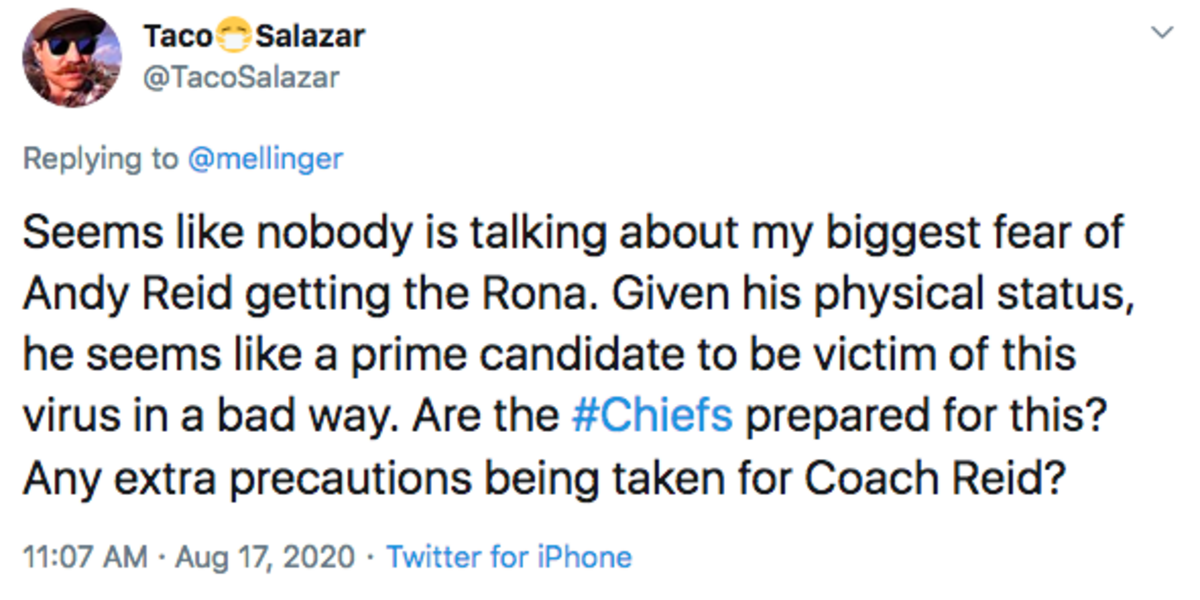
I’m not sure any team is “prepared” to lose its head coach, and Reid is both better and more important to his team than the average head coach.
Absolutely, 100 percent, ain’t-no-doubt-about-it this is something people in the building have thought about. How could you not? Reid is 62, (just being honest here) big, and has a job that requires him to communicate with and see other humans constantly.
We’ve seen two head coaches test positive, including Doug Pederson, a former assistant here in KC. Nobody is under the delusion that Reid can’t catch it.
Just to be sure, I want to emphasize that last point with its own paragraph: Reid is vulnerable to COVID-19 and, if he were to test positive, the concerns would be much different and bigger than if, say, Clyde Edwards Helaire caught it*.
* Just using him as an example, because he’s the youngest guy on the roster.
But, I have to say, there’s a case to be made that Reid is safer doing his job than you or I are living our normal lives.
The Chiefs have allowed four of us reporters to attend practices in what they call Tier 2M. It’s basically a scaled-down version of their player/coach/employee protocols. We get tested every day, and while on the premises we wear contact tracers. They’re sort of like Big Brother GPS monitors that record anytime we’re within six feet of another tracer, flashing a red light to tell us to back away.
Reid wears a face shield during practice, and everyone wears masks at all times, inside the building and out — the only exception I’m aware of being the players while they’re on the field.
Chiefs employees have taken additional steps internally, including repurposing office space to maximize distancing and extra cleaning and sanitizing.
Nobody is expecting perfection, but I do believe the habits and behavior of players and staff are very different now than in normal times. There is an understanding — and this is almost certainly truer with the #RunItBack Chiefs than with most teams — of the stakes and collective responsibility.
One more time: Reid is not immune, same as Patrick Mahomes isn’t, Tyrann Mathieu isn’t, Tyreek Hill isn’t, Clark Hunt isn’t, you aren’t and I am not.
But other than creating a bubble — more on that in a minute — I’m not sure what could be done right now to better diminish the risk to Reid and everyone else.
But, to answer part of your question, I assume Eric Bieniemy would be the interim head coach.
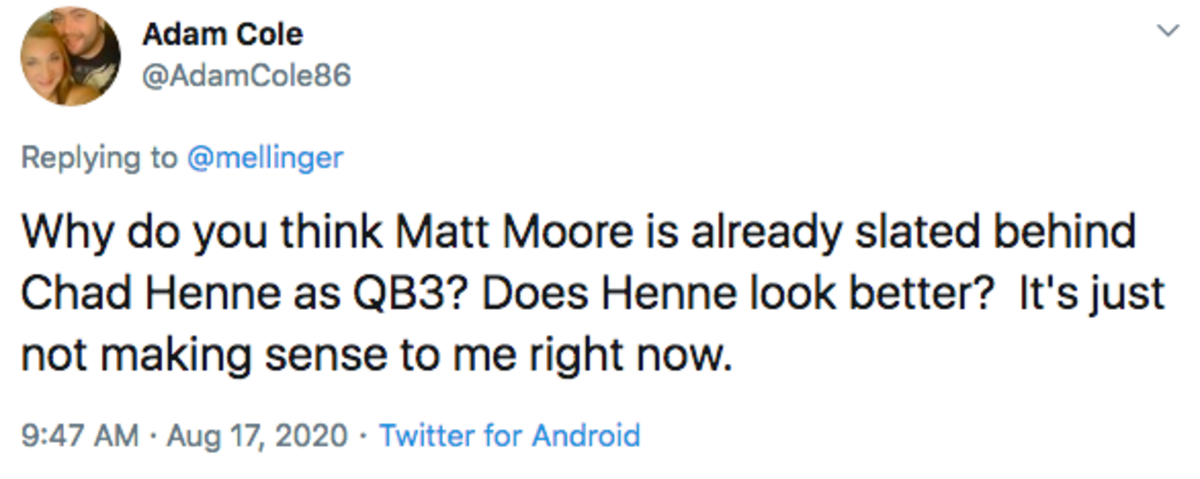
Matt Moore was great last year! You could say this about a number of guys, obviously, but the Chiefs likely would not have earned the first-round bye last year.
He extended and protected the lead in Denver (though that game was won by the defense), played well enough for the team to win against the Packers and was the quarterback on the fourth-quarter comeback win against the Vikings.
If the Chiefs hadn’t beaten the Vikings, they’d have been 11-5 and the Dolphins’ win over the Patriots in week 17 would not have mattered. The Chiefs would’ve played the Titans in the wild card round, the Patriots would’ve been rested, and who can say with certainty what that would have meant?
All of that is true.
So is this: Chad Henne was the backup quarterback in 2018. He was the backup quarterback in 2019, before the ankle injury. So it makes sense that he’s the backup now.
Reid has said he rates Henne and Moore similarly, and that can be true, but if he rated Moore above Henne then Moore would’ve been the backup this time last year and the year before.
There is a small sample size warning here, because I’m not going through old tape of these guys as starters, but to me Henne looks a tad bit more athletic and more consistently accurate than Moore. Both guys check the boxes with preparation and intelligence. Henne has played in and started more games.
Quarterback is always an interesting position to watch, and this year that’s more true than most. You can get through an emergency in every other position group, all of which (except the kicker and punter) have more numbers.
But if a team has to go with a quarterback who’s underprepared or Signed Off The Street™ then the whole operation is stalled. The Chiefs’ ideal formula with their quarterbacks is to have Mahomes backed up by a veteran, with a developmental guy as the No. 3.
The hope is that the veteran can help Mahomes see stuff on film and not drive the car off the cliff if he’s needed for a game or two, while the developmental guy might be able to graduate to backup or even trade piece.
The virus changes this calculus. The Chiefs will be motivated to protect that position as much as possible. Reid has essentially called Henne and Moore a redundancy, but now is the time for redundancies. Keeping both veterans behind Mahomes gives the Chiefs more layers of protection.
Besides, the expanded practice squad rosters mean teams can more easily keep four quarterbacks.
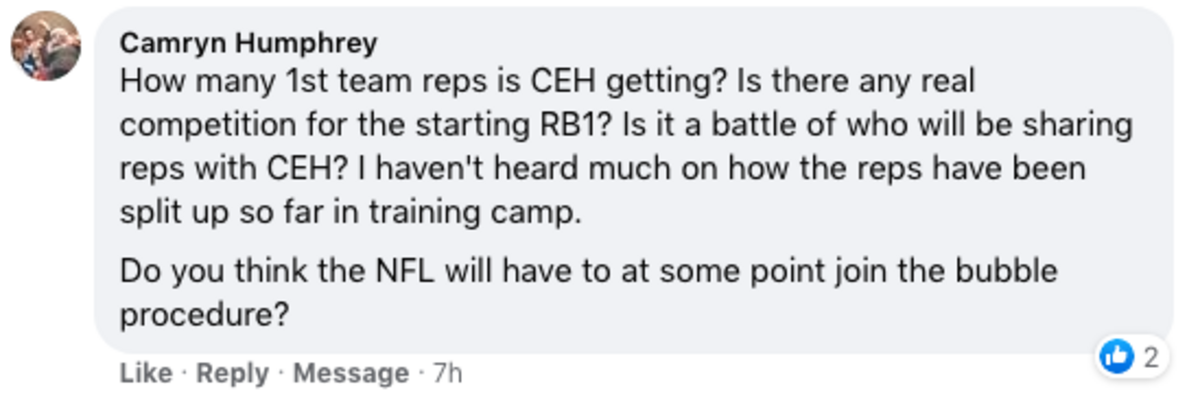
He was the running back when the starters took the first snap in the first practice open to media. That’s both significant and the type of thing that’s overblown this time of year.
The Chiefs will use a lot of running backs. They always do. Last year they used five, and that does not include fullback Anthony Sherman. Obviously they hope to have fewer injuries this year, but that’s a position where you can’t rely on fewer injuries.
My guess is that Edwards-Helaire will get the plurality of snaps when healthy, and perhaps even a majority. But I’d be surprised if this is an Ezekiel Elliott situation. DeAndre Washington, Darrel Williams, and Darwin Thompson (if he can pass-protect) are capable.
And, dear reader, this is where we get to talk about an NFL bubble.
If the only thing that mattered was containing the virus and playing a full season, every NFL team would create a bubble. Replicating the NBA or MLS with one bubble, or even the NHL with pods, well, that’s unrealistic in the NFL.
Each team has 250 or so people it could consider essential to business. That’s 8,000 people. That’s a small town. You can’t bubble that.
But each team could create its own bubble. This would be costly, of course, but also fairly straightforward. Buy out a hotel, test every day, install security at every entrance/exit, keep players, coaches and selected staff inside and move ahead.
I believe in looking at the data, and the data indicates that travel risk is generally overstated. There has not been any outbreak tied to an airport or flight and, besides, with charter flights you’d essentially become a traveling bubble. Only the pilots and flight attendants would be new. And if you really wanted to be safe you wouldn’t need flight attendants, and the pilots could stay in the cockpit.
The NBA, NHL and MLS have shown us that bubbles work. The Marlins and Cardinals have shown us that strict protocols without a bubble are vulnerable.
So, if the ONLY thing that matters is containing the virus and playing a full season then the NFL should bubble up. Now, I understand why they aren’t. Mental health matters. Comfort matters. Life is not lived by the strictest scientific standards. I get it.
But that’s an option. I’d be surprised if the NFL switched lanes midstream, though, and I’d imagine doing so might be functionally impossible. If we got to the point that this was a real conversation, it’s probably because the virus has spread even more, which means bigger problems in the world and the need to pause for at least a week or two for teams to quarantine and test and make sure they’re safe.
The bubble ship has sailed.
But, moving on, more about the running backs ...
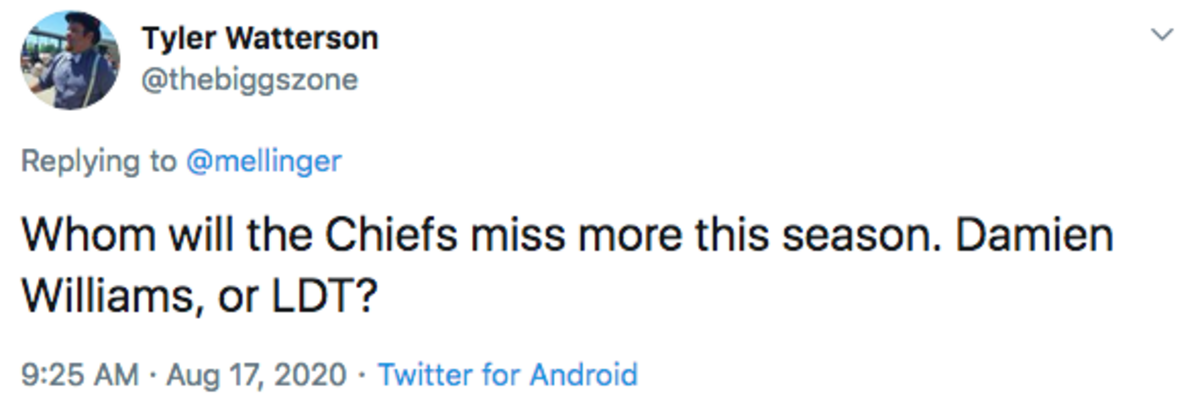
I believe the answer is Damien Williams.
Laurent Duvernay-Tardif is a good player, but he did struggle at times last season, particularly in run-blocking. The Chiefs have rarely spent big resources on the interior line — Mitch Morse is the exception — and they believe they have it covered well enough with Kelechi Osemele and Martinas Rankin.
With Williams, the Chiefs’ running back situation would’ve been even more committee-ish, and they’d have been better protected against injury.
Williams is not a star, but he is versatile, talented and experienced. The Chiefs would be better with him, but it’s probably also true that Edwards-Helaire would be the day one starter either way.
Williams’ opt out decision — understandable in every way — becomes a major football problem if Edwards-Helaire is injured, or the Chiefs’ depth there otherwise continues to slide.
Always great to answer crystal ball questions about the man who occasionally likes to say “my crystal ball is broken.”
My guess is yes. I’m less confident in that than I would be if David Glass was still in charge.
It would be hard to overstate the level of trust that Moore and Glass had in each other. Their respect was mutual and deep, to the point that Moore could talk Glass into going over budget if he wanted, but wouldn’t ask unless he was certain. Glass appreciated that Moore dragged the Royals to legitimacy, and Moore appreciated that Glass funded the push and never broke a promise.
A lot of owners would’ve fired a GM with similar results after the 2012 season. Moore understood that at the time. A lot of GMs with similar constraints would’ve taken the Braves job after the 2014 season. Glass understood that, too.
Moore and John Sherman are building that relationship. The men have a strong mutual respect, both professionally and personally, but real relationships take time to build.
My point here is that if the current push doesn’t take traction, it would make sense that Sherman would be quicker to try something new than Glass would, and your 2023 timeline here is a smart one because it’s basically a question of whether the Royals will have contended or provided tangible reasons to believe they’re about to by then.
At this point, the case either way would be inconclusive.
The pitchers are encouraging, and not just encouraging, but encouraging in the way that it’s hard to imagine how they could be more encouraging. They have not — and here, if any Royals employee is reading this, we’ll pause so they can knock their knuckles raw on wood — had major setbacks with injuries or lack of performance.
Brady Singer’s raw numbers aren’t awesome — 4.56 ERA, five homers and 12 walks in 25 2/3 innings — but if you watch the starts you see how close he is. The same could be said for Kris Bubic, actually, and more prospects are on the way.
The hitters are a problem, though. The Royals have struck out nearly four times as often as they’ve walked, and they do not have a homegrown position player younger than 28 who has shown he can consistently hit.
The margin for error is slim there, then.
At the moment, I’m leaning 55-45 toward this thing working, because the pitchers are so encouraging and I believe in some of the updates the Royals are doing with infrastructure* and I believe Sherman when he says he’ll invest at the right time.
* They’re doing some fascinating stuff with behavioral science and performance science, in particular.
But there are a hundred ways this thing could go sideways, and two (hopefully) full seasons after this should be enough time to see.
I keep coming back to this thought, though. In 2012, the year of the #OurTime disaster, a lot of people wanted Moore to be fired. Heck, a lot of people — including some in the local media, who sort of retroactively changed their minds to a hilarious degree — wanted Moore and Yost fired through July 2014. The results show those were the years that Moore’s front office was doing its best work.
Meanwhile, Moore received wide praise in 2014 through 2017 or so. The results show those were the years that Moore’s front office was doing its worst work.
The Royals had the 17th-best farm system before the season, according to MLB.com, and it figures to have risen a bit since. Those types of evaluations will be worth monitoring throughout the next few years.
The Tigers, Twins, White Sox and Indians are ahead of the Royals in most ways right now, including those prospect rankings. You can build a credible case against the Royals’ push taking hold.
But at least for now, I’ll lean optimistic, particularly with the idea that the Royals are again attacking market inefficiencies. There is one club official in particular who despises me saying this, but it’s a Moneyball approach, and it worked the last time.
Well, one of is roles should be as the Will Not Block A Young Prospect guy, but that was always true.
Gordon is struggling. He’s always struck out a fair amount, but he’s also gotten his walks, hit his line drives, found his hits. Those aren’t coming right now and there are times he looks shook, his approach stretched by too many guesses.
He is an exemplary professional, and the Royals value that even more than most clubs. He will be in the team’s Hall of Fame soon. At some point, perhaps at a downtown ballpark, there will be a statue of him rounding first and pointing to the sky after the homer off Familia.
But at the moment there isn’t a soul on the field who has faith Gordon will get a hit, and sometimes that seems to include Gordon. If Brett Phillips is hitting, you can make an argument that the Royals’ best outfield is with Whit Merrifield and Hunter Dozier, and not with Gordon.
Mike Matheny has had these conversations with Gordon. The good thing from a fan’s perspective is Gordon does not have a fragile ego. He knows when he stinks, and he doesn’t want to be seen as the guy blocking progress. There are no sacred cows here.
Gordon has stunk almost equally against right and left handed pitching, so I’m not sure there’s a great case for a platoon here.
The Royals might want to get Bubba Starling more time. Nick Heath should play more when he’s healthy. Gordon will continue to lose time. That’s the way it should be.
The case for Mondesi is hard to make right now. He looks lost at the plate, and has even been thrown out on four of nine stolen base attempts. He’s striking out nearly once every three times he goes to the plate, and entering Monday had walked just twice all season.
This is an armchair analysis, but to me he looks defeated mentally.
There is something about his body language that looks like he’s carrying around a lot of extra weight, and I don’t mean physically. He puts a lot of pressure on himself, and he also feels a lot of pressure from the outside.
It’s telling that the Royals’ approach with him — not just now, but for years — has centered on telling him how good he is. Pedro Grifol uses the Francisco Lindor comparison. Dayton Moore once spent a dinner telling Mondesi he could be the Royals’ version of Patrick Mahomes.
Mondesi turned 25 last month. That’s not old, but in baseball terms it’s no longer young, either. Lindor had three top 10 MVP finishes before he turned 25.
So, yes, if you wanted to give up on Mondesi it’s hard to talk you out of it. Baseball players are hard to predict, though. When Mike Moustakas was 25, many would’ve called him a bust. When Alex Gordon was 25, he was an injured bust.
There’s still time.
But there’s not as much time as there used to be.
Sure, but for what?
The Royals have been open to trading Merrifield. I’ve written that. But the market never built, so the team signed him to an extension creating club control through 2023.
At least in theory, that would cover the first year or two of when the Royals can realistically expect to contend. They won’t — and shouldn’t — give that up at a discount.
If the Royals could get a return that made them younger, but with a big league-ready or two player involved, they’d probably do it. And, who knows? Maybe the right contender is desperate this year or next.
But the Royals have looked into this. Merrifield’s big league track record is solid. But it hasn’t convinced anyone to give up a top prospect yet.

I’m going to take your question too literally here in the beginning and say that some schools will play full seasons, and others will not play at all.
At least in Kansas and Missouri, there is no central authority. Decisions are typically made at the league level, with heavy input from schools.
My guess is high school football will happen the way everything else is happening: guided by guesswork and preconceived notions, with bursts of happiness interrupting a chaotic, unknown, and at times scary baseline.
You might have heard I wrote about this last week, and a few days later I only feel stronger about everything in there.
We are out of good answers. No guarantee exists that high school kids will be safer without football than they would be with it, and that’s a heck of a think to type.
Already, we have seen schools and even leagues cancel. There will be more. Infection rates in Kansas and Missouri are above 10 percent, which is seen by many health experts as an important threshold.
We’re doing a really crappy job with this thing, and if some of the videos going around are any indication we’re not about to make a second-half comeback.
This is not a call for us all to pretend the virus does not exist, but rather the acknowledgment that we do not have the luxury of assuming spread will be diminished without high school football.
What are those kids going to do from 3 to 6 every day without sports?
Also, do you think they will be more or less likely to follow reasonable guidelines without the incentive and structure of sports?
These are all unquantifiable hypotheticals, of course, but I’m asking these questions to point out that there are no easy answers. It’s easy to think only about everything that can go wrong with football*, and easy to forget about the unintended consequences of canceling it.
* I keep saying “football,” because that’s what’s in my mind, and what most of you are most interested in. But the same rules apply here for volleyball and other high school sports, though it seems as if golf and tennis could be played safely.
I will emphasize one point from the column here. I’m done with the snap judgments about other peoples’ lives, within reason. High schools that play football are not by definition reckless, and high schools that cancel are not by definition paralyzed by fear.
We need to get far beyond those weak-minded, intellectually lazy labels before we can make progress with this ... or, if we’re honest, a lot of other issues in our country.
We have more in common than we’ve made it appear, and we’ve lost the acknowledgment that with a different set of circumstances (often outside our control) and perspective we’d probably make different decisions.
Sometimes the only contrast between you and someone you disagree with is a different life experience, or a different personal priority. Doesn’t make you good and the other person bad, or vice versa. Makes you both human.
I’m going to keep emphasizing this until I’m fired, or dead or, I suppose, both.
It’s been said many times that COVID is this generation’s 9-11, but it’s hard not to feel that COVID’s effects will be stronger and longer lasting than 9-11.
Maybe that’s recency bias. Maybe we get a vaccine soon. Or better treatments. Or even widely available and quicker tests.
Any of those developments could greatly change things. What if a point-of-contact test could be developed for a reasonable cost? Schools could be full. Football could be played. We could even have fans.
But COVID has also exposed a lot of problems. Most of them are more serious than college sports, and because I feel myself going on a tangent that could last thousands of words and go way off track, let’s stick with college sports.
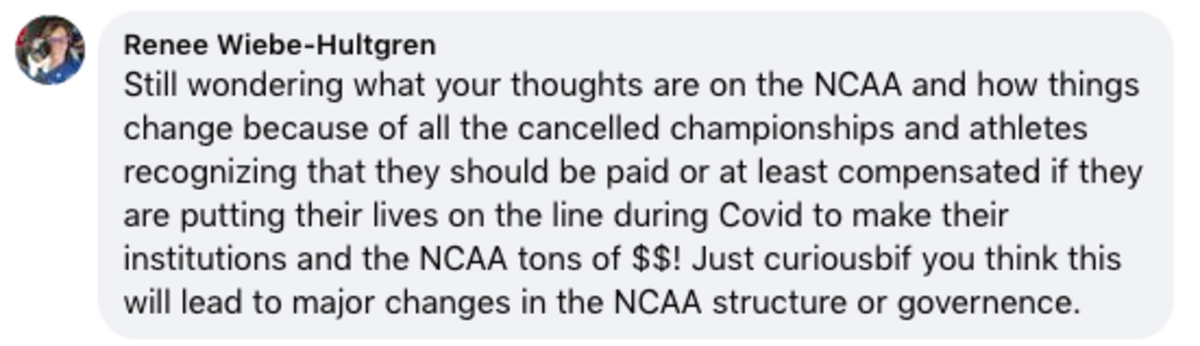
Yes, I do believe athletes are finding their voice. They’re understanding their power, and their influence. These trends aren’t new, but the progress has been slow. We probably needed a major health crisis for college athletes to speak out like this.
They don’t have as much to lose. Their seasons are canceled or threatened anyway, and their health concerns are real, so a critical mass was bound to develop.
More and more, I find myself believing that we’re moving toward the European model. The best prospects will be professionalized younger and develop under the coaching and guidance of the top leagues.
That Division I sports will be more like FCS football or Division II sports — filled with talented athletes not quite good enough for the higher level. That the tradeoff would be less talent and more mutual loyalty. That we’ll have a much better idea how much college sports’ commercial value is tied to institutions, and how much is because of the athletes.
This would simplify a lot of issues. It would solve some problems. The athletes could be paid, and there’d be fewer instances of high schools and colleges pushing guys through who have no interest in a college education. It would be more honest, on so many levels.
Baseball has operated like this for decades.
But there are reasons that might never happen in football and basketball, too. College sports — when they happen, anyway — generate a ton of money, which means they have a ton of money to protect their own interests. The move toward name, image and likeness rights is a reluctant acknowledgment of which way the wind has been blowing.
The NFL and NBA have reason to protect the status quo, too. Major League Baseball teams spend millions of dollars every year funding farm teams. NFL and NBA teams allow colleges to do that work at no charge, in exchange drafting more mature and more branded® talent. Everybody wins.
The athletes win less, but the connections, opportunities and exposure created by the college sports industry are more valuable than some are willing to admit.
Anyway, here I am, swerving away from one tangent and straight into another.
To answer your question: Yes, I do believe college athletes will come out of this with more agency and influence than they came in with.
College sports was always built on quicksand. The model has been outdated for decades, and schools have only modernized too late and too little. They prioritized the short term for the long term, and greed over fairness. That kind of thing will never last.
So, I don’t know what the future will be. My best guess is that the next five or 10 years will be sort of awkwardly split between status quo and the European model.
The NBA is showing more interest and investment in developing top prospects outside of college basketball. With or without the minimum-age requirement, if the NBA continues to convince the best prospects to skip school we’re going to see a significant shift in who is interested in college basketball and why.
The great irony of all this is that if college athletes had been treated like employees, college football and basketball would be in much better shape. The athletes would have had influence in medical protocols, which we’ve seen from professional leagues is how you reach agreements and make progress. They’d also be eligible for bubbles.
We’d be better off. If only the NCAA had decades to address all this.
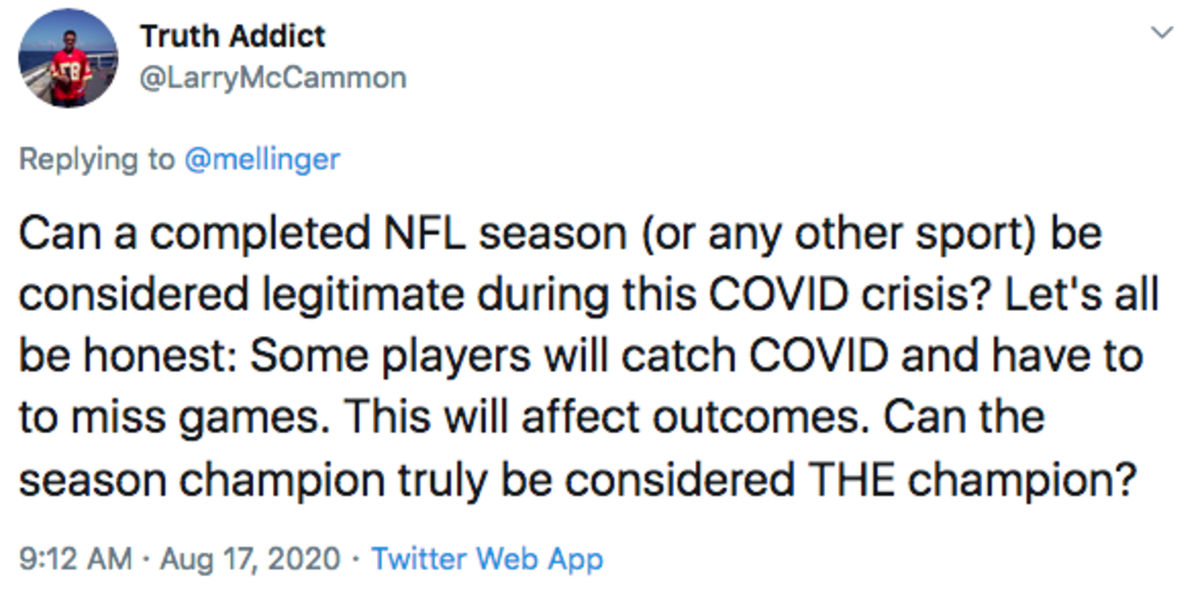
You’re asking about all sports, but to me the answer varies. There is no way the 2020 World Series winner will be viewed with the legitimacy of any full-season winner. It just won’t happen.
The other sports are different. The NBA and NHL played nearly full seasons. More than past strike-shortened seasons, at least. They’ll play full postseasons. The bubbles changed dynamics, and without crowds the games will feel different, but the competition will still be there.
My best guess is that those champions will be viewed differently than those from normal seasons, but not necessarily as less legitimate. The exception would be the NBA’s nightmare scenario — the Bucks and Lakers meet in the Finals, but Giannis and LeBron test positive and don’t play.
The NFL is in another category. They’re planning for a full season.
We’ll see if that happens, of course, but if they pull it off — and the very, very, VERY early indications are positive — why would the Super Bowl champion be looked at differently?
You could say a lower seed did not have to win a true road game (assuming no fans), but of all the things we have to think about in the world, where would that rank?
The NBA’s caveats apply here — including the Chiefs’ nightmare of Reid or Mahomes testing positive in the postseason — but if the NFL achieves a full and fan-less season it’ll be the most normal thing of our new lives.
Until the Zoom parade, at least.
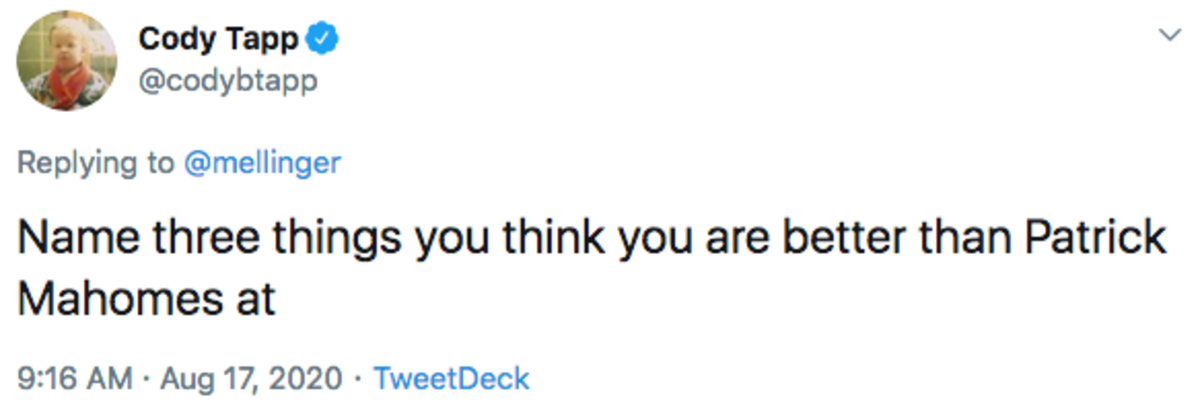
Three? How about 13?!?!?!?!?
A LIST?
A LIST!
There is simply no way he can make ribs like me.
Or cheeseburgers.
Or wings, actually.
I’m an elite dishwasher loader.
Dad jokes.
I can remember my wedding anniversary much better than he can.
Writing. I mean, if I can’t win this one, then I’m just hanging it up.
There’s no way he can turn my 4-year-old’s tears into laughter like me.
I have to assume I’m more willing to mow the lawn.
Ain’t no way he remembers to make coffee the night before so it’s ready when he wakes up as often as I do.
He’s probably got some half-billion dollar smoothie recipe that turns dislocated kneecaps into bionic joints, but I have to believe I’m more efficient with what’s readily available.
Killing bugs.
Most NES games, at least right now, because I’m working on the assumption that he’s far too young to have ever played the 8-bit and some of that stuff like Super Mario Bros, and Double Dribble takes a few reps to figure out.
Honestly, I’m at the end of the list.
This week, I’m particularly grateful to not just be one of four reporters allowed inside Chiefs training camp practices, but that the weather has been so mild. Training camp practices usually mean outrageous heat, but it’s been pleasant.
This story was originally published August 18, 2020 at 5:00 AM.