
Mellinger Minutes: Chris Jones’ and Chiefs’ challenge, Royals and Bobby Dang Witt Jr.
The question is natural, and it’s asked in all sports, before and after a contract guaranteeing generational wealth is offered:
Will the money change the athlete?
Will the edge be lost, or the desperation, or the productive fear of failure?
To me, the examples of athletes mailing it in after a contract are exaggerated. You can find guys like Jeff King, who retired after securing his pension, or Jose Guillen, who became emboldened when his big contract coincided with Trey Hillman’s hiring.
But you can also find examples like George Brett, who competed like a cuss long after his money and legacy were secure. Or Tony Gonzalez, who could have mailed it in on bad teams but continued a Hall of Fame path.
It is now Chris Jones’ turn on the wheel. He grew up so poor he slept on a loveseat his senior year of high school, and now has $60 million guaranteed from a contract signed last week.
Now it’s his turn to show whether he’ll become more Jeff King, or more George Brett.
“I want that gold jacket, man,” he said, referring to the prize for Pro Football Hall of Fame induction.
That’s the right thing to say, but the proof will have to come. There are good reasons Super Bowl winners don’t often do it again the next year. When they do, they often have a nice mix of new players, with freshened perspectives and motivations.
The Chiefs are, basically, trying to recreate 2019 with the same team. Twenty of 22 starters are back, and the entire coaching staff. This you know.
Particularly around Kansas City, the idea of a pending Chiefs dynasty is sometimes talked about like as much foregone conclusion as a lofty goal.
We can all see why. The generational quarterback is 24 years old, and signed for 12 years. With few exceptions, the best players are young. Charvarius Ward is the best player who is not under contract past this season, and he’ll be a restricted free agent.
It’s an enviable spot, for sure, but the dynasty stuff ignores so much of the randomness that comes with every season. The Chiefs avoided disaster last year when Patrick Mahomes recovered so quickly from a dislocated kneecap. They got lucky when Terrell Suggs was there for them on the waiver wire, and even luckier when Ryan Fitzpatrick won in Foxborough.
Then Bill O’Brien happened in the first playoff game, and Jimmy Garoppolo missed Emmanuel Sanders wide open in the last playoff game.
I don’t bring any of this up to say the Chiefs weren’t the best team. I believe they were, even if I believe the Ravens aren’t far behind.
I just mean that there’s a lot of variance in these things. I mean that the best teams don’t always win, and that the different athlete vectors that coincide to win one Super Bowl usually need to be jumbled around a bit to win another.
It’s easy to see why the Chiefs are motivated to keep this group together. Anyone would. But there are so many unknowns here, still, and that’s not even talking about a pandemic we’ve done a rotten job of containing and a salary cap that is going to make roster building even more difficult.
This week’s reading recommendation is Kalyn Kahler on former Packers pass rusher Kabeer Gbaja-Biamila’s path from hero to feared, and the eating recommendation is the jalapeño popper burger from the Brick.
If you haven’t already, please give our Mellinger Minutes For Your Ears podcast a try. The newest episode is built around what I believe is still the Chiefs’ only public comments about the energy that forced Washington to change its name and the impact that might be felt here. We’ll have another episode later this week, too.
Please give me a follow on Twitter and Facebook and, as always, thanks for your help and thanks for reading.
All of it.
I want the sounds of the ball cracking off bats and into mitts, the rhythms of between innings, and the image of the world’s best baseball players doing their thing. I want to think along with a manager again, and see a diving play up the middle again, and see a bang-bang play at first again.
I want to see bat flips and hand signals and dirty uniforms. I want to see someone go from first to third, and an outfielder open up aggressively for a throw to the plate.
I want to come down from putting the kids down and see the score in the 6th inning and decide whether to watch the rest or put on Netflix.
I’m looking forward to seeing Adalberto Mondesi’s speed and Sal Perez’s arm and Brady Singer’s promise. I’m looking forward to seeing the Alex Gordon cleat-shaped dead grass near the Royals’ on-deck circle and Josh Staumont’s fastball and Whit Merrifield’s competitiveness.
It’s another step toward normalcy, despite *gestures at everything* and I can’t wait to see it.
I’m looking forward to all of it.
Well, maybe not quite all of it.
Ahem...
I feel this in my soul, my man.
I contain multitudes.
I’m thrilled to be able to watch baseball again, but have to believe the empty ballparks and announcers back home and ban on high fives and spitting will be relentless reminders of how weird this all is.
Sports can be an escape, and even if that line is overused, most of us would agree it’s true at least sometimes and also that nothing short of a vaccine can serve as an escape from the coronavirus.
I’ve thought a lot about this, and you know how I feel about painting with broad brushes and predicting human behavior but here goes anyway:
Some of us have made other routines. Some of us have found other ways to fill our time. Some of us just aren’t that interested in sports what with all the unemployment and pandemic going around. Some of us are going to be slow to come back to sports, if at all.
But I also know that some of us miss sports desperately. That doesn’t mean we don’t feel everything in the above paragraph, but it does mean that some of us are starved for live sports to at least interrupt real life right now.
I’m not sure if this is what you were asking about, specifically, but it’s hard to imagine many people being out on baseball because of the abbreviated season. I don’t mean to dismiss that, but to me if you’re willing to cut through the pandemic for baseball I’m not sure you’re going to be out on ethical grounds because the season is shortened.
This has been mentioned before but the line you hear most often inside the major pro sports: I know we’ll start, I don’t know if we’ll finish.
MLS’ recent test results — *furiously knocks on wood* — are very encouraging. They’re encouraging not just for MLS, but for the NBA and NHL, showing that bubbles can work, even in Florida, at least for now.
Major League Baseball’s test results have been similarly encouraging. They’ve had positives, but the numbers have generally been lower (even with constant testing and many cases being asymptomatic) than you’d expect if players and staff were living in the general population.
The NFL has some work to do here, and the procrastination has been epic. But I just can’t believe this won’t be figured out. They’ve had too much time, and everyone involved has too much to lose.
College sports appear to be screwed.
We talk the most about football, for obvious reasons, and maybe there’s a needle to be threaded with golf or tennis or swimming but the trend lines for college sports are the opposite of encouraging.
Every underlying factor working for professional sports is working against college sports. The difference in resources, discipline, central authority, and — how should I put this? — ethical questions — are fundamental.
I’d be thrilled to be wrong about all of this, obviously — and we should never underestimate money — but I just don’t see how university presidents can justify having sports right now.
This is cold but true: there is no obvious way for college football to be played this fall, and if college football isn’t played then there is no reason (and less money) to play the other sports.
The hell of it is that we’re probably waiting for a vaccine to see college sports again.
*pauses, looks around*
*knocks on wood until knuckles are bleeding*
*whispers*
Maybe we might could possibly be maybe getting a vaccine sooner than later?
Honestly, I don’t think that’s realistic. You know this space often chases rabbits down holes, but even here I don’t know how useful this is.
I just can’t imagine enough players feeling enough reason to sit this thing out that we have a canceled season. The announcement of daily testing is a huge step forward, and more than other sports are doing.
Again, there’s just too much at stake, and the NFL knows what a destructive unforced error it would be if it lost a season — or even the credibility of a season — because it could not come up with a health plan agreeable to players who want and largely need to play football.
But I will answer a similar-in-function question: how many players would test positive before a team had to postpone or forfeit a game?
Nick Kenney is the Royals’ head athletic trainer. Kurt Andrews is Sporting KC’s director of sports medicine. A few weeks back, I talked with for a column on the challenges of playing sports right now. We turned clips of those conversations into a podcast. I hope you consume all of it.
With the plugs out of the way, one thing that struck me from the conversations is that neither team had a plan for this. They did not have a guideline that said, for instance, we can have five players quarantined at once but on the sixth we’ll shut it down.
I have to admit, this surprised me in real time.
Kenney and Andrews are each widely respected in their industry, with strong reputations for preparation and operating honestly. It seemed strange that neither knew what the limit would be.
But, at least according to the epidemiologists I’ve talked with, that’s the smart approach.
There are simply too many variables to make a predetermined decision. How many positive cases happened on the same day? Within two days of each other? Three? How many of those cases have contact tracing that extends around the team? What is the context of the bubble of community? On and on it goes.
Now, if we’re being as cautious as possible we probably should have an independent public health expert making the decisions on when a team has to go. A commissioner will be inherently biased to keep going, and would have to account for a natural tendency to lean toward business interests.
This may all prove to be a moot point. Soccer and basketball inside a bubble present challenges. Baseball teams with strict protocols at work but operating on the honor system outside of it come with bigger obstacles.
But playing football? With that many players and staff? Without a bubble? As cases could rise again during flu season?
I’m not sure anything short of a vaccine can ensure safety.
I’m glad the NFL is trying. These are well-compensated adults, capable of making their own decisions, and I assume that by the time everything is announced the players will be able to opt out if they want.
But we need to keep life moving, as best we can.
Here’s the deal, you guys.
Patrick Mahomes changed everything. He took a franchise that had peaked at being just good enough to lose in the division round and turned it into the Super Bowl champions and a potential dynasty.
He took a team that had been stubbornly creative in ways to lose playoff games and turned it into the first ever to erase three consecutive double-digit deficits in the playoffs.
He gave a franchise its swagger back, from top to bottom.
But, you have to admit, losing a season this well positioned to a pandemic and chopping a potential dynasty off at the head because of a shrunken salary cap based on economic destruction would be one hell of an old-school Chiefs Chief’n move.
Sorry. But it had to be said.
This can be read as some sort of heightened coronavirus-infused brand of spring optimism, but the Royals making the playoffs would not be the most shocking thing in the world, and I’m not just saying that because 2020 is on such a bender.
The Royals would have virtually no chance at the playoffs across 162 games.
But any team has a chance over 60, and I would argue the Royals have a better chance than your standard issue rebuilding team. It’s more than just small sample size. For instance:
- Salvador Perez has a well documented history of wearing down in the second half of a season. He has not played since 2018, so he should be fresher than ever.
- Adalberto Mondesi has a well documented struggle playing full seasons. The Royals don’t need 162 from him.
- The Royals’ best version of themselves includes a batch of rookies transitioning to the majors, and I’ve heard baseball people make the argument that transitioning will be easier this year than ever because empty ballparks won’t be as intimidating.
- The line between being aggressive and reckless is blurry, and the biggest danger in pitchers blowing out will be in going too hard too soon, but an improved bullpen should be able to air it out a little more in a shortened season.
You asked specifically about prospect development. There are levels to this, of course, but here is an incomplete list of reasonable goals involving guys who are under club control through at least 2022:
- Keller avoids major injury, continues to gain confidence.
- Jakob Junis improves secondary pitches, consistency.
- Mondesi avoids the injured list and finds more consistent production.
- Hunter Dozier continues to be tough with two strikes and replicates 2019.
- Ryans O’Hearn and McBroom play like big-leaguers.
- Josh Staumont shows control and a repeatable delivery to go with overpowering velocity.
- Meibrys Viloria, Cam Gallagher, or MJ Melendez show enough to be considered the next primary catcher.
- Pitching prospects Brady Singer, Jackson Kowar, Daniel Lynch, Kris Bubic, and Austin Cox stay healthy, and at least find some big-league success.
That’s a general checklist. The Royals won’t hit all of them. But if they get most — and the most important are Mondesi and the pitching prospects —they’re probably feeling justifiably optimistic going into 2021.
Now. One guy we didn’t mention gets his own question...
I don’t know what to make of this guy. He just turned 20 last month.
Gleyber Torres is one of baseball’s brightest young stars, and broadcasts last season took on a comical run of OMG HE’S ONLY 22 YEARS OLD PEOPLE and when he turned 20 he had exactly zero plate appearances about Class A.
But, my goodness, if you’re looking for reasons to be skeptical I’m not sure where you go.
He’s putting together tough, competitive, confident and ultimately successful plate appearances against big leaguers, and that was the biggest question when the Royals drafted him.. He is smooth in the field, wherever they play him.
Baseball is often about body language, and Witt Jr.’s is dang near perfect.
We’re not even three weeks into this, and summer camp is so different than traditional spring training that the Royals thought No. 4 overall pick Asa Lacy would be better off developing on the side for now. The disclaimers are many and they are legit.
But with each passing day, it seems, Witt Jr.’s ceiling remains as high as the day he was drafted (a rarity) and his floor rises.
Coming soon: think pieces and radio segments on Kansas City being the ultimate example of the value in athletes raising athletes with Patrick Mahomes, Adalberto Mondesi and Witt Jr. used as the examples.
Not really.
My understanding is that when the Chiefs practice indoors a limited number of us will be allowed to watch, and other than that, we’re locked out of even the media room.
My understanding is that we will be allowed in press boxes, but nowhere else. All interviews are to be conducted through Zoom or phone calls.
Something real is going to be lost here, and that’s even if we were sure to go back to normal with a vaccine.
You won’t know as much about your favorite team. You won’t hear answers as honest, and you won’t hear conversations that simply won’t exist now. You have the same level of information or insight. Something will be lost.
This is not complaining. Of course I understand. I think we all understand. I’d wear a mask made from nails and subject questions through Morse code if it meant sports would otherwise be normal.
But when issues like this are mentioned by people like me, I hope you’ll remember that these are not self-interested complaints about losing some irrelevant privilege or status symbol of being in a locker room.
Actually, I don’t know any reporters who like being in a locker room. There’s an underlying feeling of privacy intrusion, it’s often cramped, and to talk to anyone you need to do a thousand calculations involving everything from level of nudity, body language, how often they’ve talked that day or week, and whether the other reporters will follow you over there and turn your one-on-one into a useless group interview.
That’s not complaining either. I love my job, but all jobs have parts that are less than perfect.
I’m just pointing this out to say that sports fans should want reporters to have as much access as possible, and to support the push to regain as much as access as we had before when it’s safe.
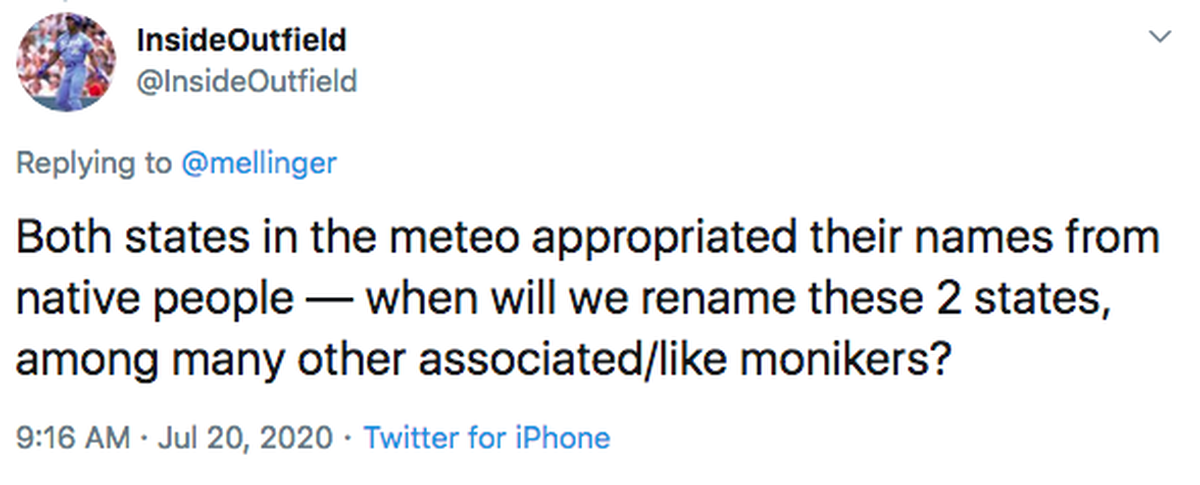
I am so glad this question was asked, and I mean this with maximum respect:
This slippery slope argument on teams changing names is nonsense.
The gap between using negative or misleading stereotypes of a group of people that’s been treated outrageously awful to sell t-shirts or create excitement for a sports team ... the gap between that and the label of a piece of land is like the gap between this cup of coffee I’m drinking and the Pacific Ocean.
Cancel Culture is not coming for the Dallas Cowboys, is what I’m saying, and anyone going down this road is signaling that they aren’t thinking about this honestly.
I’ve heard the sensitivity argument, too, that anyone who has a problem with calling a football team the Redskins or the tomahawk chop or anything else just needs to stop being a snowflake.
But — hear me out with this — maybe getting angry at the suggestion of changing a relatively small part of what a sports team does before games is a sign of sensitivity.
We can all come to different conclusions. We can all have different opinions.
But if we’re not willing to think honestly about this, and at least listen to people from different backgrounds about why they may see something differently, then those conclusions and opinions mean nothing.
Here it’s worth mentioning, for the hundredth time, that the Chiefs have done their homework on this. They have done research and they have listened and they have made changes.
You can criticize elements. Maybe they should be in more regular communication with Native Americans who want the name changed, to at least hear those arguments. Maybe they’re spending too much time on imagery, and should focus resources on tangible help in those communities.
Whatever.
Again, different views.
But whatever you think, you have to see that the Chiefs aren’t flying blind here. This isn’t a new issue for them. They knew this test was coming. They didn’t know when, but they knew it would come. They studied for it. They’re prepared.
The conversation here is much different than it is in Washington. This is important, and it’s a point that many seem to be missing.
The conversation here is not about changing the name. Or, at least, the serious conversation is not about changing the name.
The conversation here is about the war drum, war bonnets, Warpaint and the tomahawk chop.
From what I’ve learned, the Chiefs have been respectful about the war drum, and found a way to use the platform for education. I believe war bonnets will be banned as much as the Chiefs can legally, and we’ve probably seen Warpaint for the last time.
At some point, the debate is going to center on the chop.
Chiefs president Mark Donovan made this point: the support for war bonnets and Warpaint is a tiny crumb when compared to the chop. The Chiefs tried to stop the chop once, and fans responded with overwhelming support.
That was a long time ago, and things are different now, but the point remains that this where the debate will go.
The Chiefs want to keep the chop but may feel forced to drop it. We’ll see. The immediate context is interesting, if games are played without fans, or even with limited capacity. The energy won’t be the same either way, so it may turn into a workable moment to make major changes.
Again: nobody knows how this will go.
But the Chiefs will remain the Chiefs. Stop arguing that point. It’s a straw man.
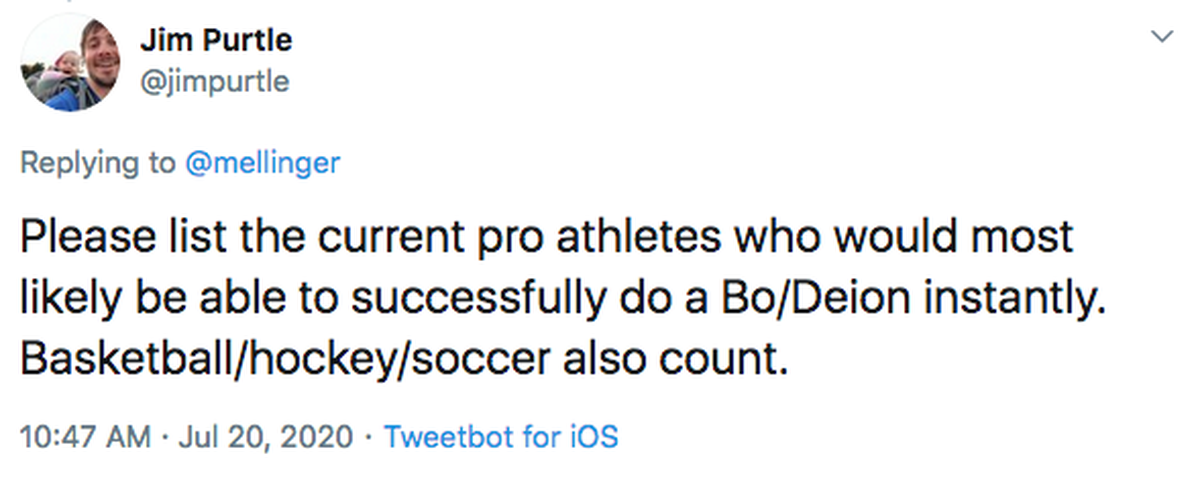
The difficulty of doing this can hardly be overstated. It’s essentially superhuman.
The profile I’m looking for is, basically, an established big-league baseball player who’s athletic enough to be useful in the NFL. Basketball, soccer and hockey players are out because their seasons overlap too much with football.
So, we’re focusing in on baseball. That’s because the skill and repetition required for baseball are so specific and extreme that I can’t imagine an athlete from another sport jumping right in and learning to play baseball while still moonlighting in football or basketball or whatever.
Michael Jordan might be a helpful example here. He was the best athlete in the world, dedicated himself fully to baseball, and hit .202/.289/.266 at Class AA. There are some who believe he could’ve made it to the majors someday, but that’s far from guaranteed, and he wasn’t playing basketball.
So, anyway, my mind starts going to someone like Aaron Judge. He obviously has the size and strength to play tight end or something. Could he develop the agility?
What about Francisco Lindor or Ronald Acuna? Could they develop the explosion to be a receiver? Do they have the hips for corner?
Could Mike Trout play running back?
I don’t think so. I want that to be clear. It takes more than athleticism to succeed in the NFL. It takes an otherworldly energy, resilience, brain power, and a body resistant to injury. It also takes a willingness to risk a massive amount of money and, actually, I would argue a willingness to accept that you’ll make less money.
Because playing two sports means not being as good at either, and the big money in professional sports is reserved for the very best. You’re essentially accepting a lower ceiling in both sports. Endorsements can only do so much.
It’s also possible I’m taking your question much too literally.
This week I’m particularly grateful for my wife. She makes me laugh and feel every day, and she has this wild ability to sort of absorb or take care of all the stuff that I miss or don’t see. Lucky for a million reasons.
This story was originally published July 21, 2020 at 5:00 AM.