
Twenty years later, KC’s Maurice Greene reflects on marquee snapshot in storied career
Nearly 25 years since he last lived here, Maurice Greene still comes home from Gilbert, Arizona, a few times annually to see family and friends and extended family like first coach (and second-father figure) Al Hobson.
All these years later, about every time he does, his wife, Latoya, convinces him to seek out one of those signs with the image of him running that can still be found around Kansas City, Kansas.
“Home of Maurice Greene,” the one near Greene’s alma mater, F.L. Schlagle High, reads.
“World’s Fastest Human.”
They’ll get there, and Latoya will say, “I need to take your picture.”
We’ve done that already, he’ll mildly protest.
“But she’s like, ‘Do it again,’” he said, laughing.
Now, Greene doesn’t exactly need reminding of how he was the embodiment of that sign again and again and again in his prime.
All of a sudden, though, it’s been a long while since he held the informal title conferred upon a reigning 100-meter champion … and, in this case, among the most remarkable athletes in area sports history.
It was long enough ago that he was last truly in the public spotlight in 2008 — for his television role in “Dancing With The Stars” with dance partner Cheryl Burke. On his way to Sprint Center as part of the touring group, Greene at the time playfully lamented, “I’m not Maurice from the Olympics any more.”
“It was crazy,” he reiterated when we talked last week. “But when … everyone is watching it, they will notice you.”
Being noticed and serving notice are two different things, of course.
So here we pause to appreciate how he did just that 20 years ago last week to set up the most memorable moment in an amazing few years.
From 1999 to 2005, no one ran a faster clean 100 than the 9.79 Greene unleashed at the 1999 World Championships in Seville, Spain.
From 1997 to 2004, he won four Olympics medals and won the 100 in three world championships.
He’ll tell you now that separating a favorite among all those would be like trying to do the same among his three children.
“You just love them all the same,” said Greene, who now is training clients and teaching physical education and coaching multiple sports at a charter school, the American Leadership Academy, Gilbert North.
Heading into the U.S. Olympic Track and Field Trials in Sacramento in July 2000, though, Greene was driven by an ache despite all he’d already accomplished.
Never mind that his life had changed radically since he’d failed to qualify for the 1996 Atlanta Games and moved to Los Angeles in pursuit of realizing his potential.
So what if the financially challenging days of odd jobs and working on loading docks or fast-food restaurants (or walking greyhounds at The Woodlands back in the day) had become a thing of the distant past.
Or that his turn of fortune had started when he won the 100 at the 1997 World Championships (beating then-world-record-holder and Atlanta Games gold medalist Donovan Bailey) and all the more after Greene set the world record in 1999.
According to The Star in early 2000, Greene in 1999 was commanding $100,000 a race in Europe and expected to earn $3 million-plus through an inventive-laden contract with Nike and other endorsements. While plenty of that was absorbed by taxes and agent and coaching fees, Greene was able to buy a home in Shawnee Mission for his parents, Ernest and Jackie, and live in great comfort.
But money couldn’t buy what was missing.
Four years earlier, Greene went to the Atlanta Games just to feel the pain of watching the 100. He wept in the stands when Bailey won, but in a sense he basked in the tears as motivation.
In the weeks leading up to the trials, Greene used the word “worthless” more than once to describe how he’d feel about his track career if he never won Olympic gold in the 100. He expanded on that just before the Sydney Games in an interview with ESPN The Magazine:
“How do people rate sprinters? By the Olympics. If you don’t win the gold, you’re not the greatest. My career without a gold will be worthless. … Hey, that’s the truth — worthless and void.”
So no wonder Greene was overjoyed on July 15, 2000, when he won the 100 final in Sacramento to earn the berth to Sydney.
He celebrated on the track and in the stands and even in the media tent, heading to the podium giggling and singing, “I made the Olympic team, I made the Olympic team.”
But that only made it possible for him to achieve what became a quest. And while Greene had his fun in Sydney, including making his way around in a yellow Ferrari, he also went there with a mindset of, “I can’t let anyone take this away from me.”
“So it really put me in that state of mind, like, ‘Look, you are right here at the doorstep of what you want to do and what you want to accomplish,’” he said. “‘But you’ve got to make sure you do everything right.’”
The world saw what that state of mind looked like as Greene stalked around moments before the 100 final.
“I actually felt like a lion,” he said, laughing. “That’s why I got that lion tattoo on my arm. Because I (felt like) a lion in the jungle … And I wanted to be the king of the jungle.”
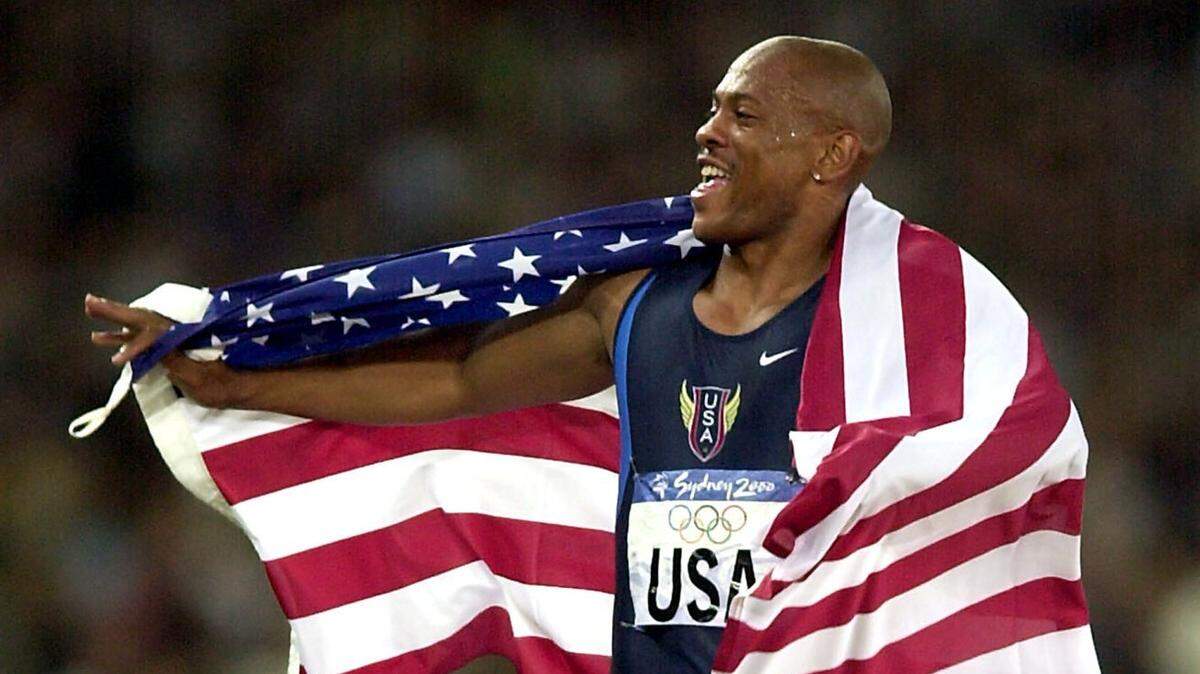
And so he was, 9.87 seconds after the race began.
That was one of more than 50 times he ran the 100 in under 10 seconds and the first of two golds (also in the 4x100 relay) he won in Sydney. He’d win two more Olympic medals in Athens.
But even if it all feels the same to him now, there was something singular in that night before more than 110,000 people at the Sydney Olympic Stadium … a night The Star recently rated the 13th-greatest performance in Kansas City sports history.
In the immediate aftermath, Greene thanked God and hugged competitors and training partners and wrapped himself in a U.S. flag and threw his shoes into the stands.
“I always wanted to give the fans something extra,” said the man also known to have employed a fire extinguisher on his shoes after a race.
Indeed, Greene was known for being vocal and animated, which later showed up in the form of the post-4x100 relay group celebration that many considered over-the-top preening. (That episode left Greene saying “we lost our minds,” and apologizing.)
So when it came time for him to receive his gold medal for the 100 from International Olympic Committee president Juan Antonio Samaranch, some thought he was trying not to laugh as he made faces.
“Actually, I was trying not to cry,” he said that night. “When I get nervous, my tongue comes out of my mouth and I start biting my lip.”
Then he did cry. Kind of like he had four years before.
“But tonight,” he said then, “these were tears of joy.”
Green remained so consumed with “on to the next thing” in track, he acknowledges, that he was “like 90 percent of other athletes” who aren’t prepared to go on to the next thing in life.
Or as he put it, he didn’t prepare “for the afterlife” that he made official in 2008.
“Dancing With The Stars” eased the transition for a while. So did travel. But after a few years, he needed fresh purpose and started coaching. He added teaching a couple years ago.
He will turn 46 Thursday, and the only anniversary he brought up on the phone wasn’t the 20th but the sixth of being married to Latoya. He’s focused on bestowing his old competitive edge upon others, saying he wouldn’t race any of his proteges and that he is apt to tell them, “Just imagine we ran and you won.”
“It’s not about me,” he said. “It’s about helping the younger athletes (reach their potential) and be good citizens and get to their next stage in life.”
Few if any will ever know the stage he once held.
Even if the peak was 20 years ago and Usain Bolt is the fastest human on Earth these days, what Greene did will never be voided in large measure because of the void he filled in Sydney.
“What I’ve done, it’s in the record books,” he said. “It will never go away.”
And a snapshot worth zooming in on again and again over the years.