
Why the Royals’ decision to move in the fences benefits them more than opponents
AI-generated summary reviewed by our newsroom.
- Royals bring Kauffman fences in 8-10 feet for 2026 Opening Day; projection +1.5 wins
- Pitching staff induces highest soft-contact rate; hitters, notably Bobby Witt, gain power
- Fence move reduces corner outfield defensive load and widens acceptable roster targets
The wait for a new Royals ballpark plan perseveres.
But the plan for a different ballpark? It’s here.
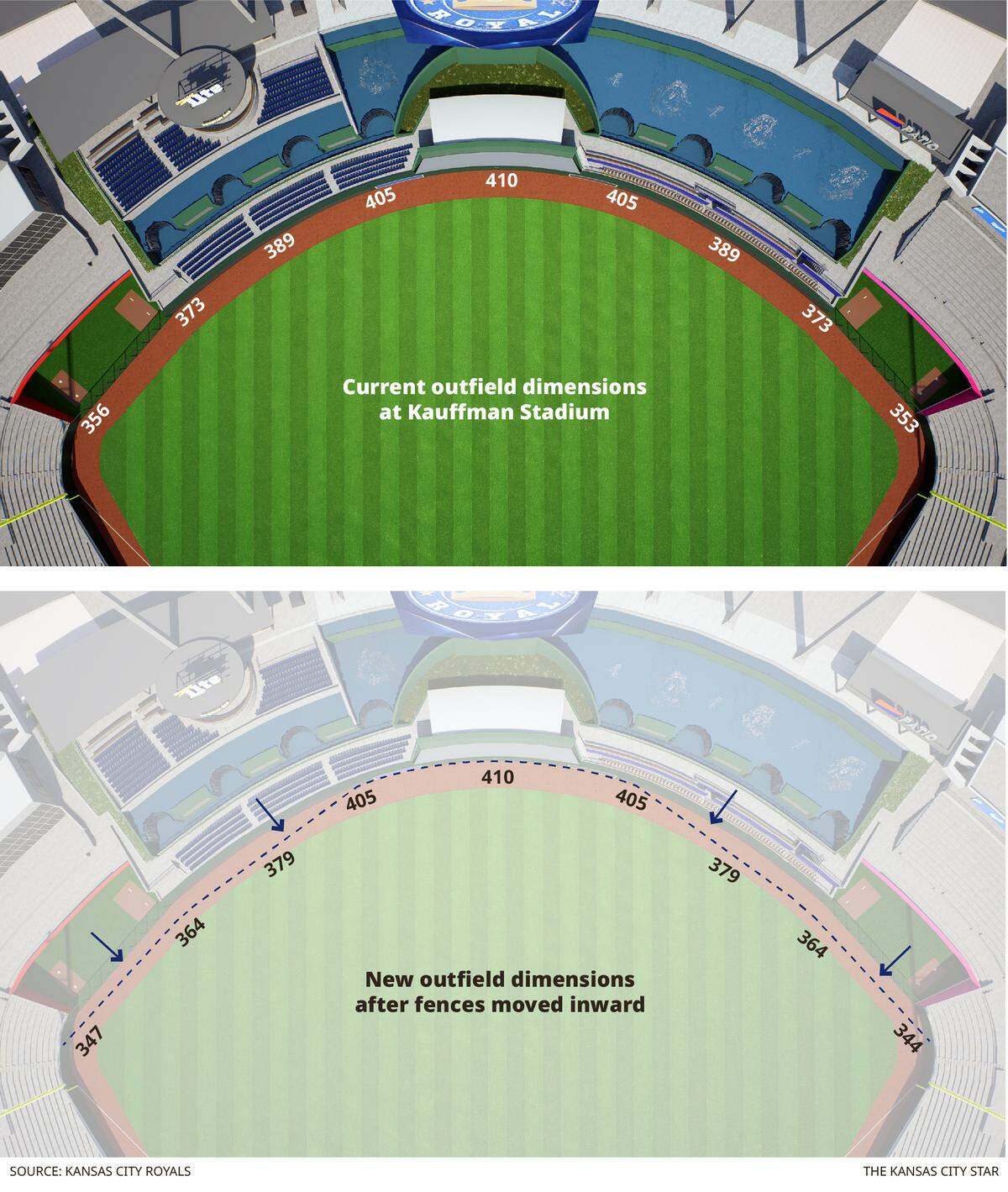
The Royals announced Tuesday that they will bring in the Kauffman Stadium fences by about eight to 10 feet — other than straightaway center — in time for Opening Day in late March.
It’s a glimpse, if not a trial run, into what a new stadium might entail. Eventually.
It’s an even better glimpse into the team they might put in a new ballpark — and the team they already have.
There’s a compelling turn-over-every-leaf element to the forthcoming change. The Royals didn’t arrive here on a whim, nor to appease the complaints of the hitters who have more than a time or two rushed to their phones after a game to study their own launch angles and exit velocities, trying to compute how in the world a fly ball didn’t leave the yard.
This was a months-long, even years-long, process. Daniel Mack, the team’s assistant general manager for research and development, talked Tuesday about how wind played into the placement of the fence. If you attended the news conference, you walked away saying, they thought of everything.
But there’s a far more compelling output from the data:
When the Royals spin the wheels on their internal projections, it shows that moving in the fences averages to about 1.5 more wins in 2026. In a search for every competitive advantage, the Royals believe they found one in changing their stadium dimensions.
How?
Well, their pitchers induce soft contact at a higher rate (17.3%) than any team in baseball and hard contact at the seventh-lowest rate (31.7%) in the league. The pitching staff will suffer some consequences, in other words, but not as much as their hitters will benefit, and their data shows star shortstop Bobby Witt Jr. will benefit as much as anyone.
“When we looked at similar ballparks with our current pitching staff, the results are still very good in what would be similar to the new Kauffman dimensions,” general manager J.J. Picollo said, adding, “The group that we have right now in a small window where this stadium is still going to be in existence — we had a chance to capitalize.”
It’s a fascinating development, really, particularly if it’s additive to roster supplementation rather than a replacement for it.
But what’s more fascinating: That everything above is already true, because they’re not making this change without that reality.
Royals general manager J.J. Picollo said he doesn’t anticipate this will change the team’s identity. That might be true, but only for one reason: They already have changed their identity, at least to a degree.
For years, the Royals have been built on defense and baserunning, not only because it’s their preferred style but because their stadium demanded it’s part of their DNA. That DNA won a World Series. It’s not that they no longer want to be a good defensive and baserunning team.
But last year, they converted a second baseman into their opening-series left fielder, and they converted a rookie first baseman into their right fielder for 52 late-season games. They lived with the 15th-rated left field defense and the 23rd-rated right field defense, per Fangraphs, so long as they could try to get a little more offense in the lineup. This, from a team that long considered it vital to collect three Gold Glove caliber outfielders, because you had to prioritize covering the spacious Kauffman Stadium.
We’ve already extended the compare-and-contrast exercise to the 2014-15 teams well past its expiration date. But rarely has there been such a definitive sign of the difference between past and present.
Those teams thrived from the idea of the ball in play.
This one just made a field dimensions change that will more easily put the ball out of play.
They don’t need to adjust the roster to accommodate for bringing in the fences, because the roster beat them to the punch. It’s B then A, not vice versa.
The new dimensions are designed to meet the roster where it sits.
And where it’s going?
You can’t help but wonder about the trickle-down effect — how it will alter roster decisions in the future. The Royals haven’t exactly been shopping on the top shelves in free agency over their history, but they’ve targeted a specific type of outfielder — one who can play above-average, if not elite, defense — because the stadium demanded they prioritize it.
The new Kauffman Stadium will remain in the top-10 of outfield ground for which to account — it’s not one end of the spectrum to the other — but they just made the defensive assignments of the corner outfielders a little less demanding. They therefore just widened the range of acceptable targets.
Well, so long as they hit it out of the park.
Those two spots in the Royals lineup didn’t hit a year ago. The outfield movement will add home runs but will subtract some singles and maybe even some doubles and triples, too. Those long balls need to come from the corner outfielders, but those are the spots whose defensive jobs just got a little easier.
It should lighten the load in the field.
They need to carry a bigger stick at the plate.
This story was originally published January 14, 2026 at 6:00 AM.