Inside the Royals’ decision to move the outfield wall — and what they hope follows
AI-generated summary reviewed by our newsroom.
- Royals will move outfield walls 8-10 feet inward and lower height to 8.5 feet.
- Club projects these changes could add roughly 30 team home runs and one per series.
- Front office framed the change to normalize park effects and improve hitter outcomes.
Kansas City Royals general manager J.J. Picollo hopped on a conference call with the majority of the club’s 40-man roster.
He had news to share.
On Tuesday, the Royals announced plans to move their outfield walls in at Kauffman Stadium. The decision was made to better align with typical Major League Baseball ballparks and generate more offense.
“I think every one of our players know we wouldn’t do anything to hurt our team,” Picollo said. “You know, when you really break it down in a simple way to explain it, we believe this benefits our team. And in the end, we had a very supportive group.”
The Royals will bring the outfield wall in about 8 to 10 feet — starting near each foul pole. The outfield gaps will move from 387 feet to 379 and taper back toward center field, which remains at 410 feet.
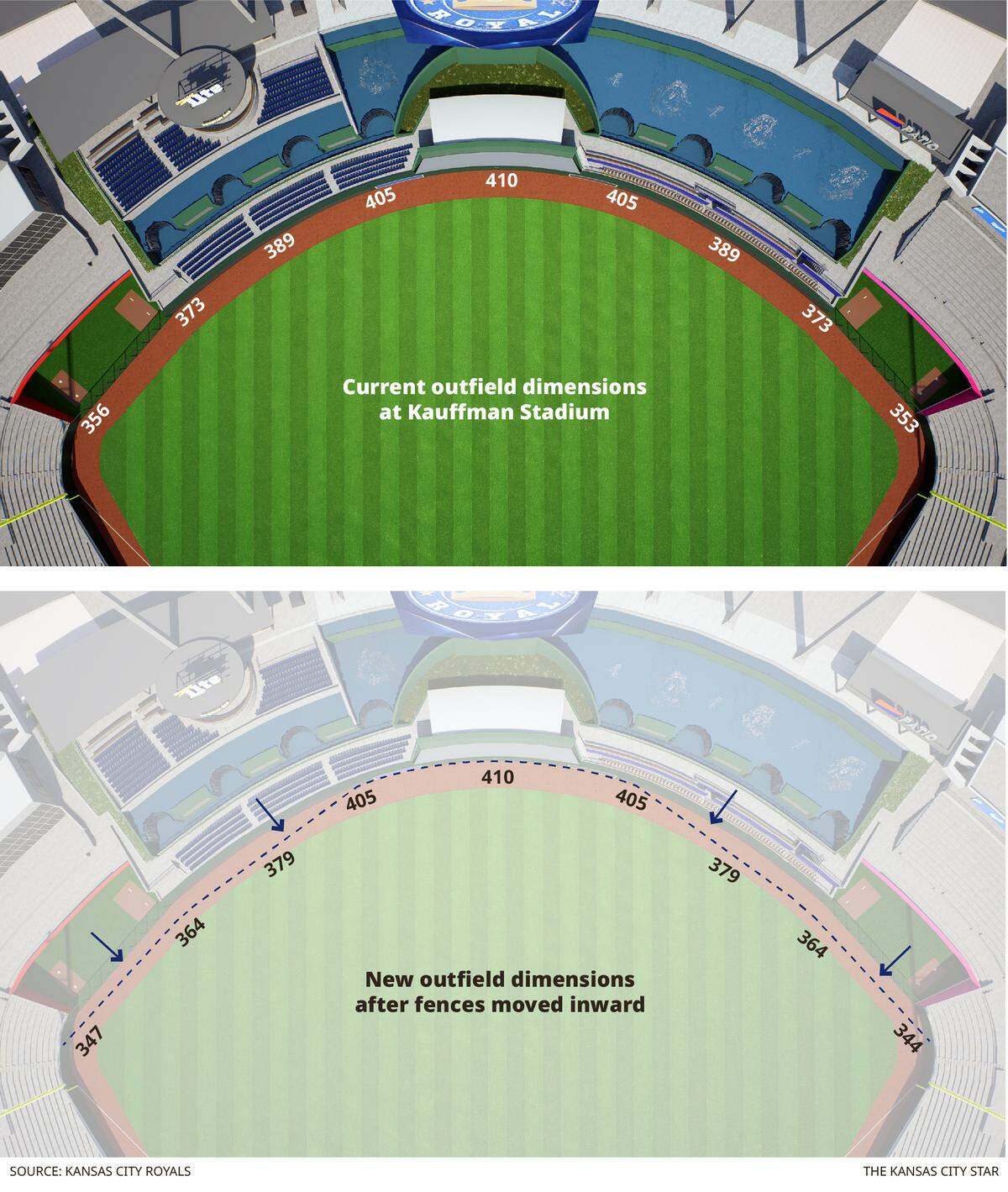
KC also decided to lower the height of the outfield wall from 10 feet to 8 ½ feet in most places. The club is adding 150 seats in left field and around 80 new drinkrail seats in right field.
The changes are expected to lift the offense.
“We play 81 home games and we are on the short end of some offense simply because it’s a tough ballpark to hit the ball out,” Picollo said.
The Royals said they conducted extensive research in recent months. They were ranked in the bottom third of run value for flyballs at Kauffman Stadium. It was simply difficult to hit baseballs out due to multiple factors.
Royals assistant general manager Daniel Mack led the research project. He found that certain wind trajectories affected how far the ball traveled. And it was happening often.
“It’s one of those ballparks where the wind, on average, hurts us,” Mack said. “It’s as if our park plays, with the walls, about 5 feet further back on average.”
The Royals hope to strike an offensive balance. The club hopes that with a new outfield there won’t be a significant difference between playing in home and away games.
“We think that’s a better way for our hitters,” Mack said. “They don’t have to worry about playing in one offensive space 81 times and then play across the entire spectrum the rest of the time when they go on the road. It’s something that gives them a sense of consistency and fairness.”
Last season, the Royals could’ve benefited from the new dimensions. In March, Royals second baseman Jonathan India nearly hit consecutive homers against the Cleveland Guardians. He belted two flyballs that traveled 368 and 343 feet.
Both flyouts might’ve played differently with the new outfield layout. Instead, they represented two routine outs.
The Royals estimate the new outfield dimensions could’ve contributed to around one more home run per series. In total, the Royals could’ve had 30 more home runs as a team.
“The hitters are going to have a better chance to be rewarded when they hit a ball well without the ball being caught,” Picollo said.
The Royals have the potential to be a high-powered offense. The club has three All-Stars in Bobby Witt Jr., Salvador Perez and Maikel Garcia. Additionally, Vinnie Pasquantino posted a career year in 2025 while Jac Caglianone and Carter Jensen are seen as top-level prospects.
Witt is among the best contact hitters in the league. He now has more opportunities to elevate his extra-base totals. Meanwhile, Caglianone has immense power that could develop with more hitter-friendly confines.
“(Witt) is one of the players that was probably most negatively impacted by our ballpark when it comes to flyball run production,” Picollo said. “So we have reason to believe that his production will go up.”
The Royals are expected to move out of Kauffman Stadium when their lease expires following the 2030 season. The new outfield dimensions will remain throughout that time frame as the club embarks on its final five seasons at the venue.
It serves as a chance to see if there are any advantages with the current group of players while also projecting for the future.
“The group that we have right now, in the small window where this stadium is still going to be in existence, we had a chance to capitalize,” Picollo said.
The Royals expect the outfield project to be complete in time for the home opener on March 30 against the Minnesota Twins.
“I think it’s going to impact our hitters in a very positive way,” Picollo said. “More than anything, we’re going to keep emphasizing that we want our guys to maintain certain approaches that fit their style of hitting that will work here and work on the road.”
This story was originally published January 13, 2026 at 5:40 PM.