
Forget the record for a moment. Here’s what to like about the Royals this year
In early December, just about a week after the Royals announced him as their next pitching coach, Brian Sweeney took a detour after baseball’s winter meetings in San Diego.
Instead of traveling home, he flew up the coast of California for dinner with Kris Bubic. They talked mostly about life, as Sweeney recalls now, but at some point the conversation turned to baseball, and at some point that conversation turned to a specific pitch.
A slider.
Funny thing is, they’d both been thinking about the pitch for quite some time. Bubic wanted to throw it a year ago, but that coaching staff turned him down. Sweeney actually brought it up in his interview for the job.
So there they sat, Sweeney hoping Bubic might be on board with his idea, and Bubic hoping to be able to persuade Sweeney of the same concept.
Which prompted an exchange like this:
“So what do you think about throwing a slider?”
“Oh, man, I’d love to throw it.”
“Go get it.”
That was that.
The 2023 season is just two weeks old, young enough that we’re still in small-sample-size territory but old enough that we can dig into the early returns on the most important changes the Royals made this offseason.
The pitching.
I realize the timing of such a column might be a bit unusual, given that starter Brady Singer got knocked around by the Braves on Friday at Kauffman Stadium. But this is about the big picture, not a reaction to one outing. About what we can learn from the entirety of the initial 14 games. About what it means for the future.
The headline? There’s a lot to like.
A lot that can improve, sure, but a lot to like. And a heck of a lot more to like than at this time a year ago.
The Royals have some early success stories — so maybe they’re more like success chapters. For the entirety of last season, the gripe here was not only that the Royals’ totals were bad, but the individual success stories were so infrequent.
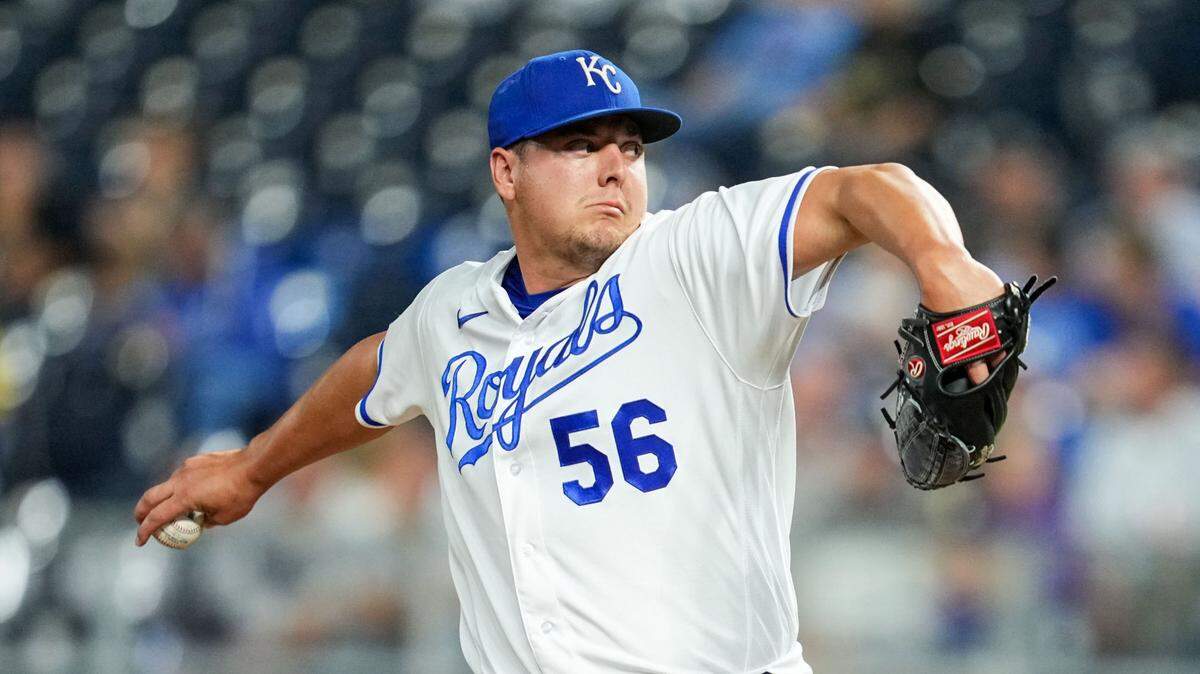
Bubic has a 1.64 earned run average through two starts this season. Thirteen strikeouts. One walk.
He started 27 games last season, and not once did he allow just one run over the course of consecutive starts. Only one time did he limit consecutive starts to one walk.
In other words, his first two starts this season are far better than any consecutive starts he had all of last season. He looks like a different pitcher because he is a different pitcher, at least to a certain extent.
Because his best pitch now? The slider, according to the Stuff+ metric. You know, the pitch he was told not to even try throwing a year ago. The pitch Sweeney made a point to bring up in his interview this winter because he felt like Bubic just had to use it.
That wasn’t just pulling an idea out of the hat, either. Bubic, a left-hander, struggled against lefty hitters to the point where he said he lost confidence throwing to them. With good reason — the lefties hit .372 against him.
“We looked at the whole person — the delivery, the pitch profiles, the plan of attack and the performance. Why isn’t he getting lefties out?” Sweeney said. “Well, it’s basically fastball-changeup with the occasional curveball.
“Why doesn’t this guy have a slider? I brought that question up. Wouldn’t you know it, it was in his head already. He had a vision for it.”
To be clear, this would be worthwhile if it was simply a Kris Bubic story.
It is not simply a Kris Bubic story.
It is early proof — and the hope is not too early — that the coaching plays a significant role, even at the highest level of the game. It is proof than the Royals are headed in a new direction, and in a more effective direction.
And I say that knowing the record is 4-10 after Friday night.
I say that knowing the other numbers too.
In spring training, the Royals made a point to throw more strikes — as simple as the game plan can get. Truth is, they talked about it a lot the previous spring, too. This time, it was identification of the problem ... and then the solution.
The Royals have moved their catchers closer to the plate to put them in better position to receive (and frame) pitches as strikes. Those results might represent the biggest internal improvement to date. Beyond it, though, for some pitchers, the catcher lines up directly behind the plate, rarely moving from side to side, especially early in counts. And the pitcher is told to throw the ball down the middle.
We delved into that philosophy this spring. So, the results?
The Royals are throwing more first-pitch strikes, more strikes overall and more pitches that fall into the zone (a metric that that doesn’t even take into account the improved framing jobs). After the second-to-worst walk rate in baseball last season, they have walked the eighth fewest hitters this year.
Those are across-the-board numbers — and often the numbers that are most predictive of future.
The totals are improving.
But they are individual cases, too. And the anecdotes matter. The one-offs matter.
Bubic is one.
Brad Keller is another.
Again, almost immediately after landing the job, Sweeney texted Keller about adding a curveball to his mix. He then took photos of himself gripping a baseball a few different ways, offering Keller some options to work with as he attended Driveline Baseball. Keller couldn’t get much of a feel for the first two. The third, a spike curveball that Keller never imagined himself being able to throw, stuck.
And quickly. In a spring outing, Keller struck out nine batters. All came on curveballs.
“I’m no longer working on a feel,” Keller thought at the time. “This is a weapon I can use to get the hitter out.”
The initial plan was to use it to get some early strikes to left-handed hitters. He’s using it against righties now, too, and as an out pitch. Keller is 2-1 with a 2.12 ERA through three starts.
The takeaway here isn’t that 40% of the rotation is operating with new pitches. It’s how they arrived at the decision to use them.
Coaching.
New coaching.
These examples aren’t small tweaks but rather significant changes. Some of the alterations apply to all; some are reserved for specific individuals.
Look, I don’t know what the Royals’ final record will be in 2023, though there are metrics that suggest it will at least be better than it was a year ago. But I do feel confident in saying they are in a better position to judge the talent they actually have. Because they are putting that talent in a better position than they ever have.
It’s a first step.
And one they stumbled over in the past.