
Sporting KC’s rationale for its woeful start will soon expire. Results need to follow
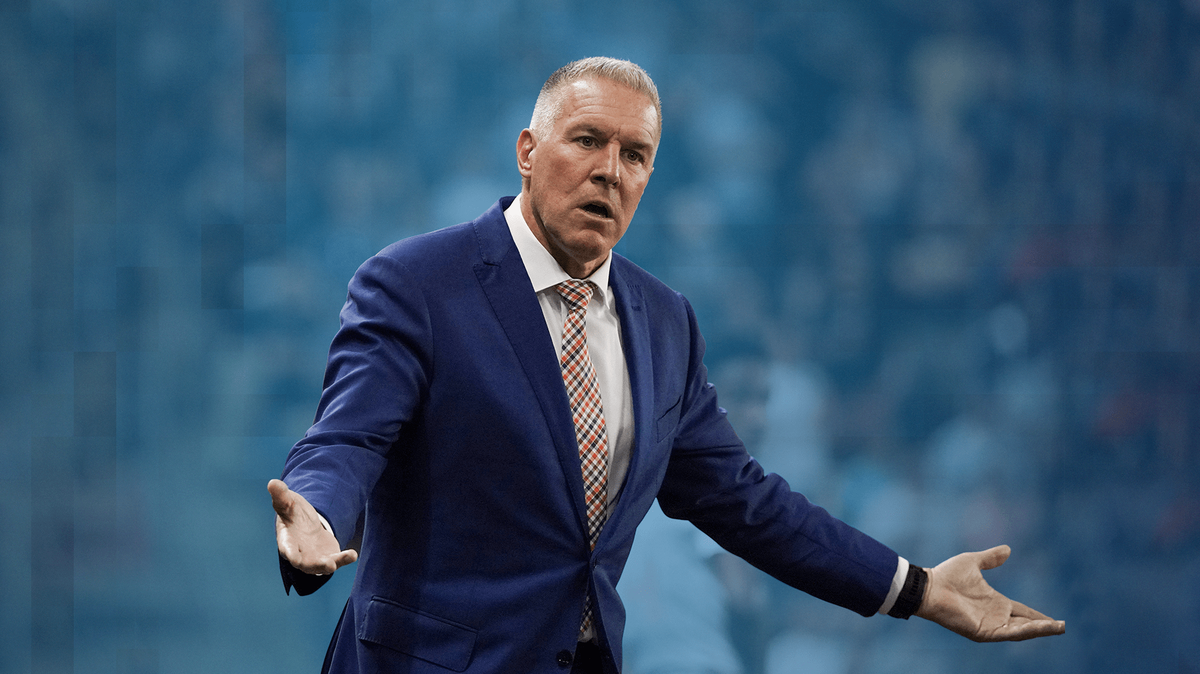
The door opens to the office of Sporting Kansas City coach Peter Vermes, and he plants himself in a black chair in the middle of the room. Over his left shoulder, the wall is draped with tokens of the organization’s past — and, in turn, his own past, because the two have become increasingly synonymous.
As of late, though, the decorative wall presents a stark contrast from the present day. Which is why, at this moment, Vermes is leaning forward in his chair, expanding every finger on his hand as he replies to a question.
“There are days I’m incredibly pissed off,” he says, and then he grabs his pointer finger and bends it backward. “So go down the line here. I’m angry.”
And then he reaches for the next finger. “I’m frustrated.”
The ring finger. “I’m embarrassed.”
And his pinky. “I’m disappointed.”
The word embarrassed piques my interest, I point out. Elaborate on that?
“I hate losing,” he says, before slowing his cadence. “I absolutely (bleeping) hate losing.”
So, yeah, that’s the backdrop for this hourlong meeting, and frankly why we’re here. Sporting KC has been doing a lot of losing lately — or at least it hasn’t been doing any winning.
In a 29-team league, Sporting is one of just two without a victory this season. We can’t write this off as merely an early season slump, either. The full context: Sporting is 11-20-10 since the start of 2022. Eleven wins. In 41 matches. A franchise that hasn’t missed the playoffs in back-to-back seasons since its rebrand has dug quite a divot.
For that matter, one of the league’s most historically consistent franchises is strikingly inconsistent, enough that the recent history might be snowballing into the current results. Enough that part of Vermes’ job now is to coach against doubt. The conversation will get to that.
But it opens as general as possible.
How do you explain the results?
The response spans nine minutes, but the theme of it can be found in a couple of sentences sandwiched into the middle.
“No matter how I phrase it, what I’m going to say can easily be viewed as an excuse, but I’m not using it as an excuse; I know what the reality is in my world,” Vermes says. “The facts are (that) since the start of last season, we just haven’t had access to our entire roster. And that has created inconsistency, and that inconsistency has led to poor results.”
It is not a particularly surprising reply (or part of a nine-minute reply) if you’ve been paying attention for the past 15 months, but let’s take a ride down its plausibility.
Sporting KC is 20-8-7 with striker Alan Pulido, the most expensive acquisition in club history, in the lineup, and it is 20-28-13 without him. That’s a difference of 0.72 points per game.
Sporting is 12-3-4 with both Pulido and Gadi Kinda in the starting lineup. They are, guess what, better when the two of their very best players are actually on the field. Same as most teams in the league. Same as most teams in any league. This is kind of how sports work.
But the inverse is also true: Sporting has not done enough to cover for absences, even as it might feel like playing with one arm behind its collective backs. It used to pride itself on being bigger than one or two players, and if injuries are an significant part of the conversation, the organization has lost some of that ability.
Whether you agree or disagree with any of the above, though, it’s actually getting off track. Or it soon will be off track.
Here’s the track: As Vermes directly points toward the injuries as the primary rationale for the standings, he is actually indirectly pointing elsewhere for the upcoming results.
To himself.
Pulido made his first start last weekend against Colorado — a game that felt like a get-right opportunity that only bubbled into a what-else-can-go-wrong evening. Kinda is on target to return late this month.
In other words, the rationale that has accompanied too many news conferences for a year-plus is on the verge of extinction. They’re getting their big names back. With that internal sigh of relief should come the external weight of pressure.
The other side of the Pulido and Kinda returns leave nothing but the roster that Vermes has assembled, managed and coached. His status atop every pillar within the technical side of the organization is something of a relic within the league. It’s a luxury that carries a counterpoint.
Responsibility.
His responsibility.
The injuries have shared that burden for a year and a half now. But absent those, the responsibility narrows to one. That’s not only how it should always work, but especially how it works in the logic of this conversation.
I pointed that out in some form, by the way.
If it’s true that the injuries are responsible, or even largely responsible, for this run, then by that logic the results will turn soon after you get these guys back.
“I know this might be bold statement, but I don’t think we have a good team — I think we have the potential to have a great team,” Vermes replied. “When we’re completely healthy, I think we’re going to be there.”
There is some danger in the long-lasting assessment — and we discussed my forthcoming opinion on this, as well — in that too much focus on what you don’t have can prompt you to fail to see all that’s wrong with what you do have.
Sporting doesn’t change much in terms of personnel, on or off the field, and while that consistency was once the feather in the cap of a franchise with the results to back it up, those results haven’t been there for a year-plus. Believing the return of a couple of players will solve all of that, or even most of it, has the potential to create a blind spot for what else could be to blame for the standings.
Sporting’s defense was a mess last season, for example, allowing the second most goals in Vermes’ tenure, and it’s hard to believe a couple of healthy attacking players would have precipitated a complete about-face there. As the defense has much improved this year, a true silver lining if Pulido and Kinda can infuse the other end of the field, the offense has all of two goals. Two. Sporting operated with its full lineup on the front line last weekend and still got shut out.
These are the kind of numbers that prompt NFL teams to search for new offensive coordinators or MLB teams to find new hitting coaches.
Sporting KC dominated the Colorado match and still lost, and those kinds of nights predated Pulido or Kinda’s arrival. That can’t all be attributed to who isn’t on the field.
“I think there’s individual guys that are trying to do a little too much,” Vermes said.
Wouldn’t that be a product of where you guys are? Of where you have been?
“Yes. We’re overcooking it a little bit. For sure.”
It’s not hard to find the examples. Sporting KC missed back-to-back penalty kicks in one game this season. Last weekend, the goalkeeper gifted them the ball in the box and they did not even create a shot, let alone a goal. The team practices penalty kicks. The team practices wide open chances in the box.
That’s the snowball effect I mentioned earlier. In the ever-changing world of coaching, the mix has necessitated Vermes coach doubt. Rather, coach against doubt. He has actually made a point to demonstrate to the players what they are doing right.
There’s a candidness to Vermes that shows when he admits that — a question most would evade, for that matter.
“The solutions are right here,” he said, and then he directed his hand toward the facility’s locker room. “The solutions are right there. Eliminate the doubt, and that will get us through.”
Sporting has its most capable goal scorer — most expensive, anyway — back in the lineup. Its most creative midfielder will follow.
Will the results?
They’d better, right?
“All of those adjectives I used to describe how I feel, I’ll say this,” Vermes said. “There’s not one of them — not one of them — that in any way shape or form paralyzes me from coming up with the solution and believing that we already have it here and we can do it.”
This story was originally published April 14, 2023 at 7:00 AM.