How Andy Reid & Matt Nagy call offensive plays for Chiefs — and why it’s so effective
Joe Bleymaier wasn’t sure this would work — and he wasn’t the only one.
Bleymaier was a Kansas City Chiefs pass game analyst for the 2019 season, and he watched from the press box when coach Andy Reid decided on a man-coverage-beating pass during a home game against the Denver Broncos.
It didn’t make sense. Based on all tendencies Bleymaier knew (and had researched), then-Denver coach Vic Fangio never played man coverage with this red-zone down and distance — or at least he hadn’t in this current season.
And someone else was puzzled as well: Chiefs quarterback Patrick Mahomes.
“When the play came in,” Bleymaier said, “even Pat was like, ‘Are you sure?’”
Yes, Reid was.
A few seconds later, Bleymaier watched as the Chiefs ran a legal pick play to perfection, knocking Broncos defenders into each other. Receiver Tyreek Hill caught the pass, going untouched into the end zone before celebrating his touchdown in the snow.
As Reid expected, the Broncos had gone against all tendencies and attempted to play man coverage.
Even when Bleymaier — now the Chiefs’ pass game coordinator — never saw it coming.
“Those years of experience,” Bleymaier said of Reid, “are just priceless.”
And they also shine through thanks to the way the Chiefs organize their offensive operation.
Reid had continued a trusted method — one that began when he was a Green Bay Packers assistant in the 1990s and has carried on through this week, when the Chiefs play the Philadelphia Eagles in Super Bowl LIX.
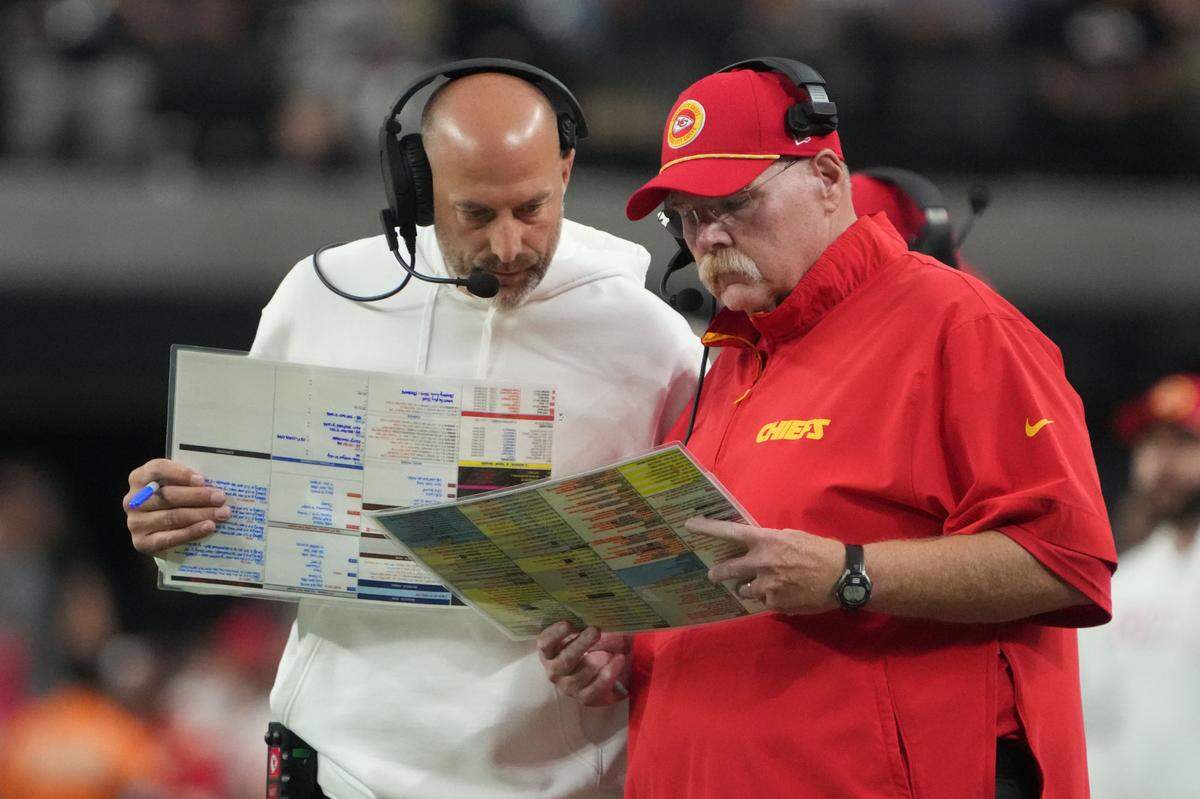
KC calls its offensive plays in a way that is different from many other teams in the NFL. It’s a process, though — from Reid to offensive coordinator Matt Nagy to Mahomes — that has remained effective even through decades of use.
The Chiefs’ play call will have gone through three different iterations from the time the play clock starts at 40 seconds and trickles down to 15. It is a high-stakes game of telephone that only reaches peak form when hours of study combine with an obsessive focus on each syllable.
And the Chiefs, at this point, seem to have nearly perfected their hidden journey.
Andy Reid’s role as play-caller
Chiefs receiver Rashee Rice caught the Week 1 pass over the middle, taking it 16 yards against the Baltimore Ravens before being tackled from behind.
If there was any doubt at all, let’s be clear about who on the Chiefs’ coaching staff decided on this play call:
It was Reid — in a specific and succinct way.
When it finally reached Mahomes’ helmet, this call eventually included terms like “Gun trey left” and “Buster zebra.”
But for the original thought — spoken over the Chiefs’ headset — Reid only uttered one word.
“Honeycomb.”
A shortened version of a whole play is how every Chiefs play starts from Reid.
There’s good reason behind this step. Sure, Reid could call the play himself to Mahomes if he wanted. And he certainly knows all the details that the QB needs to execute the play correctly.
But Reid is also the head coach. Other things require his attention, and as a play-caller, those details are often are more worth his time.
How is the offensive line looking? What coverage is the opponent going with? Is the QB shaking off his last hit OK?
Reid can’t observe any of that if he’s constantly staring at his call sheet.
“I think it just allows Coach to get in that flow, in that rhythm,” Chiefs quarterbacks coach David Girardi said. “Anticipate what he wants to get to next.”
Make no mistake: Reid’s play-calling decisions still have to come quickly.
The Chiefs coach’s box helps some. When the ball is spotted, assistants alert Reid to the exact down and distance while also pointing out any game-situation tidbits he needs to know.
In the 10 seconds it takes for the play clock to go from 40 to 30, Reid — almost always — has shared his play-call selection with Nagy.
Marty Mornhinweg, who worked with Reid at four different stops and was his longtime offensive coordinator with the Philadelphia Eagles, says Reid’s decision-making in this setting is one of his great strengths.
“He’s very efficient, very fast,” Mornhinweg told The Star. “Play’s over — boom. The call comes in.”
Matt Nagy’s job as a relayer
Matt Nagy wasn’t just nervous; he admits now he was “scared to death.”
This was 2016 — his first year as Chiefs offensive coordinator — when he realized just how difficult his new gig was about to be.
“There’s a major process that goes behind it,” Nagy said. “And as a young guy, as you get started, it takes time.”
And also memorization.
For each short play call he was about to receive on game day, Nagy needed to know the formation and personnel — and also how to change the call based on whether the Chiefs were on the left or right hash mark.
So he started a weekly tradition. Each Tuesday night, Nagy grabbed his team’s laminated play-call sheet and walked out to the Chiefs’ practice facility.
There, he walked in laps around the field for an hour, starting from the top play and reading to the bottom as a way to both study and memorize.
Nagy kept up that routine for the next year and a half.
“It was something I had to do,” he said. “And it just made me feel better and more confident.”
Now in his second stint as the Chiefs’ offensive coordinator under Reid — and his fourth season with the job overall — Nagy said he’s gotten to a point where “we have it down pretty good” with getting Mahomes the play before each snap.
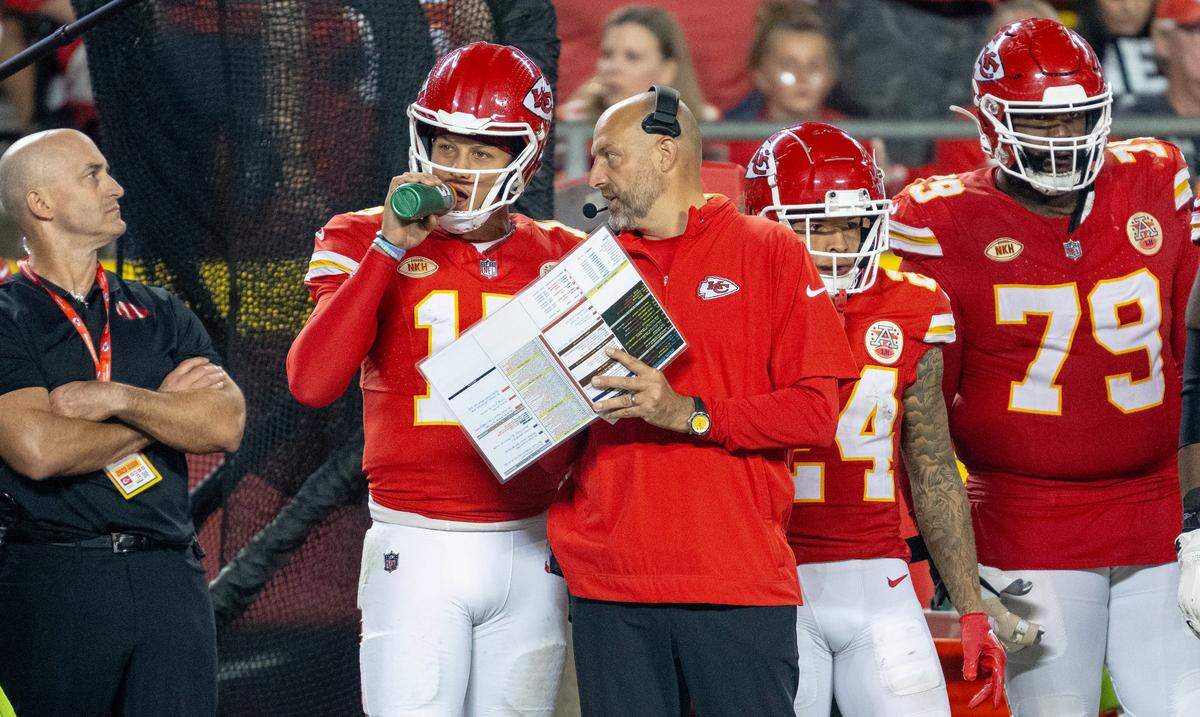
Not that the process should be considered easy.
Nagy’s role as a “relayer” here is multifaceted and critical. Once he hears a short phrase from Reid, his job is to locate it on a 400-call play sheet, then deliver the 12 words or so to Mahomes with full information on shifts, movements and formation.
He’s also racing the clock. If Reid’s job is completed with 30 seconds on the play clock, Nagy aims to get it to Mahomes with 20 seconds left.
There’s an art, though, to how Nagy communicates these words to Mahomes.
‘You’re almost telling a story’
For one, Nagy says he tries to make his words “rhythmical.” He starts with the play call, then gives the formation, and then repeats the play call again.
Mornhinweg says that tradition stems back to the ‘90s and early days of coach-to-QB communication, when the headsets went out frequently. Reid liked having Mornhinweg give the full play call at the start; at least then, the QB would still have the play if the technology failed.
The call isn’t like reading a sentence in monotone, though. Girardi says, “You’re almost telling a story when you call a play,” with Nagy utilizing voice inflections on certain words.
Two different play calls might sound similar, or a motion might need some emphasis so it’s not skipped over.
Girardi said these are the times when Nagy’s enunciating can play a significant role.
There’s also the potential to help Mahomes outside the actual call.
The offensive coordinator’s microphone turns off with 15 seconds left, meaning there can be a moment or two left at the end if Nagy wants to remind Mahomes of a specific read, or diagnose the type of defense that’s on the field.
It’s a delicate balance, though. QBs typically don’t want to hear that type of advice before every play, meaning Nagy must pick his spots when deciding to give that one extra reminder.
“That’s a skill,” Bleymaier said, “and that’s just reading the quarterback from 30 feet away.”
Which leads to the attribute Mornhinweg said was most important when he relayed calls to the field under Reid:
Trust.
He said the process went smoothly 99% of the time, as he and the QB executed their roles.
But that other 1%? When he said a wrong word that changed up a run play, or his quarterback didn’t repeat things correctly in the huddle?
That’s when a strong relationship between quarterback and offensive coordinator became so critical.
“Communication — that is so important throughout the week, throughout the offseason, throughout training camp,” Mornhinweg said. “Honesty equals trust.”
Chiefs backup quarterback Chris Oladokun says he’s been impressed by Nagy’s ability to encourage Mahomes throughout games, while also speaking clearly about what he needs from the team’s leader.
“Whether highs or lows, always talking to Pat, ‘OK, you’re doing great, man. Hey, let’s get the guys going,’” Oladokun said. “So it’s a really good, smooth, communication system with him.”
What Patrick Mahomes does next
Girardi says there’s one surefire way for an NFL play to fail.
And that’s for a quarterback to repeat it without conviction in the huddle.
“You’re a salesman out there, too,” Girardi said. “Pat does a great job, but when he’s calling that play, the guys believe the play is gonna work, period. And part of that is the way Pat presents it.”
Girardi has been around him enough to know. He’s seen Mahomes repeat the words from Nagy with similar tempo and emphasis, all the while sending the type of message Girardi appreciates:
“We’re gonna rip their heart out with this play.”
“Every play you feel like you’re going to be able to go out there and execute,” Girardi said, “the way that he commands the huddle and communicates.”
There’s also an underlying reason for that confidence, though. Oladokun said Mahomes has earned it throughout the week.
Quarterbacks can’t loaf with this particular play-calling setup, nor can they fake their way to success. To repeat — and decipher — the words from Nagy, Oladokun says it takes Chiefs QBs 3-4 hours of studying each day to ensure each formation, motion, shift and play is accounted for.
“By the time Sunday comes,” Oladokun said, “we can just hear a play, and we’ll know.”
Mornhinweg believes this point is part of the beauty of what Reid has built with this offensive formula.
The system requires a lot of moving parts on game day. However, getting to where it works appropriately also demands extensive work from coaches and players to ensure a smooth operation.
“It takes time and energy,” Mornhinweg said, “and you better put it in.”
That was also the case 15 years ago in Philadelphia, when Eagles quarterback Michael Vick played for Reid while hearing the play call come in from Mornhinweg in his helmet.
Vick said that he knew both coaches believed in him.
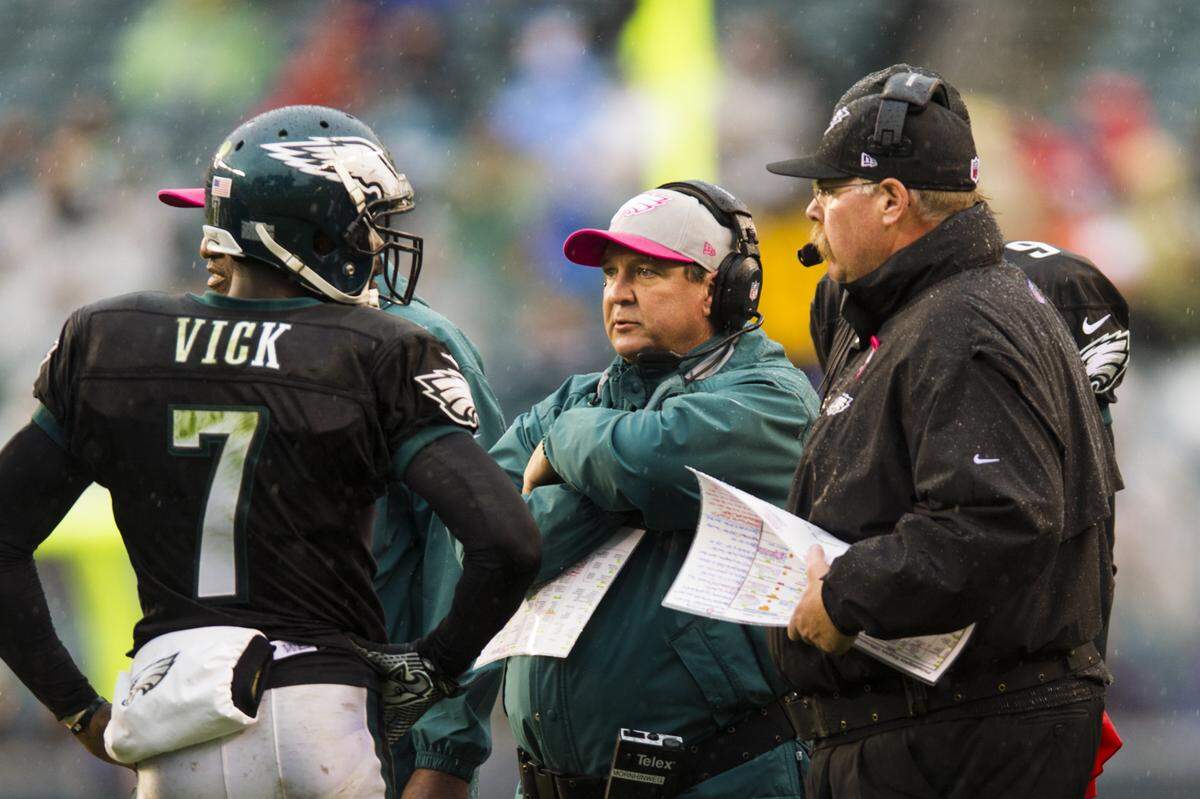
“Marty, Andy, they would always make sure that we were prepared,” Vick told The Star, “and that we weren’t gonna get out on the field, and there (wasn’t) gonna be a moment where you forgot the play or didn’t know the play or didn’t know the read or couldn’t execute, somehow, some way.”
Not that Mahomes wants to find himself in those panic-type situations.
In the final 15-20 seconds of the play clock, he must read the defense and also send teammates in motion. Being even a few seconds behind can throw things off routine.
The quarterback has been known to become frustrated — one example came in the Chiefs’ playoff game this year against Houston — when he receives the call on the field later than expected. Offensive coaches also know Mahomes’ famous “finger wiggle” hand motion is often a sign that he wants to get the next play quicker.
For the most part, though, this 63-times-a-game offensive ritual for the Chiefs occurs without incident.
And when that happens, the Chiefs benefit from what their unique system provides.
Playing to Andy’s strengths
Oladokun says that Chiefs teammates naturally talk about Andy Reid, the play-caller.
And the phrase that Oladokun hears most often? That Reid has, shall we say, cojones of steel.
“He’ll call anything in any situation,” Oladokun said. “We’re lucky to have him.”
Part of that, though, comes from the freedom Reid has given himself.
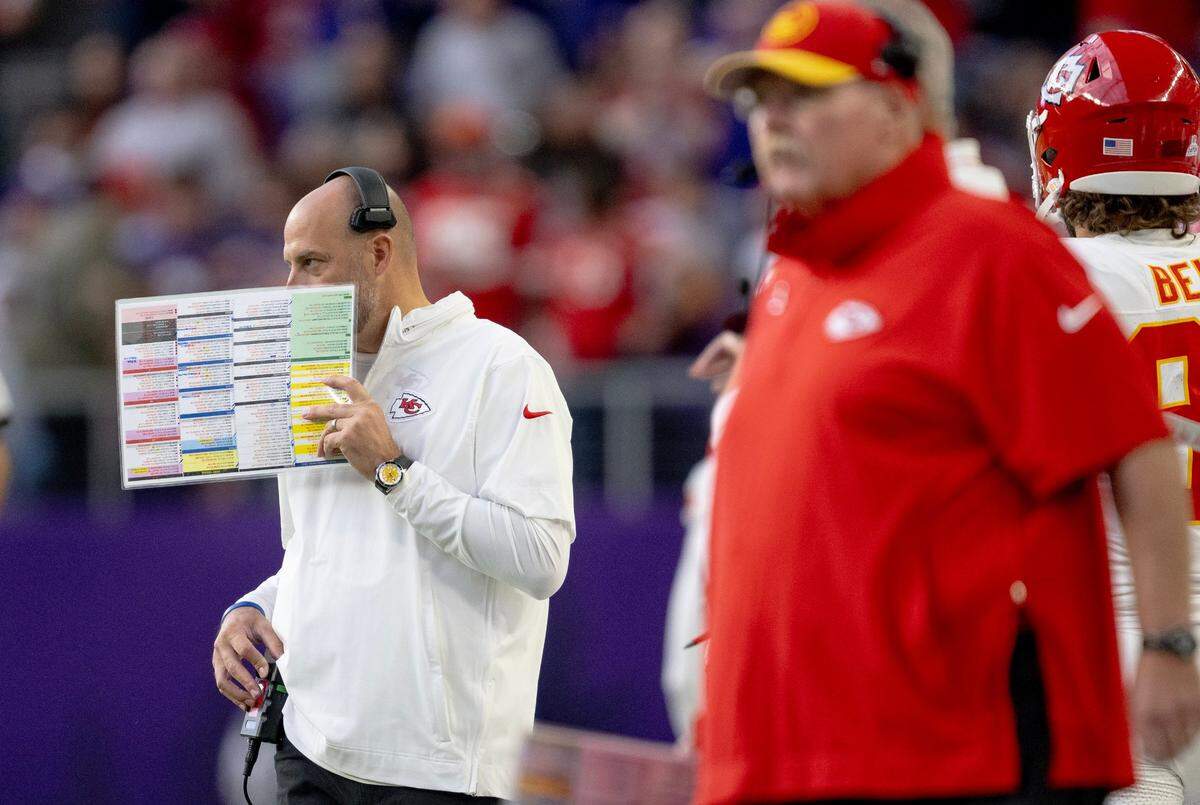
His ability to call plays — while not having to dwell on them — provides an edge many other coaches don’t have. Bleymaier says this allows Reid to go a step above in his whole-game analysis and “be at an even higher 10,000 feet.”
Reid gets another chance Sunday to display this rare gift. And he’ll also go up against Fangio again, who will lead the Eagles’ defense on the other sideline.
If Bleymaier has learned anything, it’s to trust Reid with whatever he dials up in Super Bowl LIX — as crazy or unorthodox as it might seem.
It’s all part of the genius.
And also part of the plan.
This story was originally published February 7, 2025 at 5:30 AM.