‘Perfect balance’: How Jeremy Guthrie has struck right chords in Royals TV booth
AI-generated summary reviewed by our newsroom.
- Jeremy Guthrie transitioned from MLB pitcher to a full-time Royals television analyst.
- Guthrie is part of a three-man rotation of color analysts with Rex Hudler and Eric Hosmer.
- He pairs pitching experience with extensive research to explain game strategy to fans.
Jeremy Guthrie tossed a baseball in the air.
As he entered the Kansas City Royals dugout, Guthrie was flooded with memories. There was his MLB debut in 2004 and World Series title in 2015.
And then, there were countless conversations with teammates. One of his most beloved teammates — Royals captain Salvador Perez — greeted him upon arrival. They shared a quick embrace and conversed in Spanish.
Guthrie, 47, lives for those quaint moments. Any time he can talk shop, throw the baseball around with his kids or appear in a Savannah Bananas game, he jumps at the opportunity to share his love of the game.
“I’ve been able to stay close to the game and kind of stay engaged with the movements of baseball because I love it so much,” Guthrie said. “I’m appreciative of what it has provided for my family and myself. And I’d like to keep doing it.”
This season, Guthrie is closer to the game than ever before. His playing days are over — albeit for the occasional game or two for a good cause — and he has stepped into a full-time role on the Royals’ broadcast crew.
Guthrie is a part of a three-man rotation of color analysts. He rotates alongside Rex Hudler and Eric Hosmer to join play-by-play announcers Ryan Lefebvre and Jake Eisenberg in the broadcast booth. The Royals also feature Hall of Famer Jeff Montgomery on broadcasts.
It’s his fourth year of broadcasting. After starting out on radio, he has seen his television responsibilities expand. Admittedly, Guthrie views it as a true learning experience.
“It’s not something I ever expected to do or thought about doing,” Guthrie said. “So every day is a learning curve as it would be for anybody. I think I’m really grateful to have Ryan, Hud, who’s been really great at sharing insight and advice. And then, the chance to work with Jake and even Stu (Steve Stewart) in my first year on the radio.
“Everyone on the entire broadcast team, Joel (Goldberg) has given great insights and been patient. The producers Kevin (Cedergren) and Harv (John Harvey) have been really helpful in helping me adjust.”
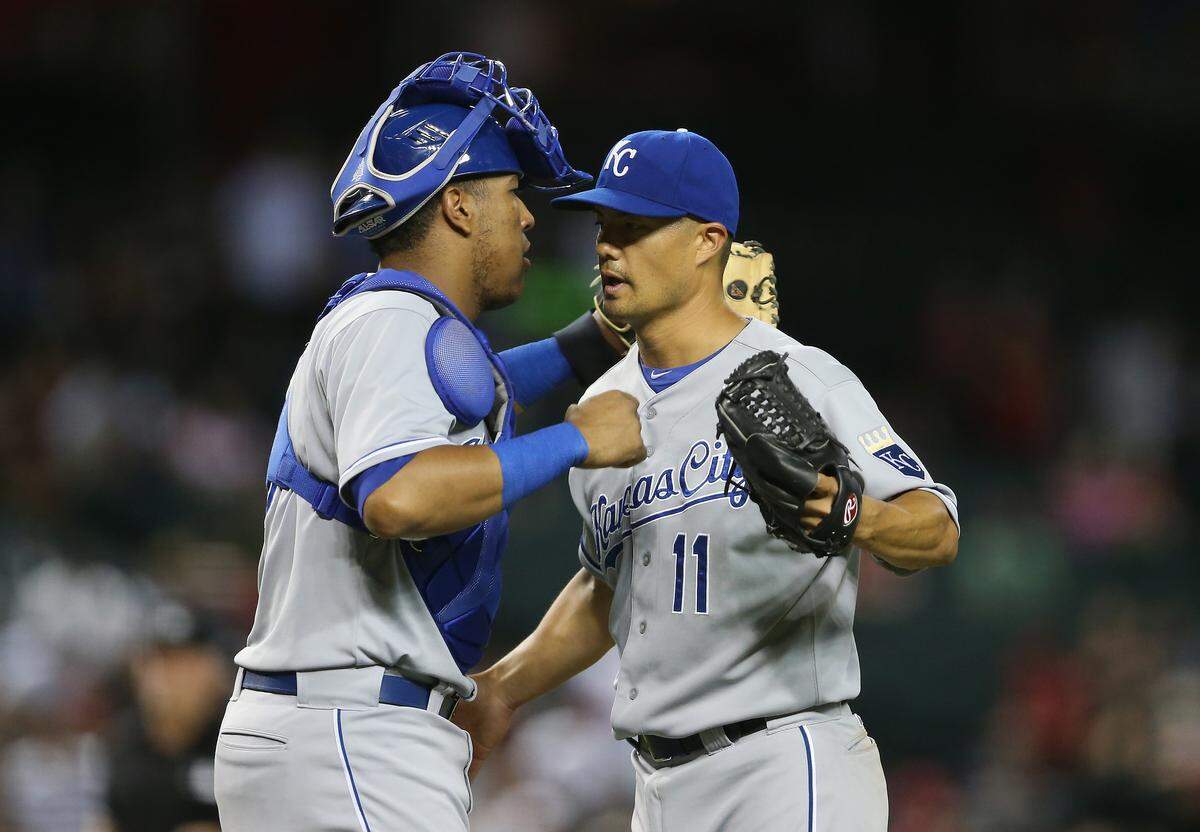
Guthrie spent over a decade with five teams. He began his MLB career with the Cleveland Indians (now Guardians) before playing for the Baltimore Orioles, Colorado Rockies, Royals and Washington Nationals.
He also appeared in the Dominican Winter League, Australian Baseball League and Mexican League. And there was a stint with Team USA during the 2009 World Baseball Classic.
Guthrie brings a lot of experience to the broadcast booth. In his career, he posted a 4.42 ERA in 306 games.
However, he understood that in-game knowledge can only go so far. In his new role, he needed to see the game from a different perspective.
“Jeremy embraced that from the very beginning,” Lefebvre said. “He’s not in the clubhouse talking to major-league coaches and teammates. So the way he communicates has to be different from that. And I think he’s found the perfect balance of taking his knowledge and being able to express it in a way where any kind of a fan can absorb it.”
Guthrie is an avid researcher. He can spend countless hours diving into statistics and connecting the dots analytically. He pairs his pitching knowledge with additional research to paint a clear picture for the audience.
Yet, he understands that everything isn’t so cut and dry. There’s a great deal of nuance that he continues to learn with each telecast.
“I hope I have some ability to take from my own career and try to help a viewer understand what’s happening and maybe why it’s happening,” Guthrie said. “At the same time, I don’t just rest on that: 15 years of professional baseball, there’s still a lot I don’t understand, especially having been just a pitcher. And on top of that, I’m learning about the game and the way it’s changed.”
The changes have been extensive. The league now has new innovations — such as the pitch clock and the ABS (Automatic Ball-Strike) system — since Guthrie last played in an official game.
Players have adapted to a faster game. Teams are more strategic and utilize analytics to find ways to win.
“I think you realize how valuable it was as a pitcher to watch the games,” Guthrie said.
To keep pace, Guthrie relies on his broadcast teammates. He has great chemistry with Lefebvre, and it comes across in the booth. The same can be said whenever Eisenberg has the call.
“My role as a play-by-play announcer is to focus on the analyst and bring out the best in the analysts,” Lefebvre said.
It helps that both Guthrie and Lefebvre have seen a ton of Royals baseball. Guthrie noted he saw thousands of games as a player. The ability to understand and equate player emotion across the air waves is a developed skill.
“The experience watching over 1,000 games as a teammate is really valuable insight,” Guthrie said. “Even if you didn’t play all the positions that you are now commenting on during a game.”
When he is not in the booth, Guthrie still finds a way to stay connected. He has been a part of multiple baseball clinics around the world. Some of his favorite spots were in Nigeria, Bulgaria, Brazil, Argentina and Taiwan.
Guthrie will also play in the East-West Classic at Rickwood Field on June 19. The special game will commemorate the Negro Leagues in Birmingham, Alabama.
He will play alongside fellow retired MLB stars. The list includes Hall of Famer CC Sabathia and former All-Stars such as Prince Fielder, Justin Upton and Mike Cameron.
“I can give you 85 pitches,” Guthrie said. “I can throw mid 80s and mix in some breaking balls and make it fun.”

Still, Guthrie knows it’s just baseball at the end of the day. Whether it’s broadcasting or spending time with former teammates, his passion for the game continues.
It’s been his life since childhood. Baseball opened doors for him to share his faith with others and learn about different cultures.
His family enjoys it as well.
“My 5-year-old daughter gets very excited when daddy’s on TV,” Guthrie said. “She gets to see me for the little open that we do at the beginning of each broadcast. And my 15-year-old son, who just finished his freshman year, I think he really appreciates it.
“Obviously, there’s a lot of interaction with the Royals, there’s some visiting teams as well, especially when there’s players that I played against. So, he asks a lot of questions and wants to understand the game better.”
Guthrie is happy to contribute in his current role. The Royals are like family, and he is honored to serve with the broadcast team.
“I enjoy it and want to keep doing it because it’s an avenue to meet people,” Guthrie said. “It’s an avenue to experience life in a unique way. And it’s an avenue to help people personally and also to help grow the game.”