After Royals announcement, what’s the future of Washington Square Park?
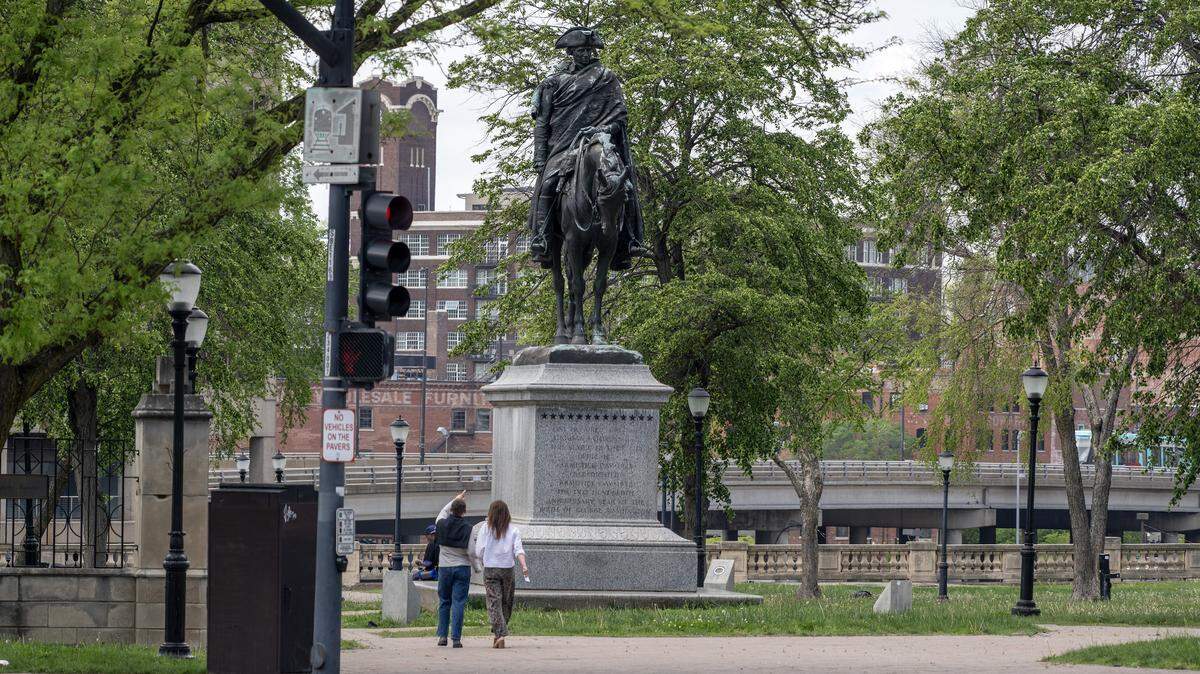
Tucked in the shadow of the shops, tourist attractions, law firms and restaurants that make up Crown Center, a century-old statue of George Washington stands guard in front of a five-acre park.
For the past two years, top city officials have touted this land, called Washington Square Park, as the perfect spot for a new Kansas City Royals stadium. Speculation over the possibility reached a fever pitch last month when parks officials authorized the city to negotiate a lease agreement with the Royals to use the park.
That narrative quickly collapsed when Royals majority owner John Sherman announced plans for a roughly $1.9 billion stadium at the corporate headquarters of Hallmark Cards, located less than half a mile from the long-discussed park site.
The celebratory announcement was met with cheers and sighs of relief, appearing to solidify the team’s home for the next three decades. But it also left a series of lingering questions about what, exactly, the team and city have planned for Washington Square Park.
The park, with rows of trees and pathways, sits adjacent to Union Station and along the city’s streetcar line. The city’s Board of Parks & Recreation Commissioners in 1925 secured the property, which is now home to the Washington statue and the Missouri Korean War Veterans Memorial.
In the wake of last month’s announcement, the Royals have floated several different ideas for the park. Sherman, in a gaggle with reporters, said the space “could be a great entrance to the stadium” and vowed to “preserve a good part of the square here.”
“The objective there … would be to really incorporate that and make that a gathering area, pre-game, post-game,” Sherman said. “When we get to the point where we can share a master plan, I think you’ll see that that creates a great gathering point and then promenade up to the stadium.”
A few days later, in a wide-ranging interview with The Star’s Vahe Gregorian, Sherman spoke in generalities about how the team planned to use the park itself. He reiterated the idea of a gathering place and referenced the possibility of tailgating, a beloved tradition at the team’s current home at the Truman Sports Complex.
“Our fans are still saying they want tailgating, so we’re trying to figure out if we have a tailgate part somewhere,” Sherman said. “But we’re also going to try to give them lots of other stuff to do.”
Sherman also briefly mentioned the potential for residential and retail space, a remarkable acknowledgment that the team might look for ways to use the city park land for broader development.
“Early indication is that there’ll be demand for multi-family, more residential here,” Sherman said. “And then, certainly, you know, more retail entertainment.”
A Royals spokesperson declined to weigh in further on the team’s plans for the park.
City leaders weigh in
Whatever the team proposes at Washington Square Park would be subject to the city’s rules surrounding park space. Those restrictions, outlined in the city’s charter, give the city’s five-member parks board, appointed by Mayor Quinton Lucas, extensive oversight over making sure the use of park land is in line with city laws.
One major restriction is that removing public park space from the city’s parks system would require a public vote, but city officials have offered no suggestion that they plan to remove Washington Square Park from that system.
Lucas, in a statement to The Star, referred to Washington Square Park as “grossly underutilized.” The mayor broadly laid out what he viewed as the team’s plans, emphasizing that the park would be added to the team’s ballpark district and would still host events such as the annual Kansas City Irish Fest.
The team’s plans “will breathe new life into the park and neighborhood,” Lucas touted.
He said there were no issues within city laws that would bar the Royals from moving forward with plans at Washington Square Park, describing the future relationship between the city and the team as “concessionaire-type.”
He referenced other uses of park space around the country, including Chicago’s Soldier Field, which is situated within broader city park land.
However, one city council member, Johnathan Duncan, said he was concerned about how much of the park would be used for private development, pointing to the dearth of public information released by the Royals.
Duncan, who represents southwestern Kansas City, also questioned whether the team would try to argue that the stadium and surrounding district were actually part of Washington Square Park itself as a way to bypass paying property taxes.
“Washington Square Park has a purpose and it looks like a tax loophole to me,” he said.
Pat Contreras, a member of the parks board, said that the board was focused on making sure that the team’s plans for the park include “some sort of accessible, usable public space and amenities.”
“Whatever that turns into, there has to be that park component that will serve the community year round,” Contreras said. “I wish I had more to share, but from a parks perspective, that’s really the focus.”
Contreras said he was not aware of any types of development ideas that would be expressly banned for Washington Square Park. He also touted the fact that the parks board will play a role in negotiating potential community benefit agreements with the Royals in conjunction with the stadium.
“That’s a big, I would say, opportunity, and certainly one that is an important role for us to play as good stewards of our park system,” Contreras said, referring to negotiations over community benefits, which are agreements that require developers to provide some type of contribution to the community.
For Contreras, the discussions surrounding Washington Square Park were “still evolving.”
“We will just continue to make sure that it still functions as a park and delivers public value,” he said.
The Star’s Vahe Gregorian contributed reporting.
This story was originally published May 6, 2026 at 5:30 AM.