
How John Sherman and Don Hall Jr. created the plan for Royals’ Crown Center move
AI-generated summary reviewed by our newsroom.
- Sherman and Hall proposed Royals’ stadium plan together while keeping ownership separate.
- The plan covers an 85-acre area at Crown Center and estimates the stadium at $1.9 billion.
- Hallmark will relocate its HQ and partner in the private development around the stadium.
By their reckoning, the friendship between Royals owner John Sherman and Hallmark chairman of the board Don Hall Jr. goes back decades.
From the start, it was steeped in a common vision.
Even as Sherman was consumed with entrepreneurship and growing his business in its early years, he was enjoying enough success that Hall sought to engage him further in community and philanthropic endeavors.
Sherman had long admired how the Halls and the families of Ewing Kauffman and Henry Bloch and others had invested in Kansas City. It didn’t take much convincing to reel him in.
Because it was “very clear that (Sherman’s) interests in the community were bigger than his interest in just his business. …” said Hall, who along with Sherman spoke with The Star at length Friday morning. “He had just a real passion to do things that were good for the community.”
Similarly motivated, Hall and Sherman dedicated themselves to numerous causes together — particularly through the Civic Council of Greater Kansas City, for which Sherman succeeded Hall as chair.
From that grew a mutual appreciation and trust.
So much so that Sherman confided in Hall when he was considering buying the Royals in 2019.
All of which helps explain the advent of the extraordinary announcement Wednesday in what each described as a partnership: an ambitious and audacious plan to enable the Royals to build a stadium and ancillary development in the footprint of Hallmark headquarters in Crown Center and Washington Square Park.
The plan calls for an 85-acre area to accommodate more than $1 billion in private development around or near the proposed $1.9 billion stadium. The stadium itself is expected to be funded by up to $600 million from the city, an as-yet-undisclosed amount from the state and, Sherman said, approximately $800 million from the Royals.
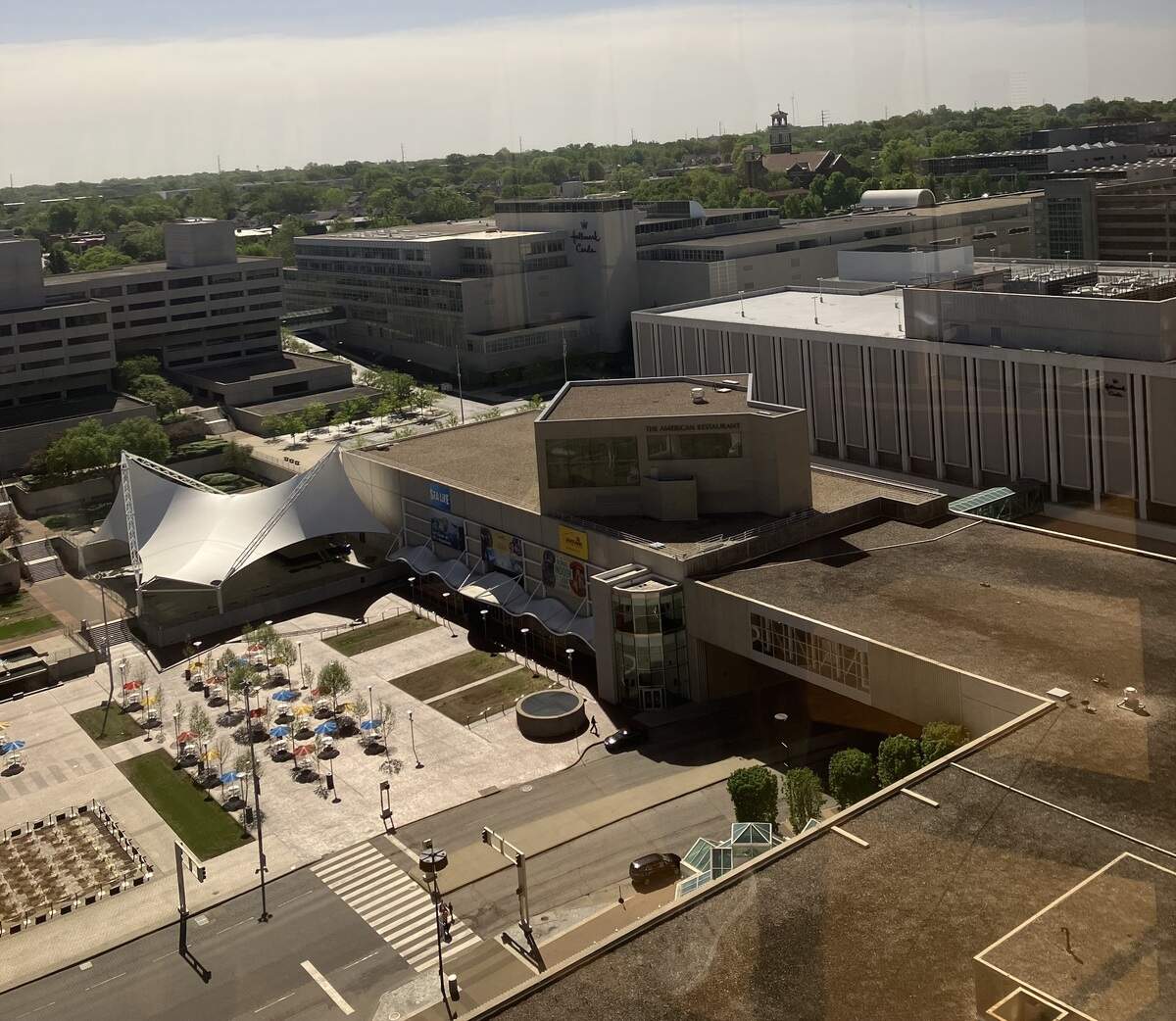
As we roamed Benton’s event space atop the Westin at Crown Center and gazed out at the 360-degree panorama of what Hall called the cultural center of the community, each spoke about how this union of two of Kansas City’s most beloved institutions came to be, and how they view what will unfold from here.
Much of it remains a work in progress.
An epiphany
Through the years since Sherman began speaking publicly about moving the team from Kauffman Stadium to a modern home most preferably in the city, Hall was a frequent advisor — or at least an ear.
His standing offer from Hall, Sherman said, was “how could he be helpful, just in general, on this journey.”
It was a long and winding road to this point, Sherman self-deprecatingly reminded again on Friday: Sure, he said with a laugh, it all went just like “65 Toss Power Trap” — the touchdown play immortalized by Chiefs coach Hank Stram being mic’d up in Super Bowl IV.
After the voter-rejected Crossroads plan of 2024, the Royals negotiated with a number of entities — including the city, North Kansas City and the state of Kansas.
Amid all that, Sherman became both struck by and stuck on some aspects of Washington Square.
Among the issues with the five-acre site were the minimal flexibility to develop around it, negotiations with the railroad to build over the existing tracks and even how the stadium itself would fit.
“You said, ‘It won’t be symmetrical,’” Hall reminded Sherman.
Sensing Sherman was struggling with those options, Hall suddenly was moved to broach something he said he hadn’t thought about much before that moment.
He’d had no previous notion of moving Hallmark headquarters, he said, and certainly had never seen it as a potential site for baseball. It wasn’t really a consideration, he added, “until I said it out loud.”
Thinking out loud, really, with someone he could trust to kick around such ideas.
“‘What if we thought about this differently?’” Hall recalled saying to Sherman.
Sherman remembered Hall putting it something like this: “‘I’d like to think about reimagining Crown Center. And what if we could think about bringing baseball here?’”
Either way, it was an ah-ha moment. Or an epiphany.
On the other end of the phone on his screened porch at home that day, Sherman immediately stood up “to make sure the blood was flowing right, to make sure I heard him right.”
He was struck at the thought of all that could be done with this type of property in the heart of an American city. And he was something approaching astounded by Hall’s willingness to consider the profound change from the company’s beloved home of more than 50 years.
“I had to bring my heart rate back down,” Sherman added, “once I understood he was serious.”
The relationship set the tone for what was to come over the impending months — from that spark to culminating the deal in the last few weeks.
Pretend we’re already partners
Shortly thereafter, they convened at Benton’s and gazed over the landscape and tried to open their minds to what was possible.
Imagine a blank sheet of paper, Hall would tell Sherman, and they set about exploring numerous scenarios with the help of stadium and land experts who offered models about everywhere on the 85 acres.
Looking down upon it Friday, Hall said “it looks pretty obvious right now, but it wasn’t obvious at the time.”
But they kept exchanging “what ifs?” and kept meeting.
Even when it meant defying convention.
“You can’t do it through brokers,” Hall said.
Meaning?
“We had to clear the lawyers out of the room a few times,” said Sherman, noting this deal had to be made “principal to principal.”
In essence, he added, they entered into the process with the philosophy that “we’re going to pretend like we’re already partners.”
By the end, Hall said, the message to attorneys advocating or documenting it all was, “‘You’re working for both of us. … We’re trying to find the best solution here. We’re not trying to go one-up.’”
Even in that spirit, the deal came together late in mid-April. A proposed city ordinance originally phrased to focus entirely on Washington Square Park was amended to be titled “Washington Square Park/Crown Center area” just a day before it was introduced to City Council on April 9.
Asked about that timetable, Sherman and Hall each pointed to his own reasons for the late shift.
“I’ve done a lot of deals, and I never say they’re (even) 50% until we’re on the way to closing …” Sherman said, later adding, “We couldn’t tell (city officials) about this until we finalized our deal. And the moment we finalized our deal, we told the mayor and city manager.”
For his part, Hall said they kept it “highly confidential” until it was done-done, so employees and tenants of Crown Center could promptly be notified when their agreement was certain.
‘We should put a little shrine there’
Each also spoke to different aspects of the nature of the partnership.
“We’ll have a development company that we’re partners in, but the stadium will be separate from them,” Sherman said. “That will be its own entity. It will be sold to the Royals, that (approximately) 15-acre plot. …
“And then the Royals will, I’m going to use the word, ‘contribute.’ I don’t know if that’s the right legal term, but in essence, the city or some agency of the city will ultimately own the ground and the stadium and then lease it back to us.”
As Hall put it: “There’s a group John heads that owns the team. We’re not involved in that at all. There’s a group that will own the stadium. … Hallmark’s not involved in that, either. The land that we currently occupy will go to that group; we will not be responsible for that.”
But Hallmark will partner in what Hall called the “third entity” of development around the stadium.
As it stands now, anyway, Crown Center itself is to be preserved, even as Hallmark will get a new home in the immediate area of what Sherman called the operation’s “phase one.”
“I hope so,” Hall said with a laugh as he considered Sherman’s term for possible expanded development later.
Hallmark has some 2 million square feet of space and some 1,200 people to be moved, Hall said, as it looks to modernize in a new environment he believes “will make us even better as a company.”
As he pondered that future, Hall said “we’ll shed a tear of nostalgia” when the building comes down but celebrate carrying on the vision of his grandfather, Joyce Hall: After he disembarked from a train at Union Depot in the West Bottoms in 1910, he furthered “the Kansas City Spirit” of grit and generosity that brought him here from Norfolk, Nebraska.
Similarly, Sherman reiterated how much he loves Kauffman Stadium, where he went on his first date with his future wife, Marny, and like Crown Center opened in 1973. He thought, too, about how they cried when they moved out of their first home on the way to their futures.
“I’m going to be sad,” Sherman said. “But I’m also kind of responsible for making sure that we kind of write the blueprint, (and) we’ll take those memories with us and bring them here and build new ones.”
When it comes to potential elements and names for the new stadium the Royals will seek to be in by 2030, Sherman said, “I think that’s a process.”
But he added that they’ll want to bring along their history back to where a major part of it started — with Hallmark’s Shannon Manning designing the Royals’ logo for their debut in 1969.
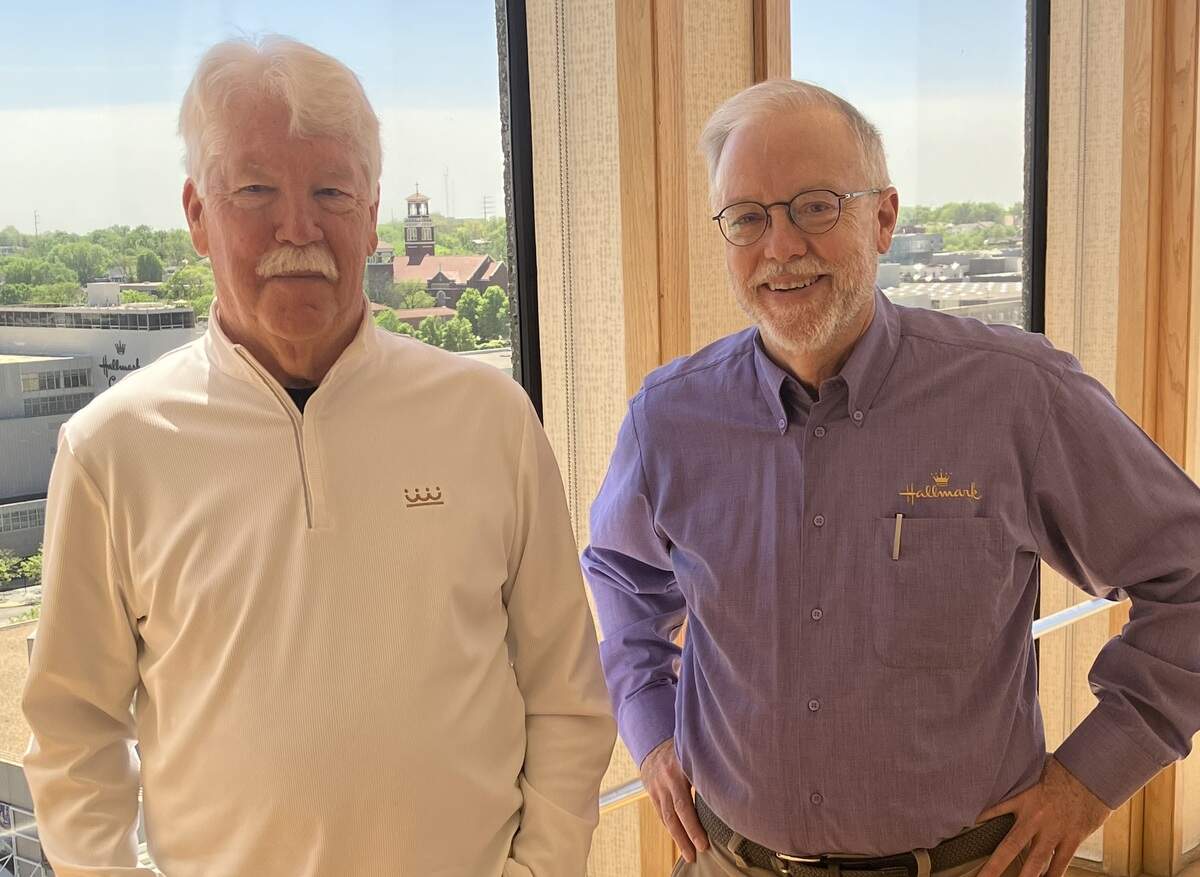
Looking out the window at Hallmark headquarters, Hall fondly remembered spending a lot of time with the late Manning — whose presence was known on Friday as Sherman and Hall each wore the respective crown-themed logos that so resemble each other.
Aptly enough, Hall figures Manning’s old office was right about where the new center field will be.
“We should put a little shrine there,” Sherman said.
Why Crown Center?
As for what’s to be built around the anticipated stadium?
It’s in the embryonic stages as a master plan remains to be assembled.
“The only thing we really know,” Hall said, “is where the stadium is.”
For now, the focus will be on working through the rest of the legislative and financial checkpoints to be able to enter into the demolition that allows for the building of the new stadium.
While Sherman and the Royals have met with land-planners and architects, he said, what to build where “all has to be proven out” with further study of demand and feasibility.
Among the sorts of things they’re exploring are residential concepts, more retail, a small concert venue and how to best activate Washington Square Park, in particular.
As Sherman looked out upon the park, he spoke in generalities about its potential.
But one way or another, it seemed he envisions a gathering place for families and pre-game festivities that could funnel into a promenade toward the stadium through Crown Center — an area that Hall noted has thrived while being cordoned off through such crowded events as Irish Fest and the Hallmark Christmas Experience.
That’s an anchoring appeal of the spot, which either is visually or physically framed by such vibrant institutions and areas as the Kauffman Center for the Performing Arts, Union Station, the National World War I Museum and Memorial, the Crossroads, the Federal Reserve Bank of Kansas City and Children’s Mercy Hospital.
It’s also anchored by 1,500 hotel rooms between the Westin and Sheraton alone, some 9,000 Hallmark parking spaces and the KC Streetcar stop by Union Station — where there are approximately 1,600 more parking spaces.
With thousands living in walking distance, too, Sherman figures the Royals will make quite a jump from what he said was the walkability ranking of Kauffman Stadium: 30th out of 30 MLB teams.
All of that, Sherman said, “relieves a lot of pressure on the system.”
As for any concerns that this would detract or siphon from the Power & Light District about a mile away, he said he believed it would “create more density” and “lift all boats.”
Reiterating his appreciation of former Mayor Kay Barnes’ role in getting the P&L project done some 20 years ago, Sherman added, “We have the opportunity here now to build on some momentum that’s built, instead of dropping this in there and having to create all that momentum.
“And that’s better. I think it’s better for all of us.”
Most of all, at least as Sherman and Hall see it, better for the city and region they’ve unquestionably dedicated themselves to for decades, with a shared vision that made this possible.
This story was originally published April 26, 2026 at 5:00 AM.