Here’s why the Kansas City Royals are eyeing a performance lab as a key to development
High-speed Edgertronic cameras, Trackman radar panels and Rapsodo devices aren’t quite as prevalent as bats and gloves at the Kansas City Royals training facility, but they’re gaining ground.
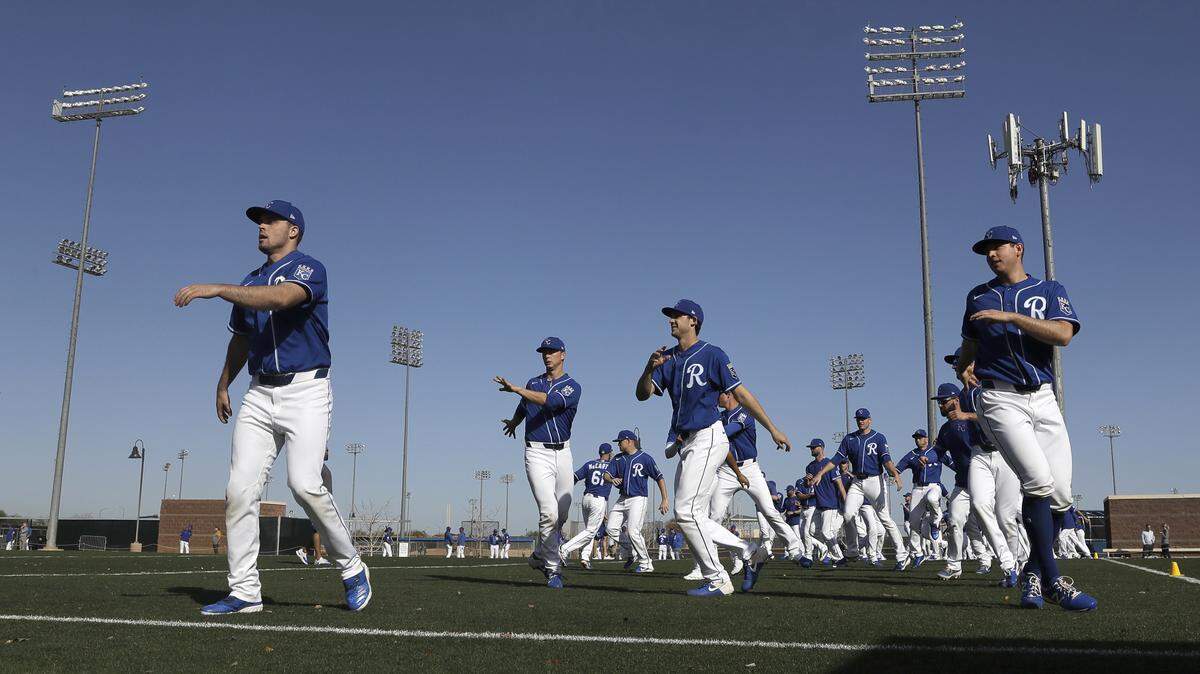
Technology already pervades every aspect of the baseball operation. That much was evident as a subset of players began workouts under blazing blue skies at the Royals’ Arizona training facility during the recent mini-camp.
It’s also clear that the Royals’ brass has even bigger designs for incorporating technology into their training to meet the needs of players, assure a level of continuity and also adjust to the changing landscape of Major League Baseball’s player development system.
The next big ticket addition on the Royals agenda could be a performance training lab in Surprise.
“Right now, we’re working on where to put it, architectural designs,” Royals general manager J.J. Picollo told The Star. “We’re still in the exploration phase, but it is something that we’d like to have here. As The Fountains opened up here across the street, more kids are going to want to be here.”
The Fountains, to which Picollo alluded, is the recently opened housing complex a short cutoff throw from the Royals facility. It includes 47 apartment units and can provide lodging for more than 170 people. It also features staff and player lounges, conference space, a classroom, swimming pool and outdoor grill and patio space.
“It’s good for us because our pitching coaches and our sports science department will have their hands on them,” Picollo said of potentially having a performance lab at their facility. “You’d know exactly what they’re doing throughout the offseason.
“The goals you may have for a player, in particular a pitcher, that doesn’t get lost because now they’re going to a different lab working with someone else who has different ideas. There’s more consistency in messaging. It’s something that’s important to us.”
When Picollo received his promotion last fall to general manager, Royals chairman and CEO John Sherman lauded his efforts as the architect behind “modernizing our baseball operations organization” under the tutelage of president of baseball operations Dayton Moore.
The Royals restructured their player development staff and system into all-encompassing hitting/pitching departments. A performance lab appears a logical next step in their ongoing modernization efforts.
Consistent messaging and increased urgency
It has become more prevalent for pitchers to spend portions of their offseasons working with data science labs with pitching gurus.
Baltimore Orioles All-Star pitcher and Gardner Edgerton graduate John Means credited part of his rise and his changeup development to his work with St. Louis-based P3 Premier Pitching & Performance.
Former Cy Young Award winner Trevor Bauer famously utilized data science in his pitch design and development as chronicled as part of the book “The MVP Machine.”
Washington-based Driveline Baseball became a recognized industry leader for the work it has done with pitchers such as former Royals top draft pick Kyle Zimmer.
The Cincinnati Reds even hired Driveline founder Kyle Boddy, who spent one season as their minor-league pitching coordinator and one as their director of pitching before they parted ways after last season.
Hitters such as Los Angeles Dodgers star Justin Turner, Red Sox slugger J.D. Martinez and veteran free agent slugger Matt Carpenter have also turned to gurus to revamp their swings.
“When you have the facility to do the things that they want to do in the offseason, they’re more likely to do it with you,” Picollo said. “That’s the goal.”
The Royals current “exploration phase” includes putting together designs, mapping out potential locations within their Arizona facility and estimating costs.
Ownership has been aware for some time of the front office’s desire to build a lab.
“The reason why I think that that lab-type setting is because it’s the offseason that you need to make real significant changes,” Picollo said. “When you’re in a season, it’s not that it can’t be done — there are subtle changes and suggestions that happen to help further develop — but it’s really in September, October, November.”
Picollo also pointed to the changes in the way farm systems are structured as an added impetus for the Royals to build their own facility.
“Contraction has led to the need to develop guys faster,” Picollo said. “They need to move through levels a little bit more quickly. So the quicker you can get on things and make adjustments, it will give a player a better chance to make that jump the next year and not allow draft classes and international classes to catch up to them.
“You don’t want panic, but there has to be a certain sense of urgency and a realization that that’s how this game is built now.”
With each organization employing fewer minor-league players and the reduction of the number of affiliates — including the elimination of one of the levels of rookie ball — making relatively-small strides at an individualized pace may no longer going to be the norm for minor leaguers.
“The skill acquisition aspect of it is more important today than it has ever been,” Picollo said. “That’s just where we have to adapt to the development system that is in place now, which is not as traditional as it once was.”
This story was originally published February 28, 2022 at 11:12 AM.