Kansas City Royals’ Mike Matheny crossed paths with all three Hall of Fame inductees
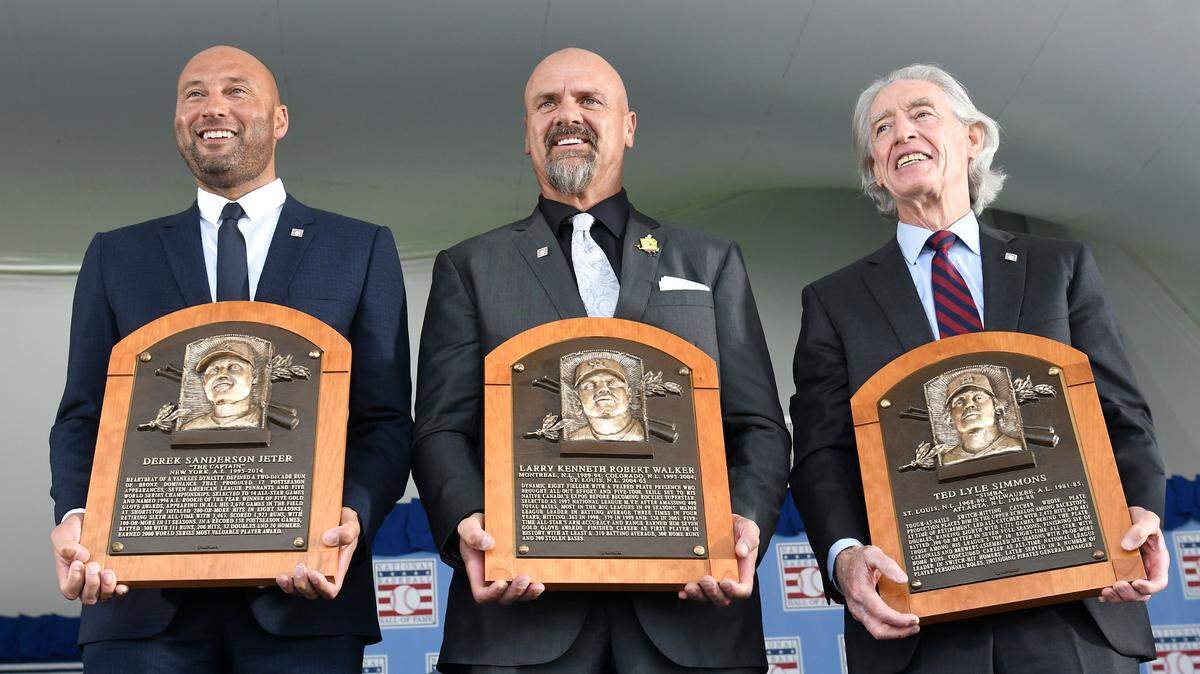
Kansas City Royals manager Mike Matheny crossed paths with each of three players inducted into the National Baseball Hall of Fame on Wednesday, including one briefly as a teammate.
Of course Matheny, a proud product of the University of Michigan and former co-captain of the baseball team, was quick to point out that two of the inductees had ties to Michigan and its baseball program.
Former Montreal Expos, Colorado Rockies and St. Louis Cardinals outfielder Larry Walker and Matheny were teammates for the 2004 season with the Cardinals. Longtime New York Yankees shortstop Derek Jeter had committed to play at Michigan, but Jeter “got a better offer” as Matheny quipped in reference to Jeter having been drafted sixth overall by the Yankees.
Former Milwaukee Brewers and Cardinals catcher Ted Simmons may be the one who resonated the most with Matheny, himself a former catcher who spent time with the Brewers and Cardinals as well as a former neighbor of Simmons in the St. Louis area.
“It’s great to see him get the acknowledgment that he deserved,” Matheny said of Simmons, a Michigan native. “This guy is crazy smart. Legendary as far as baseball development goes. Some of his theories and ideas and how he thinks about the game — he was a director of minor league development and had all kinds of different roles — he has influenced a lot of different people that are still currently in the game.”
Simmons became the 19th catcher selected to the Hall of Fame, the third since 2016 when Mike Piazza earned enshrinement followed by Ivan “Pudge” Rodriguez the next year.
The Modern Baseball Committee elected Simmons after he was not chosen through the writers’ balloting.
A switch-hitting catcher, he finished his career having batted .285 with 2,472 hits, 483 doubles, 248 home runs and 1,389 RBIs.
Among those who played at least 50 percent of their games at catcher, Simmons ranks second in hits, second in doubles, second in RBIs and fifth in runs. He caught a pair of no-hitters in his career.
Following his retirement as a player, Simmons spent a season as the general manager of the Pittsburgh Pirates and also went on to serve as the director of player development for the Cardinals and San Diego Padres, and a scout for the Cleveland Indians, bench coach for the Brewers and Padres and a senior advisor to general manager Jack Zduriencik of the Seattle Mariners.
Current Royals bench coach Pedro Grifol worked in player development with the Mariners during Simmons’ tenure there.
Matheny credited Simmons as having been ahead of the curve as far as incorporating analytics into the game and developing a philosophy.
“Pedro had some time with him too when he was in Seattle,” Matheny said. “We were able to talk about some of the different theories, things that I had heard. As we talk mid-game, I notice a number of things that we bring up in certain situations that we’re both influenced by him and how we think about the bullpen, not to get caught off guard, just little sayings that once I hear them they were just a reminder of something from Ted Simmons.”
Matheny played with Walker in the penultimate season of Walker’s career.
Walker’s accolades included a home run title (49 in 1997), three batting titles (1998, 1999, 2001), seven Gold Glove Awards and the 1997 NL MVP Award.
“A top-shelf teammate,” Matheny said. “He came over on a very good team that was on our way to winning 105 games and just blended in right away. He was always a guy, playing against him, that was just dangerous all over the field.
“He was one of the best sneaky base runners. He was fearless, jumps, balls in the dirt, the way that he played the outfield and he was always dangerous when it came to knocking the ball out of the park or doing something with hard contact.”
Jeter, currently the CEO and part owner of the Miami Marlins, was the face of the Yankees dynasty in the 1990s, the captain of the team, a 14-time All-Star, five-time Gold Glove winner and five-time World Series champion and the 2000 World Series MVP.
Matheny lauded Jeter for “how he went about his business,” and said as an opponent he couldn’t help having a lot of respect for Jeter.
“In that market to be a marquee player and to be a superstar and for him to consistently keep his name above most of the fray, to play at the level he did but also go about being one of the most recognizable stars in that market, I don’t know if enough credit is given to that,” Matheny said.
“The combination of the two, the person as well as the player, is something I always give a lot of credit to.”
This story was originally published September 8, 2021 at 5:50 PM.