
Relive the crowning of the 2015 Royals: Here’s how they won it in World Series Game 5
Five years ago this fall, the Kansas City Royals won their second World Series championship.
Fox Sports Kansas City is re-airing the Royals’ victories from that postseason this month. At 7 Thursday night, May 21, it’s Game 5 of the World Series.
To help you relive the moments from that magical October, we’ve dug into our archives.
Below are original stories, front pages and photos that appeared in the Nov. 2, 2015 editions of The Kansas City Star, the day after the Royals beat the Mets 7-2 and captured their first crown since 1985:
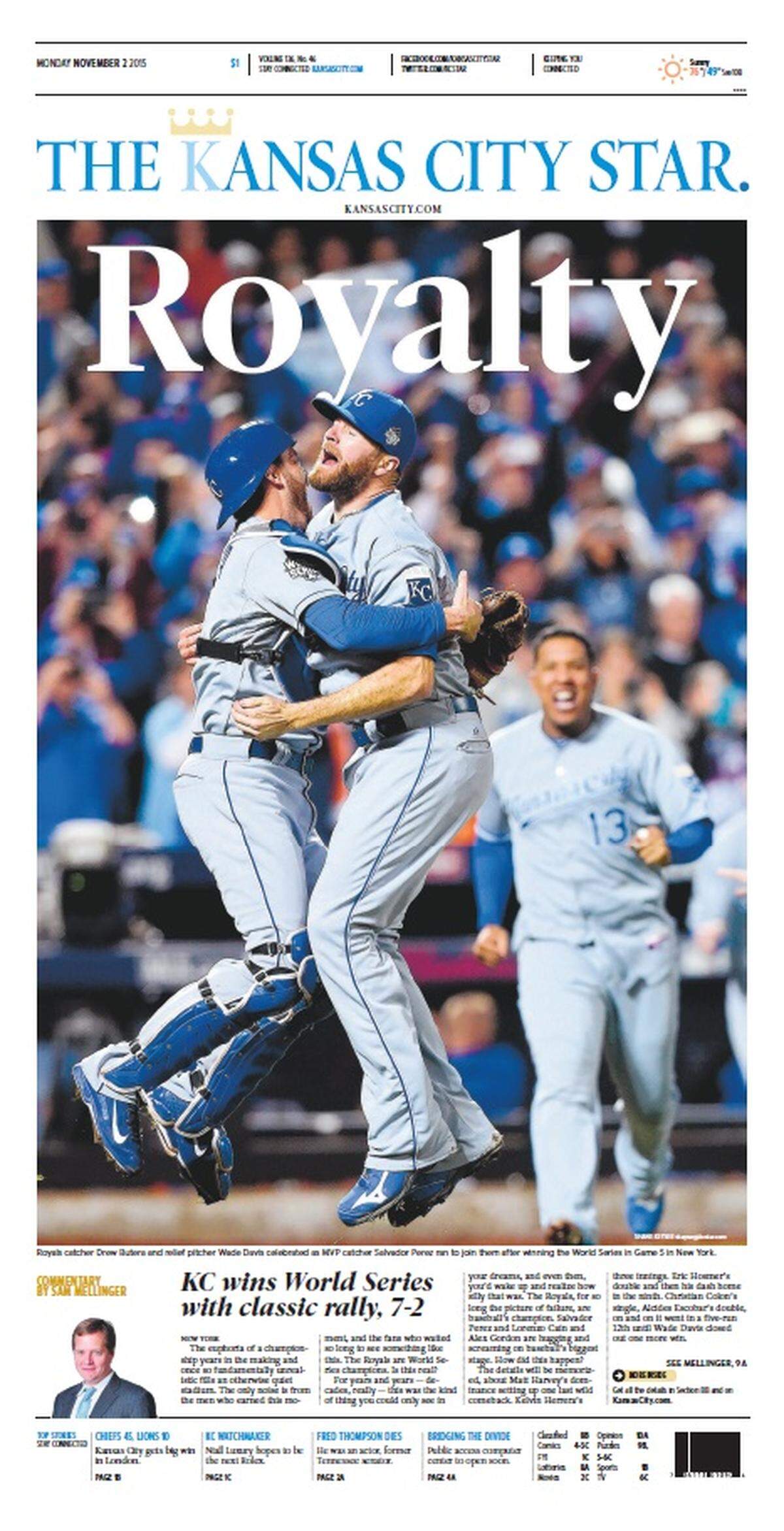
KC wins World Series with classic rally, 7-2
NEW YORK — The euphoria of a championship years in the making and once so fundamentally unrealistic fills an otherwise quiet stadium. The only noise is from the men who earned this moment, and the fans who waited so long to see something like this. The Royals are World Series champions. Is this real?
For years and years — decades, really — this was the kind of thing you could only see in your dreams, and even then, you’d wake up and realize how silly that was. The Royals, for so long the picture of failure, are baseball’s champion. Salvador Perez and Lorenzo Cain and Alex Gordon are hugging and screaming on baseball’s biggest stage. How did this happen?
The details will be memorized, about Matt Harvey’s dominance setting up one last wild comeback. Kelvin Herrera’s three innings. Eric Hosmer’s double and then his dash home in the ninth. Christian Colon’s single, Alcides Escobar’s double, on and on it went in a five-run 12th until Wade Davis closed out one more win.
The Royals are World Series champions, finally and again. They beat the Mets 7-2 in Game 5. The best team in franchise history will be honored with a parade on Tuesday, along Grand Boulevard, the same route they took 30 years ago.
Every champion is remembered fondly, but this one is different even by that high standard. Some of that is in wiping away two decades of losing, and some of that is in the way they attacked every day, every game, every inning, every pitch. Kansas Citians bought more tickets than ever before, and spent more time watching on TV than ever before. Following this team became more than a pastime, and more than a habit. It is now an addiction.
This is the team that Kansas Citians will brag on to their kids, to their grandkids, and maybe even their kids’ grandkids. This group has done more than win the world championship. That happens every year, for some lucky city. But not like this.
The Royals have rewritten not just a franchise’s sorry history, but forever changed the way sports are viewed and loved and consumed back home. Kansas City has not had a championship parade in 30 years, long enough that babies conceived and born in the years since have grown up to know sports success only as something that happens in other places. It is long enough that some of those kids are doctors, or war heroes. They have careers and mortgages and marriages. Some have divorces. This is a long time coming.
These Royals will be forever remembered for the forceful way they sliced through the regular season, and continually refusing to die in the playoffs. Eight of their 11 playoff wins came after trailing in the sixth or later. Six of those comebacks have erased deficits of two runs or more. No team has ever done that. This is the greatest rally team in more than 100 years of playoff baseball.
The eighth inning in Houston. Cain scoring the pennant-clinching run from first on a single, and Davis pitching both sides of a rain delay in Kansas City. The ball scooting past Daniel Murphy’s glove and Hosmer’s sprint home here in New York. Baseball’s playoffs create drama naturally, but the sport has never seen anything like this.
These Royals have shown baseball’s hungriest market how to love the sport again, and that wishing for and even expecting good things to happen doesn’t have to end in heartbreak.
Cain’s brilliance, Perez’s relentlessness, Mike Moustakas’ resiliency, Alcides Escobar’s easiness, Gordon’s determination, Davis’ steadiness, Ned Yost’s stubbornness and the patience of David Glass and Dayton Moore — they are all irreplaceable parts of one of the great long-term turnarounds in professional sports history.
Others have won on budgets, but in modern baseball the Royals lifting the trophy with all those little flags on it is without precedent. The A’s were celebrated with a best-selling book and a Brad Pitt movie, but Moneyball never played in the World Series. The Rays may be the closest cousin to what the Royals accomplished, but they lost their only World Series in five games. The Rockies built a pennant winner almost exclusively through their farm system, but were swept in their only World Series.
This is the lifetime professional accomplishment of so many, starting with Moore, along with all the believers who quit their jobs and moved their families to join this crazy pursuit back in 2006. Close friends told Moore not to do it. The Royals lost 100 games that year, which was actually an improvement.
Moore has said that if he knew just how terrible the organization was, he probably would not have accepted the job. The year before, they skipped the team picture because, in the words of a club official, “who would want to remember this group?” At his introductory press conference, a cameraman congratulated him for taking over the worst team in sports.
Look at them now. Champions. That bleak past is merely the setup for a remarkable rise from baseball’s easiest punchline — at one point, the late night comics actually slowed down, more out of pity than anything else — to one of the great champions in recent memory.
They won 95 games in the regular season, more than anyone else in the American League. Seven of them were selected as All-Stars, a few because of overwhelming support from fans, the rest very much on merit. Now, they are eternally bonded as the group of men who gave a starved sports city a championship, finally.
Kansas City is different now, because of this team. Buildings downtown light up in blue. Kids wear T-shirts with Gordon or Perez or Cain on the back. Conversations begin with, “You watch the game last night?” and in a good way. On any block in any neighborhood back home you might see two, three, four blue Royals flags out front. Some of the people who drive through these neighborhoods are the men who made it happen. The players, the coaches, the executives.
Nobody knows where the future will take these guys. The business of baseball has a way of breaking up successful teams and even with record attendance the Royals are more affected by rising costs than most.
The same way James Shields and Billy Butler weren’t back for 2015, some from this group won’t be back for 2016. Johnny Cueto, Ben Zobrist and Chris Young are free agents. Gordon is likely to decline an option in his contract.
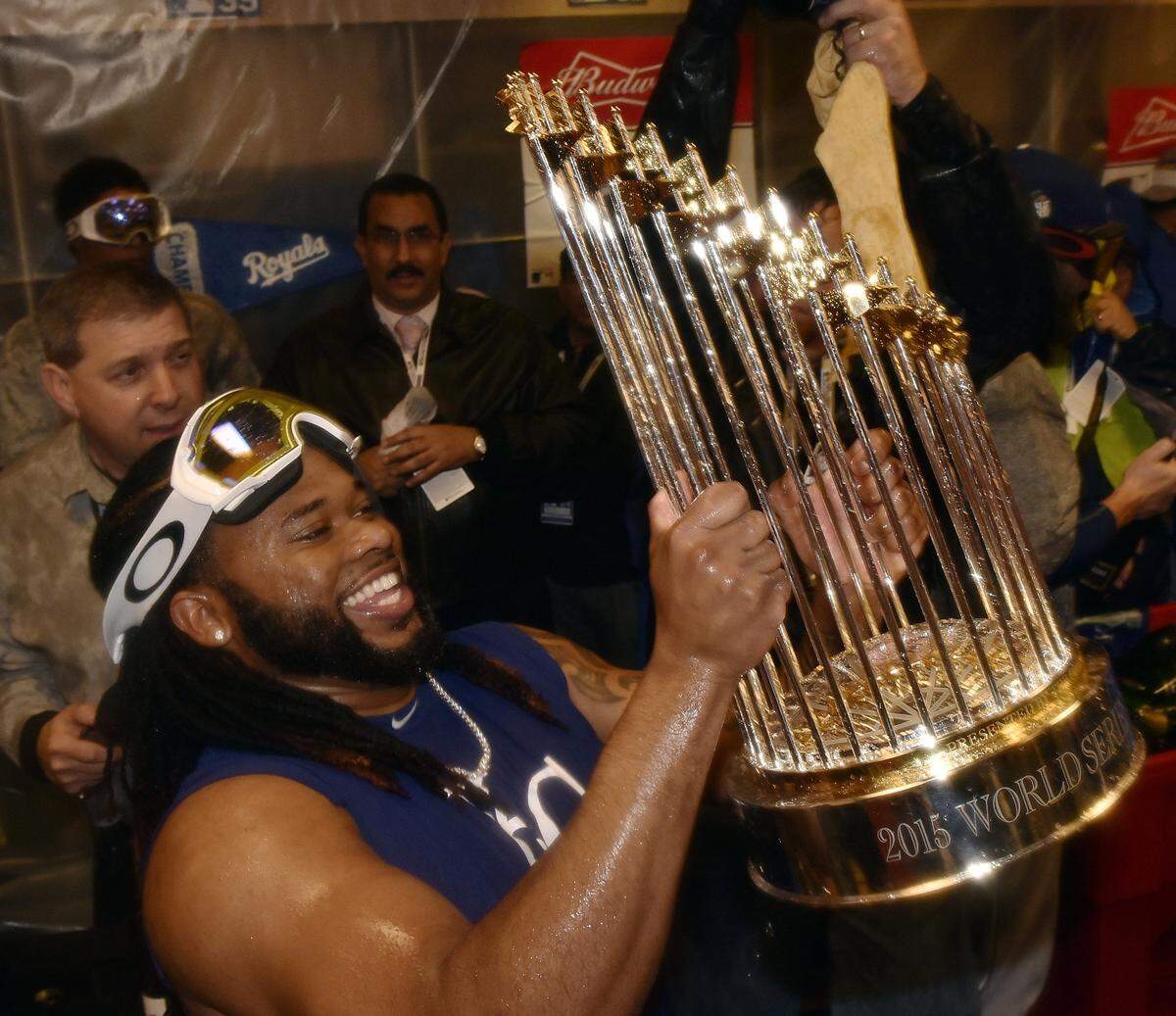
But no matter what, this will be the team that Kansas City talks about for a generation. Their names and pictures and successes and celebrations will be documented in the team’s Hall of Fame building. Their flag will fly atop, and a few of them may get their numbers retired next to George Brett’s, Frank White’s and Dick Howser’s.
They’ll get old together, the same way Brett and White and Willie Wilson and Bret Saberhagen have grown old together in our memories. They’ll get together at reunions, Hosmer remembering the night they bought a city drinks at a bar, Gordon talking about how standing on third base at the end of Game 7 fueled an unceasing drive in 2015, and, probably, Perez harassing Cain on camera for a new generation of fans.
Fans will have their own memories, from the ones who believed all along to the ones who will claim they believed all along. They used to bond with something that felt a little too much like Stockholm syndrome, with jokes about the throw home hitting Ken Harvey’s back or Kerry Robinson climbing that wall in Chicago for a ball that bounced in front of him to then-manager Buddy Bell, caught in the middle of another long losing streak, muttering, “I’ll never say it can’t get worse.”
They went through some rough times, these fans and the team they root for. For so long, their love was not returned. Their team was unworthy of their time, of their money, of their hearts. For so long, “the process” looked like another doomed plan.
The signs came subtle, and quiet, at least at first. It says something about just how low the standards were that in the beginning longtime baseball men from other organizations complimented the Royals by saying they were finally operating like a big league organization.
They had to navigate so much to get here. Gordon had to reinvent himself as a left fielder. Perez had to go from being an anonymous, small-money signing as a 16-year-old in Venezuela to one of the game’s best catchers as an adult. Davis had to go from a failed starting pitcher to perhaps baseball’s best reliever.
Zack Greinke became one of baseball’s best young pitchers in Kansas City, but the losing beat him down, and he demanded to be traded. The Royals tried to trade him to Washington, but Greinke didn’t want that either, so they made a new deal with the Brewers for what they thought at the time was an inferior haul of prospects. Except that haul was highlighted by Cain and Alcides Escobar — two foundational pieces for the Royals’ rise, the centerfielder and the shortstop, the smiling No. 3 hitter and the unconventional leadoff man.
That’s fairly symbolic of their makeover, actually. The Royals have caught some breaks, both in the big picture, and in particular moments during these playoffs. But other teams have had breaks, too. The difference is the Royals have made the most of theirs, and minimized the others’, exploiting the margins between losing and winning that once buried an entire franchise.
At some point, the men involved began to think of this ultimate goal not so much as a possibility but as destiny. They dreamed about it, but then they planned on it. Maybe that’s the way this had to go, all along. Taking on a challenge this enormous required complete belief.
They were once baseball’s most easily dismissed franchise, an afterthought if they were a thought at all. Look at them now. Baseball’s best story, baseball’s only story, the group that spent nearly a full decade building for this one moment and then a postseason making sure they would never be forgotten.
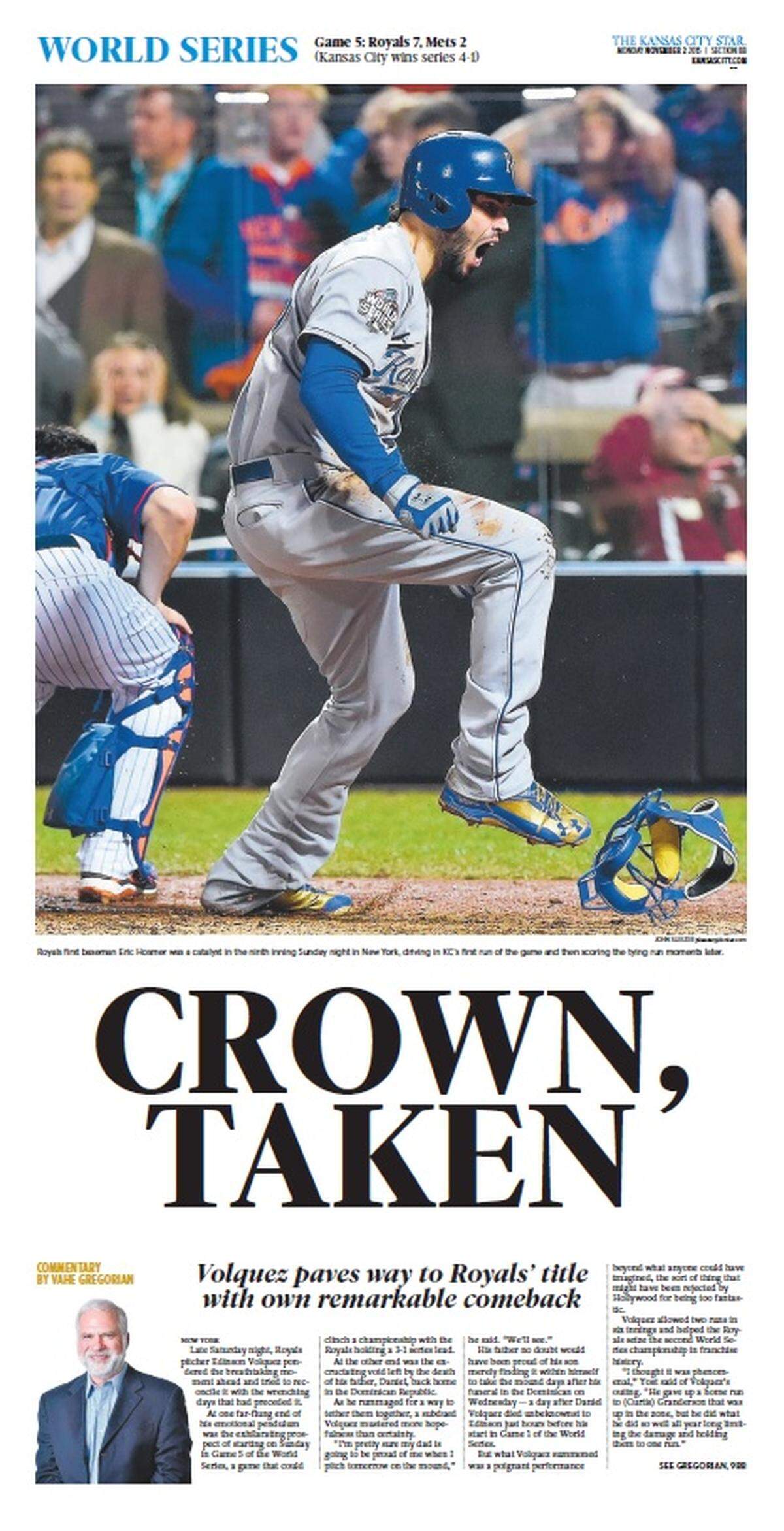
Volquez paves way to Royals’ title with own remarkable comeback
NEW YORK — Late Saturday night, Royals pitcher Edinson Volquez pondered the breathtaking moment ahead and tried to reconcile it with the wrenching days that had preceded it.
At one far-flung end of his emotional pendulum was the exhilarating prospect of starting on Sunday in Game 5 of the World Series, a game that could clinch a championship with the Royals holding a 3-1 series lead.
At the other end was the excruciating void left by the death of his father, Daniel, back home in the Dominican Republic.
As he rummaged for a way to tether them together, a subdued Volquez mustered more hopefulness than certainty.
“I’m pretty sure my dad is going to be proud of me when I pitch tomorrow on the mound,” he said. “We’ll see.”
His father no doubt would have been proud of his son merely finding it within himself to take the mound days after his funeral in the Dominican on Wednesday — a day after Daniel Volquez died unbeknownst to Edinson just hours before his start in Game 1 of the World Series.
But what Volquez summoned was a poignant performance beyond what anyone could have imagined, the sort of thing that might have been rejected by Hollywood for being too fantastic.
Volquez allowed two runs in six innings and helped the Royals seize the second World Series championship in franchise history.
“I thought it was phenomenal,” Yost said of Volquez’s outing. “He gave up a home run to (Curtis) Granderson that was up in the zone, but he did what he did so well all year long limiting the damage and holding them to one run.”
Volquez’s performance for the ages was forged through various flashpoints, including that homer by Mets leadoff man Granderson on a dangling change-up.
If he was feeling fragile or vulnerable before Granderson’s homer, Volquez somehow instantly was galvanized:
The Mets wouldn’t get another hit until the sixth inning, thus only then notching more than Volquez himself.
In his first at-bat, Volquez had smacked a single to right that represented the first hit by a pitcher in Royals postseason history.
The quirky breakthrough also was reassuringly punctuated by the sight of Volquez grinning and yukking it up in an exchange of gestures with teammates in the dugout.
He would leave after yielding one more run in a sixth that was both fortunate and unfortunate but ultimately a crucial victory for the Royals.
The Mets loaded the bases with no outs on a walk to Granderson with a narrow ball four that clearly vexed Volquez, a hit by David Wright and an error by Eric Hosmer.
But Volquez extricated himself and the Royals from the trap with a solitary run, on a sacrifice fly, to keep them well in range of contention considering the postseason fondness for late rallies that this time was buoyed in the ninth and delivered in the 12th.
On this night, though, perhaps the most profound comeback was the one by Volquez.
While manager Ned Yost had maintained since Wednesday that he expected Volquez to pitch Game 5, Volquez himself told reporters at his father’s funeral on Wednesday that he wasn’t certain he could.
He didn’t arrive in New York until Saturday from the Dominican, and suddenly he was left staring at a fraught task unfathomably carried out previously this season by teammates Chris Young and Mike Moustakas.
Each had played the very day after (and beyond) learning of the death of a parent, believing that to be a way to honor their wishes and perhaps to take sanctuary in the game and among teammates.
As painful as the losses were for Moustakas, who lost his mother, Connie, and Young, who lost his father, Charles, each had known his parents were fighting cancer and took some consolation in seeing them in the weeks before their deaths.
It’s not known what Volquez knew about the health of his father, who was 63 and reportedly died from heart issues.
What is known is that in the case of Volquez on Tuesday, the jarring news had been withheld by request of his wife, Roandry, who wanted him to be able to pitch in the opening game of the World Series.
In hindsight, Volquez endorsed her judgment because he didn’t believe he’d have been able to pitch had he known.
This, though, this would be different, having to perform with the grief of knowing of the death of his father, a mechanic who he called “one of the greatest men.”
He was the one who bought him his first gloves and spikes and drove him to emulate Pedro Martinez.
“He was everything for me ...,” Volquez said. “He put me in the right way.”
From the moment he returned to the team, Volquez said, they helped him be “in the right way,” too.
He was swarmed with hugs and smothered in words of encouragement in the clubhouse that reaffirmed what he’d been hearing and seeing and feeling for days.
“It was unreal,” he said, later adding, “I never thought I would get so much love from a lot of people, even outside of the clubhouse and out of baseball.
“And I was like, ‘Wow, I’ve got a lot of people that really care about what happened to me.’ And it’s a great feeling.”
Also alluding to Moustakas and Young, Hosmer said as a teammate the one thing you know you can do is “be there for them whenever you can.”
Embraced by an exceptionally close team, Volquez managed to be there for them, too.
Even if a form of precedent seemed to be set by Moustakas and Young, every circumstance of mourning is different and there was no assurance Volquez could find a way to compartmentalize it, too.
“We certainly did not expect him to come back and be ready to pitch in a World Series game,” Hosmer said.
Noting he is fortunate to still have both parents, Hosmer recalled that after the deaths of his grandparents he was “not mentally in a place to go out there and play a baseball game, let alone a postseason game.”
“You don’t even want to think about going out there and throwing a baseball,” he said. “But the fact that he came back and he’s ready to take the ball for this team, as a teammate and one of his defenders tonight, I couldn’t be more excited to go back out there and have his back.”
And so they all did for each other, adding an emotional exclamation point to the end of a 30-year championship drought already brimming with it.
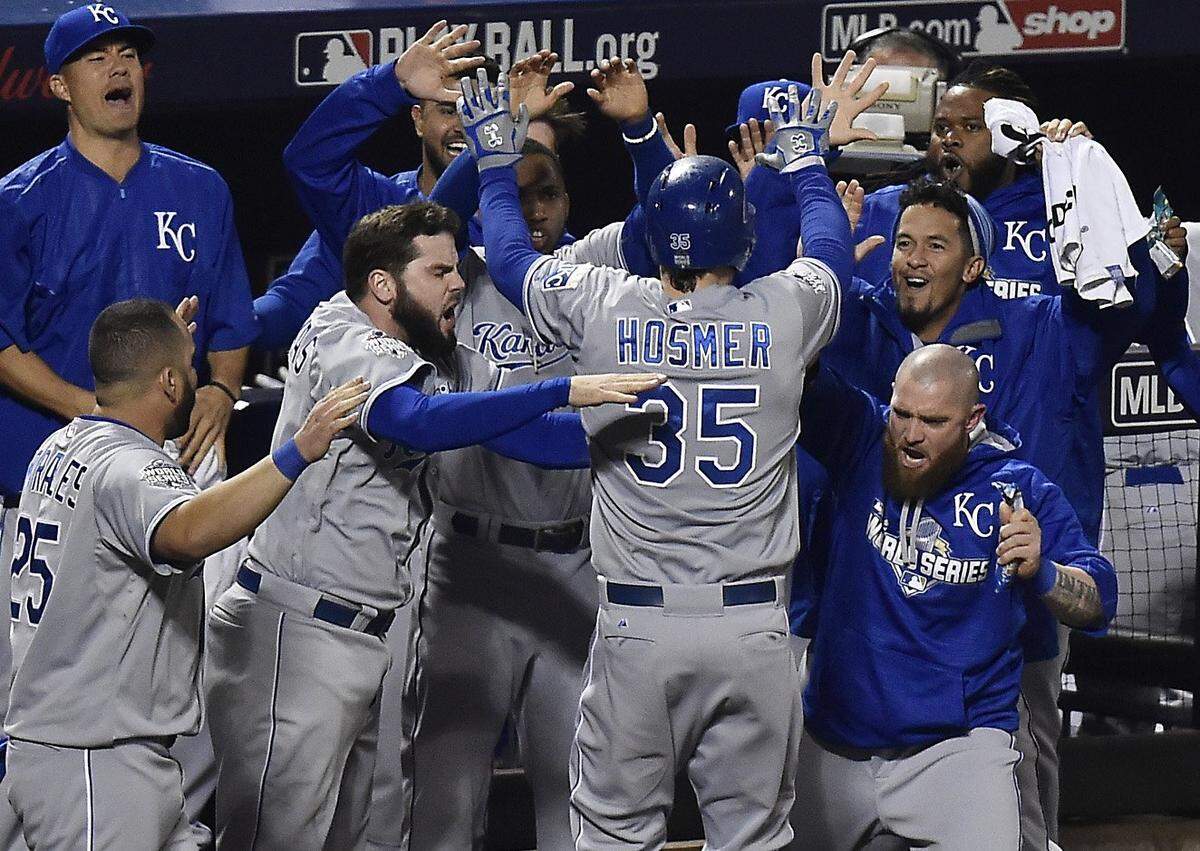
An extra-special win: KC ties it with two runs in the ninth, Colon’s RBI single in 12th gives them the lead
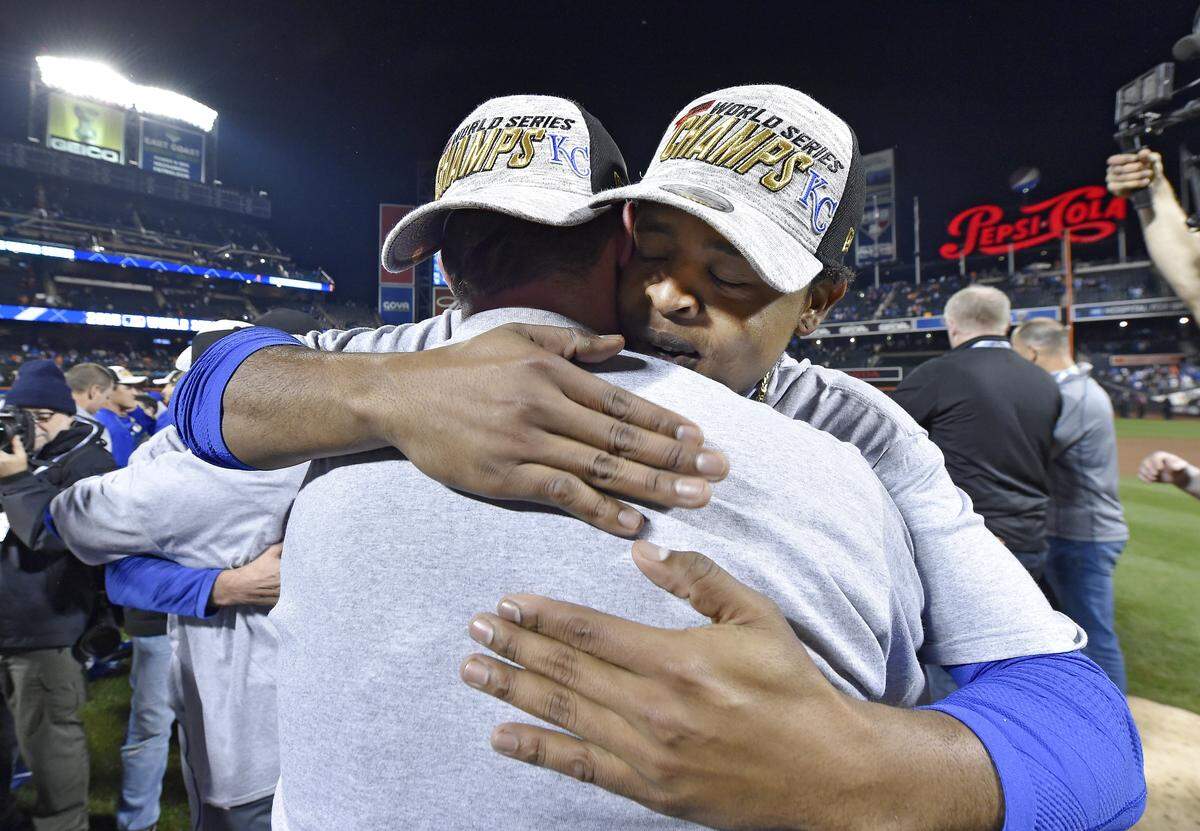
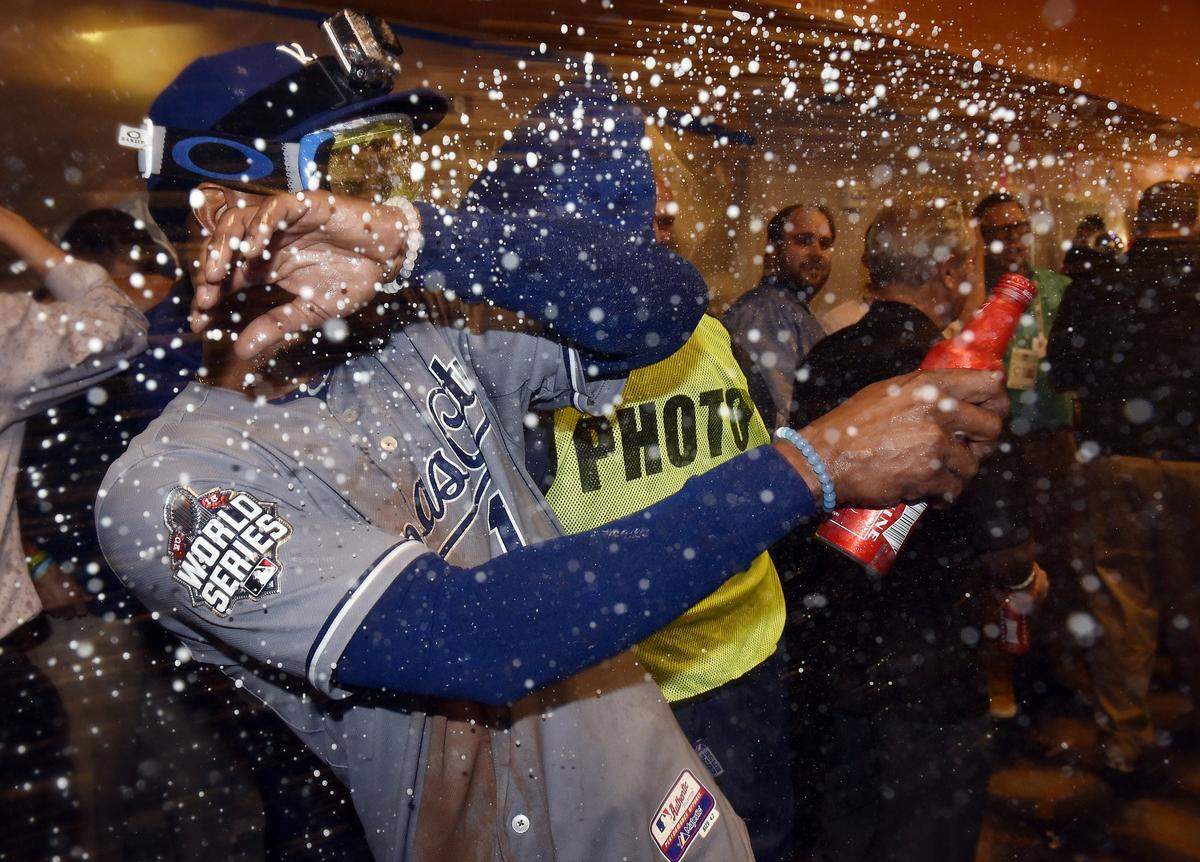
NEW YORK — The best Royals team in a generation assembled for one last time at 12:34 a.m. local time, converging in the center of Citi Field, the last mountain this group ascended. With a 7-2 victory in 12 innings over the Mets, the Royals captured the 111th World Series in five games, collected their first title since 1985 and provided a lifetime of memories for fans who stuck with this franchise through 29 years without a playoff appearance.
This group, assembled by general manager Dayton Moore and shepherded through the season by manager Ned Yost, stands atop Major league Baseball. When Moore took over the baseball operations of this franchise, the team resided in baseball’s basement, a running joke among its peers. Now they stood alone. So when the final 95-mph fastball of Wade Davis reached the glove of catcher Drew Butera, the rest of the team bounded over the dugout steps to celebrate the accomplishment.
Charging in from the dugout were Christian Colon, the man who drove in the winning run, and Jarrod Dyson, the man who scored it. Both were mothballed on the Kansas City bench for most of the playoffs. Both emerged in the 12th inning to complete the run of a lifetime.
Dyson hopped out of the dugout to replace Salvador Perez at first base after Perez led off with a single against Mets reliever Addison Reed. Dyson proceeded to utilize his finest skill, the speed that convinced the Royals to stick with him as a 50th round draft pick in 2006. So he stole second base.
Two batters later, Colon picked up a bat for the first time this postseason. Reed refused to throw him a fastball. Colon waited until a fifth slider crossed the plate. Then he punched the go-ahead single into left field and thumped his chest at first. In the aftermath, the Mets bullpen imploded. The Royals notched four more runs, the last three on a bases-clearing double by Cain.
But linger, for a moment, on Colon at first base. His teammates clambered over their dugout to salute him. He now had a career highlight to pair with his game-tying infield single from the American League Wild Card game in 2014.
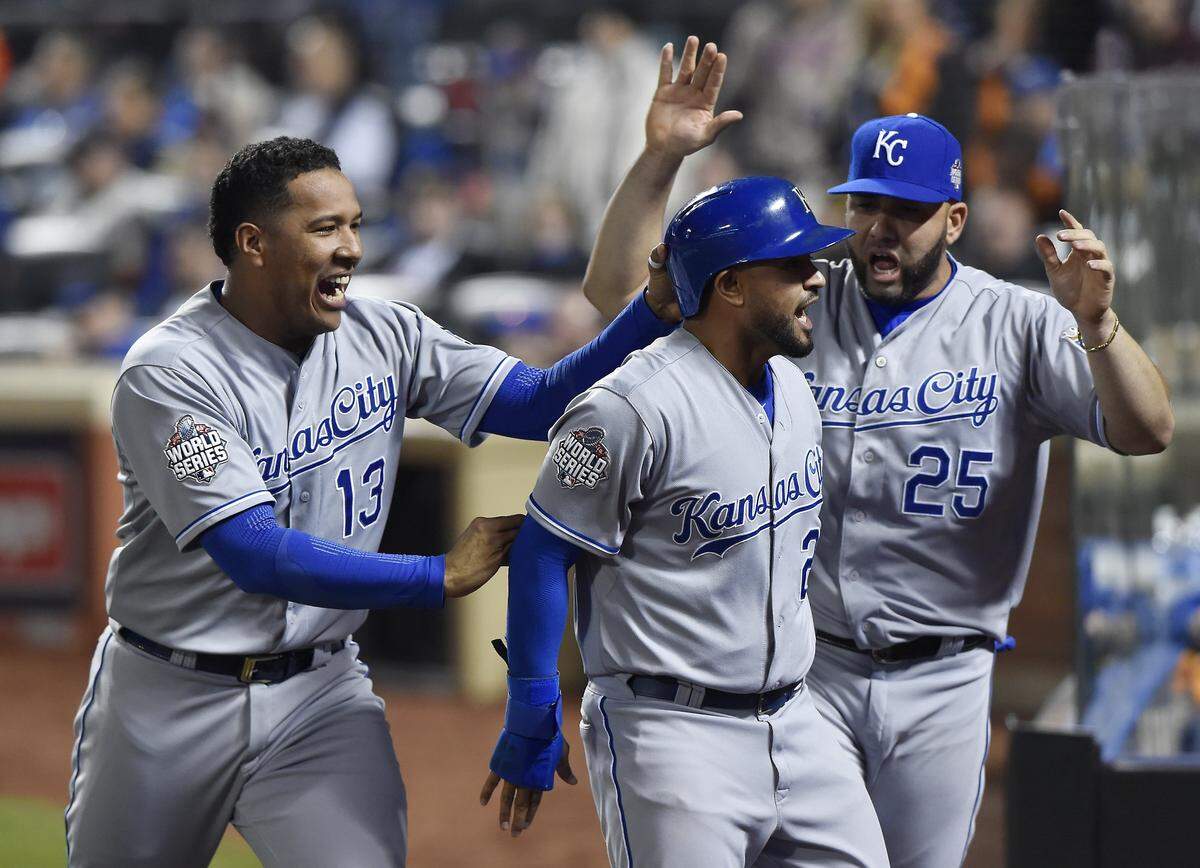
That night, so many months ago, solidified the ethos of this team. Pushed to the brink, the Royals do not break. Instead, it is their opponents who buckle.
On Sunday, in the final flourish of the season, the team followed its formula. It strung together a ninth-inning comeback with timely hitting and daring displays on the bases.
As the bottom of the eighth inning wound down, the fans at Citi Field shouted for another inning from Matt Harvey. He had blanked the Royals for the duration of the evening. He had struck out nine. Inside his own dugout, he argued with manager Terry Collins, insisting on staying in the game.
Harvey wanted the ninth. He wanted the Royals. Perhaps history will forgive him for his impudence, because the Royals did not.
The rally started in the most unlikely of ways for Kansas City. Down two strikes, Lorenzo Cain battled his way back for a walk. The crowd stirred. Harvey tried to drive a 94-mph fastball past Eric Hosmer’s knees. Hosmer did not let the baseball pass, thumping an opposite-field, RBI double.
“We always feel like we’re in it,” Hosmer said. “We never feel like we’re out of any game.”
The hit halved the score and petrified the park. Collins fetched Harvey and handed the baseball over to Jeurys Familia. Before this series, the presence of Familia almost guaranteed a Mets victory. Yet in the first four games here, he had already blown two saves. A third would soon follow.
Guile ruled the day. After Mike Moustakas advanced Hosmer to third base, Perez stepped to the plate. He tapped a grounder toward third baseman David Wright. As Wright whirled to throw to first, Hosmer broke for the plate. A precise throw from Lucas Duda would have ended the game.
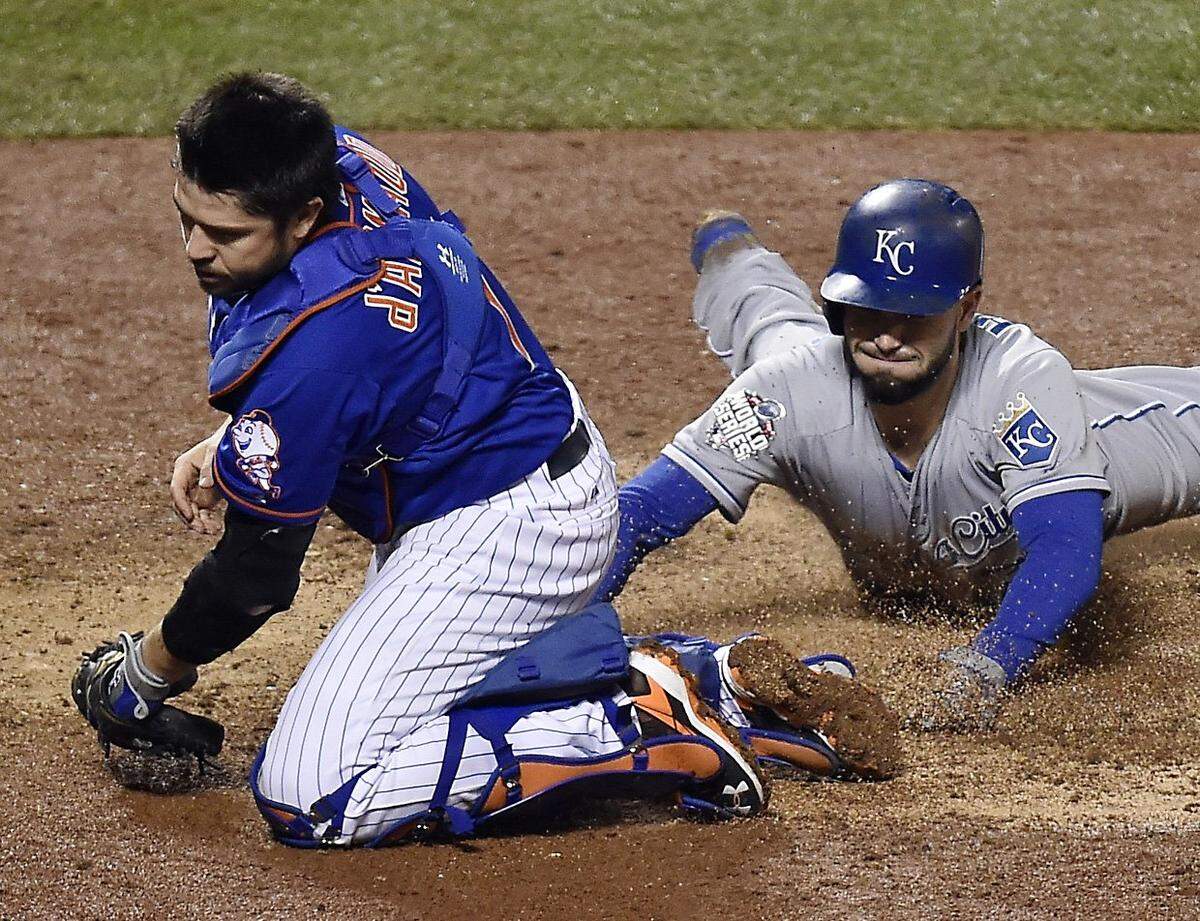
Duda did not make a precise throw. His volley home sprayed wide. Hosmer slid head-first across the plate to tie the game. The Royals’ dugout jumped with joy.
During the regular season, the Royals resembled a freight train, barreling past their foes. In the playoffs, they transformed into Ali in Zaire, luring opponents into a false sense of comfort, only to strike in the highest-leverage spots. The Royals possessed the chin of a champion. After the way the 2014 season finished, no singular shot could shake them.
When their season ended last October, with the tying run stranded at third base in Game 7 of the World Series, the Royals felt the sort of heartbreak that lingers through the winter. The players mourned the loss and sought to convert the pain into fuel for 2015.
Kansas City became the best team in the American League. They won their first division title in 30 years. Their players shined at the All-Star Game. Their coffers filled with a franchise-record for attendance at Kauffman Stadium. The renaissance emerged in full bloom.
Except all of this would have been rendered meaningless if the Royals had been unable to defy incredible odds in the first round. The journey from the brink of the abyss to postseason bliss lasted 21 days. It may be difficult to recall now, in the wake of popped bottles and kept promises, but the Royals looked on the verge of a collapse in Houston.
Across 162 games during the season, the Royals played like the best team in the American League. During the first 34 innings of the American League Division Series with the Astros, the Royals played like the second-best team on the field.
At 3 p.m. on Oct. 12, Kansas City trailed Houston by four runs. Six outs remained in their season. Then Alex Rios hit the first pitch he saw from reliever Will Harris into left field. Escobar fished for a curve and found a hit. Ben Zobrist cracked a line drive into center field, where outfielder Carlos Gomez declined to dive.
By now, of course, the rest of the story has been written into Royals legend, standing alongside the 2014 American League Wild Card Game as the exemplars of this club’s fortitude. The club earned a chance to rewrite the chapter they could not get right in last year’s World Series against San Francisco.
The seventh comeback of the postseason occurred on Saturday night. The victory allowed the Royals to hit their pillows dreaming of a title.
The players tried to treat this like any other ordinary day.
As the players warmed up, Volquez prepared inside his clubhouse. He had only rejoined the team night before. He learned minutes after leaving the mound in Game 1 about the death of his father. Volquez retreated to the Dominican Republic for the memorial service.
While Volquez was away, the team maintained minimal contact with him. Pitching coach Dave Eiland felt uncomfortable asking Volquez about baseball when his loss was so fresh. Volquez assured Eiland he could pitch.
On the third pitch of the game, Volquez allowed a change-up to flatten across the heart of the plate. Curtis Granderson boomed a solo shot over the center-field fence.
Volquez recovered to avoid further damage in the inning, but a one-run lead against Harvey looked daunting.
A two-run lead looked even worse. Volquez yielded his second run in the sixth inning when Duda lofted a sacrifice fly.
During Game 1, Harvey generated only two strikeouts. He matched that number in Sunday’s first inning.
Harvey does not deal in deception. He piles power upon power. His fastball approaches triple digits. His slider clocks at 90 mph. His change-up resides only a few ticks lower.
In the fourth, Harvey displayed the depth and breadth of his arsenal. With the count at 3-1, Cain chased a high fastball. Harvey finished him off with a change-up, down and in. Hosmer flailed at a curveball for a second strikeout.
The last victim was Moustakas. Harvey flipped a pair of curveballs for strikes. Then he blazed a 98-mph fastball past Moustakas to strike out the side. Harvey pumped his fist as he headed for his dugout.
The celebration looked premature. The Royals, after all, do their most devastating damage in the later innings. Harvey would receive a reminder in the ninth.
Harvey refused to bend. When Alex Gordon walked in the fifth, Harvey struck out the next two batters. When Zobrist rifled a single in the sixth, Harvey fanned Cain and induced a ground-ball out from Hosmer. When Moustakas led off the seventh with a hit, Harvey stranded him at first.
As Harvey toiled in the eighth, Familia warmed up in the bullpen. But inserting him into the game looked dicey. The night would belong to Harvey.
So he headed back out for the ninth shouldering the responsibility. After Hosmer’s hit, he handed the baseball to his manager and watched his closer stumble for the third time in five games.
The ending would not come until three innings later. But Citi Field loomed as the last mountain for the Royals to climb. As the ballpark emptied, this team stood alone.
“I forgot about last year already,” Perez said. “In 2015, we are No. 1.”
Kings of Queens: Hosmer’s run home gives Royals a chance to win it all
NEW YORK — Eric Hosmer took a chance, and the Royals lived to play extra innings because of it.
Hosmer stood at third base with one out in the ninth inning and the Royals trailing 2-1 in Game 5 of the World Series.
The Royals, shut out for eight innings by Mets starter Matt Harvey, scored when Hosmer’s opposite-field double scored Lorenzo Cain, who had walked and stolen second base.
That brought up Mike Moustakas, who faced Mets closer Jeurys Familia. Moustakas hit a slow roller to first baseman Lucas Duda, moving Hosmer to third.
Salvador Perez then broke his bat hitting on a soft one-hopper to third baseman David Wright. The ball was hit to Wright’s left. He stepped in front of shortstop Wilmer Flores to field the ball and upon gloving it, he looked back at Hosmer.
But Wright wasn’t near the third-base bag, allowing Hosmer to step even farther away from the base. When Wright threw to Duda, Hosmer daringly broke for home.
“With a guy like Familia on the mound, hits are tough to come by,” Hosmer said. “But that’s our style of play, to be aggressive. We just had to take a chance right there.”
The mad dash was on, and had the Mets made the play cleanly, there would have been a bang-bang play at the plate.
But the Mets didn’t. Duda’s throw was high and to the first-base side of home plate. A leaping Travis d’Arnaud couldn’t come up with the catch, and Hosmer slid headfirst into home without a play.
“On a good throw he’s out, I don’t think there’s any question,” Mets manager Terry Collins said “He just threw the ball wide.”
The boldness paid off. Once again, the Royals had erased a deficit. It happened in Saturday’s Game 4 with a three-run eighth to win 5-3, and it’s been common throughout the postseason. The Royals had come back from deficits in all three victories over the Astros in the division series, in Game 2 against the Blue Jays during the ALCS and in Game 1 of the World Series, when the Royals won in 14 innings.
Sunday, Hosmer’s run was the product of other, smaller moments.
With one out, Lorenzo Cain drew a walk from Harvey. In his previous two plate appearances, Cain had struck out against Harvey and swung at pitches out of the strike zone in hitters’ counts both times.
Hosmer’s double scored Cain, and situational hitting was required here.
Moustakas topped a Familia pitch to Duda, moving Hosmer to third and in position for the tying run.
With Hosmer’s run, Familia had blown his third save of the World Series, which had never happened.