
Relive the crowning of the 2015 Royals: Here’s a flashback to World Series Game 1
Five years ago this fall, the Kansas City Royals won their second World Series championship.
Fox Sports Kansas City is re-airing the Royals’ victories from that postseason this month. At 7 Monday night, May 18, it’s Game 1 of the World Series.
To help you relive the moments from that magical October, we’ve dug into our archives.
Below are original stories, front pages and photos that appeared in the Oct. 28, 2015 editions of The Kansas City Star, the day after the Royals beat the Mets in extra innings after Alex Gordon’s game-tying home run:
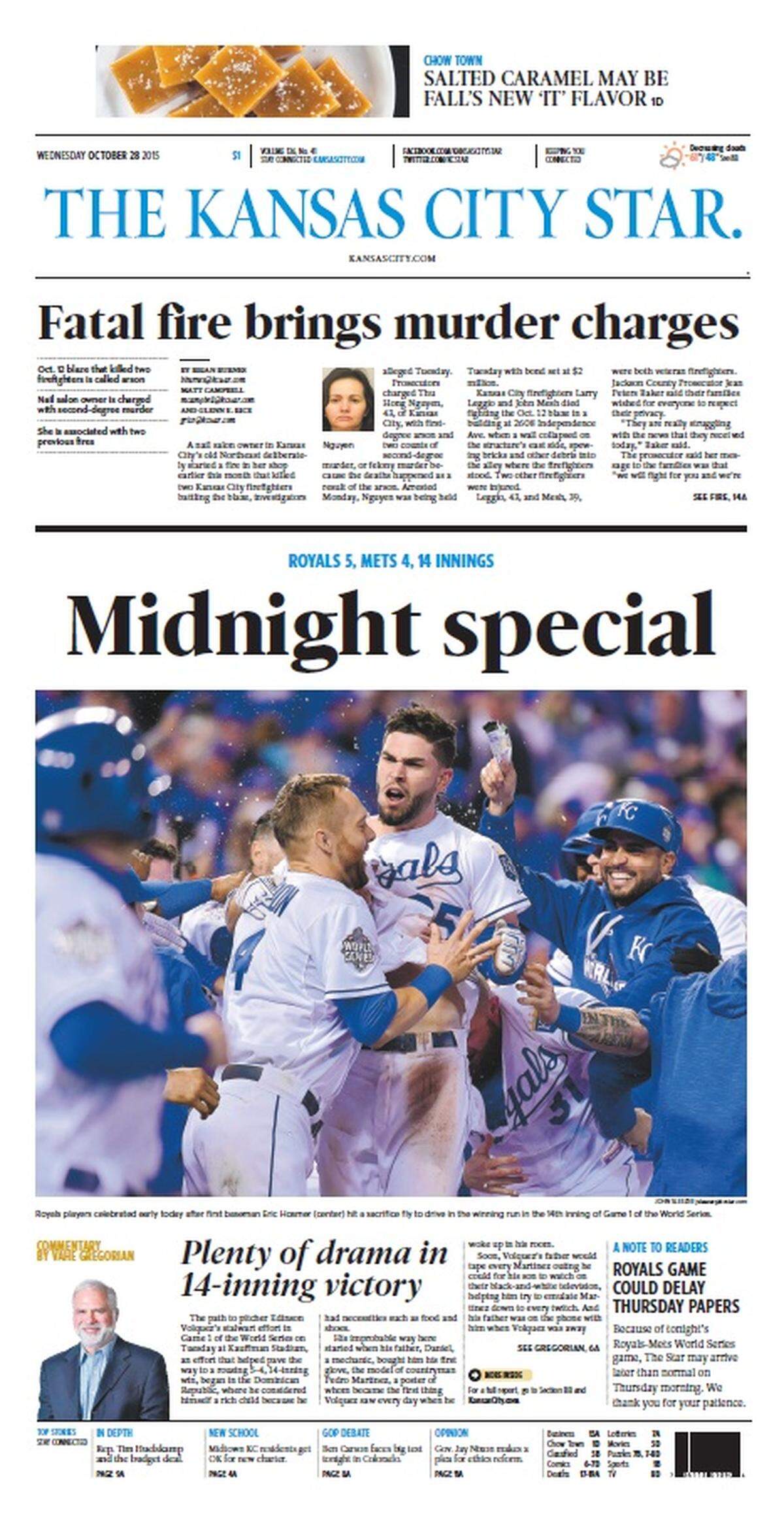
Midnight special: Plenty of drama in 14-inning victory
The path to pitcher Edinson Volquez’s stalwart effort in Game 1 of the World Series on Tuesday at Kauffman Stadium, an effort that helped pave the way to a rousing 5-4, 14-inning win, began in the Dominican Republic, where he considered himself a rich child because he had necessities such as food and shoes.
His improbable way here started when his father, Daniel, a mechanic, bought him his first glove, the model of countryman Pedro Martinez, a poster of whom became the first thing Volquez saw every day when he woke up in his room.
Soon, Volquez’s father would tape every Martinez outing he could for his son to watch on their black-and-white television, helping him try to emulate Martinez down to every twitch. And his father was on the phone with him when Volquez was away from his home in Santo Domingo negotiating his first signing bonus for $27,000 with the Texas Rangers.
In some way or another, then, Volquez’s father also was with him on the mound in a game that began shortly after ESPN reported that Daniel Volquez had died at 63 earlier in the day and ended Wednesday morning.
That piercing news would become part of the fascinating tapestry of a game that at 14 innings matched the longest in World Series history — on a night when there were initial concerns it would be rained out.
It opened with the Royals’ Alcides Escobar’s inside-the-park home run — with the help of some slapdash glovesmanship by Yoenis Cespedes — on the first pitch from the Mets’ Matt Harvey.
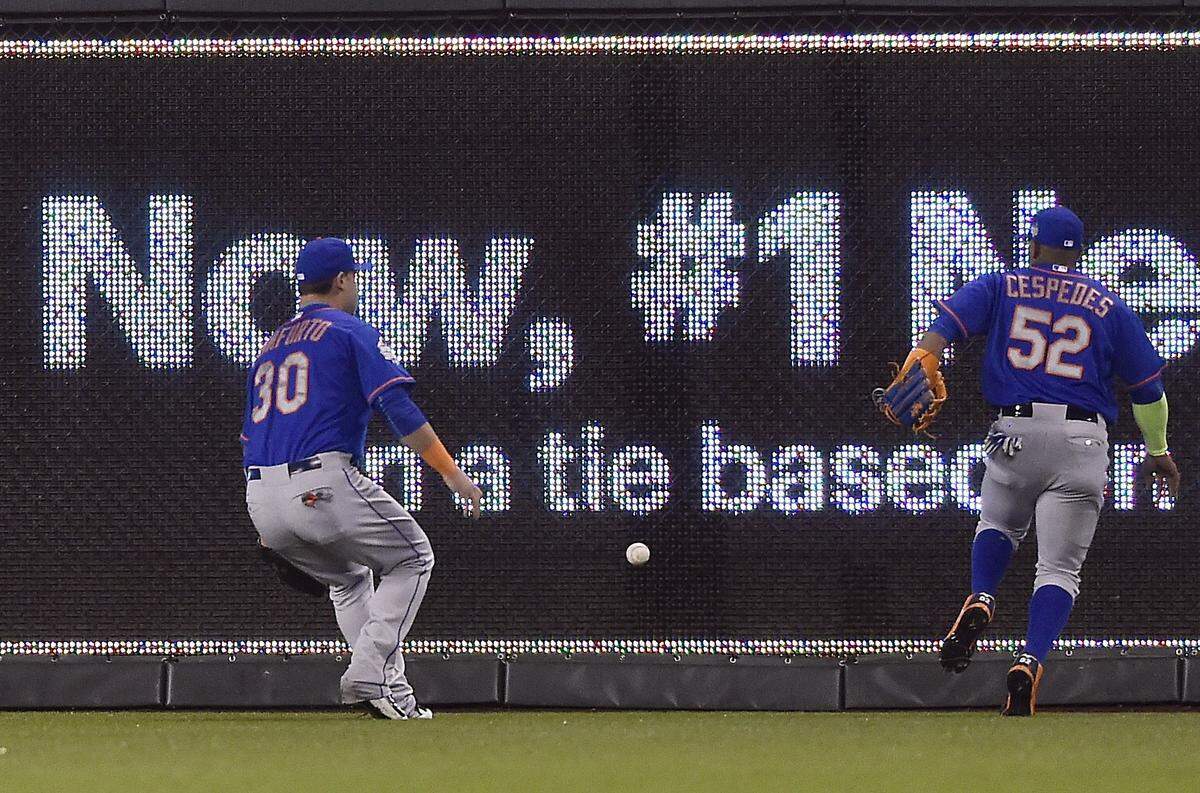
That was the first such dash in a World Series game since Mule Haas did it for the Philadelphia Athletics in 1929.
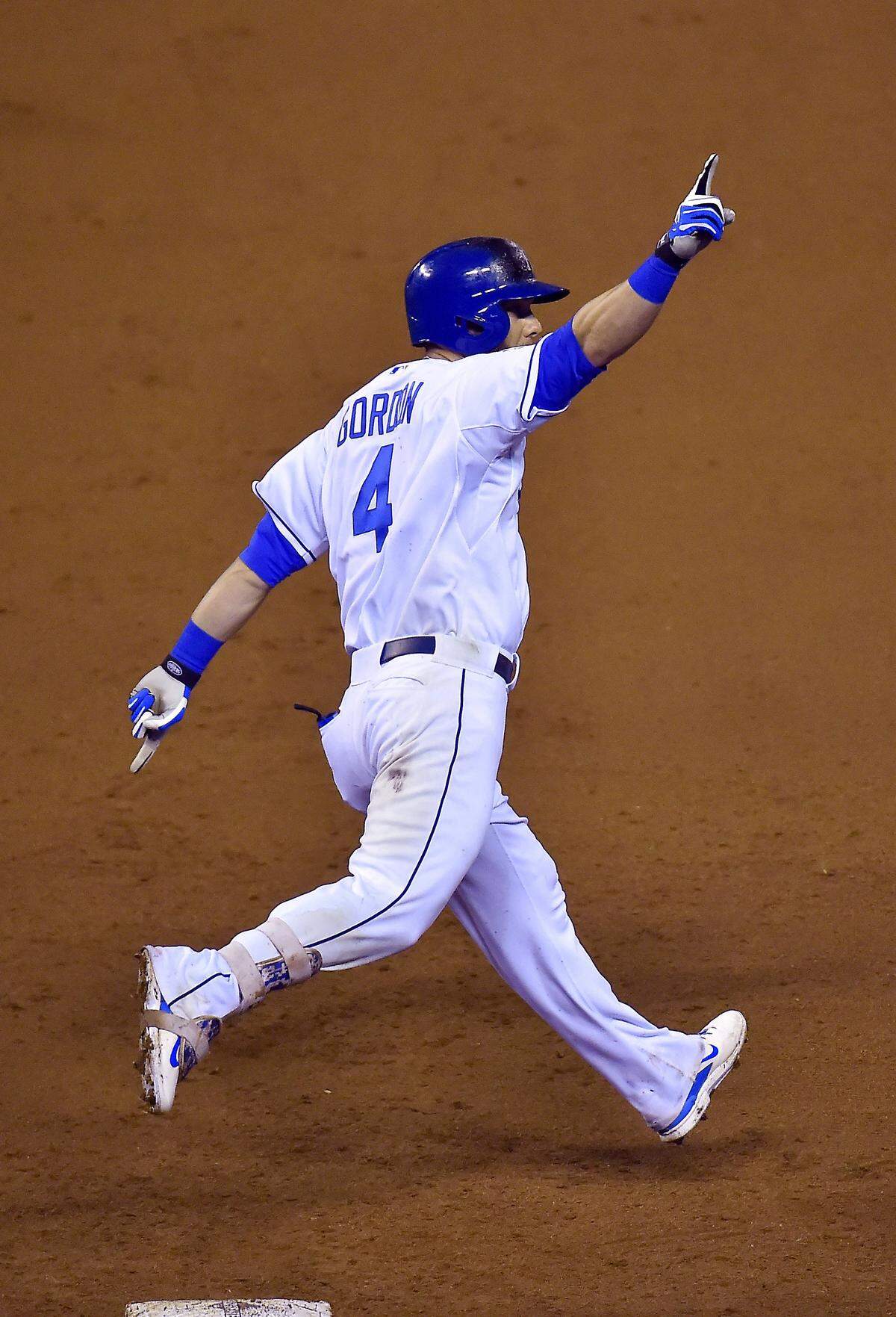
It became a marathon because Alex Gordon yanked Gold Glove first baseman Eric Hosmer off the hook for Hosmer’s rare error that allowed the Mets to take a 4-3 lead in the eighth.
Gordon’s home run in the ninth inning was the first game-tying or go-ahead homer at least that late in Game 1 of a World Series since the iconic one by the Dodgers’ Kirk Gibson off Oakland’s Dennis Eckersley in 1988.
It became about redemption when Hosmer stood and watched his fly ball to right that he knew would drive in Escobar from third with the game-winning run in the 14th, a play punctuated by Hosmer flipping his bat.
But Volquez will always have a special signature on a night he’ll surely remember like no other.
The death of his father was the jarring latest episode in a mournful recent trend for the Royals, three of whom now (including third baseman Mike Moustakas and parent Chris Young) have suffered the loss of a parent in recent weeks.
Moustakas’ mother, Connie, died on Aug. 9, her son staying with the team on what he considered her wishes.
Young’s father, Charles, died on Sept. 26, a day before he insisted on pitching to honor his father and channeled five innings of no-hit baseball before leaving to join the family.
Young, whose sturdy start helped the Royals win Game 4 of the American League Championship Series, pitched three innings of scoreless relief to get the win.
Volquez also received what might be seen as a poignant boost from Moustakas, who in the sixth inning dived to backhand a two-out smash off the bat of Wilmer Flores with a runner on second base.
Moustakas snapped to his feet and fired a strike to Hosmer to snuff out the rally and leave Volquez with the stuff of what is known as a “quality start” — three runs in six innings — but also was so much more.
At the time of deadline for this column, it was not yet certain what Volquez had known before the game of his father’s fate.
ESPN reported that Volquez had learned of his father’s death on the way to the ballpark; the Royals said Volquez had been unaware as he started the game.
Consistent with the Royals’ stance with The Star, during its broadcast Fox later quoted a Royals source as saying he hadn’t been told before the game by request of his wife, Roandry.
Whatever the case was, the once-volatile Volquez summoned in his first World Series appearance the poised intensity to be what he has been all season for the Royals: the most stable starter among a group of more-celebrated, higher-ceilinged but far more fickle sorts.
Volquez retired the Mets the first eight New York batters he faced and didn’t give up a hit until the fourth inning, when the Mets created a run with three base hits.
They’d add another in the fifth on Curtis Granderson’s home run and another in the sixth before Moustakas’ play snuffed out any more trouble.
Volquez left trailing 3-1, but the Royals tied it in the bottom of the sixth on RBIs by Hosmer and Moustakas.
Volquez’s night was long over by the time the game was decided, of course, but his impact on the game was indelible — just like his father’s was on him.
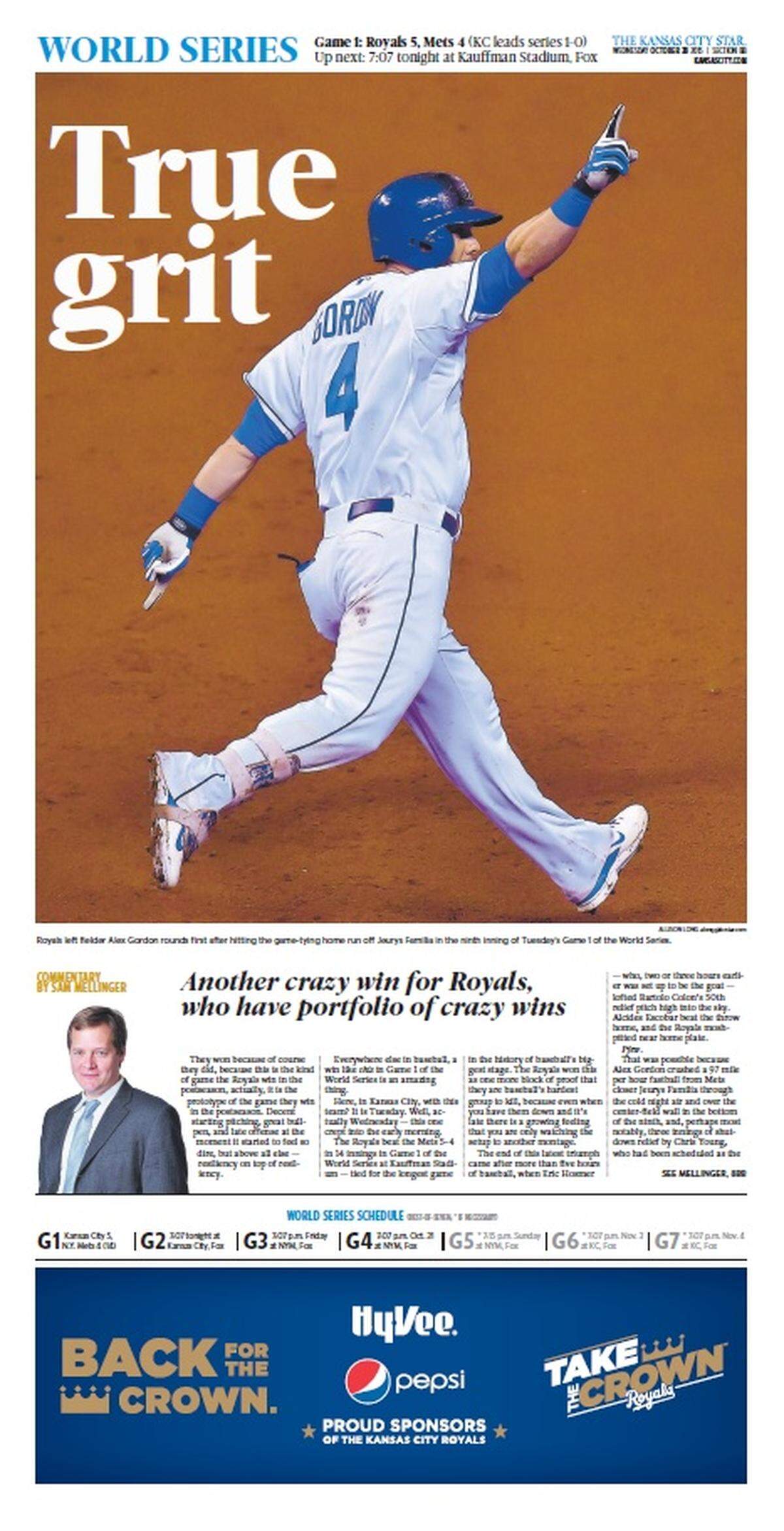
Another crazy win for Royals, who have portfolio of crazy wins
They won because of course they did, because this is the kind of game the Royals win in the postseason, actually, it is the prototype of the game they win in the postseason. Decent starting pitching, great bullpen, and late offense at the moment it started to feel so dire, but above all else — resiliency on top of resiliency.
Everywhere else in baseball, a win like this in Game 1 of the World Series is an amazing thing.
Here, in Kansas City, with this team? It is Tuesday. Well, actually Wednesday — this one crept into the early morning.
The Royals beat the Mets 5-4 in 14 innings in Game 1 of the World Series at Kauffman Stadium — tied for the longest game in the history of baseball’s biggest stage. The Royals won this as one more block of proof that they are baseball’s hardest group to kill, because even when you have them down and it’s late there is a growing feeling that you are only watching the setup to another montage.
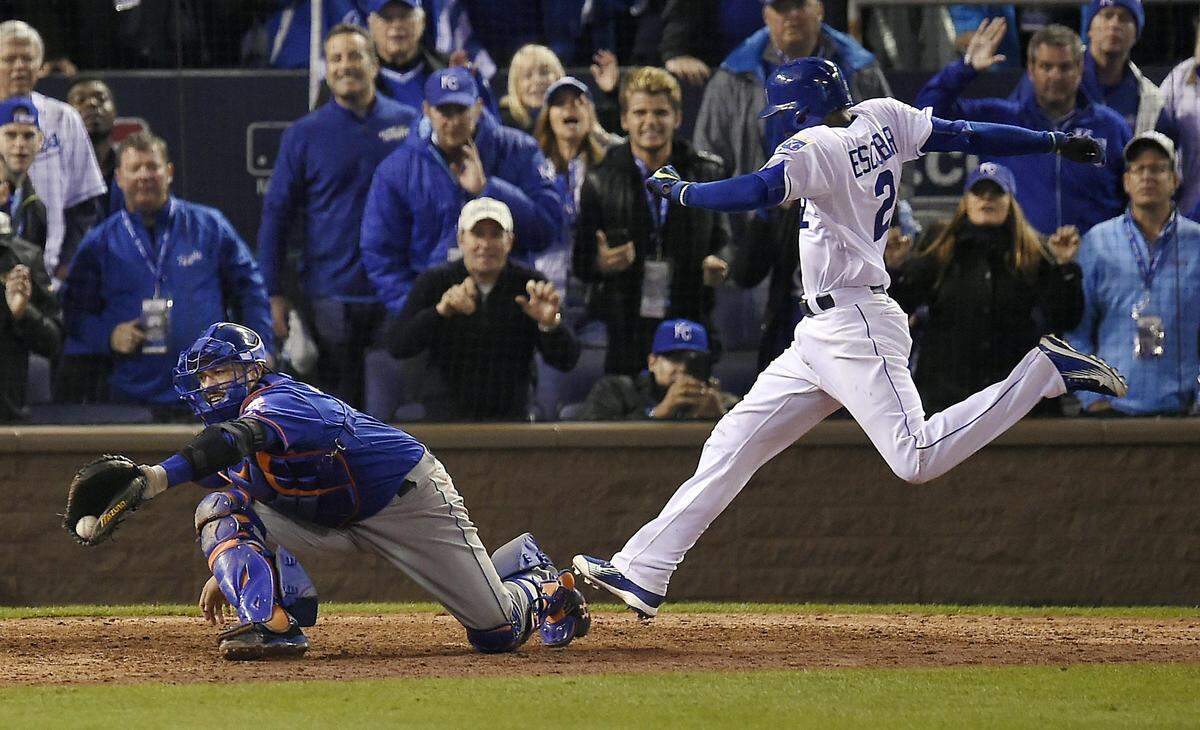
The end of this latest triumph came after more than five hours of baseball, when Eric Hosmer — who, two or three hours earlier was set up to be the goat — lofted Bartolo Colon’s 50th relief pitch high into the sky. Alcides Escobar beat the throw home, and the Royals mosh-pitted near home plate.
Pfew.
That was possible because Alex Gordon crushed a 97 mile per hour fastball from Mets closer Jeurys Familia through the cold night air and over the center-field wall in the bottom of the ninth, and, perhaps most notably, three innings of shutdown relief by Chris Young, who had been scheduled as the Game 4 starter.
Gordon’s homer erased a nightmare eighth inning in which Hosmer, the Gold Glove first baseman, made an error that allowed the go-ahead run to score, and two of the Royals’ best hitters had awful at-bats with the tying run in scoring position. It was the first game-tying or go-ahead home run in the ninth inning or later of Game 1 of a World Series since Kirk Gibson off Dennis Eckersley in 1988.
Baseball’s playoffs have a way of mass producing drama, but even by those standards, these Royals are on a different level. The Wild Card Game. The eighth inning in Houston. Game 6 against Toronto. At this point, if Lorenzo Cain isn’t scoring from first on a single and Wade Davis isn’t shutting it down with one of the great clutch relief appearances in recent baseball history, it just doesn’t rate.
The joy of this one was set up by the shocking sadness. This game happened to be played on the 29th anniversary of the Mets winning Game 6 of the 1986 World Series on Bill Buckner’s error. This is a coincidence, of course. But, you have to admit, it’s a heck of a coincidence.
Buckner’s error was about a man who probably should not have been in the game missing an easy play. Hosmer’s error was about one of the game’s best defensive first basemen not moving laterally to get in front of a ball that may have taken a topspin hop quicker than he expected.
The Royals have won so many games and, in many ways, two American League pennants with defense. To see them lose a World Series game because of defense is like tuning into public radio and hearing 2Pac.
Even without Hosmer’s error, this one had a lot to remember. Edinson Volquez started for the Royals on the day his father died, the third member of the team to lose a parent this season. The national broadcast went dead for a time, delaying the game. Escobar’s homer. For Royals fans, it had everything but the familiar final result.
The Royals lost this game in the eighth inning. Not just Hosmer’s error, but in an agonizing bottom of the inning after Ben Zobrist roped a ball into the right field corner for a double.
After that, Lorenzo Cain — the Royals’ No. 3 hitter, and a .307 batter in the regular season and a .310 hitter in the postseason — tried to bunt. Twice. He whiffed badly, then struck out swinging on the third pitch. After that, Hosmer came up with a chance to atone and appeared intent on hitting each pitch to the Adam’s Mark hotel across the interstate. Like Cain, he struck out on three pitches. The inning ended on a harmless ground out by Mike Moustakas.
That’s a heck of a setup to the party, right?
The Royals have changed the way a city feels about baseball, and they’ve done that by winning, of course. Winning is always the most important thing. But the bond has come quicker and harder than it otherwise might because of the way they’re winning.
Every win is a memory with these guys, one burned in your brain by the moment some 40,000 people jumped up and down and shook an old stadium as the Royals moved one step closer to a world championship.
Down going into the ninth inning, it’s easy to give up on a baseball team. With these Royals, it means they’re only getting started.
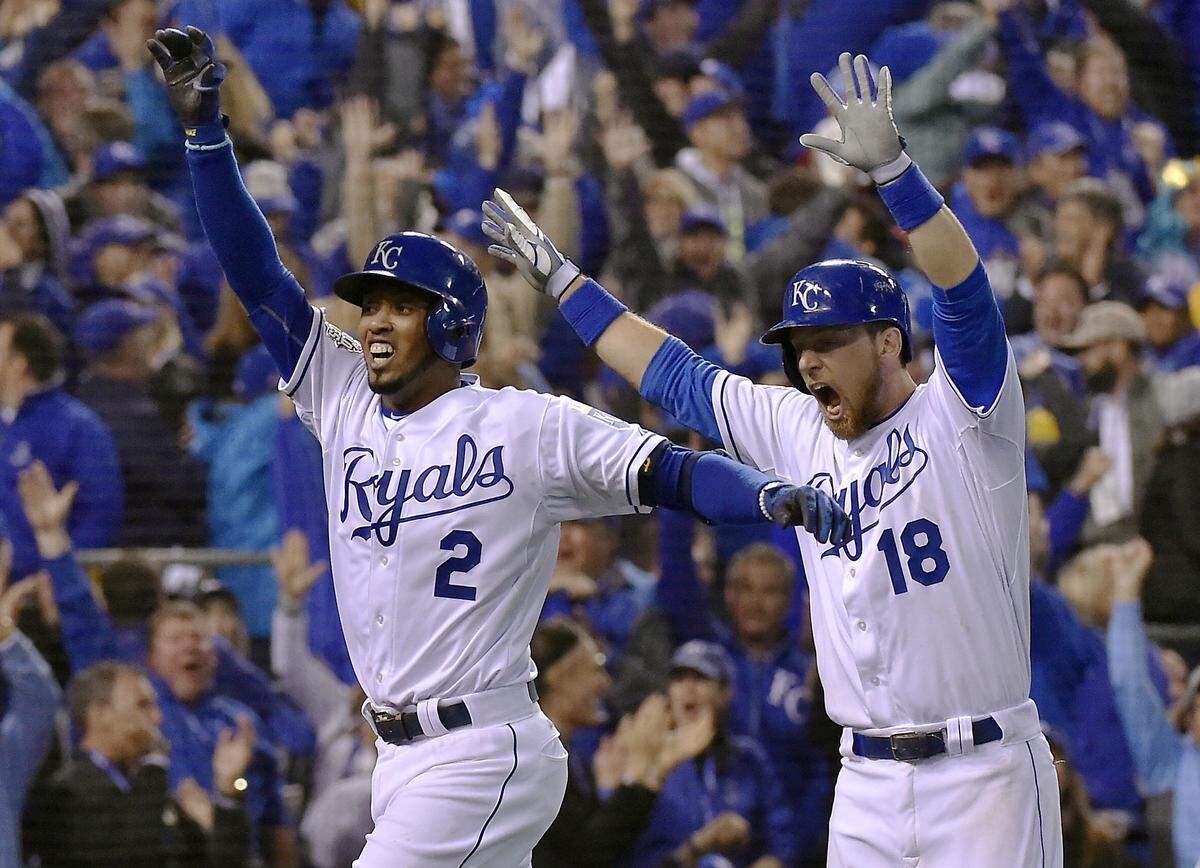
Waiting and winning: Hosmer’s bases-loaded sacrifice fly in bottom of 14th scores Escobar
He strode to the plate at 15 minutes past midnight, six innings and a calendar day removed from exiting this ballpark looking like a goat. Eric Hosmer came to the plate with the bases fully stocked with Royals and none out in the 14th inning of Game 1 of the World Series. He did not have to do too much. He did not try.
Hosmer lifted a sacrifice fly to right field, deep enough to plate Alcides Escobar, the winning blow after five hours and nine minutes of gut-wrenching baseball in a 5-4 victory over the Mets. No World Series game has ever lasted 15 innings. Only three have gone 14. Hosmer assured the Royals could go home happy, even if Tuesday had turned to Wednesday.
The game required the bottom of each team’s roster to contribute. The Royals scored in the 14th off pitcher Bartolo Colon, who was working his third inning of relief.
The Mets left 11 runners on base; the Royals countered with 11 of their own. The Kansas City relievers allowed one run across eight innings and struck out 12. The victory belonged to Chris Young, the team’s Game 4 starter, who contributed three innings of emergency relief.
And to think it all appeared over when the ninth inning began.
Two outs away from defeat, Alex Gordon unloaded a titanic blast over the center-field fence off Mets closer Jeurys Familia. Familia had not blown a save in three months. The baseball traveled an estimated 428 feet and awakened a sullen stadium. In the dugout, Hosmer found Gordon and gave him a hug. Gordon removed some guilt from Hosmer’s conscience.
On the 29th anniversary of the Mets last world championship, New York grabbed the lead with the mirror image of their final flourish against the Red Sox in Game 6 of that World Series. The grounder that conquered Hosmer represented a far greater challenge than the one that rolled between Bill Bucknor’s legs. But still it stung.
The ball chopped off the bat of shortstop Wilmer Flores. Ready to run at second was mid-game entrant Juan Lagares, who had singled off Kelvin Herrera and stolen second. Now he jetted home after the ball skipped by Hosmer.
In the bottom of the frame, after a leadoff double by Zobrist, the Royals made a curious strategy decision. Lorenzo Cain, the team’s No. 3 hitter and a potential American League MVP candidate, tried to bunt twice against Mets reliever Tyler Clippard. Cain failed, and struck out on the third pitch.
Hosmer struck out next. Zobrist took third on a wild pitch and Kendrys Morales walked. But into the game came Familia to record a four-out save. He produced a groundball out by Mike Moustakas. But Familia could not finish the job in the ninth.
Edinson Volquez turned in the minimum requirement of a quality start, with three runs allowed across six innings. He still matched the output of Mets starter Matt Harvey, who the Royals toppled with a two-run rally in the sixth. Shortly after Zobrist doubled and scored, Moustakas tied the game with an RBI single to plate Cain.
Oddities marked the early portion of the game. Escobar smashed the first pitch he saw for an inside-the-park homer in the first. The Fox broadcast went out in the fourth, which forced both teams to play without replay reviews for a stretch. A misty drizzle covered the park.
The forecast dominated discussion as the evening approached. The tarp covered the diamond all afternoon, slightly elevated by a pair of fans drying the surface underneath. Two smaller, blue tarps protected the World Series logo along the lines.
With the field unavailable, the Royals warmed up inside their indoor batting cage. As drizzle soaked the field, first-base coach Rusty Kuntz warmed his arm in a T-shirt and shorts. He soon departed, along with the majority of the on-field demimonde when a downpour fell.
The clouds cleared, relatively, in time for the game to begin without delay. As Volquez took the mound, reports proliferated on social media about the death of his father in the Dominican Republic. ESPN Deportes reported that Daniel Volquez, 63, died as a result of heart disease.
The reports emerged as Volquez loosened up in the bullpen about 30 minutes before the first pitch. It was unclear if the news had reached Volquez. A team official insisted Volquez was not aware of it, but ESPN Deportes wrote Volquez learned during his drive to the ballpark on Tuesday.
After Volquez vanquished the first three hitters he faced, Escobar handed him a one-run lead. The Mets opened this series with Harvey, the burly right-hander who wears the nickname “The Dark Knight of Gotham” when he is not sparring with Mets officials about his self-imposed innings limit.
Escobar came to the plate for his first at-bat since winning the American League Championship Series MVP. He hit .478 against Toronto, and swung at the first pitch in the first inning in all six games. At one point, he admitted he hacked so often in those spots because 99 percent of the time, the opposing pitcher threw a fastball for a strike.
Either Harvey ignored the scouting report or he refused to bend to Escobar’s tendencies. Harvey heaved a 95-mph fastball over the plate. True to form, Escobar swung.
Perhaps the greatest discrepancy between these two clubs — greater even than the Mets’ advantage in starting pitching — is the difference between the two defenses. The Mets dispatched Yoenis Cespedes, typically a corner outfielder, into center field for Tuesday. The assignment paid immediate dividends for Kansas City.
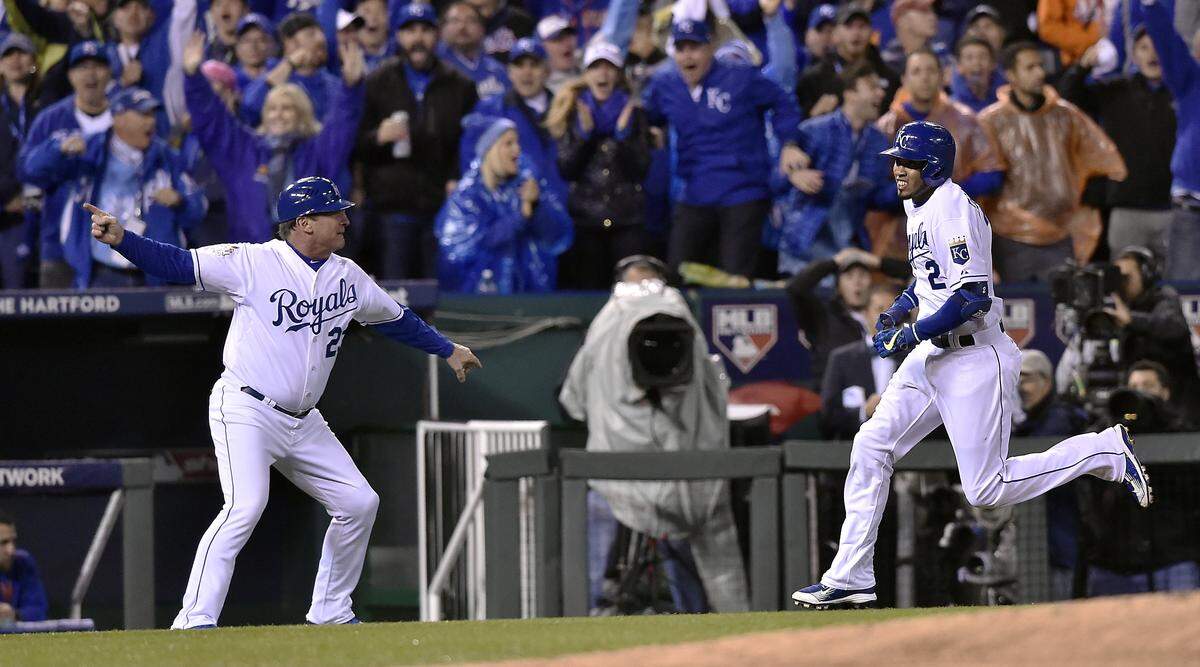
Escobar cracked the baseball into the left-center gap, closer to Cespedes than rookie left fielder Michael Conforto. The duo converged but struggled to communicate. At the last moment, Cespedes opened his glove for a half-hearted, hopeless stab. The baseball fell to earth and rattled along the warning track.
Escobar never stopped running. He spotted the green light from third-base coach Mike Jirschele. Escobar did not even need to slide.
The ambush did not jostle Harvey into a collapse. He lugged his team through the inning and his teammates tied the game in the fourth.
Daniel Murphy, the Mets’ postseason version of Babe Ruth only able to survive at second base, led off with a single up the middle. Lucas Duda chopped a single up the middle. Moustakas dove to smother a grounder off the bat of catcher Travis d’Arnaud, but could not make a play on the RBI infield single.
The game veered off the path in the bottom of the fourth. After Harvey fanned Kendrys Morales, Mets manager Terry Collins emerged from his dugout to speak with umpire Bill Welke. Welke left to speak with Ned Yost. The Fox truck at the ballpark lost power, which cut out the video feeds inside the clubhouses, robbing both teams of replay capabilities.
In an odd scene, Collins chatted with Moustakas in the batter’s box as Welke conferred with Yost. Loping down from the stands was Joe Torre, MLB’s chief baseball officers. The two teams agreed, temporarily, to play without replay.
The delay lasted about five minutes. Both teams reacquired replay in the top of the fifth, using an international feed from MLB. This left the Royals with the renewed ability to re-watch Granderson’s go-ahead homer in the fifth.
Volquez led in the count, 1-2, when he fired a 95-mph sinker. The pitch bisected the plate. Granderson made it disappear inside the Mets bullpen in right field.
An inning later, the Mets continued to harass Volquez. Yoenis Cespedes led off with a single. Duda grounded a single up the middle, where the Royals presented an infield shift. Moustakas stood along on the first-base side of second. He had to range to his left, toward first, to corral Duda’s grounder. He could not handle it, and Cespedes rumbled to third.
Two batters later, Conforto lifted a flyball to left field. Alex Gordon settled underneath. Cespedes waited like a sprinter at the blocks. As soon as Gordon caught the ball, Cespedes sprinted home. The throw was not close, and the Mets led by two.
Zobrist did not allow his teammates to hang their heads for long. He stroked Harvey’s first pitch in the bottom of the frame, a 94-mph fastball, into the right-field corner for a double. Cain shot a single into right. With runners at the corners, Eric Hosmer managed a run-scoring flyball to center.
The inning created a microcosm of Kansas City baseball. Harvey occupied himself with the task of keeping Cain at first. He threw to first four times as he faced Hosmer and Kendrys Morales. And still Cain swiped the bag. The stolen base also protected against a double play, because Morales grounded back to Harvey for the second out.
Moustakas passed on a pair of curveballs to start his encounter with Harvey. He did not ignore the subsequent change-up, even though it dove toward the opposing batter’s box. Moustakas ripped the pitch into right-center to score Cain.
Yet two innings later, in a similar situation, the Royals shifted away from their strengths. Cain could not put down the bunt. Kansas City could not even the game.
Until the ninth when Gordon homered.

Escobar’s mad dash
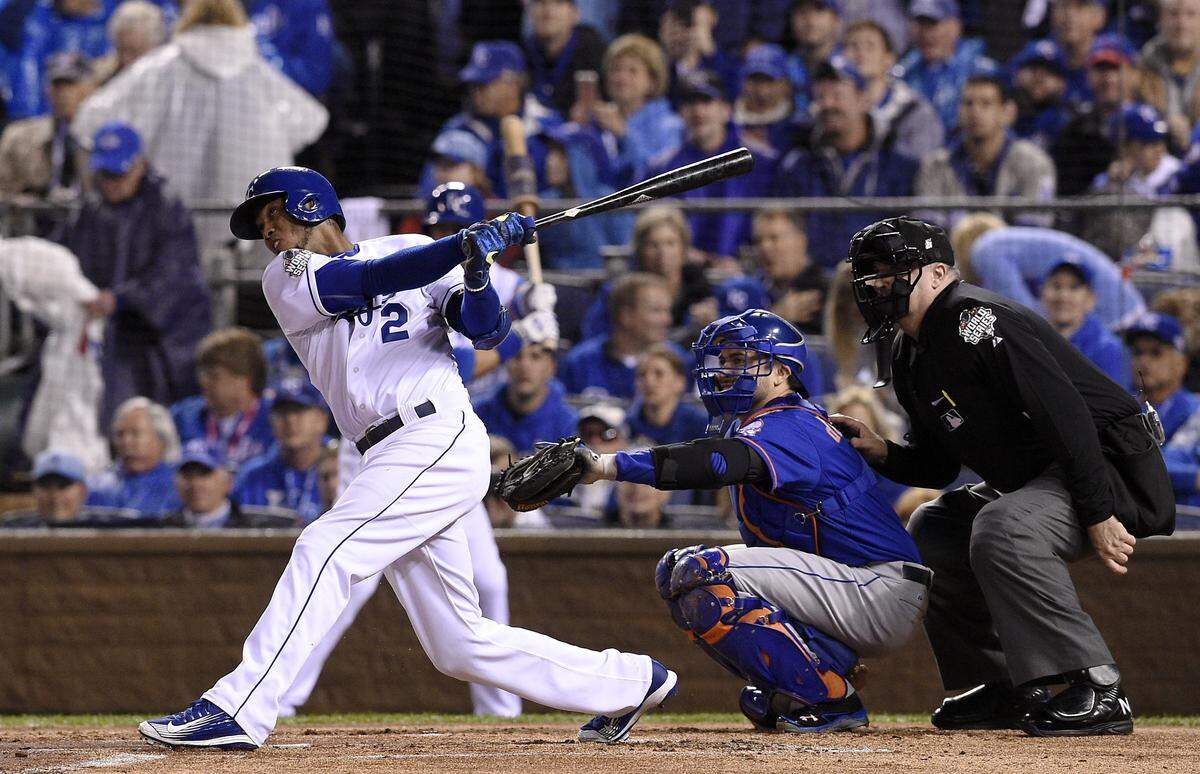
Alcides Escobar swung at the first pitch he saw, and there was nothing unusual about that.
But the result hadn’t been seen for decades.
Escobar connected on a Matt Harvey fastball and sent it into the left-field gap where it landed, and 360 feet later he crossed home plate standing up.
Moments later came the word from official scorekeeper David Boyce.
Home run.
The rarest of baseball plays occurred in the oddest of circumstances — the first pitch the Royals saw in the 111th World Series — and got them off to a fast start in a game that extended into extra innings.
The inside-the-park home run was the first in a World Series game since 1929, and it marked the second time such a feat had opened a Fall Classic game.
In 1929, George “Mule” Haas of the Philadelphia Athletics turned the trick against the Cubs.
In the second game of the first World Series, in 1903, Boston’s Patsy Dougherty hit a home run to right-center field against Pittsburgh.
Escobar’s shot shouldn’t have turned into a home run. It appeared that center fielder Yoenis Cespedes and left fielder Michael Conforto miscommunicated as the ball was approaching.
Conforto appeared to stop and give way to Cespedes, who didn’t have his glove in a position to grab the ball, which rolled to the wall.
At that point, it looked like a standup double for Escobar. But the ball caromed off Cespedes’ foot and rolled along the warning track.
By the time Cespedes had picked it up, Escobar was at third and headed for home.
The home run was Escobar’s first in this postseason. He entered the game the only Royals player among the regulars who hadn’t hit a home run in this postseason.
The Royals had a 1-0 lead, and the Mets trailed after an inning for the first time in five games, a span of 41 innings. Not since the fourth inning of the Game 5 of the National League Division Series against the Dodgers had the Mets left an inning with a deficit. They never trailed in their sweep of the Cubs in the National League Championship Series.
Escobar has been the team’s hottest postseason hitter. The home run extended his playoff hitting streak to 11 games, and he’s in pursuit of Lorenzo Cain’s consecutive-game hitting streak of 13, which Cain established this postseason.
This was the Royals’ 12th playoff game this year, and Escobar is 11 for 22 (.500) when leading off an inning, including 6 for 11 (.545) when leading off a game. He has now hit for the cycle when leading off a game, notching a single, double and triple leading off games against the Blue Jays. Escobar was chosen MVP for the series.
He got the World Series off to a great start for the Royals.