
Relive the crowning of the 2015 Royals: Here’s a flashback to the ALCS Game 6 clincher
Five years ago this fall, the Kansas City Royals won their second World Series championship.
Fox Sports Kansas City is re-airing the Royals’ victories from that postseason this month. At 7 Friday night, May 15, it’s Game 6 of the AL Championship Series.
To help you relive the moments from that magical October, we’ve dug into our archives.
Below are original stories, front pages and photos that appeared in the Oct. 24, 2015 editions of The Kansas City Star, the day after the Royals beat the Blue Jays 4-3 and reached their second straight World Series:
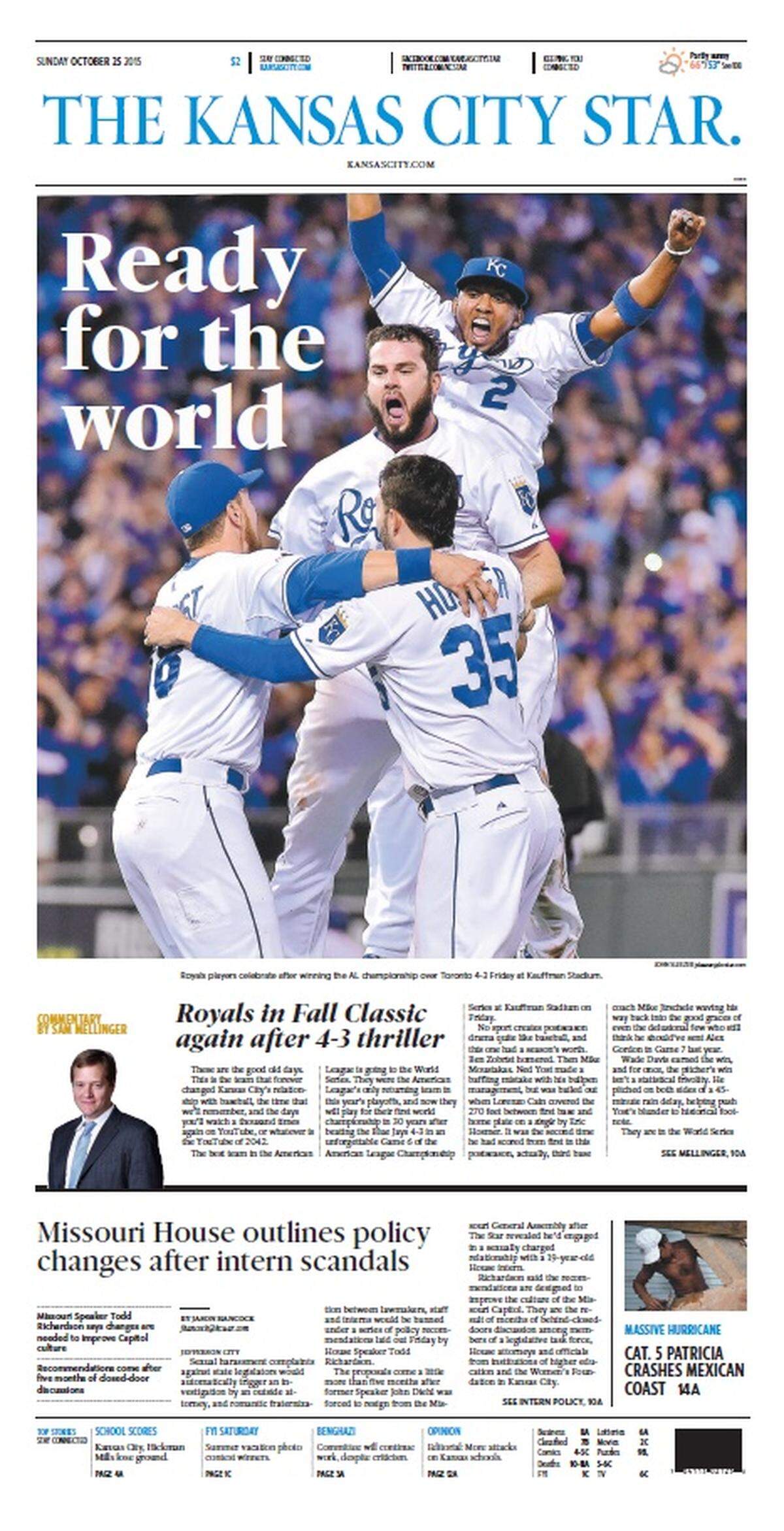
Royals in Fall Classic again after 4-3 thriller
This is the team that forever changed Kansas City’s relationship with baseball, the time that we’ll remember, and the days you’ll watch a thousand times again on YouTube, or whatever is the YouTube of 2042.
The best team in the American League is going to the World Series. They were the American League’s only returning team in this year’s playoffs, and now they will play for their first world championship in 30 years after beating the Blue Jays 4-3 in an unforgettable Game 6 of the American League Championship Series at Kauffman Stadium on Friday.
No sport creates postseason drama quite like baseball, and this one had a season’s worth. Ben Zobrist homered. Then Mike Moustakas. Ned Yost made a baffling mistake with his bullpen management, but was bailed out when Lorenzo Cain covered the 270 feet between first base and home plate on a single by Eric Hosmer. It was the second time he had scored from first in this postseason, actually, third base coach Mike Jirschele waving his way back into the good graces of even the delusional few who still think he should’ve sent Alex Gordon in Game 7 last year.
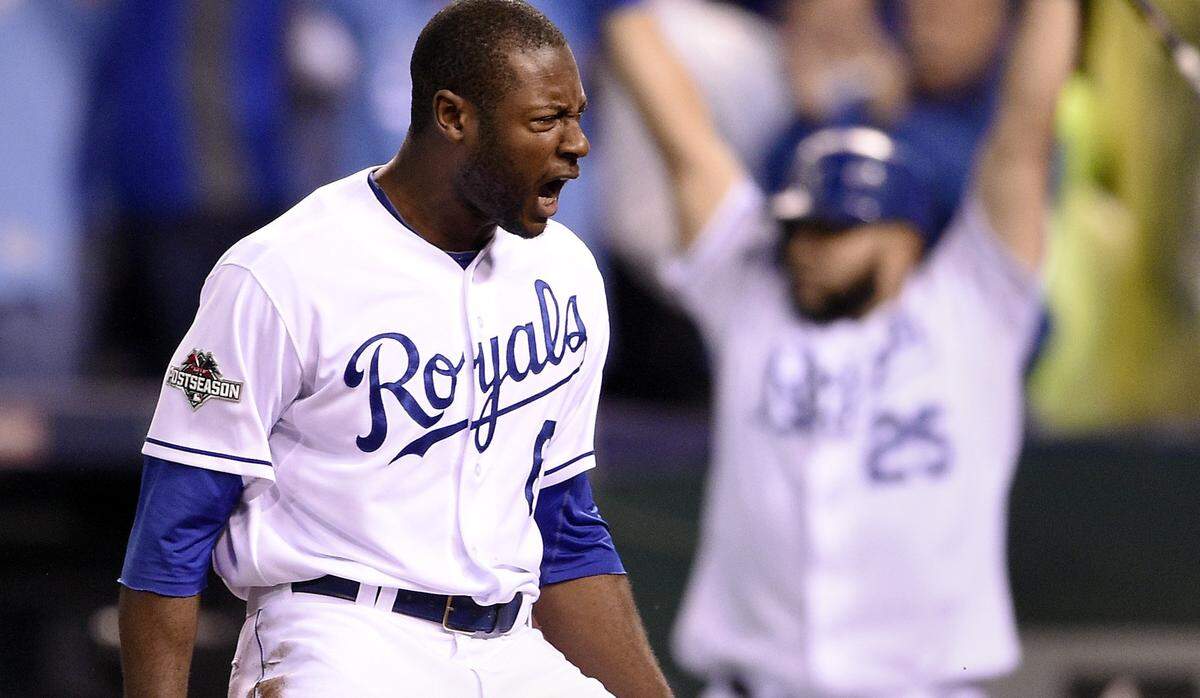
Wade Davis earned the win, and for once, the pitcher’s win isn’t a statistical frivolity. He pitched on both sides of a 45-minute rain delay, helping push Yost’s blunder to historical footnote.
They are in the World Series for the second consecutive season. They made two World Series in their first 45 years of existence.
This came out of the, um, blue, didn’t it? The Royals were so bad for so long that it became part of the background music of living in Kansas City. We had fountains, barbecue, and bad baseball. One rebuilding plan bled into another until it was impossible to tell the difference anymore, and so maybe it had to happen this way, that the new golden age of Royals baseball would pop up just as many fans and some media wanted people fired.
Last year, the Royals reset a sorry generation of baseball. This year, they did something that might be just as difficult, and certainly more lasting — they followed it up with an even better season, and another American League pennant.
Last year was a breakthrough, a month-long party. This is excellence, something the Royals hope lasts much longer.
They beat baseball’s most powerful team with power. In Game 6, that meant home runs from Ben Zobrist and Mike Moustakas and some of the sport’s hardest fastballs from Yordano Ventura, Kelvin Herrera and Wade Davis.
But that was, largely, the story of the first five games, too. The Blue Jays scored more runs and hit more homers than anyone in baseball. But the Royals scored 33 runs in the first four games, and overall in the series outscored, outhit, and outslugged the Blue Jays.
Much of the last three months has been about the all-in trade for Johnny Cueto, and the wild high (Game 5 of the Division Series) and lows (lots of them) that came along. They won the ALCS by twice beating David Price, the former Cy Young Award winner who the Blue Jays went all-in to trade for.
They did with the kind of beginning-to-end smothering that gives truth to every one of the players and coaches who have called this a team effort. Every starter but one has homered in this postseason, and the outlier is Alcides Escobar, the swing-happy leadoff man who might have been their best hitter in the ALCS.
They had to walk through some tight moments, even after putting together that epic comeback in Houston and then riding Cueto’s brilliance in the clincher to get here.
The last was the ninth inning, when the Blue Jays put runners on the corners with no outs against Wade Davis.
The most obvious was after the eighth inning, when Yost left Wade Davis in the bullpen so that Ryan Madson could pitch against the Blue Jays’ best hitters. Yost can cite the rain that was on the way, but even in that context, this was a predictable mistake.
Madson’s best pitch is his changeup, and nobody hits changeups better than the Blue Jays. Madson gave up more than two runs in only two outings this year, both against Toronto. When Jose Bautista tied the game with a home run, it was the result the decision deserved.
And when the Royals won the game in the bottom of the eighth, they had won what they deserved. This team has shown itself to be irrepressibly resilient, thrilling when it is going right, and indefatigable in its ability to scratch out every available margin.
They smothered Price with that five-run seventh inning in Game 2, gritted through Cueto’s failure in Game 3, and came back with a mountain of offense in Game 4.
In the clincher, Moustakas hit a homer that may or may not have been Jeffrey Maier-ed by a fan in right field — some replay angles suggested that Caleb Humphreys reached over the railing, but umpires upheld the home run after a review.
Tight moments came later, too, navigating the fifth and sixth inning that have occasionally been so difficult for the Royals. Yordano Ventura came in to face Josh Donaldson with two on in the fifth (Donaldson scorched a 91 mph cutter, but right into Moustakas’ glove), and in the sixth Kelvin Herrera came in to strand a runner at second.
Ventura gave the Royals everything they needed. He has had such a strange season. The big contract, the opening day start, the fights, the struggles so bad the Royals tried to send him to the minors, and then pitching so well he was the Royals’ best starter going into the playoffs.
He was brilliant with his curveball, aggressive with his fastball, and carried it all with just the right amount of swagger. Well, OK, maybe, technically, doing the big-testicles thing and apparently trash-talking the Blue Jays’ first base coach is a little too much swagger, but the results were good, which is all that matters — 5 1/3 innings, four hits, five strikeouts, one run.
That’s a little different, no? For far too long, watching the Royals was about everything but that night’s final score. It was about young players developing, or old players finding their youth again, or more often than anything else, an excuse to drink a beer or start a conversation with a friend. The process became something like a curse word.
Now the only thing that matters is winning a championship. The Royals have said that from the first day of spring training. Catch them in an honest mood, and some will admit that winning the pennant was enough last year. Not anymore.
This group has allowed Kansas City to love baseball again, and now they have done something that George Brett and Frank White and Dick Howser and Willie Wilson never did. They have made consecutive World Series.
Those guys did something this group has not, though. They won a championship. Now, that’s the only thing that matters.
Core players overcome challenges and sweep away doubts
The Royals’ 25-man postseason roster has 12 changes on it from last season, and the Royals probably wouldn’t have won their second straight American League Championship Series on Friday at Kauffman Stadium without the makeover.
That was particularly true with the additions of Kendrys Morales, Chris Young, Ryan Madson, the postseason version of Alex Rios and Ben Zobrist, whose first-inning home run stirred Kauffman Stadium to a life it never lost in the Royals’ 4-3 victory over Toronto in the decisive and nerve-wracking Game 6.
But this all has sprouted foremost from the core of players who came of age here, players whose early struggles left skeptics expecting they’d just add to the generation of futility that had engulfed the franchise.
They needed time to develop, general manager Dayton Moore would say year after year after year after taking over in mid-2006.
And of course it did after so many barren years had left so much in a shambles.
But by the time the nucleus was arriving in the big leagues in the early 2010s, patience was ebbing and the common criticism was that Moore kept moving the goalposts on when the youngsters could be expected to find themselves.
The trouble with that is that everyone is on his own pace, no matter how abundant the talent might seem to be.
Belief without evidence might be one way to define faith, but who here could be blamed for thinking belief without evidence just meant more emptiness ahead?
They all had their challenges, even Lorenzo Cain and Sal Perez and Alcides Escobar and Danny Duffy and the injured Greg Holland and Alex Gordon, who was drafted before Moore arrived but had to undergo a radical transition from third base in 2010 before he became an All-Star leftfielder.
But no one had more expected of them as future franchise cornerstones than first baseman Eric Hosmer and third baseman Mike Moustakas, each of whom was promoted from Class AAA Omaha in mid-2011 with the label of being the future and symbolically conjoined to this day playing catch in front of the dugout before every game.
And here they were on Friday with some fine symmetry, each making major offensive contributions before completing the final out of the game with Moustakas fielding Josh Donaldson’s hard grounder to throw him out at first and douse a last Toronto threat.
They also were connected with somewhat quiet postseasons before Friday, with Hosmer hitting .220 (albeit with several key hits) and Moustakas just .132 highlighted by his game-tying RBI in Game 2 of the ALCS.
But Hosmer drove in Cain with the game-winning run after Toronto had rallied to tie it 3-3.
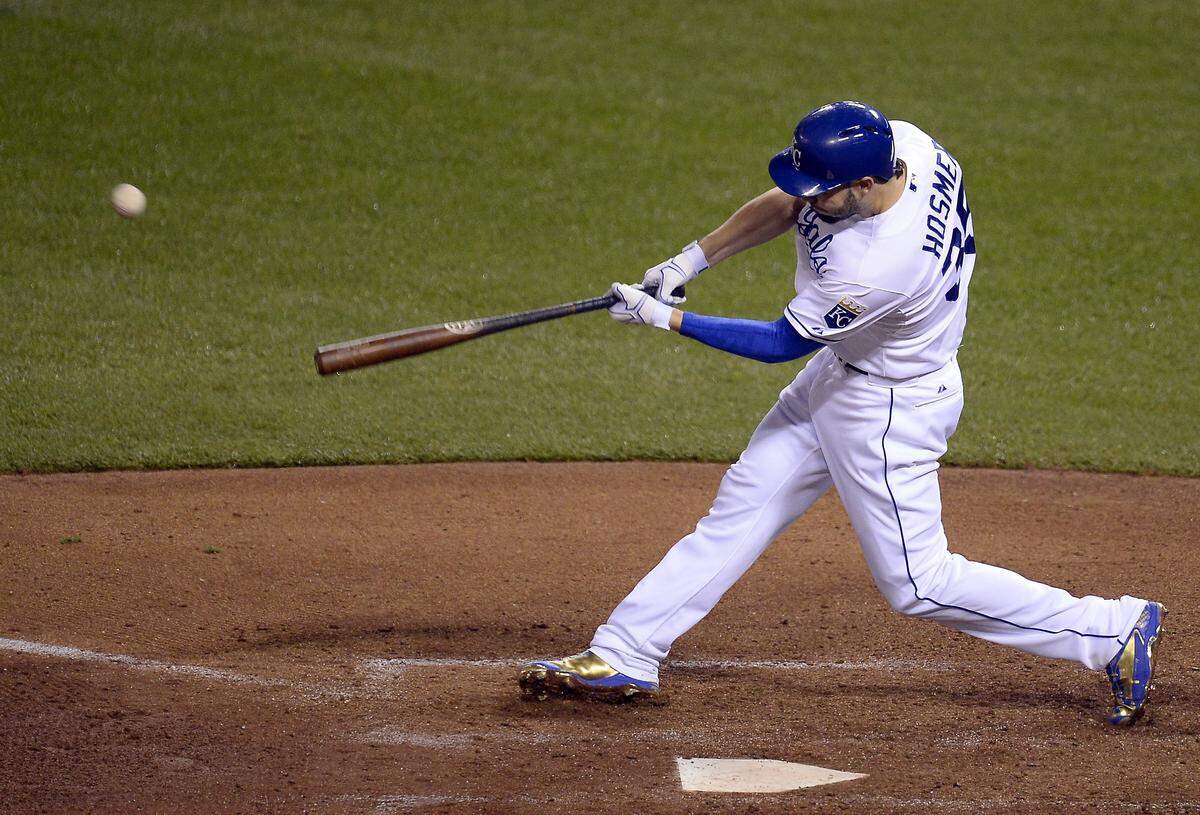
Meanwhile, nobody embodies those ups and downs and the human element of all this like third baseman Mike Moustakas, who last season was both demoted to Class AAA Omaha and hit a franchise-record five home runs in a postseason also marked by his iconic catch crashing the dugout suites.
That postseason largely proved transformative for Moustakas, who had career bests with a .284 average (.72 higher than 2014), 22 home runs and 82 RBIs all while contending with the illness of and, ultimately, the death of his mother.
Then came this postseason, when Moustakas’ presence was prominent as the emotional sparkplug of the Royals’ rally from down 6-2 in the eighth inning of Game 4 against Houston but when his numbers had sagged.
But other than driving in the tying run of Game 2 against Toronto, Moustakas had been four for 37 this postseason.
On Friday, though, he was a catalyst when the Royals needed him most, first thumping a controversial home run to right center to give Kansas City a 2-0 lead.
The ball, caught by a fan near the outfield wall, was scrutinized and certified by review officials even as the play left Toronto fans furious.
Moustakas’ seventh-inning hit turned into another run when Rios drove him home, and the captivating Royals held on — and maybe had to if they wanted to advance.
Another reason for Royals fans to bask in this, of course, simply was the relief of finding no bogeyman lurking under the bed:
The prospect of Game 7 had been a nightmare scenario bubbling for Kansas City since the Blue Jays extended the series Wednesday with their 7-1 victory in Game 5.
Like laws or sausages, you wouldn’t have wanted to see that game be made.
Given the utter unreliability of Johnny Cueto, considering Toronto would be coming off its fifth straight win while facing elimination this postseason, that would have been a matchup for which even the most zealous Royals fan would have to manufacture enthusiasm and belief and would go into with a grimace.
Thirty years after the Royals inflicted on Toronto a comeback when they were down 3-1, the note was due for turnabout.
And as setups for miserable sequels go, for the local audience, anyway, this one would have had all the trappings of, say, “Caddyshack II.”
Or better yet, the awful “Jaws II” and the tagline that was the best thing about it: “Just when you thought it was safe ...”
For fans, anyway, it would have been hazardous to their mental health in against a Toronto team that was down two games to none in the best-of-five ALDS against Texas and is steeped in a similar sort of grit and passion that defines the Royals.
“So far to this point, we’ve had that knack of responding at the right time ...,” Toronto manager John Gibbons said Friday afternoon. “They fear nothing. We’ve got nothing to lose. You fall down 3-1, nobody expects you to win, so what do you have to lose? Other than go out and shock everybody, really. ...
“And I guess you do it a couple of times in the postseason, hey, see if you can do it again.”
But they couldn’t.
Because, it turns out, bearing a resemblance in character to the Royals isn’t the same as actually being the Royals.
Because for the second straight season, the Royals are the undisputed best team in the American League thanks to a unique blend of personnel and personalities.
But one best known for being built around a nucleus of players that grew up before your eyes — through all the awkwardness and uncertainty and pain to finally become who they are.
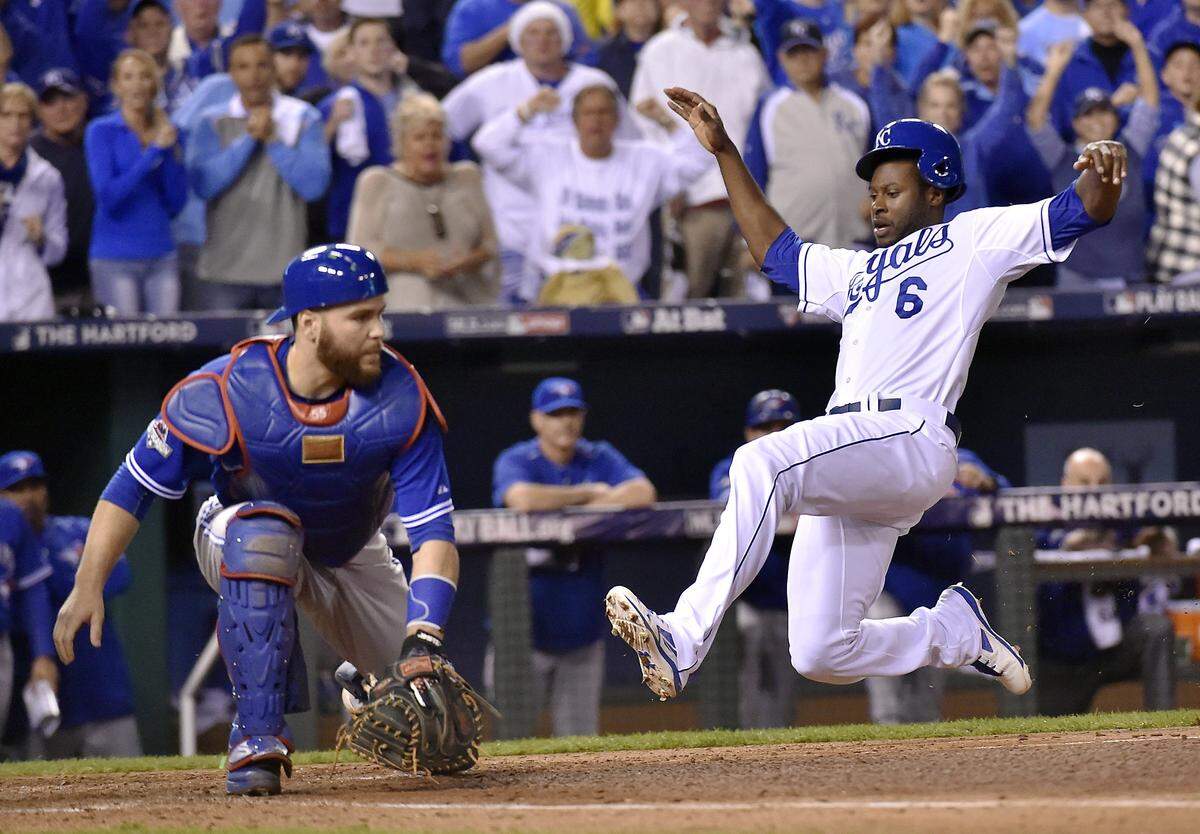
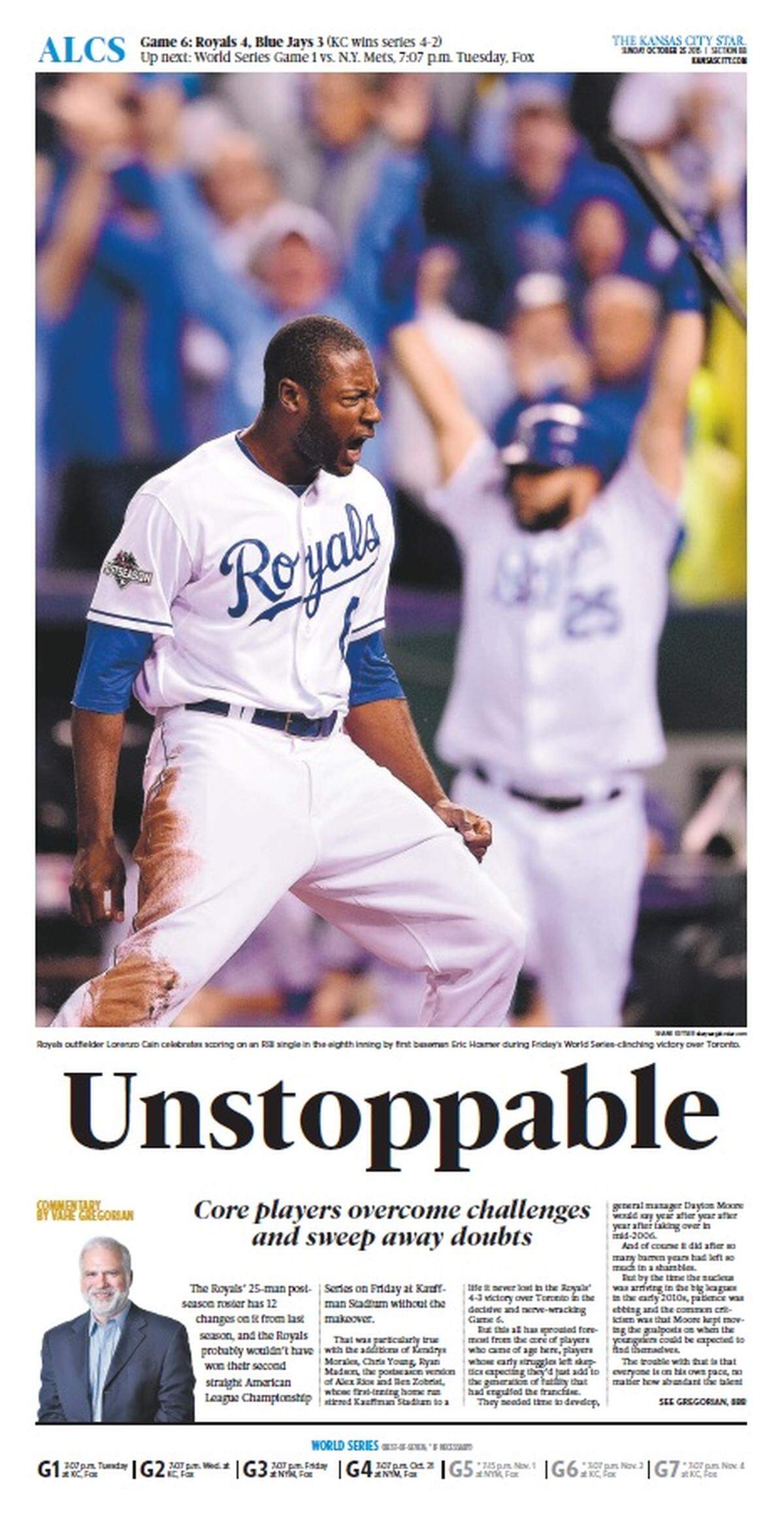
Dash back to Series: Lorenzo Cain scores from first on a Eric Hosmer single to give Royals 4-3 win
The savior for Ned Yost, the right arm who waved the Kansas City Royals into their second World Series in a row, stood a few feet shy of third base as Eric Hosmer’s single soared into right field. Mike Jirschele, a minor-league lifer turned big-league coach, squinted as the baseball settled into the corner.
He earned infamy among certain fans for his refusal to send Alex Gordon in Game 7 of the World Series last year. Now he transformed his arm into a windwill, ordering Lorenzo Cain homeward, bringing in the pennant-capturing run in the eighth inning of a 4-3 Royals victory over the Blue Jays in Game 6 of the American League Championship Series.
The RBI single from Eric Hosmer, who scored Cain all the way from first, capped a gut-wrenching evening with a scene of ecstasy. The Royals benefited from a mistake by outfielder Jose Bautista, who thundered two home runs on this night, but chose to throw to second rather than home on Hosmer’s hit. Jirschele saw it all the way, and the Royals ran straight back into the World Series.
The victory means the Royals will host Game 1 of the World Series on Tuesday night against the New York Mets. The Mets are in search of their first championship since 1986. The Royals, of course, have not captured a title since 1985.
In the bottom of the frame, Wade Davis stared down Josh Donaldson, the probable American League MVP, with two outs and two on. Softened by the rain, wrenched into misalignment by Yost, Davis still induced a groundout to send the Royals back to the Fall Classic.
Davis collected the save after sitting out more than an hour because of a rain delay in the eighth inning. He helped camouflage a colossal blunder by Yost before the rain came.
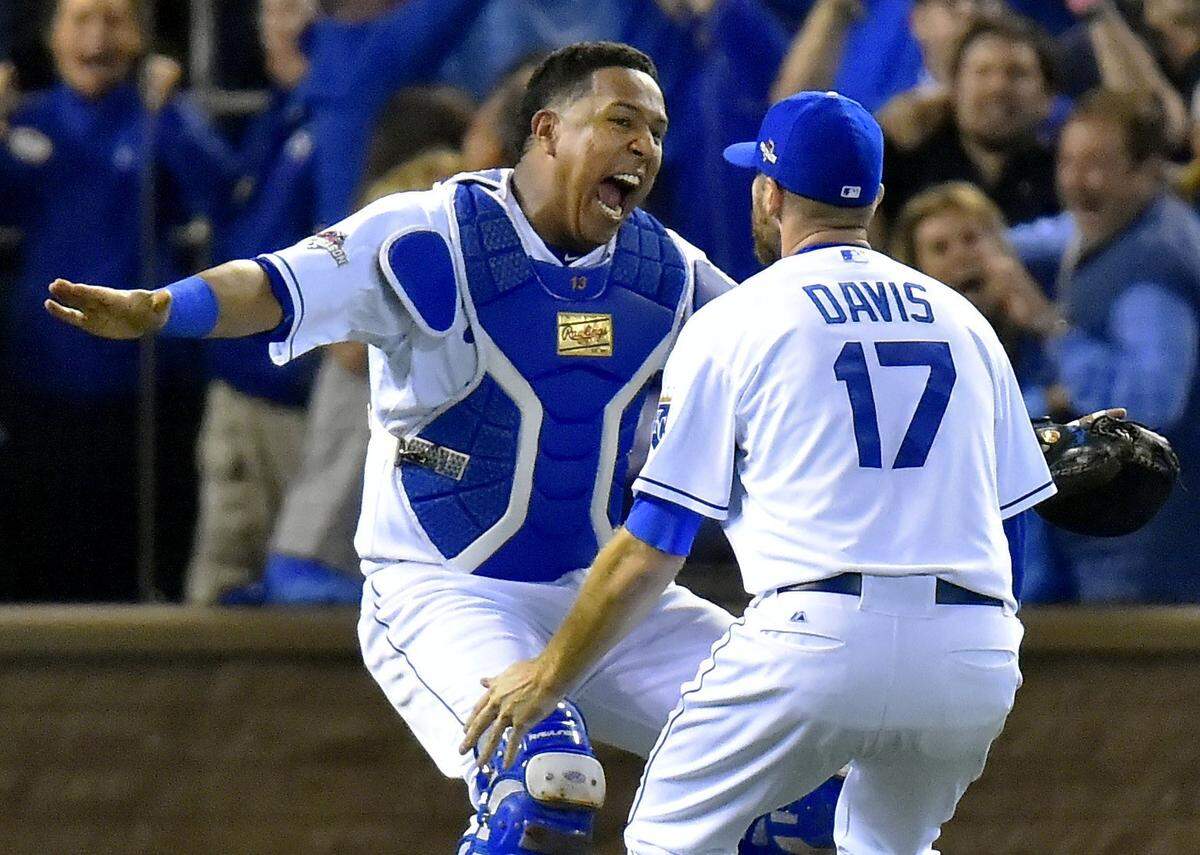
The eighth inning was a catastrophe wrought by inclement weather and ill-advised bullpen usage. Holding a two-run lead heading into the eighth, Yost chose Ryan Madson to pitch instead of sending in Davis for a six-out save.
Yost did so despite a sizable layoff for Davis, who had pitched only once in this series. Yost did so despite Madson’s pitiable history against the Blue Jays, who hit .600 against him in four regular-season games this year. Yost did so even though Davis already recorded one six-out save this postseason, in Game 4 against Houston, and even though a victory allowed for three days off until the World Series.
Into the game came Madson. Two pitches into his outing, Davis started to warm up, creating a surreal split-screen that heightened the madness of the inning. Madson gave up an infield single to outfielder Ben Revere. He struck out Josh Donaldson. But facing Jose Bautista, Madson threw a 96-mph fastball at the letters.
As Davis threw to the bullpen catcher, the baseball soared in his direction. The sight shocked the crowd, packed to capacity and prepared to celebrate the pennant. After a walk to Edwin Encarnacion, Yost pulled Madson and sent in Davis, who promptly retired the next two batters.
At this point, the rain intervened. The game entered a delay that lasted 45 minutes. The weather may have played a role in Yost’s thought process, as he did not want to lose Davis for the ninth inning due to the weather. Even so, he still chose to expose Madson to the best hitters on Toronto’s lineup, rather than deploying Davis, an All-Star and perhaps the best reliever in the American League.
And yet the Royals still won. The offense is too talented. And Davis appears indomitable.
Ben Zobrist and Mike Moustakas supplied home runs in the first two innings against Toronto ace David Price, who stymied the Royals thereafter. At last the hitters chased him in the seventh. Alex Rios continued his torrid postseason with an RBI single off reliever Aaron Sanchez.
Yordano Ventura held Toronto to one run across 5 1/3 innings. Kelvin Herrera collected the next five outs. Plenty of drama awaited around the corner.
Fighting to stave off elimination, Toronto started Price, the southpaw star they acquired shortly before the trade deadline. He sought to recalibrate his inglorious postseason history. A fan near his dugout held a sign to project Price’s postseason record as a starter if he lost this game: “The Price Is Wrong,” the sign read. “0-8!!”
The Royals had already toppled Price in Game 2. Price subdued his hosts for six innings before a seventh-inning rally vanquished him and provided Kansas City a two-game lead in this series.
There was little waiting around on Friday. The hitters swung away from the first pitch onward. In the bottom of the first, Price spun a cutter toward Zobrist, his former teammate in Tampa Bay. Zobrist stung a drive down the left-field line. The ball just cleared the fence.
An inning later, Moustakas came to the plate, nursing a .150 batting average in this series, a .132 average for the postseason. Price picked up two strikes on Moustakas, but left a 1-2 changeup over the middle. Moustakas unloaded on the pitch and scorched a line drive toward the Pepsi Porch in right-center field.
As the ball approached the stands, a pair of fans wearing gloves reached over the railing. The winner was a dark Wilson model attached to the left hand of Caleb Humphreys, a bearded, bespectacled 19-year-old from Blue Springs. Humphreys caught the ball as the crowd went wild.
Down on the field, Bautista pointed in disgust. Toronto manager John Gibbons asked for a challenge. As the umpires conferenced with replay officials in New York, Humphreys felt nervous. He told a reporter from The Star he was praying for the homer to be upheld.
The prayer of Humphreys and thousands of others issued inside the park during the interim were answered. The homer stood. The lead doubled.
Up two, responsibility transferred to Ventura’s slender shoulders. He understood the gravity of the evening, how he might guide his club toward the game’s greatest stage. He had been wobbly for much of the postseason, with opposing hitters clubbing him to the tune of a .909 on-base plus slugging percentage. As a fix, he tried a subtle technical tweak.
Ventura does not utilize an elaborate windup when he pitches. But he operated exclusively out of the stretch from the start on Friday, even when there were no runners on base. Dividends were paid early on, as Ventura struck out four with his curveball across three scoreless innings.
In the fourth, he fell behind Bautista, 3-1. It was Ventura’s first three-ball count of the game. Sitting on the fastball, Bautista obliterated a drive that nearly reached the Royals Hall of Fame past the left-field fences. The ball looked bound for Des Moines.
The blast did not dent Ventura’s confidence. He left shortstop Troy Tulowitzki motionless with a full-count curveball to end the inning. Ventura stared daggers at Tulowitzki as he walked off the mound. Umpire Jeff Nelson waved his mask at Ventura and shooed him off the field.
When he returned to action, Ventura lacked the polish of his first four innings. He walked catcher Russell Martin. After a walk to outfielder Kevin Pillar, the bullpen phone rang and Luke Hochevar stood up. Inside the dugout, Yost made no move toward the mound.
The lineup turned over when second baseman Ryan Goins flied out to center. A flyout by leadoff hitter Ben Revere allowed Yost an opportunity to intervene. Surely he would send Hochevar to face Donaldson, Toronto’s most dangerous hitter and the likely American League MVP.
A gathering convened on the mound. Yost was not part of it. Salvador Perez slapped Ventura on the backside. Alcides Escobar thumped Ventura on the chest. Moustakas hollered words of encouragement and jogged back to third base.
Moustakas did not wait long for action. Donaldson scalded a low line drive down the line. The exit velocity of the baseball clocked at 114 mph. The ball’s journey ended in the webbing of Moustakas’ glove. His hand still stinging, Moustakas sprinted off the diamond to a standing ovation.
Despite the escape, Yost continued to tempt fate. He sent Ventura back out to face Bautista to start the sixth. Bautista hit a harmless fly, but Encarnacion thumped a two-base hit to the wall. The double ended Ventura’s night and placed the fate of the Royals in the hand of their bullpen.
In first was Kelvin Herrera. He blew away first baseman Chris Colabello with a 100-mph fastball for one out. Two days after giving up a critical double to Tulowitzki, Herrera induced an inning-ended flyball in the rematch.
Herrera returned for the seventh and pitched a spotless frame. Now came the critical decision for Yost: Madson or Davis? He chose Madson. The decision backfired. But the Royals still survived.
Shutdown baseball: Yordano Ventura comes up big in Game 6 start
With a different approach, Yordano Ventura did his job.
In the biggest game of the season, Ventura gave the Royals 5 1/3 innings of one-run starting pitching Friday night, marking the first time in the postseason he started a game and surrendered fewer than three runs.
Ventura left the game the Royals eventually won 4-3 with a 2-1 lead.
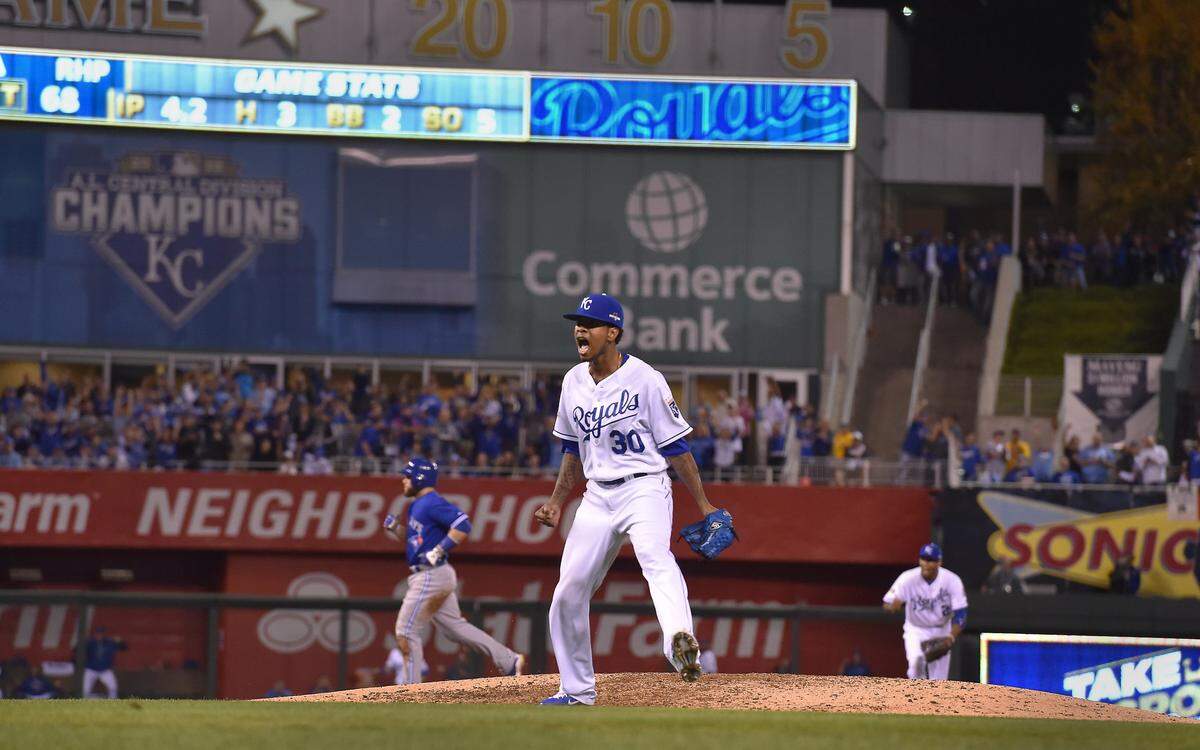
Ventura didn’t figure in the decision. He was in line for a potential victory until the Blue Jays tied the game in the eighth with a two-run homer by Jose Bautista off reliever Ryan Madson. The game was then delayed by rain.
All 22 batters Ventura faced saw him pitch from the stretch. Not just with runners on base but with the bases empty.
The maneuver appeared to create less movement and more focus. And it worked.
After surrendering a leadoff double down the right-field line to Ben Revere, Ventura calmly struck out Josh Donaldson, got Bautista to fly out to right and retired Edwin Encarnacion on a grounder to shortstop.
Ventura slowly walked off the mound toward the dugout, not looking up. He was locked in.
The next nine Blue Jays were retired in order when Ventura made his only mistake, leaving a fastball over the middle of the plate. Bautista crushed it for his first ALCS home run, 428 feet to the left-field seats.
The inning ended with Ventura striking out Troy Tulowitzki, and here Ventrua slowed, staring at Tulowitzki as he walked toward the dugout, long enough for home-plate umpire Jeff Nelson to wave Ventura away.
Perhaps that episode contributed to Ventura’s lack of concentration to open the fifth. Facing the Blue Jays’ seventh and eighth hitters, Russell Martin and Kevin Pillar, Ventura issued two five-pitch walks.
At this point, Luke Hochevar started warming up in the Royals’ bullpen. But Ventura returned to the strike zone.
After a sacrifice-bunt attempt by Ryan Goins rolled foul, Ventura got the ninth-place hitter to pop out to center field. Revere followed with a fly-out to right.
Donaldson then tore into Ventura’s first pitch and hit a vicious line drive to the left side. Mike Moustakas went to his knees and laid out for the snare for the third out.
With the heart of the Blue Jays order due up in the sixth, would Royals manager Ned Yost allow Ventura to start the inning? At this juncture in Game 5 on Wednesday, Edinson Volquez started the inning trailing 1-0 and the inning ended with the Jays having a 5-0 lead. Volquez loaded the bases and had walked in a run without recording an out before he was lifted.
Ventura started the inning on Friday, getting Bautista to fly to center. When Encarnacion roped a double to left field, Yost shot out of the dugout and was pointing to his lifted right arm just after crossing the first-base line.
Kelvin Herrera entered the game, got out of the inning, and Ventura’s night was over having surrendered four hits with five strikeouts and two walks.
He had outdueled Blue Jays starter David Price, who had surrendered solo home runs to Ben Zobrist and Moustakas to give Ventura the early lead. Price left the game in the seventh and was charged with three runs.
Ventura had entered the game with a 6.57 ERA in the postseason, having surrendered nine earned runs in 12 1/3 innings. His only decision was a loss in Game 1 of the division series against the Astros, when Ventura was pulled after two innings in a rain delay while trailing.
Ventura was the opening-day starter, and the Royals arranged their postseason rotation to allow Ventura to take the ball in the first game of the playoffs.
But he didn’t deliver a dominant effort until Friday, getting handing a lead to the bullpen.
All 22 batters Yordano Ventura faced saw him pitch from the stretch. Not just with runners on base but with the bases empty.