Royals’ luckiest play vs. 2015 Astros in Game 4? Maybe it wasn’t so lucky after all
When thinking back to the Royals’ 9-6 victory over the Astros in Game 4 of the ALDS — which re-airs at 7 p.m. Tuesday on FSKC — I’ve always remembered the narrative like this:
1. The Royals “kept the line moving,” putting together five consecutive singles when down 6-2 in the eighth
2. They got a huge break when Kendrys Morales’ grounder skipped over Carlos Correa’s glove for an error
3. They took advantage after that, with Alex Gordon bringing in the go-ahead run and Eric Hosmer adding on insurance in the ninth.
Morales’ moment still has always been a bit unsettling. KC deserves so much credit for its comeback, yet the game’s most important sequence — the Royals’ odds of winning the game went from 44% to 78% because of that one play, according to FanGraphs (and would have been at 24% had Correa fielded it cleanly to turn two) — has mostly been attributed to the Royals getting fortunate at the most opportune of times.
And yet ... after further review, I don’t think that’s what happened here at all.
If anything, I think history has gotten both the heroes and scapegoats wrong with this particular turn of events.
The contact
I’m not sure why it is, but Morales’ grounder — from the FOX camera angle — appears to look like an easy comebacker.
Maybe it’s hard to see because the ball is coming straight at us. Maybe it’s because the grounder leaves a divot, or because of what appears to be some well-watered dirt and grass in front of the plate has made things more mushy than you’d expect.
Either way, here are the facts when it comes to Morales’ contact: It left the bat at 107.6 miles per hour, according to Statcast, the second-hardest of 38 hit by both teams in that game.
That number surprised me when I saw it. Morales, no matter what it looks like, absolutely blistered that pitch.
Exit velocity, though, is not the end-all, be-all when it comes to hitting.
Morales shot this grounder with negative-6 degrees of launch angle. That gives the defense at least a chance to make the play, which also needs to be considered.
With all that in mind, I asked MLB.com’s Mike Petriello for the expected batting averages for those six straight Royals hitters that reached in the eighth, based off their exit velocities and launch angles.
| xBA | |
| Rios single | .840 |
| Escobar single | .280 |
| Zobrist single | .620 |
| Cain single | .630 |
| Hosmer single | .740 |
| Morales error | .280 |
Though Morales ends up at the bottom of this list along with Escobar, this analysis also ignores something important: spray angle.
While it’s true that hitters probably don’t have exact control over which direction they’re going to hit the ball — at least in the moment — it absolutely has an impact on whether their contact will result in reaching base or not. With the .280 number above, we can easily envision a ball going to a deep-playing shortstop, who would easily be able to field and throw out the runner.
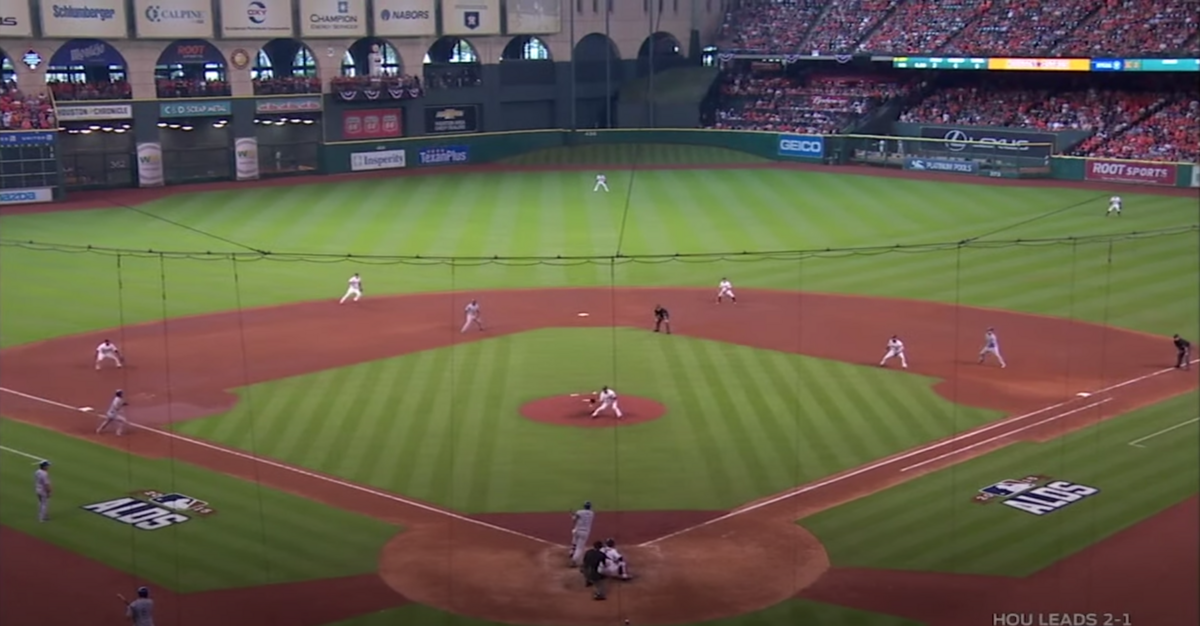
With Morales, though, his smash is going right up the middle. With a normal infield alignment — and the Astros are playing straight up here, as replays show — the Astros’ have only one line of defense: pitcher Tony Sipp, who is some 60 feet away.
More on direction
Statcast allows us to examine this situation even deeper. I searched for all instances since 2015 of grounders very similar to Morales’: Between 106-108 mph, between negative-5 and negative-7 launch angle and between negative-1 and 1 degree of spray angle (aka, right back toward the pitcher).
The results: Among 22 batters who had these events with any baserunner situation, 10 reached on singles, 11 made field outs and one reached base on error (Morales). In other words, exactly half of those players reached base safely.
Something else you’ll notice about the above numbers: There were no double plays. If we drill down further, there were nine instances of players in double-play situations (runner on first, less than two outs) who hit the ball similarly to what Morales did; seven reached base without an out, while one grounded into a force out and another was thrown out at first.
I put together a video compilation of these nine at-bats in chronological order, and it’s worth watching to better understand Morales’ grounder in context.
Three takeaways
After watching, I think it’s safe to come to three conclusions about the type of ball that Morales hit:
1. It’s difficult for pitchers to react in time to stop these hard hits
2. If the ball is not deflected by the pitcher, it’s a single every time ... unless a team is overshifting with a defender directly behind second base (which the Astros weren’t)
3. If the pitcher does deflect it, the ball literally could go anywhere and oftentimes is slowed way down, which often can often prevent a double play.
In fact, if we look at these clips together ... Morales’ appears to be the outlier. Pitchers completely miss the ball five out of nine times, with only one of those resulting in an out (when the Royals’ Whit Merrifield was shifted behind second base against Melky Cabrera and picked up a force out). On the other four instances when the pitcher did deflect it, only one out was made, when Lorenzo Cain ricocheted it off Steve Cishek, which allowed Javier Baez to make a charging play in from shortstop.
Again, though, the exit velocity here is what causes the issues. Pitchers don’t have time to react. Even when they do, they don’t have time to do that well, which usually causes crazy bounces off arms and bodies.
An easy case could be made that, in all actuality, the Astros were the fortunate ones on this Morales grounder. Sipp getting his glove on the ball at all was an unlikely event, and if he had missed, history tells us (along with the Astros’ positioning) that Morales would have had a sure single to center. The fact that Sipp tipped the grounder while redirecting it toward Correa, with the ball maintaining a decent pace, is also a result not common among other situations like it.
Correa, as we know, did not field the ball. And we probably have a good idea why: A ball hit at 107.6 mph and still getting to him that quickly would have a lot of life, and it likely resulted in the excessive topspin that pushed the second hop above Correa’s glove; that circumstance ended up benefiting the Royals, as it allowed additional runners to advance.
We can search for a slightly greater sample here as well. If we keep the same launch and spray angle parameters, and look for all groundballs over 105 mph in double-play situations, we get 18 results.
Those batters had 10 hits for a .556 average. One reached on error, five made single outs and two players grounded into a double play.
One of those was the result of a Bryce Harper overshift. That leaves one example — an Ian Desmond grounder that was snagged cleanly by Padres pitcher Clayton Richard — as the only pitcher-led double play.
But even that isn’t like Morales’ situation. There is not a single example in the last five years of a ball hit that hard at that angle with that direction resulting in two outs for the defending team after it was deflected by the pitcher.
The verdict
As it stands now, I would think most fans who watched Game 4 would have these opinions of the main characters:
1. Sipp — with his viral reaction to the play — was a sympathetic figure who was let down by his defense while taking a tough-luck loss
2. Correa was a scapegoat, mishandling a ball that looked routine and could have swung the game back to the Astros
3. Morales was lucky, a slow-footed DH whose grounder was bailed out by some fortunate events.
The data here, though, I think would tell us each of those three takes are somewhat incorrect.
Sipp should bear the brunt of the responsibility for the negative outcome; he surrendered a rocket shot and was only potentially bailed out when the ball glanced off his glove in a fortuitous way.
Correa shouldn’t be looked down upon much (if at all), as asking a player to anticipate that sort of spin off a ball hit that hard probably shouldn’t be an expectation, even of a big-leaguer.
And Morales might be the most miscast of all. He stung the pitch, watched as it took a weird hop, then was only credited with a reached on error; one could easily make the case he deserved not only a hit, but also the two RBIs that tied the score.
What can’t be argued is that this was one of the best MLB rallies ever. The Baseball Gauge has tracked the win-probability percentage of each playoff series in baseball history; the Royals dropped to a 0.8% chance in Game 4, which makes it the second-best comeback out of the 340 playoff series in the history of baseball tracing back to 1903.
All along, I thought the Royals got there with a lot of help. I’m much less convinced of that now.
The data seems to tell a different story, indicating this fateful play actually spun in both directions.
Considering the circumstances, Morales avoiding a double play — based on his contact — should have been all but assured.
And him reaching first base safely? About a 50-50 proposition.
In other words ... not that lucky at all.