A look back at where the Royals’ championship run started: the Kansas City farm system
Back-to-back World Series appearances capped by a parade to celebrate the franchise’s first championship in 30 years. That was the thrilling, exhilarating and satisfying conclusion for the Kansas City Royals and their long-suffering fan base.
The foundation for that landmark occasion in the franchise’s history, now nearly five years ago, was laid in several seminal moments dating back to 2006 that carried far less fanfare.
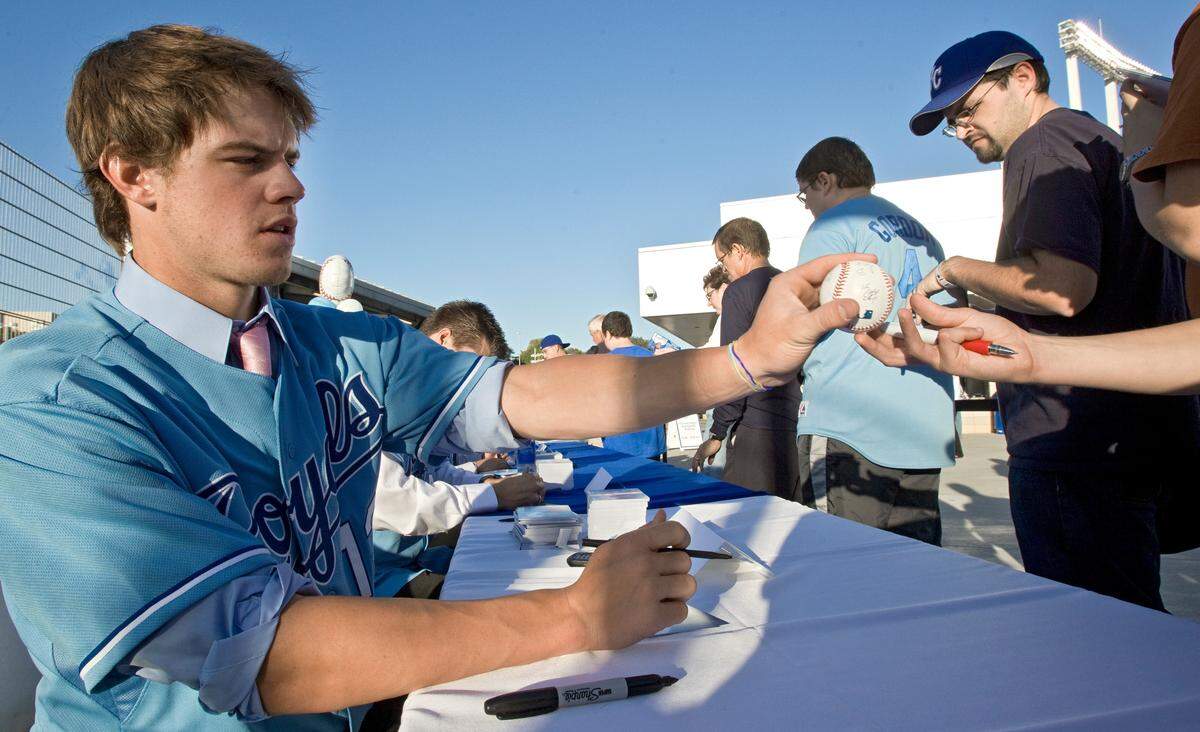
The biggest sign that those seeds were starting to bear fruit arrived in 2011, when the baseball world stood up and took notice of a so-called “Blue Wave” rolling up through the minor leagues. Baseball America dubbed the Royals’ farm system the best in baseball.
The cornerstones of that farm system — Mike Moustakas, Eric Hosmer, Danny Duffy, Yordano Ventura, Jarrod Dyson and Christian Colon — became the homegrown core of that World Series championship in 2015.
“You look back on it and you feel like you put a lot of pressure on those players,” Royals assistant general manager/baseball operations Scott Sharp said. “Because from the time they signed, Eric and Mike and the Wil Myers of the world, and the guys that came through like (Johnny) Giavotella and Dyson and Colon, the message to them was, ‘Look, you guys are going to deliver a World Series to Kansas City. You are. That’s what the goal is here.’”
As youngsters, those players were bombarded with reminders of the history of the Royals’ previous World Series team in 1985, and how it was built through the farm system.
The way they played. The legends they’d become. Those young prospects were told that they were expected to be part of the next group who’d hit it big in Kansas City.
During their rebuild, the Royals certainly benefited from repeatedly picking near the top of baseball’s amateur draft. Their positioning allowed them to secure such players as Luke Hochevar (first overall, 2006), Moustakas (second overall, 2007), Hosmer (third overall, 2008) and Colon (fourth overall, 2010).
They also picked up players like Duffy, Myers and Giavotella in the third round of their respective drafts. Key contributors in later rounds included Greg Holland in the 10th in 2007 and Dyson in the 50th in 2006.
Just as importantly, if not more so, the Royals augmented their stockpile of young talent with crucial inroads internationally, an area in which the franchise lagged sorely before Dayton Moore’s arrival as general manager.

International flavor
Rene Francisco still recalls the GM’s words in the early days after Moore hired him to head up KC’s international operations.
“I talked very highly of you and the international program we’re going to have here,” Moore told Francisco.
No pressure.
“It’s a challenge when someone tells you that,” said Francisco, now the Royals’ assistant general manager/major-league and international operations. “You say, ‘Well, he’s expecting good things.’ I took it to heart because he’s saying this in different places where he went and spoke to fans and ticket-holders.”
The Royals moved Orlando Estevez from the pro scouting staff to a role as their Latin American coordinator. Over the years, they’ve also moved their Dominican Academy into a new complex in Guerra outside of Santo Domingo.
But they invested in more than staff and facilities.
On Francisco and Estevez’s first trip to Venezuela representing the Royals, they executed what seemed like a relatively innocuous signing: a 16-year-old international free agent named Salvador Perez, the eventual World Series MVP, six-time All-Star and five-time Gold Glove-winning catcher.
At their first workout at their Dominican Academy in December 2006, they signed eventual star relief pitcher Kelvin Herrera.
”We had money to spend, but we were doing it like we’ve always done it,” Francisco said. “Calculated.”
Some of their highest-price signings in the early years included Cheslor Cuthbert for $1.35 million, which was a record signing bonus for a Nicaraguan player in 2009, and winning a battle with the New York Yankees to sign Adalberto Mondesi for $2 million.
They also spent efficiently to sign players such as Perez ($65,000), Ventura ($28,000) and Herrera ($15,000). Perez and Herrera were selected as All-Stars in 2015, while Ventura started five postseason games in 2015 (sadly, the hard-throwing young star died in a January 2017 car wreck at age 25 after spending just three full seasons in the majors).
“They all had good makeup,” Francisco said. “You can say whatever you want to say about Yordano, but when he got on the field in between the lines and started competing, he was a hard-working guy. He did all his work and went beyond. Competitor-wise, he was great.
“Mondesi, you want to say ability-wise he could be a superstar. Salvy, an All-Star. But the makeup and his work ethic, he just wants to keep learning and improving. He’s always had that.
“Herrera went through ups and downs because of injuries. He almost quit, but the makeup of him and how hard he wanted it is amazing. Cheslor got an opportunity and he had ability. They all had good qualities. Not all of them were the same. Some had better abilities than others. The one thing they all had, they all wanted to compete, and they all worked.”
Just win
Sharp served as the Royals’ director of minor-league operations in 2011, having joined the organization as assistant director in 2006 to help pursue a championship.
“Dayton impressed that upon us very early on as a group,” Sharp explained. “‘Look, if you don’t think we can win a World Series here, you don’t belong here. Don’t come to work here if you don’t think that we can do that.’”
That started by fostering a winning environment in the minors: The Royals’ idea was that the talented players they collected wouldn’t feel like they were just being “developed,” because the mindset was “at 7 o’clock, it’s about winning the game.”
“That’s a big part of your development, as well, understanding what it takes to win baseball games and what your role is in that,” Sharp said. “Because your role may be not just hitting a home run — it may be getting a runner over. It may be bunting. It may be playing good defense. Whatever it takes on that given night to win that game, that’s what we want you to concentrate on. We want you to win championships.”
It wasn’t only about winning minor-league championships, though this wave of Royals prospects had claimed more than their fair share by the time they were contributing to KC’s big-league success in 2014 and 2015. That also meant stressing aspects beyond typical batting average or on-base statistics while they were toiling in the minors.
Value was placed on hard-hit rate, quality at-bats and moving runners over. Club officials emphasized that they were going to look at promoting “team-focused players.”
“I’ll back up a little bit to when it’s J.J. Picollo or Lonnie Goldberg or Deric Ladnier, and they’re running the draft,” Sharp said. “They’re taking players who have won their entire lives. They’ve won state championships, have played in national championship games and won conference tournaments. Those guys are ingrained to win. That’s what they know.
“Their thought process isn’t, ‘if I play well enough here, I get to go up to this level. And if I play well enough there (and so on).’ Their mindset is, ‘I know I’m good. I’m going to move when the time is right. My goal is to win this game.’ Winning is so much more fun than losing. Isn’t that from Bull Durham?”
The winning started with a Midwest League title in 2008 for a Burlington Bees team that included Duffy, Moustakas, Herrera and Giavotella. It continued with titles at Double-A Northwest Arkansas in 2010 and Triple-A Omaha in 2011.
When it came time for them to compete for championships in the majors, they’d done it before. Shap watched Dyson throw out Collin Cowgill of the Los Angeles Angels when Cowgill was trying to tag and advance from second to third in the eighth inning of a tied game during the 2014 ALDS, and his reaction was, “I’d seen him do that.”
“I’ve watched these guys down in playoff games — again, it’s the minor leagues, but I’ve watched these guys,” Sharp said. “Somebody is getting the big hit. I’ve seen these guys do it too many times.”
Raised relentless
The other thing that became ingrained into those players in the minors was an aggressive approach on the field. That showed up later in the way the World Series-championship team played, from Hosmer’s gutsy base-running decision in Game 5 against the New York Mets to how they constantly forced a defense to make plays.
“The initial focus with J.J. and obviously from Dayton, and what we passed along to Doug Sisson, our field coordinator, and Tony Tijerina (who succeeded Sisson), was that we want these guys to be absolutely relentless,” Sharp said. “That starts on the bases. Once you get on the bases, you can control the amount of pressure you put on the defense. We want to take the extra 90 feet whenever it’s possible.”
As the major-league game became increasingly more station-to-station and reliant on the home run, the Royals stressed running hard down the line, treating every ball as if it’s a double out of the batter’s box, looking to steal second every time you’re on first, looking to go first-to-third or score from second on any hit, and advancing on any ball hit in the dirt.
Their practice plans were adjusted so that after stretching and throwing, reading balls in the dirt and base-running were the first things they did.
“Ball down, you’re taking 90 feet,” Sharp said.
The fact that Hosmer, Moustakas, Duffy and their peers came up together meant they could hold each other accountable. Along the way, they also created an internal competition that forced the cream to rise to the top.
For example, having Myers, then a catcher, and Perez play together in Wilmington forced both highly touted prospects to improve in different ways.
“You were either going to figure it out, or you were going to go home,” said Picollo, the assistant general manager.
“Just like all good teams, they had that natural competitiveness about them because the players are good,” Picollo said. “During that time, there were other players like Dyson that emerged because he was going to get left behind. He had no choice. He had to get going. He had to achieve to keep playing.”
Picollo looks at the Royals’ current farm system and sees a similar formula of good, highly competitive players who’ve become accustomed to winning championships. Royals affiliates won four titles last season on the heels of earning just one in 2018 (Lexington).
Lessons learned
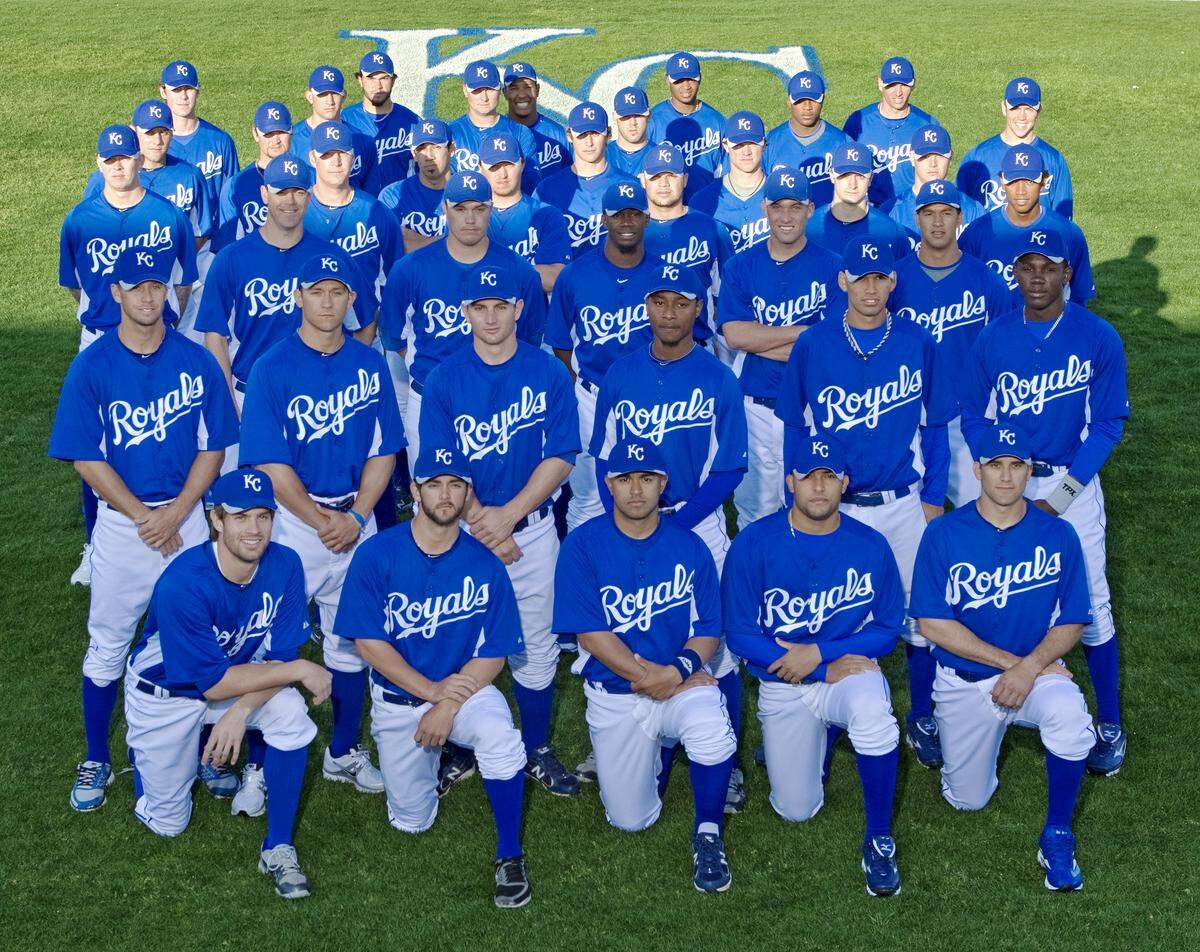
When Baseball America rated the Royals’ farm system the best in the majors in 2011, nine of KC’s minor-leaguers were ranked among the publication’s top 100 prospects in baseball.
Picollo maintains that he’s never put any emphasis on such rankings. Being highly rated doesn’t change how an organization operates. After all, he reasons, “We know what we have, what we don’t have.”
The Royals’ top-100 club from 2011 included Hosmer (No. 8), Moustakas (9), Myers (10), pitcher John Lamb (18), pitcher Mike Montgomery (19), Colon (51) and pitchers Duffy (68), Jake Odorizzi (69) and Chris Dwyer (83).
At the time, Perez, Ventura, Dyson and Herrera weren’t even ranked among the top 10 prospects in the Royals’ own system. Yet all became key parts of their 2015 championship club.
“They weren’t the reason why they were saying we had the best system in the past 25 years or whatever it was, so I’ve always used that as a reminder,” Picollo said. “I don’t really care what people think about our system: We strive to do the same thing every year through the draft, internationally, developmentally. We need to have the best players we can.”
If nothing else, the progression of that wave of Royals prospects — those who made it and those who didn’t — still provides lessons for the Royals’ player development staff, even now.
“You learn the value of patience,” Picollo said. “What’s happening at the beginning of their career isn’t necessarily an indication of what’s going to happen at the end.
“As we fast-forward to 2019 and we had some guys struggling, we’re not going to panic. We know why we took them, and we have some experiences to lean on.”