
Baylor’s rags-to-riches story complete: Bears blow out Gonzaga for NCAA championship
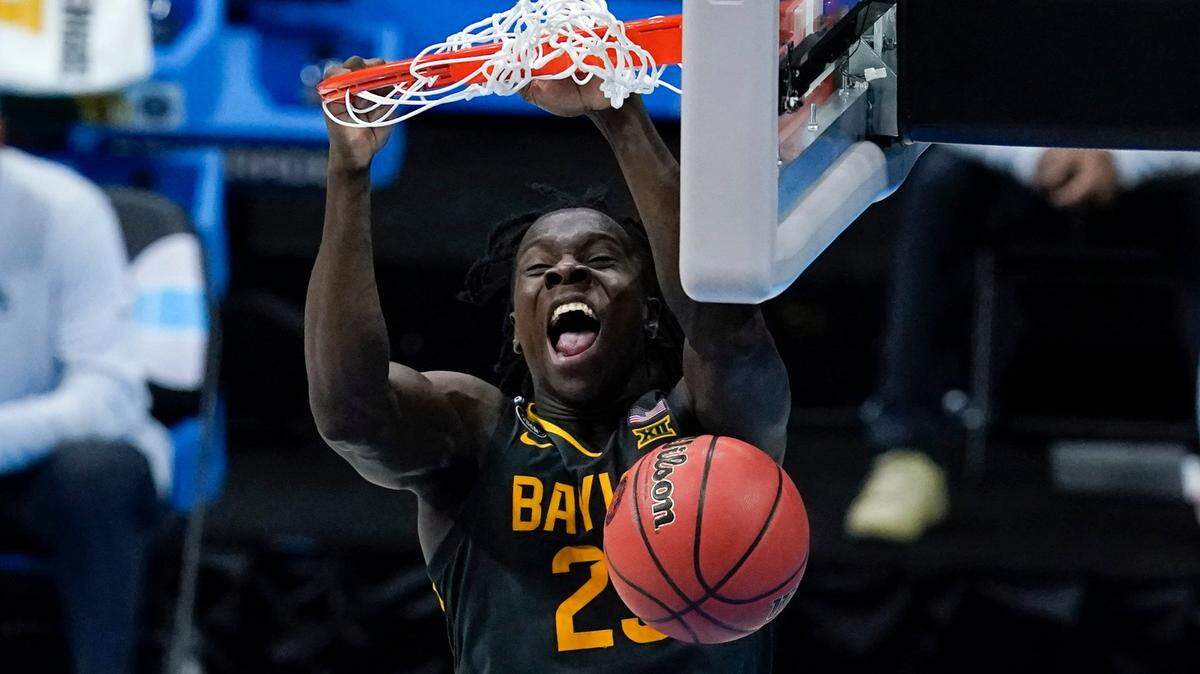
The game college basketball had waited all season to witness was no contest.
The Baylor Bears started the NCAA championship game in a sprint and never let up, capturing its first men’s basketball national title with a 86-70 victory over top-ranked Gonzaga.
The Zags were denied perfection. The Bulldogs arrived at Monday’s game bidding to become the first undefeated champ since Indiana in 1976. But Bob Knight’s Hoosiers remain the latest standard of an unbeaten season.
Baylor’s championship was the second in the 25th season of the Big 12, joining Kansas in 2008.
The matchup didn’t deliver on the promise of a heavyweight battle. Gonzaga had been top-ranked throughout the season. The Bears were second or third. These pair of No. 1 seeds were scheduled to meet in the regular season four months earlier, but like many games this season, the COVID-19 pandemic forced cancellation.
What better occasion for a first encounter than the final game?
But as the final seconds ticket away, the mask-wearing pro-Baylor crowd in Lucus Oil Stadium, greatly reduced by social distancing, gave their full-throated approval of a program that completed a rags-to-riches story.
When Scott Drew was hired in 2003, Baylor had been ripped by scandal. A player had murdered a teammate. The coach, Dave Bliss, was forced to resign for lying about the incident and for rules violations.
The program limited itself to seven scholarships, didn’t play non-conference games and took itself out of the NCAA Tournament, including the Big 12 Tournament.
But it didn’t take long for Baylor to recover under Drew. Recruiting excelled and by 2008, the Bears had produced its first NCAA Tournament team in two decades. Two years later, Baylor was in the Elite Eight.
Over the past few seasons, Baylor has played with the nation’s best. Only the Bears, Gonzaga, Kansas and Duke have been ranked No. 1 at last week in three of the past five seasons.
Another factor in Baylor’s success: redshirting. Six members of the Bears, including starters Mark Vital, MaCio Teague and Davion Mitchell, sat out a year of competition. This if Vital and Teague’s fifth year in college, Mitchell’s fourth.
All of them, plus All-America guard, played major roles in Monday’s triumph. Butler led the way with 22 points.
“If you’re going to war, and I’m coaching, I’m taking these guys,” Drew said as the confetti fell.
The Zags entered as a 4 1/2 point favorite, but the game couldn’t have started better for Baylor. Mitchell set an early tone on both ends of the floor, and Butler was dropping three pointers. The Bears jumped to a 9-0 lead. They buried their first five from deep, building a lead that grew to as many as 19. The Bulldogs’ biggest deficit this season before then was 15.
Gonzaga’s early nightmare included Jalen Suggs collecting his second foul less than six minutes into the game. The hero of Saturday’s semifinal win over UCLA with a 37-foot buzzer-beater, managed to avoid picking up his third the rest of the half.
That Zags’ exhausting victory seemed to take a toll on them early in Monday’s game. Baylor won the 50-50 balls and hustled for offensive rebounds. Nine of its 16 first-round rebounding total came on the offensive end that turned into a 9-2 second-chance points edge.
Gonzaga recovered and won the final few minutes of the first half and cut the margin to nine 4 1/2 minutes into the second half. But a key sequence that ended with Adam Flagler’s three-pointer quickly pushed the margin back to 16.
History worked against the Zags. The largest halftime deficit overcome in a championship game was 10, when Kentucky defeated Utah in 1998. The largest deficit overcome at any point in a game was 15, when Loyola defeated Cincinnati in 1963.
The game concluded the most extraordinary NCAA Tournament. For the first time, the entire event was played in centralized location with most games in Indianapolis.
Same with the women’s tournament, which ended Sunday with Stanford crowned champion in San Antonio.
Between the two tournaments, only one game wasn’t played. A first-round men’s game between Oregon and VCU was called off because of VCU’s COVID-19 issues.
Seatlng was limited throughout the tournaments. At Lucas Oil Stadium, half the building was used for games, including Monday’s title contest. Previous championship games used the entire stadium, with men’s Final Four crowds often exceeding 70,000.
The environment was less than it had been in past years, and the game didn’t live up to its billing. That didn’t make it any less satisfying for Drew and the Baylor program.