
Diseases of despair in Missouri men and boys come from the brain, not the culture | Opinion
Suicide among Missouri’s men and boys is 35% higher than the national average. And its drug overdose crisis, once considerably lower than the national average, is higher than what we see across the nation.
In 2022, I released my report, “The Status of Boys and Men in Missouri,” and met with staff from Sen. Josh Hawley’s office as he was in the process of writing his book “Manhood: The Masculine Virtues America Needs,” released in 2023. Like most books in this genre, many focus on cultural aspects of masculinity. Some, like Hawley, are asking our boys to become the kind of men who are dependable, resilient and full of the character virtues one finds in biblical texts and nuclear families. Other books ask our men to become more vulnerable and to free themselves from the social constructs of “traditional” masculinity and the role of the nuclear family in society. Meanwhile, our boys and men are more confused than ever about their role in society, and it reveals itself in poor physical and mental health outcomes.
In Missouri, like the rest of the nation, the diseases of despair (suicide, overdose and alcohol) fluctuate every few years. Suicide or overdose deaths might go up one year and down the next, but the one consistent factor is that despair overall is consistently higher among boys and men, and it is on the rise in Missouri.
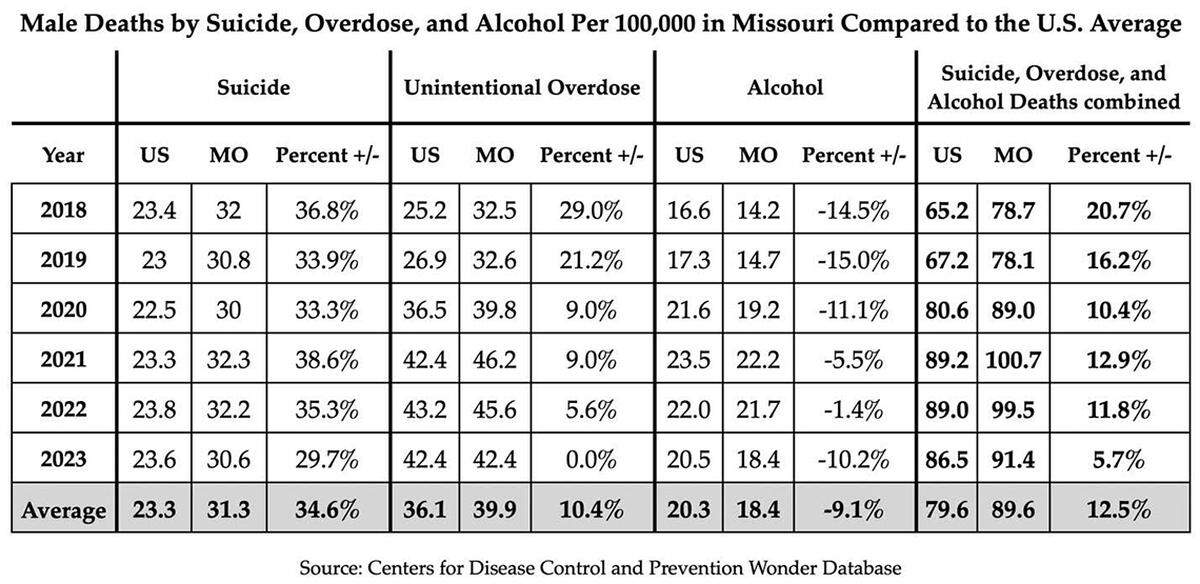
In 2018 and 2019, there were an average of 78.7 combined suicide, overdose and alcohol deaths per 100,000 Missouri boys and men. In 2021 and 2022, that number jumped 28% to 100 deaths per 100,000. Although there has been a slight drop in 2023, deaths of despair are still 17% higher than the past, at 91.4 male deaths per 100,000.
While suicide deaths have remained relatively the same over the past six years, suggesting the suicide crisis has stabilized in Missouri fails to address the spillover of despair into other areas, like those associated with overdose and alcohol that overwhelmingly impact males. The recent increase in male deaths of despair in Missouri are primarily overdose and alcohol related, up 41% and 52% respectively. While the national average around despair has increased as well, the last six years reveal that these deaths among Missouri males are 13% higher than the national average, according to data from the Centers for Disease Control and Prevention.
Suicide, alcohol and overdose are too easily discussed as separate diseases instead of manifestations of a greater disease associated specifically with the way male despair and risk-taking presents from boyhood to manhood. Treating the unique nature of men is the way to solve the suicide, alcohol and overdose crisis. If we want to help boys become men who thrive, it is important that we nurture the nature of boys in all aspects of life. And when it comes to struggling men, it’s critical that we nurture their nature, too, if we want them to heal.
Hawley not addressing brain, gender
While Hawley and others have a point when it comes to the role society plays in preparing our boys to become men through nurturing ways, few are discussing the sex differences in the brain that explain how our boys and men learn in places such as school, and how boys and men react differently to depression and trauma. The new administration and Hawley have made major efforts to recognize sex differences in sports and private places as part of a greater push to liberate women’s sports from transgender female participants and provide private spaces for women in locker rooms, bathrooms and other spaces reserved for them. However one feels about this issue, it does not address the underlying nature of what is happening in the male brain, the female brain and those who are gender questioning.
Every cell in the body knows it is either XX or XY, and the deaths of despair crisis in Missouri, like in the rest of the United States, is partly a product of male and female differences — not social constructs of masculinity.
Policymakers, on some level, are arguing about gender differences, but are often doing so from a cultural vantage point. However, it is critical to understand the biological elements of brain sex differences that impact how our boys and men process emotions, challenges and traumas differently from women.
The next push, from a policy standpoint at the state and federal level, will be a willingness to recognize the brain differences that impact men and boys in so many areas of life. My new book, “Boys, A Rescue Plan,” does more than quantify the challenges with data that is verifiable and reliable: It also offers solutions to these problems by looking at the very nature of male and female in the brain and how we can nurture their natures, so our boys and girls grow, learn and thrive together.