
Josh Hawley’s ‘Christian nationalism’ is just cover for his liberal populist economics | Opinion
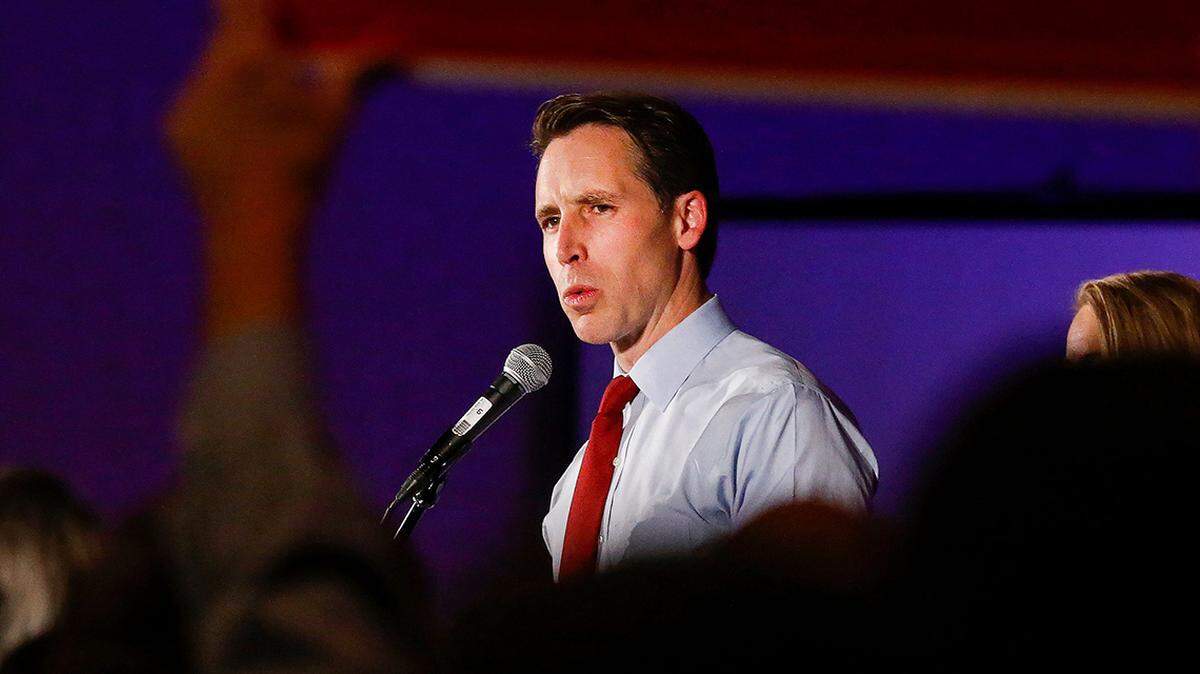
I’ll give Sen. Josh Hawley this: He sure knows how to send liberals into a tizzy. You may have heard the howls of outrage caused by his latest speech at the National Conservatism conference in Washington, D.C., where he fully embraced Christian nationalism.
My liberal friends should have listened a little deeper into the speech when he laments how the “1990s (Republican) Party privileged the money crowd in just about every way possible,” then veers off into a flurry of left-wing talking points which reaches a crescendo when he demands that Congress outlaw high interest rates on credit cards.
Hawley’s call for rising corporate income taxes should warm the hearts of all the liberals dismayed by his dalliance with Christian nationalism. “Think of all that worshipful talk about corporate tax cuts,” he said, citing Abe Lincoln’s pre-industrial revolution belief that capital should be taxed more than labor.
“Republicans,” Hawley bemoans, “fell in love with profit at any price,” before announcing that he now shares the Democratic belief that government action creates the jobs. I can almost hear him saying, “You didn’t build that.”
As frequently happens, Hawley is articulate, self-confident and wrong.
To begin with, capital already pays the same marginal tax rate that the highest earners do because the wages of capital are taxed twice, once as corporate profits and then again as capital gains. Combining the two rates, you have the same 40% rate that high income earners pay.
Hawley paints a picture of blue-collar workers beset by the heavy taxes of a giant government, but the reality of the last 50 years of Republican-dominated tax policy is that the lowest-paid 40% of all workers pay no income tax at all.
The top 1% of earners — and coincidentally, the most likely to own capital — pay 46% of income taxes. The next 59% pay 54% of income taxes and the people at the bottom pay bupkes.
The corporate income tax, separate from the personal income tax (though some companies pay taxes at the personal rate) is heinously complicated, at least in part because it is awfully hard to pin corporations down and get them to pay it.
Corporations are made up of people: executives, owners, middle managers, workers and customers. When you put a tax on a corporation, depending on the market dynamics, often one or two groups end up paying the price. And most often, it is workers and customers — not the owners and top executives — who pay, either with higher prices or lower wages and benefits. Owners and executives do not pay because capital and highly-skilled managers are mobile — they can go where the pay and profits are better. Workers are most often connected closely to their communities, so they can’t or won’t walk away for better opportunities elsewhere.
That might not be fair, but economic reality is not known for its fairness. And what is fair about a “corporate tax” that puts a cap on the working stiffs wages and boosts his grocery bill at the same time?
“A Republican repeating this (Democratic) lie suggests a high level of contempt for average voters,” Grover Norquist, the Americans for Tax Reform leader who has orchestrated decades of Republican tax cuts, told me. “Why does Josh Hawley view Missouri voters as fools?”
This is the same “lie” that Trump and his followers (like the Biden administration) tell about tariffs — those taxes on goods made overseas and imported to your local Walmart in those giant container thingies by huge ocean-going ships. Chinese corporations don’t pay those taxes. They pass them on to consumers in higher prices. If the new prices get sufficiently high, the theory goes, then American workers will make the goods and charge higher prices, too.
The problem with that notion is that the cost in higher prices is usually greater than the benefit of wages paid to American workers.
But Hawley doesn’t care if we’re all poorer — as long as we get to “love” our work, our family and our God. Which is where his economics gets, tangled up with his Christian nationalism and his politics.
This speech was Hawley’s call to narrow the Republican Party’s appeal as a more pure vessel for his kind of conservatism. For the last 50 years, the GOP has been made up of three tribes: the religious right (those most focused on social issues), free market advocates (those most focused on having a dynamic economy) and defense hawks (those most interested in protecting the other two with strong military and assertive foreign policy).
Hawley thinks the biggest group — the religious right — should kick the other two out of the GOP and focus just on their issues while regulating and taxing business like Democrats do, and adopting an isolationist foreign policy from long ago.
If he thinks making the Republican Party smaller will help him win elections, then I’ve got a feeble Delaware Democrat who might be more likely to stay in the White House than some people are betting.
David Mastio, a former editor and columnist for USA Today, is a regional editor for The Center Square and a regular Star Opinion correspondent. Follow him on X: @DavidMastio or email him at dmastio1@yahoo.com