Kansas State broke Big 12 color barrier. But where are the monuments? | Opinion

He’s a historian from Lenexa with an affinity for Kansas State athletics. But make no mistake: Ken Neaderhiser’s love for the Division I school in Manhattan goes far beyond the playing field and delves into basic human and civil rights, he said.
After exhaustive research, the die-hard Wildcats fan said he is certain about one thing: Kansas State was at the forefront of integrating what is now known as the Big 12 Conference. On Thursday, Neaderhiser will give a talk about his research in Kansas City.
He documented this important history in a series of posts that first appeared in 2020 on the website bringonthecats.com, a SB Nation site dedicated to K-State athletics.
Over a three-year period starting in 1949, 10 K-State athletes in five sports broke the Big 7 Conference’s color barrier, according to Neaderhiser. The Big 6, 7 and 8 conferences preceded the Big 12 Conference.
It’s not as if what Neaderhiser discovered was breaking news — K-State Athletics has chronicled these accomplishments and more on its website — but the breadth of his knowledge on the subject fascinates me.
My suggestion to administrators in the Little Apple would be to team up with students, faculty, staff, alumni and athletic boosters to create a strategic plan to place monuments of these groundbreaking athletes all over campus. Leaders there should be as passionate about this important historical achievement as Neaderhiser is.
Many accomplished Wildcat athletes
Neaderhiser, a 1995 K-State graduate, can roll off the names of these trailblazers with ease.
First, there was Harold Robinson, the conference’s first Black scholarship football player. Two other African Americans, Hoyt Givens and Veryl Switzer followed Robinson, an offensive lineman who made his varsity debut in 1949. Back then, freshmen were not allowed to compete on the varsity level.
Givens, a halfback, played at K-State from 1949-50. He was the conference’s first Black non-scholarship football player, according to K-State Athletics. Switzer, also a halfback, played for the Wildcats from 1950 to 1953. He was the first African American scholarship player to graduate from K-State, according to the athletic department’s website.
In basketball, the Wildcats’ Gene Wilson broke the conference’s color barrier in 1951. He was also one of five Black student athletes that integrated the Big 7’s track and field programs, according to K-State Athletics.
K-State tennis players Don and Ron Harris integrated that sport in 1952. On the baseball diamond, Easter Ray Allen and Earl Woods — yes, Tiger Woods’ father — were the conference’s first Black baseball players, according to Neaderhiser’s research.
The two other trailblazers Neaderhiser mentioned were track and field athlete Johnnie Caldwell and football player James Gentry.
When we spoke, Neaderhiser told me his goal was to amplify the significance of the Wildcats’ place in history.
“It is a great story,” he told me in an email. “I actually don’t call it Black history — I call it one of the greatest accomplishments in school history. On merit, that is what it deserves to be called.”
To the best of his knowledge, Neaderhiser said he wasn’t sure if any of the athletes he mentioned have buildings or athletic facilities on campus named after them. There may be a plaque or two on campus, but he said he’d rather see more prominent displays.
In an email, Kenny Lannou, a spokesman for the Wildcats’ athletic department, said the university has honored these pioneers and others at home games and “we also have permanent displays at each facility on the respective athletes,” he wrote.
Still, I’d love to see these athletes’ names affixed to athletic facilities akin to the football stadium which bears the name of legendary coach Bill Snyder — it’s called Bill Snyder Family Stadium. K-State also has the Vanier Family Football Complex and the Shamrock Practice Facility.
In basketball, the university has the Ice Family Basketball Center, a training facility for the men’s and women’s hoops programs.
Free event on K-State history
On Thursday, Neaderhiser will present “One of the Greatest Accomplishments in Kansas State University History” at the Black Archives of Mid-America in Kansas City. The event is from 5:30 to 7:00 p.m. inside the non-profit’s Heritage Hall at 1722 East 17th Terrace. Admission is free but registration is required.
To register, click here or call the Black Archives at 816-221-1600.
“Hear the powerful firsthand account from Ken Neaderhiser about how K-State integrated the Big 12 — a pivotal milestone in both college athletics and civil rights history,” a post on the Black Archives’ Facebook page reads.
When I asked Black Archives of Mid-Missouri executive director Carmaletta Williams what drew them to Neaderhiser’s presentation, she cited the importance of local history. Staff became aware of Neaderhiser’s work while researching for another project, she wrote in an email.
“We are working on an exhibition on Warren Armstrong, née Jabali, and it surfaced during our planning and research,” she wrote.
Jabali is a former professional basketball player from Kansas City who died in 2012. He was inducted into the Kansas Sports Hall of Fame in 2019.
“Born Warren Armstrong on the Kansas side of the state line, he played his high school years on the other side for Kansas City Central,” the Kansas Sports Hall of Fame website reads. “Blair Kerkhoff from The Kansas City Star referred to him as the best high school basketball player in Kansas City history.”
K-State breaks the color barrier
When we met recently at Urban Prairie Coffee shop in Mission, I sensed the passion Neaderhiser had for this subject. His eyes lit up when talking about the K-State pioneers who broke the color barrier. His voice spiked when he spoke of the admiration he had for Milton Eisenhower, younger brother of former President Dwight Eisenhower and the first K-State grad to lead the school as president.
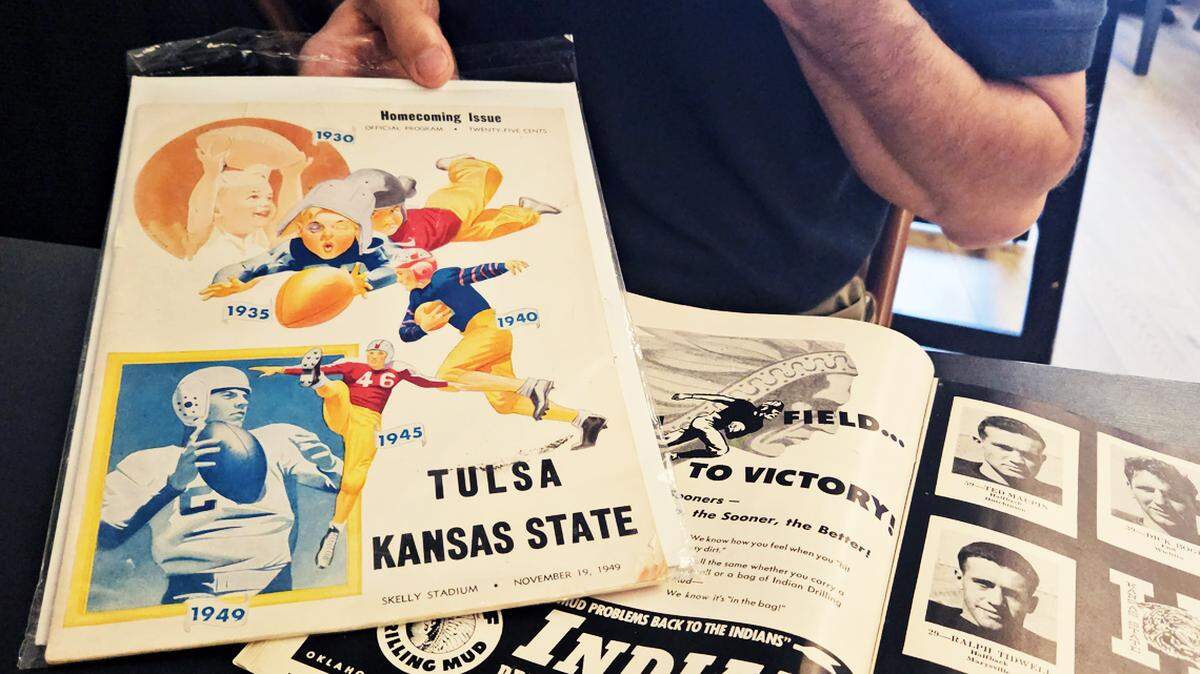
Neaderhiser had with him two game-day programs from more than 75 years ago. The artifacts were from the 1949 K-State at Tulsa matchup and the 1950 K-State at Oklahoma contest. Both could be considered a collector’s dream and were in pristine condition.
The 1950 game in Norman marked the first time a Black athlete competed at the University of Oklahoma, Neaderhiser said. Back then, a gentlemen’s agreement excluded Black athletes from a conference that included Mizzou and KU, he said.
“The Big 7 conference had even codified a home field sovereignty rule,” Neaderhiser said. “It was a compromise to end the conference gentlemen’s agreement banning black athletes. If any school had black athletes, OU and Mizzou were given the right to bar them from competition at their facilities.”
And those schools often did, according to Neaderhiser’s research.
At K-State, Neaderhiser said this ungodly agreement was defied and forced down under Milton Eisenhower’s leadership.
“To my knowledge this is the first time a school president publicly announced his intention and followed through on playing Black athletes against and at segregated schools,” Neaderhiser wrote in an email.
When Neaderhiser first started his research, he told me his main objective was for K-State to honor the aforementioned trailblazers by naming on-campus facilities after some of them. Years later, he has a different perspective. Now he just wants those tied to the university to use what he labeled as the R.E.M. method to remember K-State’s place in this history of civil rights in this country.
The acronym “reminds us of our past, good and bad; educates us in the present; and motivates us towards the future,” Neaderhiser said.
On Thursday in Kansas City, that glorious past will be on display for all to see.
This story was originally published July 17, 2025 at 5:07 AM.