A good man died in Rome today, and I will miss him | Opinion
A good man died in Rome today, mourned by many around the world who never knew either him or his Jesus.
“The Bishop of Rome, Francis, has returned to the house of the Father,” Cardinal Kevin Farrell said in announcing the death of Pope Francis at age 88 early Monday, after a long respiratory illness. “He taught us to live the values of the Gospel with fidelity, courage and universal love, especially in favor of the poorest and most marginalized.”
When I think of Papa Francesco, the former Archbishop of Buenos Aires, Cardinal Jorge Mario Bergoglio, the first Jesuit pope and the first from the Global South, I think first of his deep humanity and fatherly care. We saw that immediately, in his first papal trip in 2013, to the tiny Sicilian island of Lampedusa.
At the Mass he said there, to remember the thousands of North African migrants who had died crossing the sea, he said their loss was like “a thorn in the heart” and challenged the “culture of comfort which makes us think only of ourselves, makes us insensitive to the cries of other people. In this globalized world, we have fallen into globalized indifference. We have become used to the suffering of others: it doesn’t affect me; it doesn’t concern me; it’s none of my business!”
Everything that Francis has done in the dozen years since then could all be seen right there in that mission statement, including his beautiful 2015 “Laudato Si’: On Care for Our Common Home,” a document that’s usually referred to as the pope’s climate change encyclical but really was his unified theory of everything.
Never forgot the least of these
I will always remember Francis stopping his car as he was leaving the airport in Philadelphia so he could kiss a child in a wheelchair.
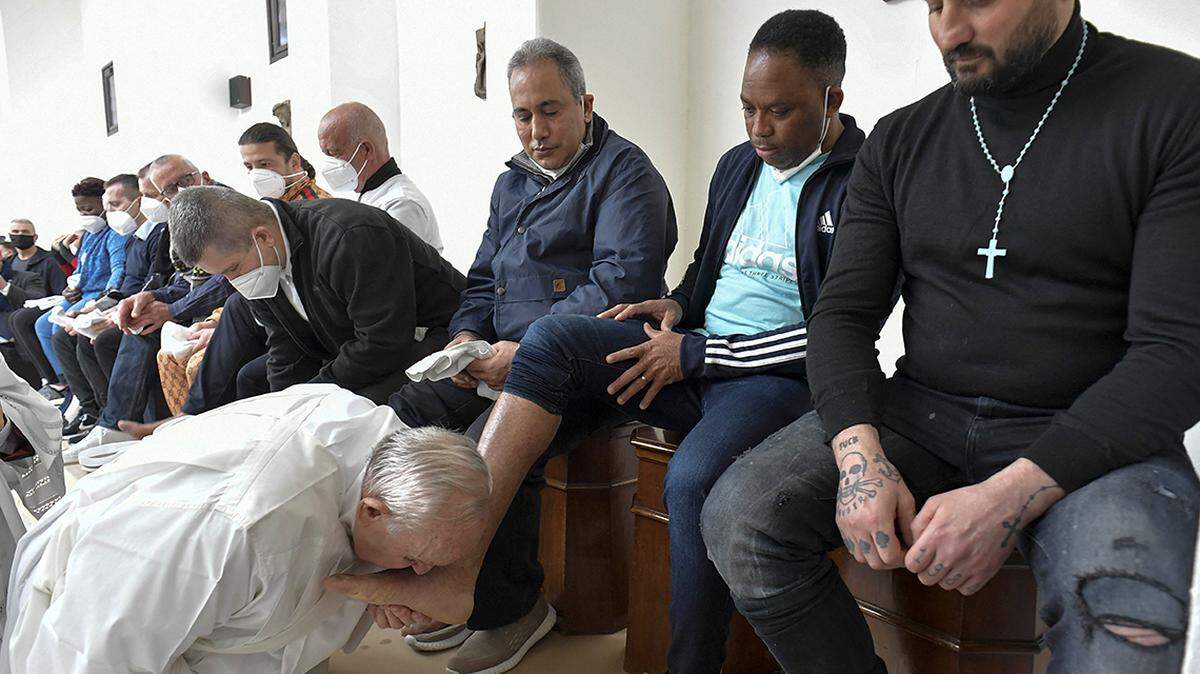
And I will remember him washing the feet of inmates in a prison in Rome, as Jesus washed the feet of his apostles, on every Holy Thursday except this one, when he went to the prison but apologized to those incarcerated there for not being able to bend down.
The last time I was in Rome, he had invited unhoused people to use some of the amenities in St. Peter’s Square, and not every tourist was too keen on that, but he never forgot the least of these.
He was also fatherly in his sometimes angry remonstrating — against clericalism, and what he saw as the excessive fanciness of clerical dress. Recently, he told the American bishops to for the literal love of God bestir themselves and push back harder on mass deportations. “What is built on the basis of force and not on the truth about the equal dignity of every human being begins badly and will end badly,” he wrote.
Curia is the ultimate deep state
To say that he was disliked by some inside the Vatican who did not want to change — you have not seen a deep state until you have seen the curia — and by some on the American right might be the understatement of the millennium.
But it’s also true that the successor of Peter was often like the fisherman in popping off rashly, most unpopelike. That’s another reason he was so beloved, but it did get him into trouble he hadn’t necessarily been looking for.
He made mistakes, sometimes serious ones, none more so than when he initially said that allegations that a Chilean bishop had ignored and covered up the sex abuse of a notorious priest were a “calumny.” Later, Francis apologized for his “grave mistake” and invited three victims of that priest to spend five days with him at the Vatican hotel where he lived.
One of those victims, Juan Carlos Cruz, told reporters later that Francis had told them, “I was part of the problem. I caused this, and I apologize to you.” Cruz also said, “I believe that he was sincere.”
The remarks for which he’ll most be remembered, “Who am I to judge?” made on his way home from his first foreign papal trip in 2013, was narrowly speaking about gay priests: “If someone is gay and he searches for the Lord and has good will, who am I to judge?” But it spoke to so much more than the subject at hand.
At the prison on Holy Thursday, just days before his death, he told reporters, “Every time I enter a place like this, I ask myself: why them and not me?” He always, it seemed to me, put himself in the shoes of the other person.
That was his job, yes, but it’s the job of all of us, and that’s what he reminded us, again and again.
In a world in which compassion is so often and so wrongly equated with weakness, the power of that witness is not diminished, but is thrown into even greater relief.
I will miss the good man who died in Rome today, and will always be so grateful for his life.
This story was originally published April 21, 2025 at 10:27 AM.