‘Four years is a crazy long time’: Man held in JoCo jail since 2017 without any trial
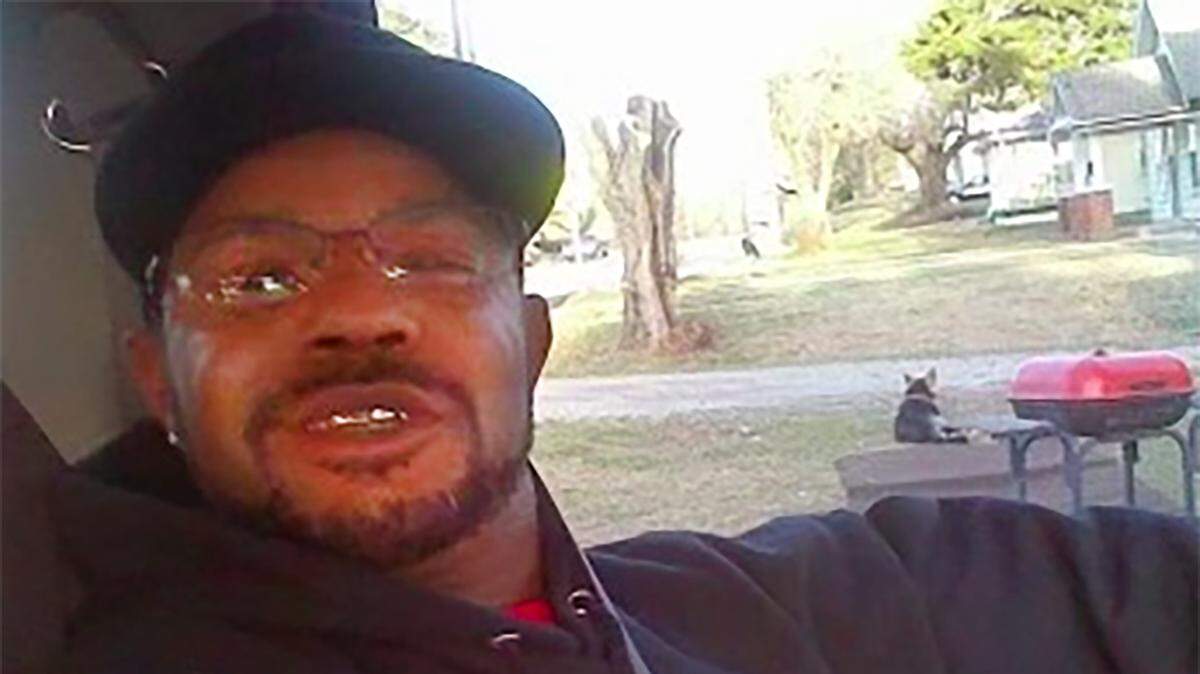
Landunn Richardson has spent the last four of his 50 years in a Johnson County jail cell without ever going on trial. He’s still there because he can’t pay his $500,000 bond and won’t plead guilty to a crime that he says he didn’t commit.
“They don’t know my brother” if they think he’ll ever plead guilty, says Bridget Chatmon. “He’ll sit there for the rest of his life before he does that.”
Richardson, whose long pretrial detention only came to my attention because he wrote to me from jail, sold used tires in Kansas City, Kansas, before his December 2017 arrest in connection with an August 2016 traffic fatality.
He was finally supposed to go on trial this August. But after I contacted his court-appointed attorney, Jason Billam, to ask why his client had been behind bars so long already, Billam decided to withdraw from the case. So now, Richardson’s court date will be put off even further.
If Richardson were to plead guilty, he’s been told, he’d be sentenced to 14 to 16 years. He says Billam, who would not speak to me, “told me if I don’t take the plea, they’re going to double that.” In other words, they’ll double that sentence if he insists on going to trial and is found guilty.
It’s only if you’re poor, without financial or social capital, that you can essentially be held hostage in this way, sending up flares like notes to journalists you don’t know. “Four years is a crazy long time” to be awaiting trial, said John Raphling, a Human Rights Watch senior researcher who studies the pretrial detentions that as he says are “a major driver of people pleading guilty, whether they are guilty or not.”
Pickup’s tie rod broke, leading to fatal accident
So how did Landunn Richarson wind up in Johnson County’s New Century Adult Detention Center in the first place?
At 7:27 p.m. on Aug. 26, 2016, which was a Friday, Richardson and his pickup came flying across the median in the 5200 block of Metcalf Avenue in Mission. As the tires that had been in the back of his ‘94 GMC Sierra spilled all over the road, his southbound truck hit 50-year-old Vickie Taylor’s northbound Nissan Pathfinder nearly head-on.
Richardson, who had to be cut out of his seat belt, suffered a concussion and some cuts on his shin, heels, and above his left eye. He wasn’t seriously injured, but spent days on suicide watch at KU Med Center after learning that Taylor had not survived.
A nursing student who hadn’t seen the crash, but had stopped to see if she could help, crawled in through the broken back window of Taylor’s overturned SUV and held her hand as she took her final breaths. “I just let her know that she wasn’t alone,” the woman testified in a preliminary hearing in 2018. Taylor was pronounced dead almost immediately, at 7:45 p.m., but it took until 10:27 p.m., a police report said, “to extricate her body.”
A prosecution summary says that “Richardson reported hearing a pop and losing all braking and steering ability” right before the collision.
At that point, Richardson told me when I visited him in jail recently, “I just laid down in the seat and held on.” An autopsy of his pickup, a vehicle that police later destroyed, showed that his left front tie rod had broken. Tie rods control steering.
All the same, 16 months after the collision, Richardson was charged with reckless second degree murder or, in the alternative, involuntary manslaughter. Either charge requires a finding of “reckless and extreme indifference to human life.”
Police and prosecutors insist that he was reckless that night, and that the crash happened not because the rod broke but because he’d been driving under the influence.
That isn’t exactly implausible: Richardson has had a string of DUI arrests, and was driving on a suspended license when his truck hit Taylor’s car.
But the evidence doesn’t prove that he was drunk or high that night, either: His alcohol level was .03, well under the legal limit of .08.
He did test positive for PCP and cocaine, but there are no levels listed on the labs that were done at KU Med the night of the accident. At the pretrial hearing, one witness for the prosecution acknowledged that such tests can show drug use from the previous 30 days. Another witness said PCP can stay in the system for a week.
Richardson did lie in his initial statements; according to one supplemental police report, “he stated the last time he used pills or marijuana was about a month and a half ago.” Now he says he’d used a couple of days before the crash.
Whether it was a day or a year, though, the question is what proof there is that he was high that night, and the record shows none. Our legal system is not supposed to punish defendants for crimes other than the ones for which they’re charged.
Woman who died beloved by police officers
Richardson says that his first defense lawyer, who had the case before Billam did, put his situation to him this way: “Accident or not, you’re a Black man that killed a white woman in Johnson County and somebody’s got to be held accountable. There wasn’t even sitting room at her funeral; she was well liked in this community.”
Should he insist on going to trial anyway, Richardson says that lawyer told him, he should know that “I just had a murder trial and not one person of color was on the jury; we’re going to lose.”
According to Richardson, his first defense attorney also told him that the woman who’d died that night was beloved by local police officers, who knew her because she dry cleaned their uniforms.
Richardson asked for a new attorney after that, but I don’t know that anything that he remembers his initial counsel saying was untrue: Some 500 people attended a memorial service for Taylor, who was a greeter at her church. On the GoFundMe to raise money for her funeral expenses, her son-in-law Steve McCleary wrote, “The police who helped her on her final night were the same ones she helped with their dry cleaning. The support from all of the officers has been truly appreciated.”
Is that why Richardson was overcharged?
Insha Rahman, a former public defender who is now a vice president of the New York-based Vera Institute, which since 1961 has been working to end policies that coerce the poor into guilty pleas, called the murder charge absurd: “There’s no intent here; it’s at best a maybe negligent homicide.”
Yet Richardson’s situation “happens all the time,” she said. “If he had $500,000” for bail, “he wouldn’t be there and we wouldn’t be talking.” And what kind of justice is that?
Our system is not supposed to value some victims and defendants more than others, either, even though statistics show pretty clearly who we do and do not value: Women serve far longer for killing their male partners than men serve for killing their female partners. Black men serve 20% longer sentences than white men with similar histories serve for the same crimes.
A massive, 2013 review of 50 years of studies of racial disparities in bail, published in the New York University Journal of Legislative and Public Policy, showed that Black people are subject to pretrial detention more frequently and have bail set at higher amounts than white people with similar criminal histories facing similar charges.
That Richardson’s predicament is far from unique can be no comfort to him. And as for his supposed indifference to human life, his family says that until after his arrest so many months after the accident, when he at last learned through discovery about the broken tie rod, he’d been so paralyzed with guilt that he barely left the house. In horror that never really faded, he went over and over how the accident could have happened.
“For two years,” his sister told me, “all he could say was, ‘I can’t believe I killed someone.’ “
A supplemental police report filed by Mission Police Department detective Dennis Davis notes that when he interviewed Richardson in his hospital room on Aug. 29, Richardson cried as he “stated that he did not want to take nobody’s life and asked me to tell the family that he was sorry.”
Was he reckless on the night of the crash, though? The accident reconstruction did not show that he had been speeding.
Weslie Clark, the retired Olathe police officer who did the autopsy on Richardson’s truck, testified at the hearing that “in my opinion, (the tie rod) broke from the crash” rather than causing it. But he also said under cross-examination that yes, “you could lose control” if you tried to correct after a tie rod broke. And yes, he said, you could end up going off the road.
Kansas Legislature suspended right to speedy trial
I could go on and on about how flimsy the case against Richardson is. But the larger issue is how he, or anyone, could be in jail this long without being found guilty of anything.
It’s true that the defense has repeatedly asked for delays, according to Richardson while looking for funding to hire experts. Only in one instance that I see in the court record has the prosecution asked for a continuance. Chris McMullin, the chief deputy district attorney, told me that while he can’t talk about any specific case, in general “we have an interest in moving things along. We’re ready, willing and able to put this to rest.”
Both defense and prosecution have a duty to make sure that happens. But if it doesn’t, there’s no system in place to flag the case.
Occasionally, such a situation does get public attention: In 2016, the Kansas Supreme Court ordered the immediate release of Todd Ellison of Wichita, who had been held for more than four years while awaiting a hearing on whether he should be committed to the sexual predator program at Larned State Hospital.
But this is one more issue that COVID-19 has made worse: Last year, the Kansas Legislature suspended the right to a speedy trial because of the pandemic. Richardson, of course, had already been in jail for years when that happened.
Sharon Brett, legal director of the ACLU of Kansas, said that it’s wrong on its face for him to be “held in this limbo while the state attempts to coerce a plea out of him. The solution is not to have him sit in jail without any due process because he refuses to plead.”
It does not have to be this way: The state could and should eliminate cash bail, expand home monitoring and fast-track the case of anyone who’s been in Richardson’s situation for a year, or even six months. But since it’s only the poor who are stuck in this way, where’s the political will to make that happen?
We don’t even know how many Landunn Richardsons there are in county jails around the country.
We do know this: The accused are not supposed to be jailed indefinitely before trial in the United States of America; that’s what they do in Russia, China and Myanmar. But it’s also what’s happening in Johnson County, Kansas.
This story was originally published April 28, 2022 at 11:25 AM.