Called ‘Adolf’ as a German kid in Kansas, and protesting nuclear weapons ever since
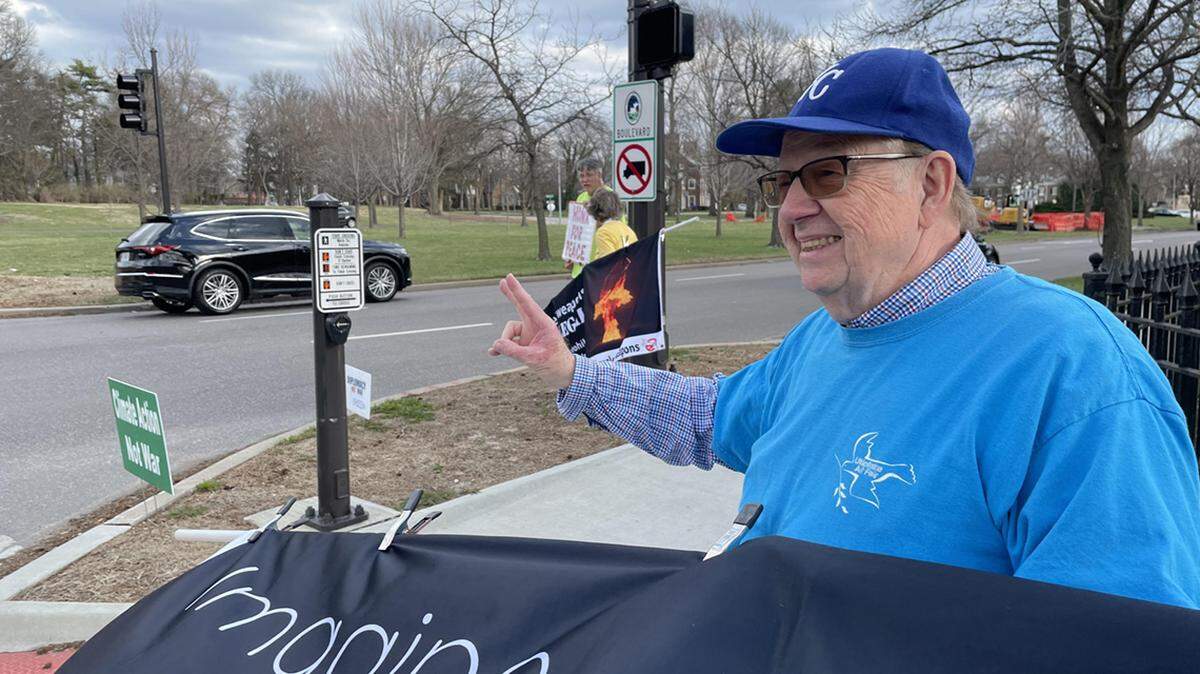
Nearly every Tuesday afternoon since 2003, Henry Stoever has stood vigil at the corner of 63rd Street and Ward Parkway. “Thank you,” he says courteously, to every passing driver who responds to his sign — “Imagine a world free of nuclear weapons” — with a honk or a wave.
They can’t hear his acknowledgment, of course, behind their car windows and over the noise of rush hour. But if 73-year-old Stoever spoke only when sure to be heard, he would have fallen silent long ago.
Instead, he and a small but determined group of mostly Catholic activists have been challenging the logic of mutually assured destruction all this time. In recent years, they’ve been trespassing at a local nuclear weapons manufacturing plant every Memorial Day, and treating the guards there, and the police who book them in, with the greatest respect.
“We don’t go limp,” Stoever says, “because they could hurt themselves carrying us.”
And yes, you can give witness even when almost no one is watching.
“If there’s ever been a voice in the wilderness, out of the heartland of America,” says Stoever’s friend and fellow protester Tom Fox, the former editor and publisher of KC-based National Catholic Reporter, “then Kansas City would have to be that voice — a long-term, lonely and faithful voice against nuclear weapons.”
Even now, with the use of “limited tactical nukes” — talk about an oxymoron — in the news every day since Russia invaded Ukraine, Americans may or may not be ready to hear what Stoever has known since college.
“When one sees a suicidal person,” or a suicidal culture, he told me in an email, “a brave person is compelled to intervene. We are addicted to war, and are on the verge of omnicide. I argue that it is necessary to do an intervention to rescue the planet, to disrupt the danger, to expose the danger and to foster change” through “the courage of nonviolence.”
But I’m interested in both how Henry Stoever became and remains the guy we see on the corner every week, smiling and flashing the peace sign even at the kid who rolls past him shouting, “Let’s go, Trump!”
“I’m sure as teenagers we said things,” he says, unperturbed. “Sometimes a young juvenile will say, ‘Bomb them all!’“ But since Russia attacked Ukraine, “we don’t get as many fingers.”
German father worked on Nazi planes
His story really begins with his late father, Henry Johann Stoever, who was born near Bremen, Germany in 1912. At 18, in 1930, he tried to join his three sisters in Kansas, but couldn’t because of the 1924 immigration laws that included the infamous Asian Exclusion Act and the National Origins Act that set quotas, and was later used to keep Jews from escaping Hitler. Though Germans had the second highest quota of immigrants, after the U.K., there was no spot for Stoever, who as a result was forced into the German Air Force.
His proposal to Marianne, whom he married in March of 1940, was, “If I die, you would have a widow’s pension.” As someone with training as an upholsterer, he repaired the interiors of Nazi planes, and spent four years in Russia, where his brother was held as a POW until 1948.
Stoever remembers his father telling him that German soldiers were welcomed into what was then the Ukraine — mostly because millions of Ukrainians had been systematically starved to death under Stalin.
When Henry, Marianne and their two children finally were able to immigrate to Frankfort, Kansas, in 1951, his father brought “real reservations about war” with him. “I was interested in joining the Boy Scouts, and my dad said they reminded him of the Hitler Youth, pledging allegiance to the flag.”
The younger Henry, who was sometimes called “Adolf” and a “kraut” and a Nazi by his classmates, was haunted, too, by “war stories on television every Sunday, about the death camps and Anne Frank.” And in a very real way, he has spent his life rejecting everything that had led to the Holocaust: “My German heritage compels me to speak out.”
The first chance he got, while studying economics at K-State, “I went out of my way to know Jewish guys.”
Conscientious objector to Vietnam War
What he read about the Vietnam War in the international press while on a trip back to Germany to visit his grandmother made him start to wonder if Americans “were the Nazis in Vietnam. I’m a very sensitive person, and when I heard we were rounding up people from the countryside,” he said, not finishing the sentence, and not needing to.
When others his age left to serve in that war, “in good conscience, I couldn’t.” As far as he knows, he was the only young man in Frankfort, Kansas, who applied for conscientious objector status, and he was allowed to work at the KU Medical Center instead of fighting.
Back in Kansas City after law school, he volunteered to offer legal advice to nuclear protesters, and their cause became his.
“This is not about one war” or weapons system, he said, but about all of them. And ultimately, it is about living in peace.
In 1973, he met Jane Peckham, a former sister of Loretto, at a Catholic Worker house where both were organizing support for the Cesar Chavez lettuce boycott, and they married two years later.
“Some of her boyfriends did not care that she was interested in human rights issues,” he said, maybe just a little triumphantly.
In a world with too little courage and no attention span, the question of how to keep working for change against discouraging odds does not trouble Henry Stoever: “It would be giving up on people, and on God,” to do otherwise, he says, and “would be the sin of despair. I believe there will be change,” but whether that happens or not, “these are acts of faith.”
This story was originally published April 7, 2022 at 5:00 AM.