Why did this KC Council candidate walk 45 miles across Kansas City in a day? | Opinion
Zohran Mamdani, the fresh-faced mayor of New York City, famously walked the length of Manhattan in a day last summer during his campaign — about 14 miles.
Rookie numbers.
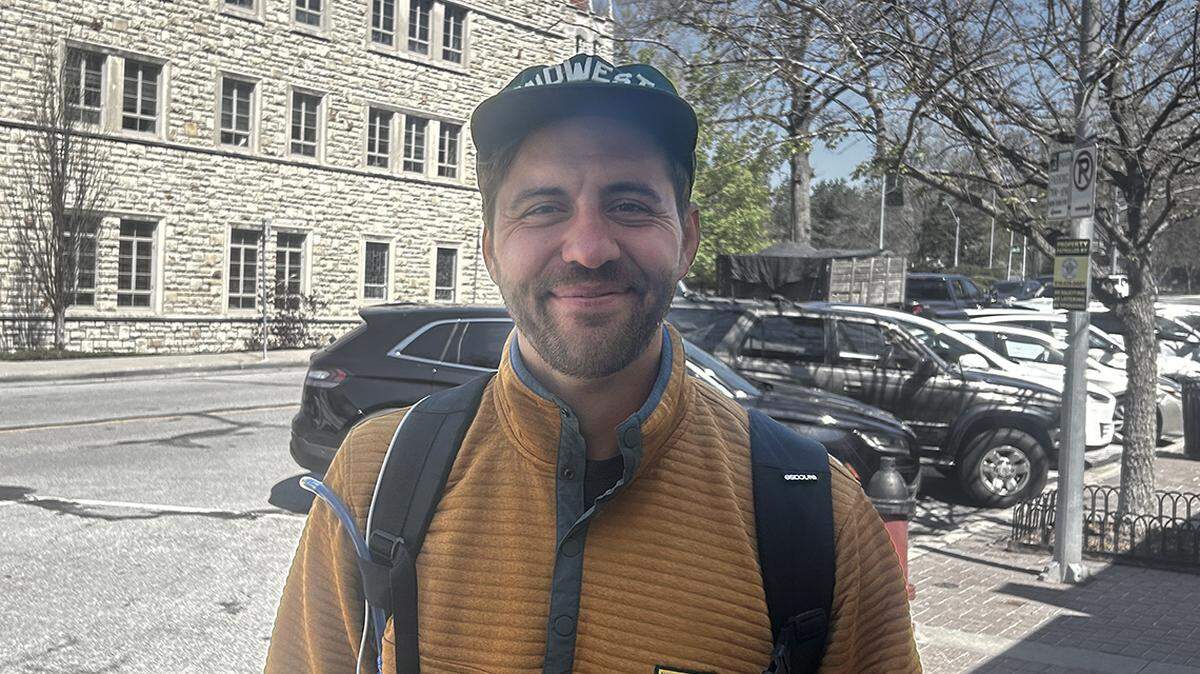
By the time I caught up with Chad Grittman on Monday afternoon near the Crestwood Shops in Brookside, he was already 30 miles into a trek that would take him from the north pole of Kansas City to its southern edge. He still had another 15 miles to go. Grittman’s running shoes, bright white when he’d set out before dawn, were now streaked with mud after an early encounter with a pickup truck.
“I had to dive into a ditch to avoid a Ford F-150 that came barreling at me on Interurban Road, way north of the airport,” Grittman, 33, said while taking a short break for a pastry on the sidewalk outside Aixois. “That was about 200 steps into this journey.”
His big walk — documented along the way on his Instagram page — wasn’t just a social media stunt, though it worked as one. A vice president at BioNexus KC, an economic development group focused on the region’s life sciences sector, Grittman is running for the 6th District at-large on the Kansas City Council. Monday’s timing was deliberate: The date marked exactly one year until the primary.
But the larger point Grittman was trying to make, he said, was about the sheer size of Kansas City and the growing challenge of paying for it.
“We live in an enormous city that in a lot of ways can’t really afford itself,” Grittman said. “Revenue projections keep going down, and expenses keep going up. Walking KC physically like I have today, it really hammers home how much we have to do to maintain all this road and sewer and parkland. It’s just becoming unsustainable.”
The housing candidate
Consider Minneapolis, perhaps the platonic ideal of a Midwestern city: thriving arts scene, solid job market, great parks and a set of policies that have made it easier to build housing and get around by bike or transit. It packs about 425,000 people into roughly 60 square miles.
Kansas City spreads slightly more people (about 500,000) across 319 square miles, more than five times the footprint. Minneapolis maintains 1,000 miles of roads; Kansas City has over 6,000. That isn’t the only reason your sidewalk might be cracked, or snow removal on your block lags, or your trash pickup gets missed. But stretching the same tax base across six times the infrastructure means there’s less money per mile to maintain all of it.
The way Grittman sees it, and it’s hard to disagree, there are only four ways out of this problem.
You can shrink the city — de-annex land — but that’s politically and legally implausible, at least at any meaningful scale. You can cut services, but there’s not an obvious place to find hundreds of millions of dollars in savings without degrading basic functions. You can raise taxes, but Kansas City is already near its limits there, constrained both politically and by state law.
Or you can grow.
That’s the path Grittman has chosen to hang his campaign on: Grow the tax base by making it easier to build more housing — not just large apartment complexes or single-family homes, but the kinds of “missing middle” housing Kansas City once produced in abundance.
“Townhomes, cottage courtyard apartments, duplexes,” Grittman said. “The classic KC colonnade sixplex that you see all over midtown — you literally haven’t been able to build those here since the 1950s” (because of zoning laws).
Grittman is framing his agenda around the levers City Hall actually controls. He’s less interested in things like the capital stack — lining up federal dollars and private financing — than in the basics: permits, codes and process. He argues Kansas City can unlock more housing, especially on the roughly 17,000 vacant infill lots already sitting on existing infrastructure, by making it easier for smaller, local builders to navigate the system.
That means adding staff, improving technology and simplifying what he sees as an overly complex development code so projects don’t require teams of attorneys and consultants just to get approved. The goal, he says, is to lower the barrier to entry so an ordinary Joe or Jane can buy a land bank lot and easily build on it — particularly in neighborhoods that haven’t seen that kind of investment in decades.
Easier building permits, lower fees
That puts him largely in line with a subtle shift underway at City Hall. Mayor Quinton Lucas last week proposed changes aimed at speeding up permitting and reducing fees, especially for affordable housing projects, as the city faces a shortage of as many as 64,000 units. The plan would set firm timelines for permit review — as fast as 15 days for qualifying affordable projects — and create a single point of contact to help builders navigate the process.
Grittman said he hasn’t drilled down too deep into the details yet but likes what he’s heard so far, noting that much of Lucas’ plan seems to overlap with his own platform. “If that’s one less thing I have to do when I get on council,” he said, “I’m thrilled.”
At the same time, city leaders are reconsidering energy codes adopted in 2023 that require stricter insulation, ventilation and testing standards — rules builders say add cost and time and have coincided with a sharp drop in home construction inside city limits while surrounding suburbs boom. Grittman said that concern is widely shared across the industry.
“Whether I talk to a small mom-and-pop single family builder on the East Side, or a big developer,” he said, “they’re both in agreement that (the energy codes) were demonstrably adding significant cost.”
One of the reasons Grittman jumped into the race so early, he said, is that he wanted the time to define himself as the City Council candidate most associated with housing — specifically, the need to build more of it.
“I want people to say, ‘Yeah, Chad will not stop talking about housing.’ I want consultants to be like, ‘You’ve got to stop talking about housing,” he said. “Because the flip side of that is people know I care about growth in this city. They know I’m trying to build more homes. They know that’s what I’m about.”
The finish line
Monday’s trek was the capstone of a larger project. A year ago, Grittman set out to walk every block of the 6th District — all 550 miles of it — and by 10 p.m., he had crossed the final streets off the list. By then, the route had taken on a kind of surreal quality. It began in cornfields and grain silos near the airport, cut through subdivisions and commercial strips, into the skyline of downtown, past the Plaza’s mid-rise wealth, along the Paseo — and then kept going, out to a part of Kansas City where oil derricks pump beside pastures with cattle and horses. It is all one city, technically, though it does not always feel like one.
Friends joined him for stretches along the way: Councilwoman Andrea Bough, whose seat he’s seeking; Councilman Wes Rogers, now running for mayor; state Rep. Emily Weber, a candidate for 4th District at-large. Grittman’s mom resupplied him with water before heading back out to knock doors in her own reelection race for mayor of Oak Grove. By the end of the day, his socks were caked in blood, and he’d had to pull his headlamp back out of his bag to navigate the dark, sidewalk-less blocks all the way out near 155th Street.
“I hope, in part, that this proves to you how hard I’ll work on the City Council,” Grittman told his Instagram followers as the saga concluded. “I hope it shows the ends I’ll go to serve the people of Kansas City.”
The route was supposed to be 45.5 miles in all, according to Grittman’s Strava app. But after the various detours to gas stations in search of restrooms and sustenance, it ended up being 46.5. He had gone, as they say, the extra mile.
This story was originally published April 7, 2026 at 11:17 AM.