What will become of the last open piece of property in Mission Hills? | Hudnall
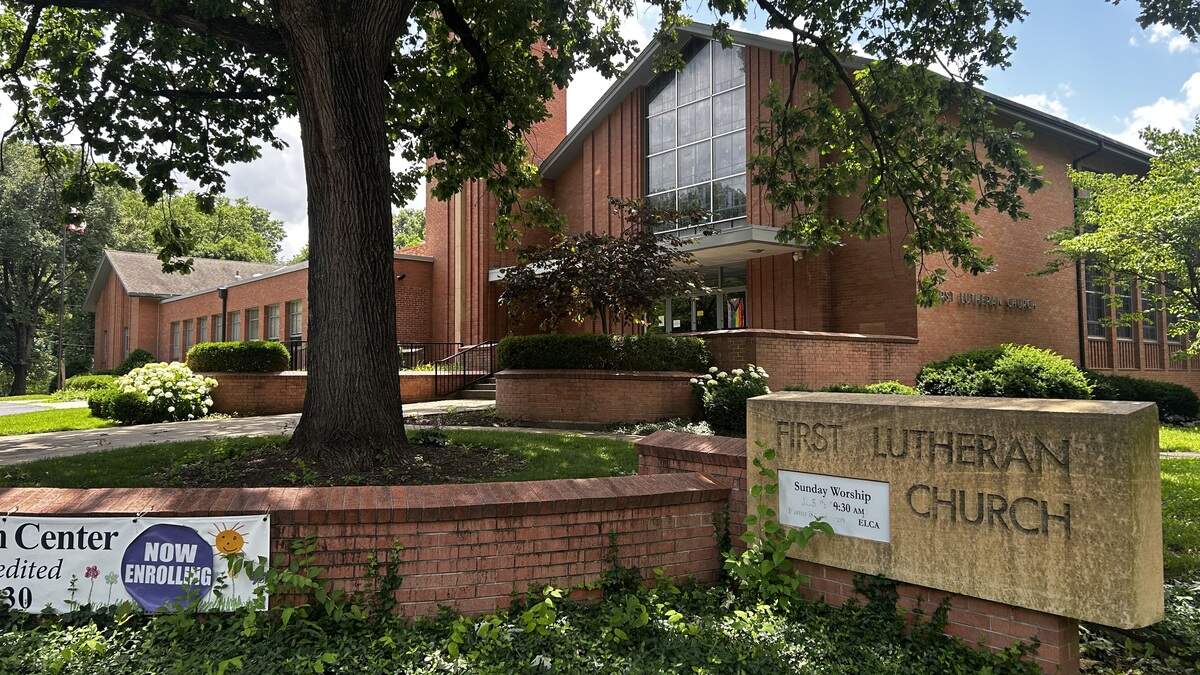
For a place so associated with wealth and money, Mission Hills is not really a place of commerce.
Deals may get cut poolside or on the fairways, but there are no storefronts, no strip malls, not even a coffee shop. Thirteen hundred houses, three country clubs, City Hall and a church. That’s the inventory.
Now the church is closing down.
A few years ago, leaders at First Lutheran Church, 6400 State Line Road, approached Mission Hills officials with news that the congregation was struggling and evaluating its future. Membership had declined. The church was considering a sale of the property and had already spoken with a real estate broker.
“Well, that kind of triggered us a little bit,” Mayor Andy Weed told me last week in the council chambers of Mission Hills City Hall, just across the street from the church.
The news left open the door to some unpleasant possibilities. First Lutheran had been a quiet neighbor with a day care appreciated by residents. But there was no guarantee that whoever replaced it would conform as cleanly to the spoken and unspoken mores of Mission Hills.
The property, which occupies a prominent corner in the heart of the small city, has long been zoned for religious or governmental uses, a designation that dates back to its founding by J.C. Nichols. So there was no chance of a rowdy sports bar or Section 8 housing. But even within the narrow zoning, there are variables. A satanic temple would qualify as a religious use. So would the Church of Scientology.
There were also less dramatic possibilities. A few miles south, in Prairie Village, two churches near 75th Street and Belinder Avenue have fallen into various states of vacancy as congregations shrank. One now houses a Montessori school, but large portions of those properties sit largely unused.
First Lutheran said it would give Mission Hills first crack at the property. So officials spent a year discussing the issue, mostly behind closed doors at the church’s request. They weren’t sure they had much use for the property. But they kept returning to the same question: What happens if we pass?
“We just finally came to the conclusion that we wanted to control the destiny of that property,” said Weed. “You just never know what could happen. So even though we didn’t have an immediate need for it, we felt it was the best option available.”
Mission Hills closed on the 2-acre site in August, paying $3.2 million for the church and surrounding land.
Now it has a new dilemma: What to do with the last piece of available property in the metro’s most rarefied ZIP code?
The residents weigh in
Mission Hills has held a couple of public listening sessions in recent months with the aim of taking residents’ temperature on the matter.
Because the council can rezone the land, possibilities are, in theory, limitless. In practice, the range of politically realistic options is much smaller.
Ideas submitted by the 150 attendees included a park, a sculpture garden, a small amphitheater for hosting small outdoor concerts. Townhomes or low-rise condos, for residents who would like to stay in Mission Hills but downgrade into something smaller than a single-family house. Light retail. A coffee shop. An ice cream parlor. Some barbarian even had the gall to suggest an eatery.
“The restaurant idea,” Weed said, “was shouted down pretty quickly.”
A new City Hall is also theoretically on the table — the need for which was evident in the fact that the meetings had to be held at Indian Hills Country Club, since the current building can’t comfortably fit more than a few dozen people.
Weed, a 31-year resident who served on the council for a decade before being elected mayor in November, was a little sensitive about that one. He had watched Prairie Village leaders get hammered by the public last fall over a proposal to spend $30 million on a new city hall complex. A few Mission Hills residents heard the news about the First Lutheran purchase and assumed Weed and the council had similar ambitions of erecting a posher office for themselves.
“I just have to assure you that was never part of our strategy whatsoever,” Weed told me.
He doesn’t rule out that some modest expansion of civic space could eventually make sense. The city is looking at both properties — the church and City Hall — together, doing a formal needs assessment. But a grand new City Hall is not where this is heading, Weed said.
There are complications before any of this gets resolved. The city had done basic due diligence before closing, but afterward assembled a task force of architects, attorneys and environmental consultants to take a harder look at what it had actually bought.
The news was not great. The building carries roughly $3 million in deferred maintenance just to stay functional. Bringing it fully up to code — Americans with Disabilities Act compliance, updated mechanical systems, the works — could run nearly $10 million.
There is also a cell tower hidden inside the church steeple. When Mission Hills bought the property, it also inherited the agreements with the wireless carriers that use it. One of those contracts runs through 2044. The arrangement generates revenue, but it also complicates things. Mission Hills will have to relocate the tower, leave the steeple standing as part of whatever comes next, or negotiate some other solution.
Then there’s the matter of the congregation, which is still holding services under an 18-month lease that runs through February 2027. One council member at the May meeting was already asking about getting demolition bids. He was gently reminded that the church hasn’t left yet.
Green space? Coffee shop?
Mission Hills has an unusual demographic profile.
The city’s largest age group is residents in their 70s. The second largest is children 5 to 9. Generally speaking, the former tend to prefer locked gates and perhaps some additional hedgerows between their leafy enclave and the hoi polloi. The latter — or, more accurately, the young parents of the latter — are a little more open to amenities that could bring a little more flavor into the city.
Right now, the boomers seem to have it. They want … yet another lawn.
“Green space definitely got the most votes,” City Administrator Jennifer Lee said. “The votes for some version of green space were 72% in one session and 74% in another session.”
On one hand, of course the boomers have the votes. They always do.
On the other hand: That is really quite lame. Put in a damn coffee shop.
Hi-Hat, the cute coffee shack a few miles down State Line, did not ruin Westwood Hills. It’s a point of pride there, beloved by the locals. And the First Lutheran property isn’t in the center of Mission Hills, where cars and traffic from the business would disrupt the residential idyll; it’s on the edge of the city. It’s practically in Missouri!
It is also worth noting that J.C. Nichols himself once imagined something like this for this stretch of State Line Road, according to Weed. His master plan envisioned a commercial node here, a parallel twin to the Crestwood Shops he developed a few miles away. Nichols either ran out of money or ran out of time; he died in 1950 before it came together.
Instead, the stretch is now a City Hall with a huge, beautiful, almost entirely unused lawn and a crumbling church. Mission Hills should loosen its collar a notch and give the neighborhood somewhere to gather that isn’t a country club.
Nothing’s set in stone yet. More public engagement sessions are planned for the fall. No votes are imminent.
“I think where we’re at now is we gave (residents) this information and we said, ‘OK, now take the summer,’” Weed said. “Get together at picnics and so forth and so on, and discuss it. Then let’s return in the fall and see what we think.”
That seems reasonable. But when those conversations resume, I hope somebody is still making the case for a coffee shop.