The curious campaign of Kenda Tomes McClain, candidate for KC mayor | Hudnall
Five people have filed to run for mayor of Kansas City next year.
We know plenty about three of them — Crispin Rea, Wes Rogers and Ryana Parks-Shaw — because they currently sit on the City Council.
PJ Guastello we also know a little about. He’s a Northland businessman, developer and brother of George Guastello, the longtime president and CEO of Union Station. He would seem to roughly fit the familiar mold of the business-world outsider who decides to jump into politics. (PJ, please call me back.)
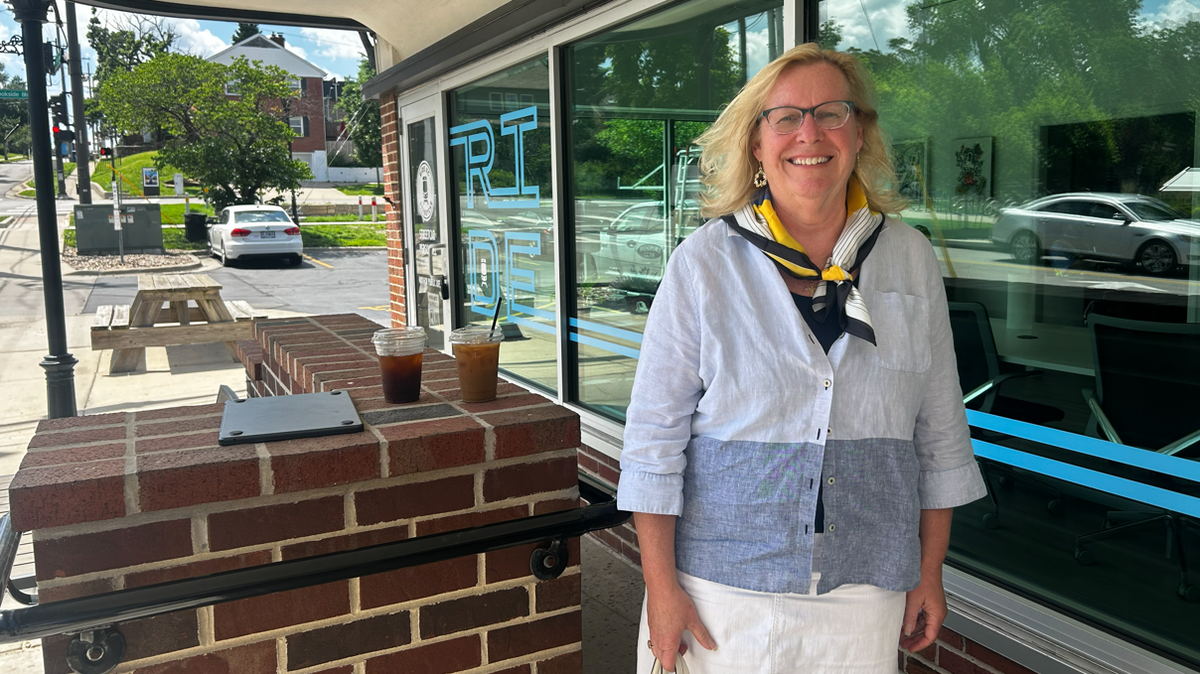
Then we have Kenda Tomes McClain, who is more of a mystery. She is a corporate attorney at the law firm Stinson LLP and lives in southeast Kansas City, right on the edge of Raytown and not far from Lee’s Summit city limits. According to the most recent campaign finance filings, Tomes McClain has raised $103,350. Of that amount, $100,000 came from a loan she made to herself.
Two other things about Tomes McClain: She has no discernible background in politics and is rumored to be quite conservative, which historically is not something you can be if you want to be mayor of Kansas City.
I was curious about that. I rang her up and we agreed to meet Monday at Crows Coffee, south of the Plaza.
I spent an hour asking Tomes McClain questions and got as much of her story as she was willing to tell.
I am still not entirely sure what is going on with her campaign.
Crime, housing, and speeding?
Tomes McClain has lived in Kansas City for 30 years. She is in her 60s and is a grandmother several times over.
She moved here from Chicago, where she worked for the law firm Sonnenschein Nath & Rosenthal, which later became the megafirm Denton’s, before she landed at Stinson. There, she leads a practice group operating in the world of commercial mortgage-backed securities. The group represents companies that administer large pools of real estate loans tied to hotels, hospitals, office buildings and apartment complexes.
Sounds like a nice, lucrative position. I asked her why she would want to give it up to run for mayor.
Tomes McClain said Kansas City has done a good job developing downtown and midtown, but has not paid enough attention to the East Side, South Kansas City and the Northland. She cited crime, homelessness, education and the rising cost of homebuilding as major challenges that are pushing residents and businesses elsewhere. The city, she said, needs to address those problems if it wants to attract more investment and economic growth.
Not much to argue with there. I asked whether she had any specific prescriptions for addressing those problems.
The answers remained fairly broad. The city needs to improve its relations with police, she said, and hire more officers and deploy them more strategically. She acknowledged that KCPD recently welcomed its largest police academy class in two decades, but noted that crime in Kansas City per capita was worse than big cities like New York, Los Angeles and Chicago. (True.)
“Kansas City is a fabulous jewel of a city, but the crime and the housing costs are making it unattractive,” she said.
Tomes McClain said the city should reconsider environmental standards building codes that have made housing more expensive. But the City Council already did that a few months ago.
She also returned several times to speeding, which she said is one of the biggest complaints she hears from residents. By the end of the conversation, people driving too fast was one of the more concrete issues Tomes McClain had raised.
Legal conflicts
With few specific proposals to discuss, I asked what Tomes McClain thought of Mayor Quinton Lucas and the City Council.
She said she was disappointed by some of their recent decisions, including what she called a “flip-flop on banning $1 alcohol.”
I asked if she was referring to the recent ban on single-serve mini liquor bottles in certain parts of the city. She was. She said she didn’t understand why “it was reversed for Westport.” (Technically, Westport was included in an early version of the ordinance but exempted before the final version passed.)
“I’m not saying I supported it or didn’t support it,” Tomes McClain said. “I don’t know enough about it.”
I tried one more topic: the proposed downtown stadium.
Tomes McClain told me she couldn’t comment about that. She said that she would have to run a conflicts check at Stinson to make sure her law firm wasn’t representing any clients involved in the project.
Stinson is a huge Kansas City law firm whose attorneys handle a wide range of development, finance and public projects. Its work touches every corner of civic life in Kansas City. One Stinson partner alone, David Frantze, lists the Royals, Union Station, the Power & Light District, T-Mobile Center and Burns & McDonnell's headquarters campus among the projects he has worked on.
If Tomes McClain was going to decline to take positions whenever a Stinson client was involved, wouldn’t that pose a problem on all sorts of issues, not just the stadium?
“Not if I was mayor,” she said. “I wouldn’t be working there anymore.”
But what about in the meantime, during the campaign?
“Could potentially be an issue, yes,” she said.
The conservative candidate?
I asked Tomes McClain whether she had a campaign manager. Yes, she said. Who?
“I’d rather not say who they are at this time,” she said. “I have two: One is more conservative; one is more labor-focused. We are building a coalition. I’m the campaign. It doesn’t matter who they are.”
One of the nice things about Kansas City politics is that elections are nonpartisan. We are largely spared the tribal and often toxic my-side-versus-your-side dynamic that has come to dominate state and federal politics. But since Tomes McClain’s responses to my questions had seemed vaguely conservative, and because she had introduced the issue in terms of her campaign management, I asked where she lies on the political spectrum.
“I hate to use the word moderate, because that doesn’t explain anything, but I think I’m about commonsense values that the citizens care about,” she said. “I wouldn’t say I lean one way or the other.”
OK, but in a national election, would she be more likely to vote for liberal or conservative candidates?
She said issues in national elections aren’t relevant to what we’re talking about.
Well, sometimes they are, I replied. For example, Kansas City recently repealed its ban on conversion therapy because of a Supreme Court ruling. That’s a national issue that crept down to the local level. What did she think of that?
She said she agreed with getting rid of the ban because “it’s not compassionate to deny people health care that they feel they want,” adding that there are people “who are struggling with a decision they made when they were young, and we shouldn’t be standing in their way.”
I noted that the conventional wisdom in Kansas City is that conservative voters tend to back the least liberal candidate in the mayor’s race. Did she think that was her?
“Yeah, maybe,” Tomes McClain said. “I mean, if you’re starting the conversation with the transgender issue, then yeah.”
It occurred to me then that we might not have been on the same page. Conversion therapy generally refers to counseling intended to change a person’s sexual orientation, not transgender medical care.
But we were running out of time, and I let the matter drop. In fairness, “conversion therapy” as a description does sound like something that could be related to transgender health care, though you would think somebody seriously running for mayor would be more familiar with the issue, given that it has been in the news here for the last few weeks.
“I think I will appeal to moms and dads and grandmas,” Tomes McClain said as we wrapped up. “And on top of that, with my experience, I can help the city attract companies to come here and help with the financing aspects of those transactions.”
The 2020 election
I did a little research the next day as I prepared to write this column and started to get the sense that Tomes McClain had not been entirely forthright with me about her political views.
On her Facebook page, I viewed a post describing Planned Parenthood as an “evil organization” whose primary purpose is “killing and sacrificing our children.”
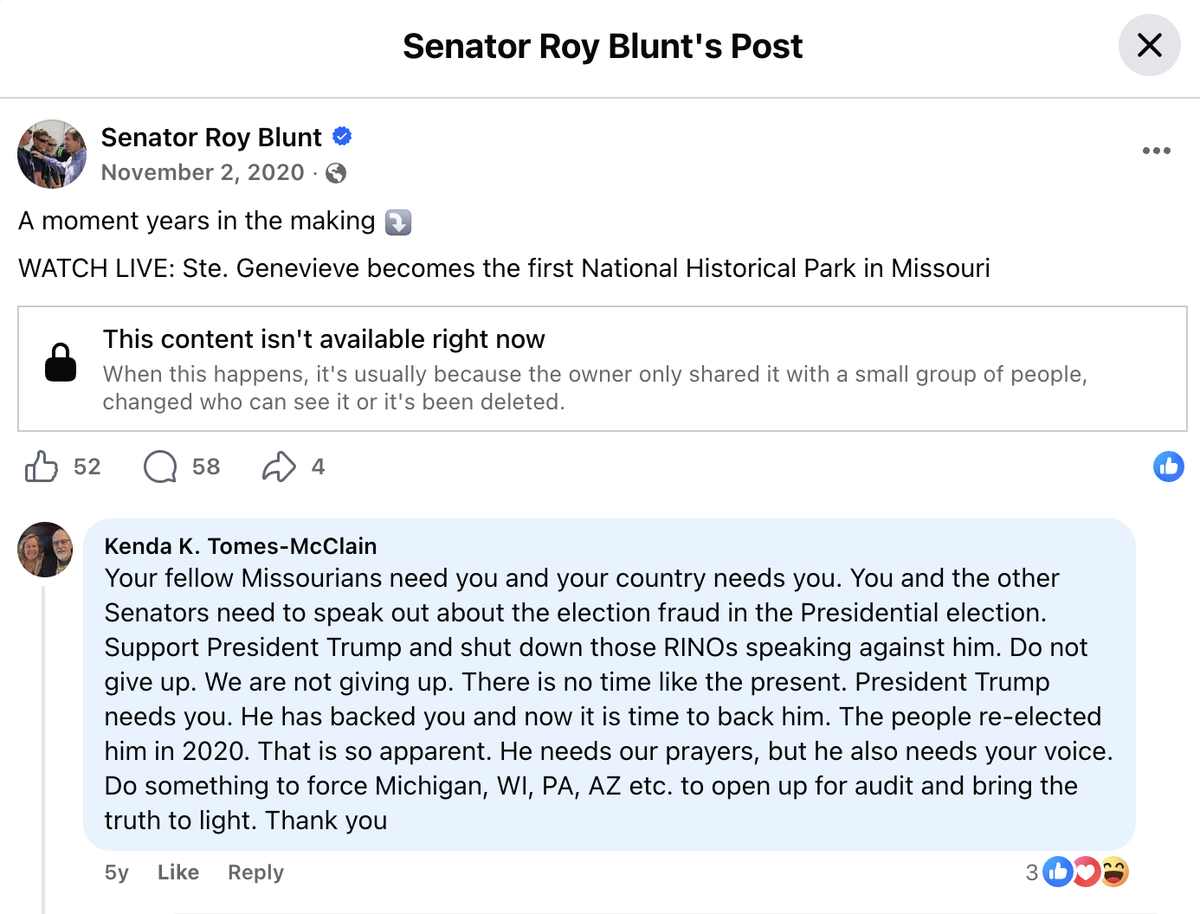
I also saw a few posts she had made on former U.S. Sen. Roy Blunt’s Facebook page in November 2020. Tomes McClain implored Blunt to “speak out about the election fraud in the Presidential election” and “support President Trump and shut down those RINOs speaking against him.”
“Do something to force Michigan, WI, PA, AZ etc. to open up for audit and bring the truth to light,” she wrote.
A lot of people weren’t at their best in 2020 and 2021. The combination of pandemic isolation, social media algorithms and online groupthink pushed people toward more extreme positions, whether that was “abolish the police” or “the election was rigged.”
I emailed Tomes McClain and asked whether she still believed the 2020 election had been stolen from Donald Trump or whether her views had changed.
“I have no idea,” she wrote. “Do you? What about 2000 and 2016? Do these things matter to this local race?”
She added: “The electoral vote was certified — that is the end of the story. But I have questions about all our elections. Our votes matter. I want to make sure all votes are counted, especially in Kansas City and Jackson County where I live, work and raise my family.”
I also noted in my email that several political posts appeared to have disappeared from her Facebook page. The links were gone, although the remaining comments often suggested what had once been there. I asked whether she had been deleting posts ahead of the campaign.
“I did not remove any posts but we have a professional social media person that possibly removed posts which involved issues having nothing to do with this race or Kansas City.”
She added, “With AI sometimes you cannot be sure what is real and what is not. Many posts on Facebook are not real and hard to say one way or another.”
I’m not sure what AI had to do with the question. I wasn't asking about fake content on the internet. I was asking about posts on her own Facebook page. But on that last point, Tomes McClain isn’t wrong. A lot of what people see online these days isn’t real. A lot of it is misinformation, conspiracy theories and outright fabrication.
For example, the idea that the 2020 election was stolen.
You just hope the people seeking public office can tell the difference.