Low snow totals likely in Kansas City. So why is metro under blizzard warning?
You might not be alone if you’re confused after discovering that Kansas City is under a blizzard warning as a powerful storm system crashes through the region Tuesday.
After all, snowfall totals aren’t expected to be that high. Isn’t a blizzard more of a winter event with lots of snow?
Not exactly.
“Well, for this one, we’re looking at a blizzard warning because really, we’re looking at these high winds,” said Ryan Cutter, a meteorologist with the National Weather Service in Kansas City. “A blizzard warning you would go with any time you get some snow and really high winds.”
There are no minimal snowfall amounts required for a blizzard.
Snowfall totals are expected to be 1 to 2 inches in the Kansas City area, Cutter said.
“But with the wind speeds — they’re blowing around sustained 30 mph with gusts 50 or more — we’ll see where that snow ends up,” Cutter said. “You’re going to have spots that get scoured clean and then spots where it just piled up because of the wind.”
The blowing snow will reduce visibility for anyone traveling, especially those on east and west highways.
The weather service defines a blizzard as a severe snowstorm in which winds must be sustained or frequently gusting at least 35 mph, falling or blowing snow must reduce visibility to 1/4 mile or less, and these conditions must persist for at least three hours.
Blizzard warnings are rare in Kansas City, according to data examined by The Star.
Since 1986, there have only been four other blizzard warnings issued for the five counties that make up the immediate Kansas City metro area, which includes Wyandotte and Johnson counties in Kansas and Clay, Platte and Jackson counties in Missouri, according to data by the Iowa Environmental Mesonet at Iowa State University.
Those warnings were issued Dec. 24, 2009, Feb. 1, 2011, Nov. 25, 2018, and Jan. 5, 2025, for storms that occurred around those dates.
Cutter, who has been with the weather service’s Kansas City office since September 2001, remembers the one issued in 2009, which he said might have been their first one.
“I remember we were sitting around the office debating and trying to figure out if we needed to do that or not because we hadn’t done that before because we hadn’t needed to do that, at least at that point in this office’s history,” Cutter said.
Rain to transition to snow in Kansas City
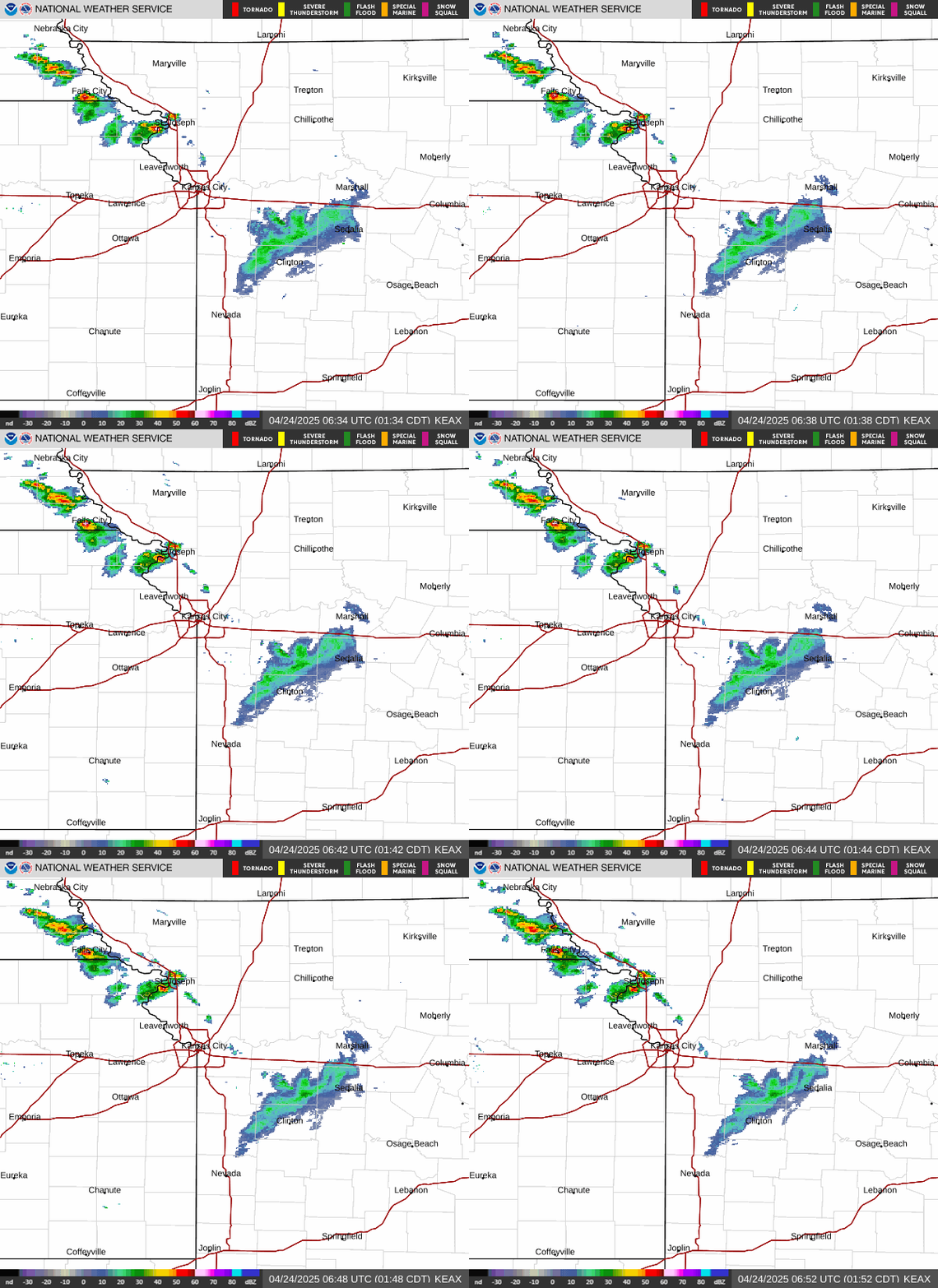
Southerly winds were pulling moisture up from the Gulf as it rained Tuesday morning in the Kansas City area, Cutter said.
The rain was getting wrapped into a low-pressure system that will move across the metro area in the afternoon, deepening as it goes.
As the low-pressure system deepens, powerful winds will develop and shift to the northwest, Cutter said. Already, western Kansas is seeing winds of 50 to 60 mph wind gusts.
There will be a lull that people will notice before the winds pick up. Cutter likened it to being in the eye of a hurricane.
“And then all of sudden, like an hour later, whack,” Cutter said.
Between 8 and 10 p.m., “you start to really notice the northwest winds kick up and start getting really blustery,” Cutter said.
After midnight, sustained wind speeds will jump above 30 mph with gusts of 50 mph or higher, particularly early Wednesday.
By sunrise around 6:45 a.m. Wednesday, winds will still be around 30 mph. The gusts will likely ease in the later morning hours, but the strong winds are expected.
“The snow is almost incidental to the wind speed because winds speeds are really what’s going to cause the issue,” Cutter said. “It’ll blow things around, reducing visibilities quite significantly, especially with the snow and wind combined, and then, yeah, causing all kinds of issues if you’re out.”
Restrict travel to emergencies only
People are being encouraged not to be out driving overnight. If they do head out, it should be restricted to emergencies only.
“It would not be a good idea, especially in high-profile vehicles,” Cutter said. “Even if it wasn’t getting cold enough to turn to snow, 50 mph winds and rain is bad enough, let alone add snow, where your visibilities really do get reduced quite significantly.”
To make matters worse, the howling winds will send wind chill values into the teens.