Giant Algeria flag in Lawrence was gift to community: ‘Standing beside them’
AI-generated summary reviewed by our newsroom.
- Herd created the Algerian flag earthwork using grass, pavers, mulch and sand.
- The earthwork drew over 800 Algerian fans and Lawrence residents to the unveiling.
- The piece serves as a multicultural exercise in welcoming different cultures.
At 3 p.m. on Saturday, Stan Herd got a phone call.
For five weeks, he’d been planting and cultivating fresh, green grass and laying red bricks down. He’d placed bags of redwood mulch and sand to represent the Sahara Desert. In conjunction with the city of Lawrence and the University of Kansas, he found the means and funds to give the Algeria national team and its parade of fans a big Midwest hello with a giant artwork and celebration.
But he wasn’t prepared for just how Midwestern it would be.
Despite, tornado-producing storms forming in the sky and projected on weather forecasts, Herd said the show must go on.
“I had people say, ‘You can’t do this, there’s a tornado coming.’ I was like, ‘No, I think we can, you know, let’s just will it away, let’s will the weather to just slow down a little bit,’” Herd said. “I’m not professing that I have any power in that realm, but the tornado weather came right close to us three hours later, just as we were wrapping.”
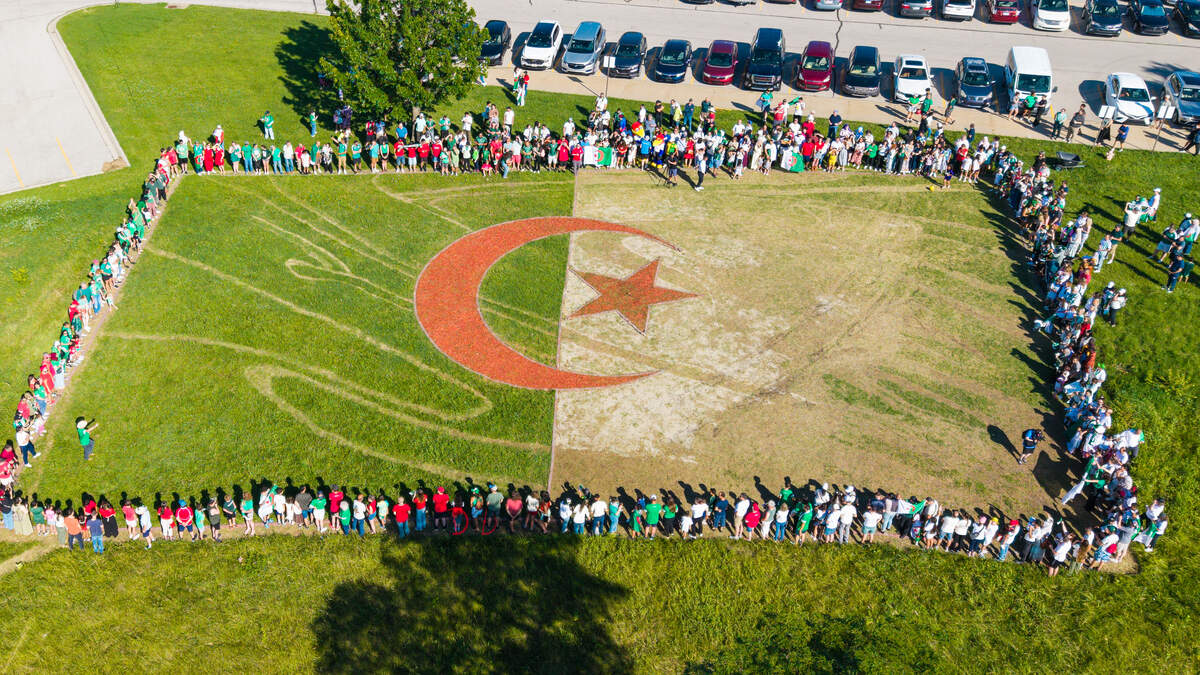
The famous earthworks artist, with help from his team and volunteers, unveiled the piece to Lawrence and the Algerian community on Saturday to a crowd of over 800. Luckily, the tornado could not ruin the moment.
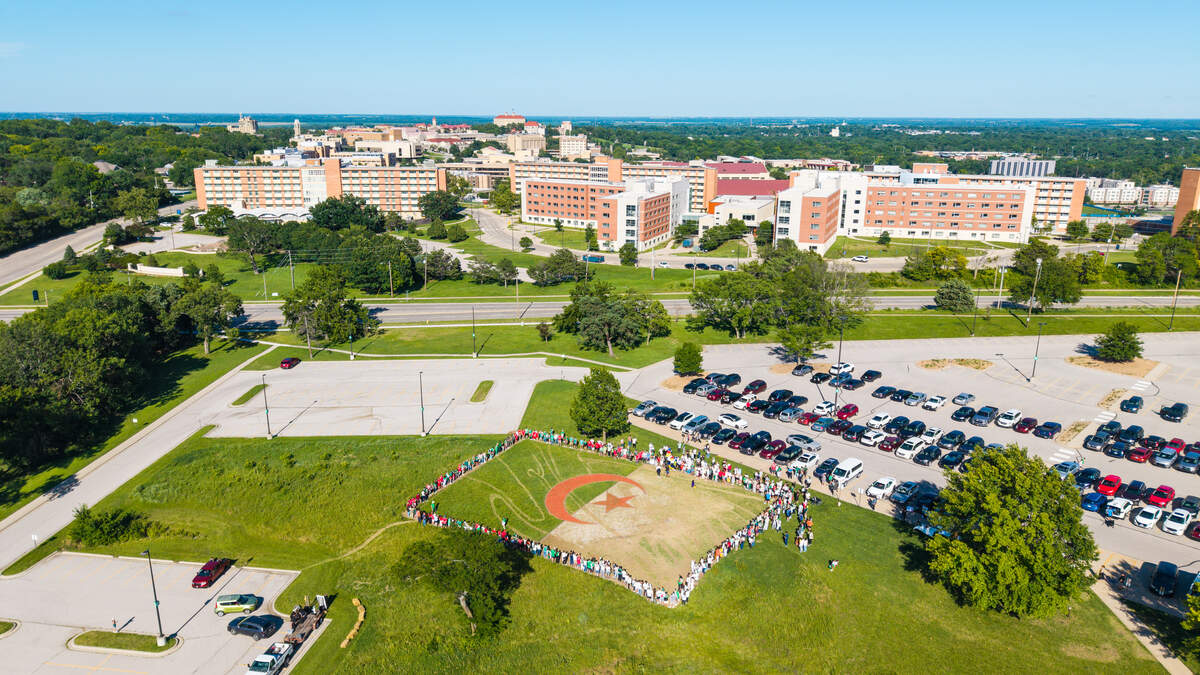
The flag, next to the University of Kansas’ Lied Center, is designed to look billowing, and represents an invitation of shared culture in Algeria’s World Cup base camp town of Lawrence — what Herd says is like a small Algeria in America’s heartland.
Herd spoke with The Star about what earthworks are, how he created this one and how it was received by the Algerian community.
This Q&A has been edited for clarity and length.
How and when did you start making earthworks?
I grew up in a small town, and I was the artist in the family, and the artist in the school, a southwest Kansas farming community. That was always my identity. And when I went off to Wichita State University on an art scholarship, I started to really take art seriously. I painted and entered competitions. I was always fascinated by the ancient peoples, the ancient civilizations who created earthworks. So I was just always aware every time I flew that things look so beautiful from there. It looks like abstract art — the lay of the landscape, the agriculture of the cities and the highways against the natural formations of the earth is just beautiful from up there.
So one day I was flying over an image that I had created on a wall, a 4-story-tall mural, and I wanted to photograph it from the air. So on that flight I went back to the airport, I flew over a field with a tractor plowing a diagonal line, and I just immediately realized the possibility. Since I knew agriculture and I was an artist, I put the two together.
My family are like seven generations of folks that worked the land, so I got home and went to my studio and immediately did my portrait of Kiowa Chief Satanta, and that would take two years before I ended up actually creating it in the ground, but that piece got a little bit of national news, and then since then I’ve created maybe 150 designs across the planet.
What went into the creation process resource wise?
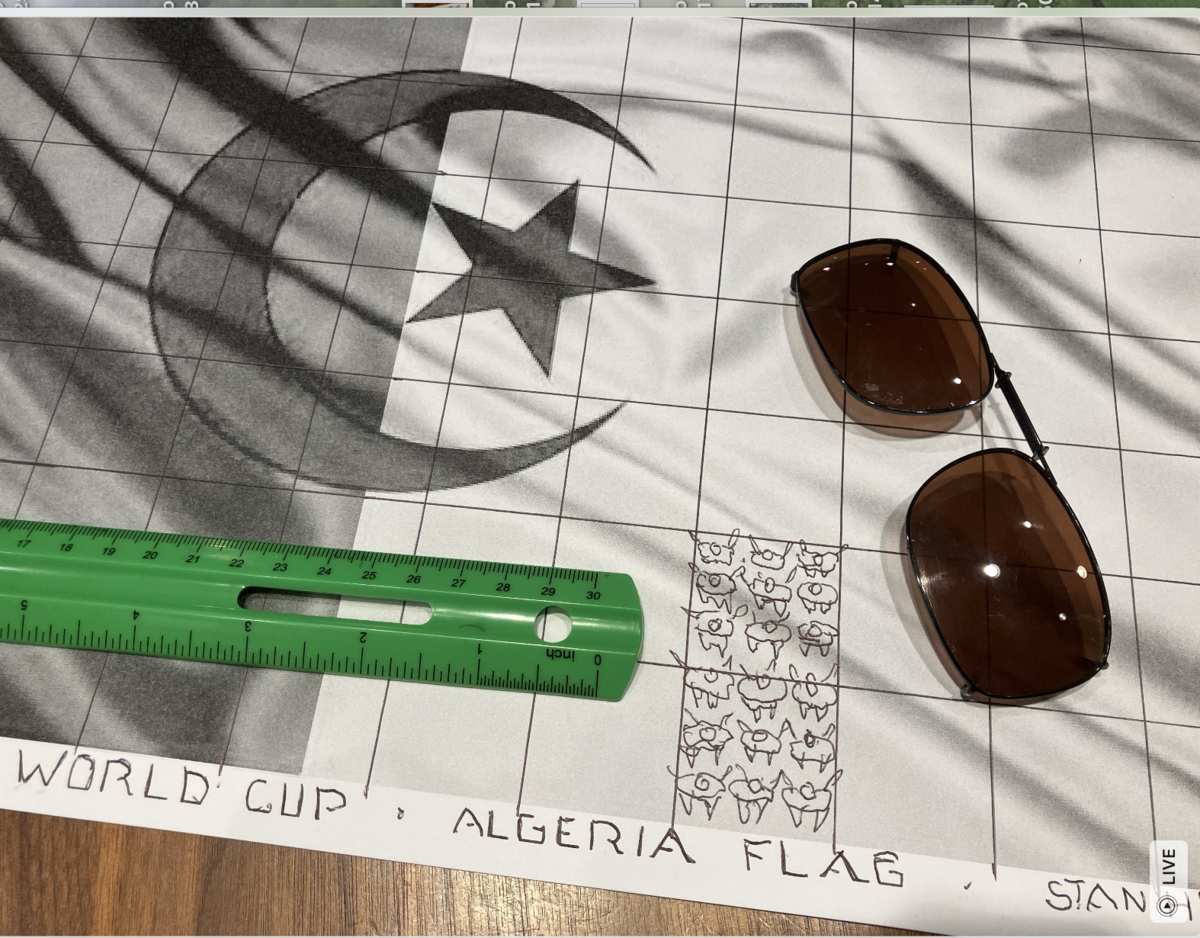
We put 2,000 pavers around the outside edge because we wanted to make it semi-permanent. . . . The Sahara Desert is the southern tip of Algeria, so we thought sand would be appropriate for the whiter color. We’ve mowed the grass down in the area that will be white spread sand, and then we created the star and the crescent moon out of the pavers. We filled that with a beautiful redwood mulch that will read as red against the green and white.
And the grass — the most important thing to me in an earthwork is to utilize what was there when you came. If you wanted to just come and throw a bunch of material down on top of something, I think it would have less beauty and less connection to the space, to the place, to the actual ground itself. So, having whatever was there when you showed up as part of the image, whether it’s manipulated or not, is really important . . . The grass was really rough in some areas. I had to sprinkle grass seed and then water it, because we had two weeks of drought.
What was the motivation behind the Algeria-honoring earthwork?
The first thought we had was just a simple flag. And so that was two months ago, and within three weeks I was on the field creating the start of the design. They raised some money here, and I created it for about a third of what I would if it was a commercial project. But I have to pay my crew, I have to pay my team — Team Herd, we call it — so we made Team Herd T-shirts. We’ve already made 500 we make another couple of 1000. Marilyn and Tom Dobski, the McDonald’s folks here, put money into T-shirts that we bought for the Algerians so that when they showed up at the field, we could just hand them a T-shirt. We didn’t have many (at the event). We had 70, I think, and there were 800 people that showed up, so they went through that pretty quick.
We are a progressive blue spot in the state, and we want to embrace and learn as much as we can about other cultures. I believe that the Algerians are definitely taking notice of the fact that they’re so welcome here. It’s not that the England and Argentinians aren’t welcome to Kansas City, certainly they are, but we have a smaller demographic. This whole town is behind this.
We have Algeria, and they have us.
How have Algeria fans, Lawrence residents and yourself reacted to the piece, and its activation event?
We changed plans 10 times in 12 hours before (the activation) happened. . . . The music started playing, and they started chanting. That’s when I got teary-eyed. Drums and kids squealing, I mean, it was just so amazing to see this energy, because they were there with their friends. Many of them knew each other, and they were celebrating Algeria — not just the team, but their culture, their people, their history.
We’ve had over 5 million hits, likes and such (online). It’s trending all over, and friends of mine who have their own little account with 3,000 fans are sending it out and getting comments, and my Instagram and my Facebook.
Art is just a platform; it’s a stage for everybody to come and emote and recognize their shared culture and humanity, and we get to be a part of that. That’s the great part, is our community gets to be standing beside them.
What is in store for the piece in the near future?
We’re just kind of building this house as the storm comes. Plans change daily. So this is almost like slow motion art happening, and we’ve done act one, as it were, by creating it and having the folks come right before the storm. And then we’ll be working on it through the week, and we may bring soccer teams out.
A lot of people are going to want to identify with Lawrence’s history as it unfolds with Algerians, and so then the final (act) would be if we can get the (Algeria) team to come on right before their last game. Even if (they don’t), the fans have shown up. Hundreds and hundreds of people with flags and shirts, enjoying and chanting and singing.
One of the things that we’ve briefly talked about, and I think this may be a long shot, is to take the star and the sickle, the moon crescent and build it up out of the ground because the ground is just a rough patch of grass on the edge of the Lied Center. (It would be) 2 or 3 feet tall, and create a permanent piece there that would pay tribute to this event. We would get the players’ names in a plaque next to it and tell a bit of the history of it.