‘A hot mess’: At Kansas City’s Union Station, long lines for special curbside voting
One passerby called it a “mob scene.” The line of vehicles for in-car, “curbside” voting at Union Station on Election Day at times stretched 400 yards.
Voters — some of whom had disabilities or had tested postive for COVID-19 — waited for hours. Then, once they finally inched their way to the front of the line, their ballots, which were supposed to be ready for them, weren’t available. They were asked to come back later, forcing them to return and wait an additional hour or more.
“It turned out to be a hot mess. … People were waiting hours and hour and hours,” said Denise Lieberman, director of the Missouri Voter Protection Coalition, a nonpartisan group with more than 1,000 volunteer attorneys tasked with keeping an eye on and removing barriers to voting. “The lines were like out of control. We had someone with like double pneumonia, getting sicker and sicker.”
On Oct. 31, the Kansas City Election Board announced that voters who were “differently-abled,” unable to enter their home polling place or, in particular, had tested positive or were exposed to COVID-19, come vote curbside at Union Station. The Election Board, in a tweet, said it would “be safer, more convenient, and take less time.”
Lieberman said that part of the problem was a recent spike in Missouri coronavirus cases, inundating the site with residents hoping to vote curbside.
“COVID is probably the biggest issue we confronted across the state today,” Lieberman said,
The election board set up a special curbside tent at Union Station in the lower west parking lot. Vehicles lined up early. Those who intended to vote curbside were asked to call in advance so that the board could prepare their ballots. But when voters arrived, Lieberman said, ballots weren’t always ready and the iPads used by election officials were slow to connect to Union Station’s WiFi.
“This is not something that we anticipated,” said Shawn Kieffer, the Republican director with the election board. “The turnout on this has caught us, as it has with most people, totally as a surprise.”
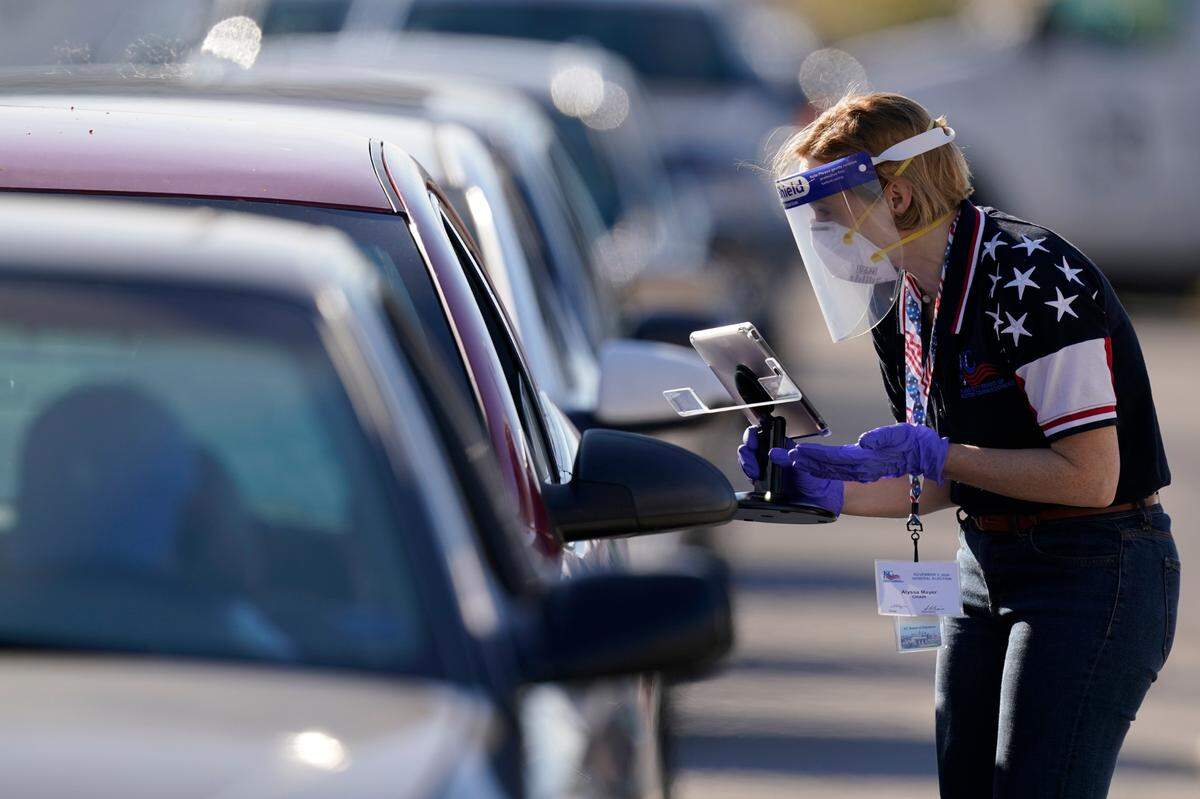
Another problem, Lieberman said, is that curbside voting was supposed to be available at every polling place. Not all polling places realized it and, as a consequence, sent voters to Union Station.
“We had a quadriplegic who was turned away from his polling place in Kansas City because he requested to vote curbside,” she said. “And someone in a wheelchair was told that their only option was to get back in their car and go down to Union Station.”
The problems were resolved soon after 2 p.m. “They got things figured out, and the lines got shorter,” Lieberman said. “But, especially in the morning, people were being told to leave and come back.”
Shortly before the polls closed at 7 p.m., only a handful of cars were seen at Union Station’s curbside poll.
Lieberman said her group recorded few other problems in the Kansas City area, other than one polling location that opened about an hour late because workers initially lacked a key to the building.
As of midday, the Lawyer’s Committee for Civil Rights Under Law had received 22,000 calls about voting problems or irregularities across the country. But Executive Director Kristen Clarke said most issues of voter access or intimidation appeared to be sporadic, not systemic.
She said a record number of mail-in ballots and early voting helped, along with extensive voter advocacy efforts across the nation.
“There are no raging fires in the country at this point,” she said Tuesday afternoon. “There have been issues that we have been able to largely troubleshoot and resolve and work through.
The committee had received the most complaints from voters in Pennsylvania, Texas, Florida, New York and Michigan.
In Missouri, the organization had received complaints from voters in St. Louis County who were being questioned about potential coronavirus infection.
The ACLU of Kansas said it received 144 calls to its election hotline. “Everything was run-of-the-mill,” a spokesman said.
Calls for peace
Elsewhere during the day, an afternoon rally was held with police and the mayor’s office. Numerous clergy members called for peace in Kansas City, regardless of the outcome of the election.
“Today, where emotions are hot, and the love of many seems cold, we’re here to simply say, ‘Hate won’t win,’” the Rev. Darron Edwards, pastor of the United Believers Community Church, said at Mill Creek Park by the Country Club Plaza.
Speaking to reporters outside Arrowhead Stadium, Mayor Quinton Lucas said the city did not anticipate any voter intimidation at the polls. Officials from the local U.S. attorney’s office, the Jackson County Prosecutor’s Office and the Kansas City Police Department were out to respond to calls.
Dressed in a red sweater and a black mask, Lucas said Election Day should be a national holiday.
“I think this is a lot more important, perhaps, than recognizing Columbus Day, for example,” Lucas said.
Voting at Arrowhead
Voters arrived before dawn at Arrowhead, where Chiefs Coach Andy Reid cast his ballot before 6:30 a.m.
There, as elsewhere in much of the Kansas City area, lines that formed before the polls opened soon melted away. Later in the morning, voters at many polling places easily walked in and out without waiting long.
By 9 a.m., between 500 and 1,000 voters had voted at Arrowhead, Chiefs team president Mark Donovan said.
The line at the stadium appeared to be moving quickly. Voters kept their distance from one another, cheerleaders posed for photographs and workers set up a free meal station outside through World Central Kitchen.
“The overwhelming response has been we’ve got to vote here more often,” Donovan said. “This is a great setup. We wish more people knew about it today. The one message I would ask for everyone’s help on — we’ve had a great turnout; we’ve had people pretty steady through here; but we got a lot more capacity. If you’re eligible to vote at Arrowhead, please come out.”
Registered voters who live in the Kansas City portion of Jackson County were eligible to cast their vote at the stadium.
Fake robocalls
The Kansas Secretary of State’s office urged voters on Tuesday to ignore robocalls telling them not to vote.
“We are receiving reports of robocalls telling voters to stay home. Disregard these calls. If you have not already voted, today is the day! Polls in Kansas close at 7:00 p.m. local time,” according to a tweet from the office.
Vandalism at WWI Museum
At 7:23 a.m., the National World War I Museum, which was designated as a polling place, tweeted that the building had been defaced with graffiti. An accompanying photo showed an exterior wall marked with red spray paint, including the words “ Fight for Revolution,” “Don’t Vote,” and a crude hammer and sickle.
The museum condemned the vandalism. “Our democracy is something that generations of veterans, including those in WWI, have fought to defend,” the museum’s tweet said. “We hope you’ll vote today & make your voice heard.”
Tuesday afternoon, about a half-dozen businesses on the Plaza were boarding up windows as a precaution after thousands of protesters converged there in the spring to rail against systemic racism and police brutality.
Johnson County Election Commissioner Connie Schmidt said voter turnout was expected to reach 80%. In Kansas City, election officials thought about 65% of voters would cast ballots.
Includes reporting by The Star’s Kevin Hardy, Katie Moore, Glenn E. Rice, Anna Spoerre, Luke Nozicka, Lisa Gutierrez and Sam McDowell.
This story was originally published November 3, 2020 at 8:54 PM.