
Sen. Pat Roberts’ win in Kansas reflects the rebirth of establishment Republicans
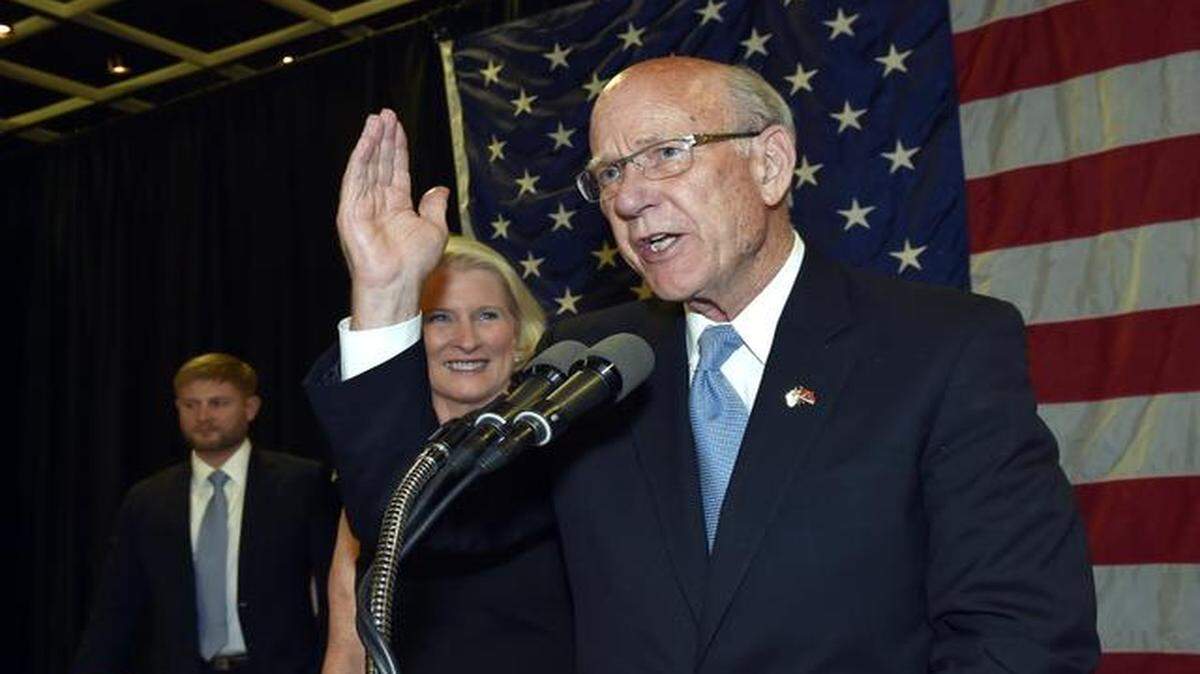
U.S. Sen. Pat Roberts defied dire predictions that he’d be swept out of office in a flood of anti-incumbent anger this week. Instead, the 78-year-old lawmaker rode a Republican wave to victory in Kansas.
His salvation signals a resurgence of the Republican establishment. It’s a trend that comes not only at the expense of Democrats, but also of tea party insurgents.
From Roberts’ defeat of independent millionaire Greg Orman to Senate Minority Leader Mitch McConnell’s decisive win in Kentucky to Thad Cochran’s re-election to a seventh Senate term in Mississippi, Election Day was good for long-serving Republicans.
And their wins came after attacks from right-wing rebels and disgruntled moderates alike that the incumbents were out-of-touch Washington insiders.
“It was a solid coming-home party for the GOP voters,” said John Hancock, a Missouri Republican strategist.
Roberts triumphed even though his roots in Kansas had withered and his campaign became stuck on autopilot in the immediate aftermath of the primary. That demonstrates the influence and effectiveness of the National Republican Senatorial Committee this cycle, said Nathan Gonzales, deputy editor of the nonpartisan Rothenberg Political Report. Chaired by Republican Sen. Jerry Moran of Kansas, the NRSC is the party’s campaign arm, tasked with electing Republicans to the Senate.
“Sen. Roberts came into this year not ready for a high-profile re-election race, let alone two high-profile re-election races,” Gonzales said. “The strategists at the NRSC pulled him across the finish line in the primary. And then he put it on cruise control. And they pulled him across the finish line in the general election.”
Moran’s campaign committee worked similar magic in Mississippi, where it rescued Cochran’s campaign from defeat in a primary runoff, Gonzales said.
“There wasn’t a senator who lost in the primary,” Gonzales said. “Based on the last couple of cycles, I would have thought there would be at least one.”
Instead, incumbents moved enough to the right to survive the sort of primary battles that Roberts weathered against Leawood radiologist and tea party favorite Milton Wolf. Roberts, for instance, has voted more conservatively in recent years.
That meant Republicans sent time-tested candidates into the general election, putting forth conventional candidates who have been the face of the party for generations.
“It’s the triumph of old white guys,” said Jack Pitney, a professor of government at Claremont McKenna College in California. “If you look up the term ‘old white guy’ in the dictionary, you see a picture of Pat Roberts.”
Republican national leadership was determined this year not to repeat the mistakes of 2010 and 2012, when the GOP lost winnable Senate races after its base nominated poorly vetted fringe candidates unable to close the deal in a general election.
This time, the Republican establishment — the party organization and outside fundraising groups such as the American Crossroads super political action committee — threw its weight behind more electable candidates in competitive states such as North Carolina and Colorado. It also concentrated on shoring up endangered incumbents such as Roberts and Cochran.
The party’s new approach to primaries played out in Kansas this year in the August primary between Roberts and Wolf. Republican groups poured money into Roberts’ campaign to get him through the intraparty election. The national party’s opposition researchers unearthed graphic Facebook photos of gunshot victims Wolf posted with flippant comments.
“Wolf would have been a vulnerable candidate in the general election against Orman,” said Bob Beatty, a political scientist at Washburn University. “It was much safer for them to have the scarred, flawed Roberts than Milton Wolf.”
Scott Schwab, a former chairman of the Johnson County Republican Party and a veteran state representative, said the GOP needed to steer away from candidates such as Todd Akin, a former Missouri congressman. Akin’s comments on “legitimate rape” in 2012 led to his defeat against then-underdog Democrat Claire McCaskill in that year’s Missouri U.S. Senate race.
His candidacy also damaged the Republican brand nationwide.
“You hate to go after another person running in the Republican Party,” Schwab said. “But if you’re going to do more harm than good, you’ve got to.”
Memories of Akin were one reason that Schwab got behind Roberts early.
“Pat’s a known commodity. I know what I’m going to get with Pat,” Schwab said. “With Milton Wolf, I don’t know what I’m going to get. Is he going to get in trouble?”
Roberts took issue Wednesday with the narrative that the national party had to swoop in and save him.
“Nobody dragged me across the finish line,” he said at the state Republican Party’s headquarters in Topeka.
Roberts credited his victory instead to “old-fashioned politics” of meeting with voters at town halls and campaign rallies.
“After they learned that the campaign was serious,” he said, “I don’t know how many people came up to me and said, ‘You’re going to be just fine. You’re all right.’”
In the end, despite bitter primary losses, many tea party voters appear to have fallen in line behind Roberts and other Republican incumbents they had previously derided. It was either that or risk Democrats holding onto the Senate majority.
“The tea party really became a part of the Republican coalition,” said Hancock, the Republican consultant. “Both sides of that clash understand that we all need one another here. And when we come together, we win more than our share.”
Even in defeat, some tea party groups will find victory in pushing the winner toward the right.
“The tea party conservatives are only going to be emboldened by the victories on Tuesday, even if their specific candidates aren’t the ones taking office,” said Gonzales of The Rothenberg Political Report.
More important than party infighting on Election Day was the mutual goal of delivering a blow to the administration of President Barack Obama. Roberts said Wednesday that the president was on the ballot in Kansas, even if his name wasn’t there officially. He was easily as prominent as Roberts in the incumbent’s campaign commercials.
Pitney, the California political scientist, said Republicans needed to capitalize on Obama’s low approval ratings. And they did.
“What we saw in past elections was bad candidates bobbling winnable seats and botching opportunities,” Pitney said. “That didn’t happen this time. This time they had good candidates, and they were able to run through the door that Obama had opened for them.”
Bryan Lowry of The Wichita Eagle and Steve Kraske of The Star contributed to this article.
To reach Lindsay Wise, call 202-383-6007 or send email to lwise@mcclatchydc.com. On Twitter: @lindsaywise.
This story was originally published November 5, 2014 at 7:01 PM.