Missouri ad says Amendment 5 fixes a ‘big tech loophole.’ Is that true?
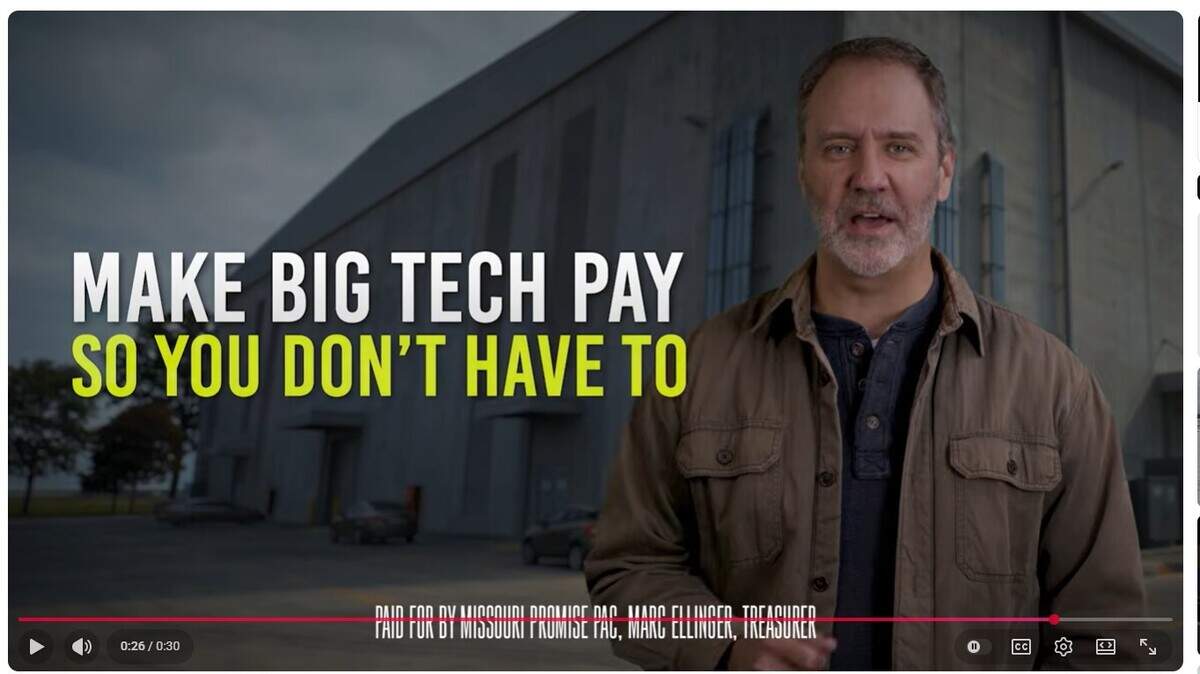
A new advertisement claims that a Missouri proposal to replace the state income tax with expanded sales taxes would fix a “big tech loophole” responsible for porn and data centers, a remarkable suggestion that opponents have called false.
The advertisement paints an ominous portrait, featuring a man in dark lighting standing in front of images of noisy computer servers. It’s aired across TV stations and websites in an effort to convince voters to approve Amendment 5 on Aug. 4.
“That hum is the sound of big tech making money from online gambling, from porn,” the man says in the ad. “Data centers are money machines making millions every minute. And Missouri’s 1917 tax code means they make all that money and get away tax free.”
Amendment 5, the ad says, fixes that loophole and “makes big tech pay so you don’t have to.”
But that’s not what the language of Amendment 5 says. The GOP-controlled General Assembly voted in 2015 — not 1917 — to exempt from sales taxes the equipment used in data centers. Amendment 5, which seeks to phase out the state income tax, would not repeal those exemptions.
The proposed amendment, which state lawmakers placed on the ballot, would grant legislators broad authority to increase sales taxes and implement taxes for services with the goal of reducing the income tax.
Opponents of Amendment 5 have flatly called the advertisement misleading or false. The attempt to tie the amendment to data centers comes amid broad resistance to the artificial intelligence industry, which has sparked fierce voter backlash across the state and country.
Scott Charton, the spokesperson for Missourians for Fair Taxation, a campaign group that opposes Amendment 5, emphasized that the amendment had nothing to do with data centers.
He framed the ad as a distraction that attempts to harness emotions about AI “because they know their bad idea is sinking like a rock in a pond.”
“The ads from the supporters of Amendment 5 are telling some whoppers that would make Mark Twain blush,” Charton said. “And he was famous at tall tales.”
The ad was paid for by Missouri Promise PAC, a campaign seeking to convince voters to approve the income tax overhaul. The PAC recently received a $1.9 million contribution from Missouri Promise Inc., a mysterious nonprofit tied to Delaware that does not disclose its donors.
When asked about the ad’s promise to curtail big tech, Joe Lamie, a spokesperson for Missouri Promise PAC, echoed the same arguments in the advertisement.
“Amendment 5 modernizes Missouri’s outdated tax code by closing loopholes that let large out-of-state technology companies profit from digital advertising, streaming services that bring you music and shows, and online sales while paying little back into the state,” Lamie said in an email.
But the advertisement and Lamie’s statement failed to mention that Amendment 5 would not unilaterally tax data centers. If passed, lawmakers would have the power to decide which industries would — and would not — be subject to sales taxes.
“The entire ad is totally bogus,” said Sen. Maggie Nurrenbern, a Kansas City Democrat. “Obviously, there was the tax credit passed to bring data centers here, but the fact that if Amendment 5 passes, that all of a sudden these data centers would be taxed is just wrong.”
The advertisement’s promise to hold data centers accountable was also extraordinary for another reason. Amendment 5 represents the No. 1 priority for Gov. Mike Kehoe, a Republican who has openly embraced data centers and the AI industry during his 17 months in office.
Kehoe, for example, recently convened a forum promoting the industry’s growth and his administration has pursued large-scale data center projects, including in Kansas City.
“It’s kind of interesting, quite frankly, that Mike Kehoe’s big push is to eliminate the income tax, while at the same time he’s probably one of the biggest proponents of bringing data centers here to Missouri,” Nurrenbern said.
The controversy comes ahead of a high-stakes Aug. 4 primary in Missouri, where voters are likely to see a flood of ads. In addition to the income tax vote, voters will decide the fate of Amendment 4, another high-profile ballot measure that would make it virtually impossible for citizens to amend the state Constitution.
Voters across the state will also consider measures that would require the direct election of all county assessors and renew a sales tax for parks conservation.