Kansas Democratic governor hopefuls trade accusations over Chiefs stadium deal
AI-generated summary reviewed by our newsroom.
- Kansas governor hopefuls debated the Chiefs’ $3 billion stadium at a KCUR forum.
- Plan would issue $1.8 billion in bonds for construction and $975 million for development.
- A cited projection says bonds will redirect well over $2 billion of state revenue.
As the primary races for Kansas governor heat up, Democratic candidates are taking shots at each other over the Kansas City Chiefs’ planned $3 billion stadium in Wyandotte County.
A question posed by “Up to Date” host Steve Kraske during a KCUR debate Thursday morning exposed a stark divide between candidates over whether the heavily subsidized stadium will serve as an economic windfall for Kansas or jeopardize the state’s long-term economic stability.
“Based on Kansas Department of Revenue numbers, over the next fifteen years, the Chiefs STAR bonds will redirect well over $2 billion of expected revenue from the State General Fund that funds our schools and put it into the pockets of a special interest. How do you plan to replace that reduction in state revenue?” Kraske asked the three Johnson County candidates.
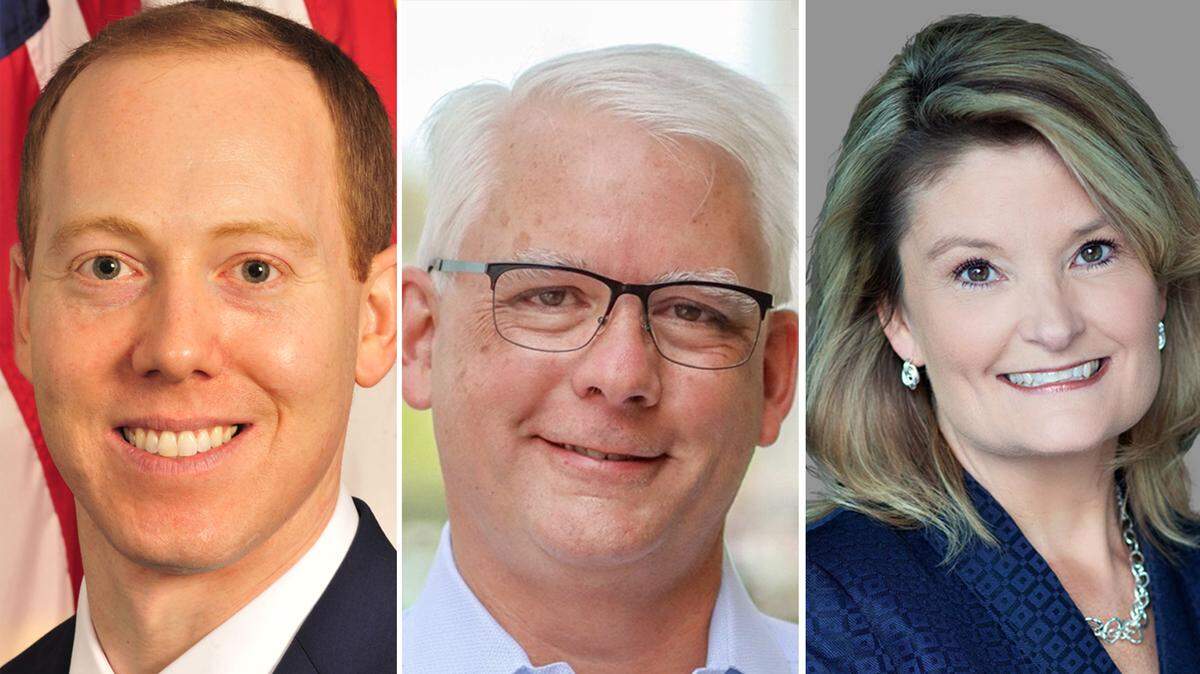
Fairway state Sen. Ethan Corson and Overland Park Mayor Curt Skoog both extolled the virtues of the stadium-financing plan, which calls for Kansas to issue $1.8 billion in bonds for stadium construction and up to $975 million in bonds to support surrounding development.
Overland Park Sen. Cindy Holscher forcefully criticized the deal, which was negotiated by Democratic Lt. Gov. and Commerce Secretary David Toland and approved by a bipartisan group of legislative leaders in late December.
Under the plan, bond debt will be paid back with future sales tax revenue generated across a yet-to-be-finalized incentive district expected to include most of Wyandotte County and a large swath of Johnson County.
“I’m excited to have the Chiefs in Kansas,” Skoog said. “It’s a great win and exciting. It will bring jobs and income to the state and revenue to the state.”
He called economic incentives “a key tool to grow the state of Kansas,” and pointed to downtown Overland Park as an example of tax breaks spurring redevelopment.
“We have used incentives to get these buildings built. But all of those incentives are based on the revenue generated from the project,” Skoog said, adding that he’s confident the clawbacks included in the Chiefs deal will ensure the team upholds its commitment to investing in Kansas.
Holscher characterized the project as “a big gamble” that gives “property tax exemptions and big payoffs to a billionaire family” — the Hunts — and will monopolize new sales tax revenue generated across a profitable region until the debt is retired.
“It’s cannibalization of revenue,” Holscher said. “Revenue that would have gone to our schools and highways will go to pay towards a stadium. I mean, that’s what we’ve seen in other projects similar across the U.S. And that’s what economists tell us. And that typically, the payoff that is forecasted isn’t there.”
Corson, who held several high-ranking jobs within the U.S. Department of Commerce before being elected to the Legislature, said he’s an unabashed supporter of the deal.
“When I have a chance as governor to create 21,000 good-paying construction jobs for Kansas families that are going to allow Kansas families to support their families and raise them in a middle-class quality of life, I’m going to swing at that pitch every single time,” Corson said.
He then questioned Holscher over why she voted for the underlying STAR bond incentive package in June 2024 that authorized Toland to negotiate a deal with the Chiefs or Royals that financed up to 70% of stadium construction with public money.
“The whole purpose of this package was to bring the Chiefs over to Kansas,” Corson said. “Sen. Holscher voted for it, and now the Chiefs came to Kansas. I don’t know what she expected to happen.”
Holscher said the specifics of the agreement with the Chiefs — not the general framework approved two years ago — is what makes the deal risky for Kansas in the long run. She voted against legislation this spring that created a sports authority to own the stadium and oversee its construction and management.
“That bill had problems,” Holscher said. “That bill did not have protections for unions and our labor workers. That needed to be added. I had an amendment to do that.”
Corson said he’s confident local laborers will be the ones to benefit the most from stadium construction. He also cited the state’s projections that the finished stadium will generate $1 billion in economic impact across the Kansas City region and 4,000 permanent jobs.
“That’s the reason that nineteen labor unions are supporting me,” Corson said. “Because I’ve continually fought for Kansas workers and for Kansas jobs.”
In a parting shot, Holscher questioned the authenticity of those endorsements.
“I’m a union member. I come from a union family,” she said. “This year, things were done differently in terms of those endorsements. Normally, there’s a process. Normally, there’s an interview, paperwork process. Wasn’t this year. And I think people should be curious about that.”
Corson’s campaign said in a statement that his record in the Senate “fighting for working people in Kansas speaks for itself.”
“Discrediting these organizations that work day in and day out for working families just because she’s mad she did not receive their support is pretty shocking,” spokesperson Glynnis Harvey said.