Missouri Supreme Court upholds Kansas City’s gerrymandered map in win for Trump
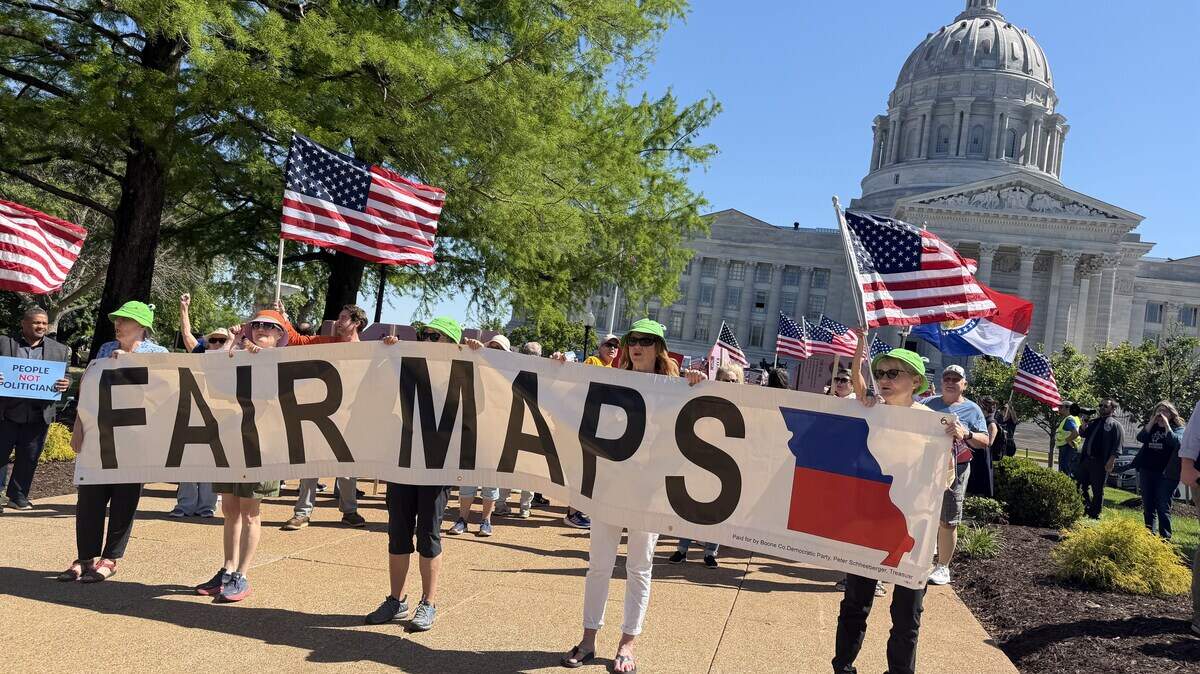.jpg "A crowd gathers outside of the Missouri Supreme Court after legal arguments in a trio of cases that could decide whether Missouri’s gerrymandered congressional map, which slices through Kansas City, can be used in the 2026 midterm election.")
The Missouri Supreme Court on Tuesday upheld the state’s gerrymandered congressional map in a pair of landmark rulings that ease a path for Republicans to unseat Kansas City’s longtime Democratic congressman.
The first unanimous ruling found that the map itself, which carves up Kansas City, was legal and did not violate the state constitution. The second ruling, which was also unanimous, found that the map was not currently blocked even though a referendum campaign turned in signatures to force a statewide vote on it.
Together, the two rulings open a door for Missouri to use the map in the upcoming August primaries and the Nov. 3 election. However, the judges wrote that they could not expressly decide whether the map is in effect yet until Republican Secretary of State Denny Hoskins decides to certify the referendum campaign for the ballot.
As of Tuesday, the decisions handed a major win to President Donald Trump, who leaned on Missouri Republicans to redraw the map amid a nationwide redistricting fight over U.S. House seats.
The lightning-fast rulings came just hours after oral arguments in a trio of cases over the map. In court Tuesday morning, attorneys for the ACLU of Missouri and the National Redistricting Foundation urged the state’s seven Surpreme Court judges to block or strike down the map.
The new map, signed into law by Republican Gov. Mike Kehoe last year, splits Kansas City voters into three Republican-leaning districts. The goal of the effort was to oust U.S. Rep. Emanuel Cleaver by carving up his 5th Congressional District in Kansas City.
The new boundaries carved more than 70,000 minority residents out of Cleaver’s district and used Troost Avenue, Kansas City’s historic racial dividing line, to split up the districts.
It marked an overt example of partisan gerrymandering, a term used to describe the practice of redrawing electoral district boundaries to favor one party over another.
Barring any major changes, Cleaver will be forced to campaign in a district that stretches east from Troost Avenue to the rural cities and towns spread across central Missouri. It combines the voters in eastern Jackson County with voters in places hours away, like Jefferson City, Maries County and Osage County.
Missouri Republicans immediately championed the ruling on Tuesday. Most referred to the map as the “Missouri First Map,” a name coined by conservative supporters.
“Today’s Missouri Supreme Court rulings are a HUGE victory for voters,” Kehoe said on social media Tuesday afternoon.
Cleaver, in a statement Tuesday evening, reaffirmed his intentions to run for a 12th term in Congress, calling his commitment “unwavering and resolute.” The Democratic congressman went on to express confidence that a referendum campaign to strike down the map would be certified for the ballot.
“While I have little doubt some in Missouri will do everything they can to undermine the Constitution, I am hopeful the courts will uphold the law on behalf of Missourians,” Cleaver said.
“Ultimately, the will of the people and the voters will prevail,” he said. “I know in my heart and soul that Missourians are good and decent people who will respond as such with their votes for my re-election, as well as their votes to reject this proposed map in November.”
Five Republicans have filed to run under the new map’s boundaries. One of those candidates, Republican state Sen. Rick Brattin, echoed an argument touted by conservative that only lawmakers had the ability to decide the state’s congressional districts.
“These lawsuits were politically-motivated attempts to block a map that better reflects our state, and I am glad the Missouri Supreme Court upheld the map passed by the legislature,” wrote Brattin, a Harrisonville Republican.
The pair of rulings struck another blow to Missouri Democrats, who fought against the map in the state Capitol and sought to have it struck down in court. Mayor Quinton Lucas, a staunch critic of the map, stopped short of criticizing the court decision, but said he was disappointed “with the partisan gerrymandering of our state.”
“Our voters and our voices will not disappear in 2026 and the years that follow,” Lucas said in a statement. “Sadly, statewide leadership has abandoned tradition, respect, and fairness in order to pander to Washington special interests. We’ll meet again at the ballot box.”
The mayor’s reference to the ballot box comes as Kansas City voters are on tap for a chaotic midterm election. A referendum campaign, called People Not Politicians, has submitted more than 300,000 signatures in an attempt to force a statewide vote on the map in November.
The state Supreme Court, in its second ruling, found that if the referendum campaign is found to be legally sufficient, then the map would be retroactively suspended or blocked until Missourians have a chance to vote on it.
Republican Secretary of State Denny Hoskins, a fierce supporter of the new map, has not yet certified the referendum campaign for the ballot.
This story was originally published May 12, 2026 at 4:52 PM.