Kansas residents express mixed emotions about Royals’ plans for new ballpark
AI-generated summary reviewed by our newsroom.
- Kansas residents expressed mixed emotions about the Royals' Crown Center plan.
- The Royals outlined a roughly $1.9 billion stadium within $3 billion Crown Center project.
- Many residents voiced concerns about potential downtown traffic and infrastructure impacts
Across the Missouri River in Kansas, residents responded with a range of emotions Wednesday afternoon to news that the Kansas City Royals plan to build their next stadium near downtown.
Some people at the Legends shopping mall in KCK said the prospect of baseball on the sprawling Crown Center development demonstrates the team’s commitment to the region.
Quite a few worried about how a new stadium could affect traffic flow downtown. Several others expressed relief that Kansas taxpayers won’t have to pick up the tab to keep the Royals in Kansas City.
“I’d go wherever they are,” said Deb Geist of Shawnee.
But her excitement about keeping the team close was tempered by questions about the infrastructure challenges that building so close to downtown could present
“I’m just trying to imagine in my world how they’re going to get it (in Crown Center),” Geist said. “Watching the news today and everything, I’m really surprised.”
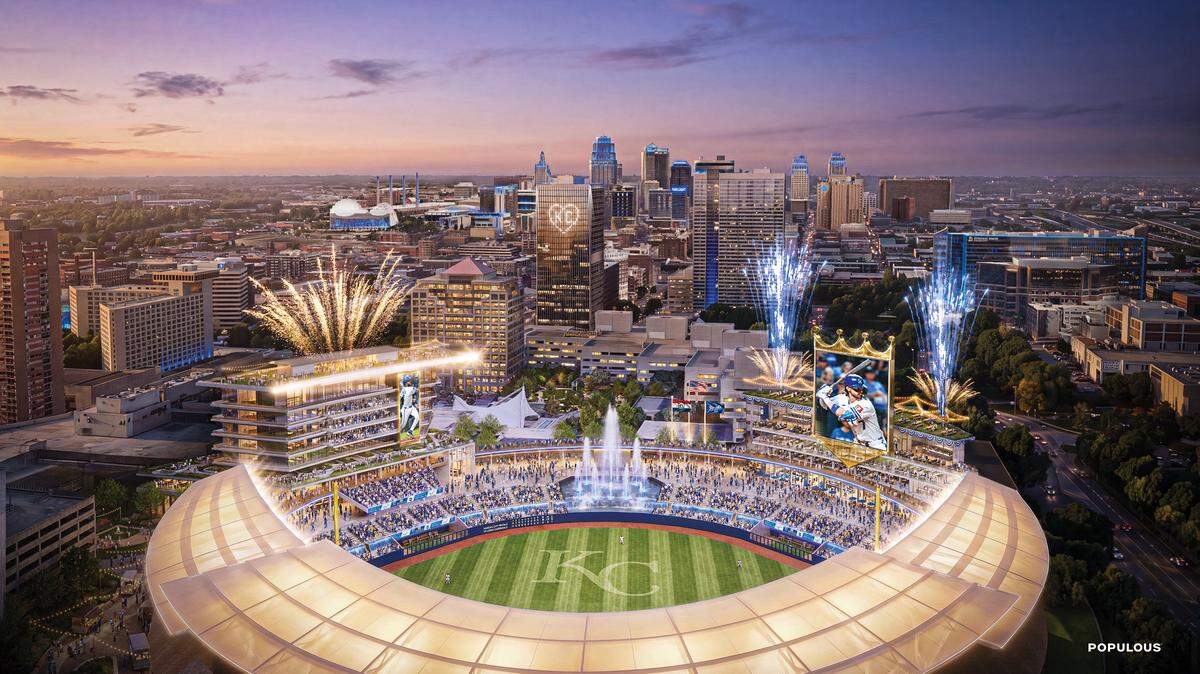
The Royals’ Wednesday-morning announcement was short on specifics but outlined the team’s vision for building a roughly $1.9 billion stadium inside a $3 billion project at Hallmark Cards headquarters in Crown Center in partnership with the company.
The announcement came days after city officials passed an ordinance authorizing City Manager Mario Vasquez to negotiate a deal worth up to $600 million towards a new stadium in “the Washington Square Park/Crown Center area.” It’s unclear how much state money Missouri will contribute to the project under a stadium incentive law adopted by lawmakers last summer.
Tasjha Dixon of KCK said she’s relieved that the cost of the new stadium will be borne by private investors and Missouri taxpayers. Dixon said she still has serious reservations about Kansas’ ability to afford the $1.8 billion it has pledged to finance a domed Kansas City Chiefs stadium in Wyandotte County. Kansas also tentatively plans to fund $975 million of construction costs for the surrounding development with future sales tax revenue.
“I’m like, oh my God, that just seems like so much,” Dixon said.
She, too, has questions about the impact that a new Royals stadium near the heart of downtown will have on commute times across the metro.
“It sounds like it’s going to create a traffic nightmare, I would imagine,” Dixon said.
More reactions to Royals’ stadium news
Another Legends shopper, Aaron Reid, said he’s dismayed by the trend of professional sports teams moving away from city centers to find the best deal.
“For instance, the Chicago Bears, they’re leaving downtown Chicago and going over to Gary, Indiana … I don’t like that,” Reid said. “I’d rather them be really collocated with the city and it be vibrant.”
Reid is a St. Louis Cardinals fan. Rooting interests aside, he said he believes the proposed Crown Center location speaks well of the Royals’ commitment to the city.
“Busch (Stadium in St. Louis) is literally downtown,” Reid said. “I think that adds to the entire environment, culture and support for the team. I get it. It comes down to dollars for a lot of teams, but I would prefer (the Royals) to remain more close to central downtown than what the Chiefs are doing in moving out a little bit farther.”
Mary Saputo-Raines, a former Hallmark employee, said she has fond childhood memories of visiting Crown Center with family members during the holidays.
“From someone who’s lived in the area, I mean, Crown Center is huge, and I feel like that will bring traffic back to downtown,” Saputo-Raines said. “I feel like it’s kind of a good thing in a way. I mean, I would like them to stay (at Kauffman Stadium). But if they were picking a place, I think that is a decent place to pick.”
David Brandt lives in Overland Park but works in downtown Kansas City. He said he has mixed feelings about Wednesday’s stadium announcement and wants to know more specifics.
“For the opportunity to go see professional baseball, it’s nice that they’re staying in town,” Brandt said. “But from just the familiarity of the Truman Sports Complex, I just think that the arteries and highways really lent themselves to that location, and I’m just worried about history repeating itself with Kemper Arena (now Hy-Vee Arena).”
Poor attendance at NHL and NBA games in West Bottoms contributed to the Kansas City Scouts and Kings leaving the city in the 1970s and 80s, respectively.
“I understand there’s a counterargument to be made that thirty thousand people didn’t have an issue showing up for Chappell Roan concerts,” Brandt said. “But the counter to that is, do people with families that live in the suburbs want to finish working downtown, go all the way to their home to pick up the kids, to then turn around and go to downtown to show up by the second inning if you’re lucky?”
Joe Davidson also lives in Overland Park, less than a mile from the Aspiria campus site that the Royals identified last year as one of three locations that were being seriously considered for a new ballpark.
Davidson was among the residents who organized to vehemently oppose a stadium at the Aspiria site on the grounds that it could negatively impact nearby hospitals and schools, further congest traffic and forgo the opportunity for new retail opportunities around the ballpark, given how densely developed the area already is.
He’s much more bullish on the prospect of a Crown Center stadium.
“I think it’s a great location,” Davidson said in a Wednesday phone interview. “It’s about as close to the physical downtown area, downtown loop and so forth, as you could have gotten with any location. Washington Square Park really wasn’t feasible.”
He acknowledged that the Crown Center site will come with its own logistical challenges, but said the right design will make a stadium there an iconic destination for locals and visitors.
“Geographically, if what they say is true and they can build the thing basically half underground, it won’t be so obtrusive and should have some great sightlines and be accessible and be something that people can see, even if there’s not a ballgame there, and kind of enjoy walking past,” Davidson said.
This story was originally published April 22, 2026 at 4:59 PM.