Fate of gerrymandered KC map unclear despite big court ruling. 3 things to know
AI-generated summary reviewed by our newsroom.
- Court OK'd mid‑decade redistricting but did not rule on the map’s legality.
- ACLU’s Cole County case could decide if the map is blocked before 2026.
- SOS certification this summer could spur more legal fights over the map.
When the Missouri Supreme Court ruled on Tuesday that last year’s mid-decade redistricting special session was legal, a chorus of Republicans quickly touted the idea that their new, gerrymandered congressional map had been upheld.
“The Missouri First Map Stands!” one GOP consultant wrote on social media, referring to the nickname coined by Republicans, who passed the map under pressure from President Donald Trump.
“MO Supreme Court upholds the Missouri First Map,” wrote another consultant.
That wasn’t necessarily the case. While Tuesday’s seismic ruling marked a win for Republicans, it was far from the final say on the map that slices through Kansas City. An onslaught of legal battles and a looming referendum could still decide whether the gerrymandered map will be in place for the 2026 election.
“They answered a question,” Chuck Hatfield, a prominent Missouri attorney involved in a slew of redistricting battles, said of Tuesday’s decision. “But they haven’t answered all the questions.”
Questions remain about whether the map itself was legal and if it will be blocked ahead of the 2026 election.
A series of separate, but interconnected court cases and a fight at the ballot box could still strike down the map, which Republicans approved in the hopes of pushing out of office Rep. Emanuel Cleaver, Kansas City’s longtime Democratic congressman.
To help readers better understand the situation, The Star broke down how each case — including arguably the most important one — could impact the 2026 election and the fate of Missouri’s new congressional map. Missouri’s redistricting battles largely fall into three specific categories: legality of the map, mid-decade redistricting and the referendum.
Most important case
Arguably, the most important outstanding question is whether the gerrymandered map is paused — or in effect — ahead of the Nov. 3, 2026, election.
That question hinges on a lawsuit filed in Cole County by the ACLU of Missouri. A ruling in that case, informally called “the Maggard case” after its lead plaintiff, will decide if the map is blocked or in effect. That decision could clear a path for Cleaver to win reelection or dramatically increase Republicans’ chances of forcing him out of office.
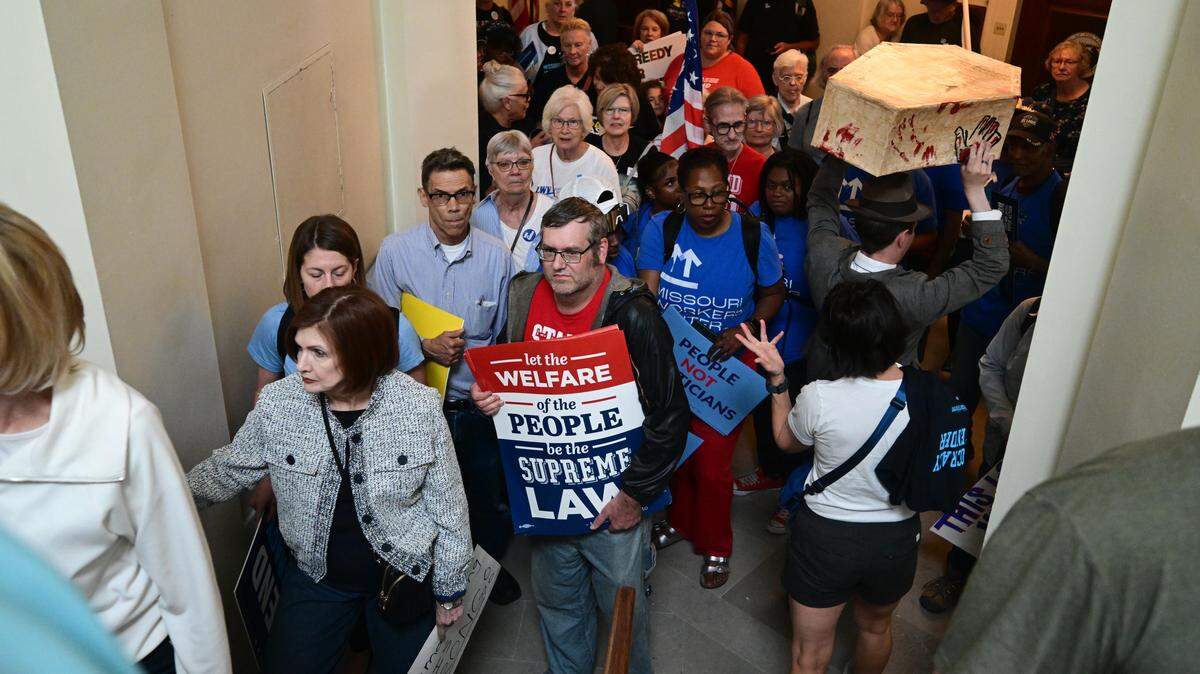
The lawsuit centers on a campaign, called People Not Politicians, that turned in more than 300,000 signatures to hold a statewide referendum to strike down the map. Historically, when Missourians have turned in signatures to challenge a new law at the ballot box, that move paused the law until citizens had a chance to vote on it.
But Missouri Republican officials have pressed forward, arguing that the map is still in effect because the referendum has not been officially certified for the ballot. The ACLU’s lawsuit contends the decision was illegal.
Cole County Circuit Court Judge Brian Stumpe had yet to rule on the case as of Wednesday. Whatever he decides, his ruling is almost certain to be appealed to a higher court.
Mid-decade redistricting
The Missouri Supreme Court ruling on Tuesday was arguably the second most important case related to redistricting. It marked a major win for Republicans — but it also left several unanswered questions.
In a narrow, 4-3 decision, the state’s highest court ruled that lawmakers were legally allowed to redraw the state’s congressional districts in the middle of the decade. That ruling found that the highly unusual process in which lawmakers approved the map was legal.
“The obligation to legislate congressional districts once a decade does not limit the General Assembly’s power to redistrict more frequently than once a decade,” Judge Zel M. Fischer wrote in the majority opinion.
In short, the court granted state lawmakers broad authority to redraw congressional districts at their pleasure and increased the likelihood of future mid-decade redistricting battles. But the ruling did not uphold Missouri’s new congressional map itself.
The special session in which lawmakers approved the map was also the focus of another lawsuit filed by the Missouri chapter of the NAACP. A judge struck down that suit last month, but the NAACP filed a notice of appeal.
The map itself
The legality of the actual map lawmakers passed is at the center of another case filed by the ACLU of Missouri. That lawsuit argues that the way in which the map slices through Kansas City violates the state Constitution.
Missouri’s new map carves Kansas City voters into three Republican-leaning districts. Cleaver’s 5th District, for example, extends from Troost Avenue in Kansas City to the rural cities and towns spread across central Missouri.
The ACLU contends that splitting up Kansas City — which has its own industries, city plans and residents with shared identities — violates the state Constitution’s compactness requirements.
A Jackson County Circuit Court judge recently rejected the lawsuit’s claims, marking another win for Republicans. But the plaintiffs in the case have filed a notice of appeal to the Missouri Supreme Court.
The referendum
Looming over everything is the potential statewide vote to strike down the map at the ballot box in November.
After lawmakers approved the map, called HB 1, opponents raced across Missouri to collect signatures to put it to a statewide vote. In December, the campaign turned in roughly two and a half times the estimated amount required to hold a referendum.
Campaign leaders earlier this month announced that they should easily qualify for the ballot, citing preliminary data from local election officials who have been tasked with verifying the signatures.
“There’s no question to me that Missourians will be voting on…whether or not House Bill 1 should be affirmed by the people or rejected by the people,” said Richard Von Glahn, the campaign’s executive director.
But the fate of the campaign rests in the hands of Secretary of State Denny Hoskins, a Republican and staunch supporter of the new map. Hoskins has until this summer to certify the measure for the ballot.
That certification would mark a critical moment for map opponents. However, it could also create several dueling and chaotic situations. One likely scenario is that Hoskins certifies the map for the ballot this summer, but claims that it’s too late to stop it from being used in the 2026 election.
“I fully expect he will say that,” Hatfield said. “He’s refused to follow the law through most of this process. So I mean, I expect we’re going to have to bring more lawsuits about it down the road.”
This story was originally published March 26, 2026 at 11:17 AM.