
KC & Independence look to ban ‘gas station drugs,’ calling 7-OH a health crisis
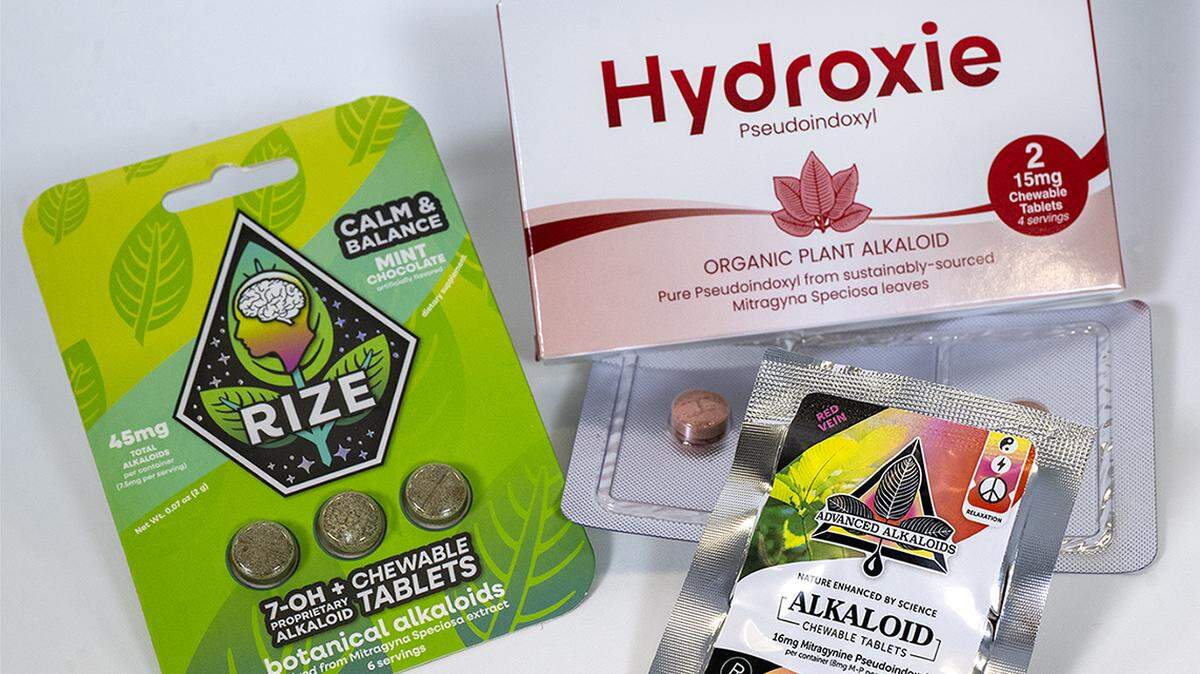
Kansas City and Independence are poised to regulate or ban so-called “gas station drugs” to address what officials call a growing public health crisis.
Kratom is a plant that has both opioid-like and stimulant-like properties and can be produced into other forms like powder, capsules and liquids. 7-OH is an alkaloid found in kratom that can be produced synthetically or semi-synthetically and also appears in various consumable forms.
Both substances, which can be found for sale in convenience stores and smoke shops, exist in a legal gray area with patchy regulation. Users often take kratom and 7-OH products to self-treat pain, anxiety, depression, opioid withdrawal and other conditions, according to Kansas City documents.
Opponents push back on the idea of the products as a health threat and say a ban could have devastating consequences.
But officials say the products, and the lack of regulations around them, present public health and safety concerns, including around addiction, negative health effects, access by minors and nuisances around shops where they are sold.
The Kansas City City Council is expected to consider rule changes that would ban synthetic and semi-synthetic 7-OH products outright and place heavy restrictions on what kinds of kratom products can be sold, including banning those that look like candy or can be vaped or smoked.
The rules would still allow for some products like natural kratom leaf or kratom leaf extract, but sales would be limited to those 21 years or older and could not be displayed in a way that would make them accessible to those under 21.
Retailers would need to get licensed and pay fees, with application requirements, to sell kratom products. The City Council is expected to consider the proposal on Thursday.
“Unregulated gas station drugs are substances that are sold with virtually no oversight or accountability,” Mayor Quinton Lucas said in a statement. “The products are marketed as legal alternatives but are often just as dangerous as controlled substances and have no place on our shelves when they contribute to addiction, overdoses, and neighborhood instability, particularly impacting our children.
“The ordinance represents a science-based, community-informed approach to protecting public health while ensuring our neighborhoods remain safe,” Lucas said.
Independence could ban kratom products
Meanwhile, at its Feb. 9 study session, the Independence City Council conducted its first reading of an ordinance that would similarly ban the sale of kratom derivatives within city limits, particularly those with psychoactive properties.
The ordinance, sponsored by outgoing mayor Rory Rowland, specifically bans the sale of 7-OH, along with pseudoindoxyl - another powerful kratom variant with effects comparable to opioids - and “any synthetic isomer… intended to produce psychoactive effects.”
“Synthetic kratom, also known as 7-OH, has been a problem across the country,” Rowland said at the Feb. 9 work session. “People have died because of using it.”
If the Independence ordinance passes, anyone found selling, providing or distributing kratom-derived products could face a $500 fine or a sentence of up to 6 months in jail.
As local policy around controlled substances continues to tighten across the Kansas City metro, Independence is also cracking down on public marijuana usage. The city council recently passed an ordinance formally banning residents from using marijuana in “any location accessible to the general public,” with a $100 fine for the first offense.
Split emerges over proposed ban
Reaction to the Kansas City proposal was mixed during a public hearing before the public safety committee on Tuesday.
“I see people turning to kratom because they are led to believe it is an entirely safe alternative to pain medications, and there likely is truth there,” said Jessica Rousseau, a yoga teacher and health counselor speaking on behalf of the yoga and holistic medicine community.
“But not everybody is being sold the entire story,” she said. “They’re only sold the parts that the industry would like them to hear. While unadulterated kratom can be used safely, too many people do not learn how to use it safely or effectively.”
That’s added to the industry pulling out specific compounds, like addictive 7-OH, and a population of well-intentioned people who are becoming addicted to a plant that is not regulated, Rousseau said.
“My question is, also as a mother, what happens if a naturally-minded mother gives her child kratom or 7-OH to help with their pain or issues that they’re having?” she said.
Some residents said they have experience using kratom and 7-OH products, which have benefitted their lives and alleviated health issues, such as pain and anxiety, while providing a safe alternative to more dangerous opioids or other substances.
“They allowed me to leave the house when nothing else was able to,” resident Keanu Carson said during a hearing. – also wrote a letter
“Kratom has literally saved my life,” N. Eve Wolf said.
But others have urged the city to go even further and restrict kratom entirely for the sake of public safety. Multiple speakers said during the hearing that family members died from kratom use.
“Kratom caused him to have a seizure, go into cardiac arrest and die a violent death on his floor in front of his girlfriend,” Susan Eppard said of her son. “His toxicology showed that he died from the toxic effects of mitragynine, an alkaloid found only in kratom. He had no prescription drugs, no street drugs, nor alcohol in his system when he died, and his autopsy showed he had no underlying health conditions.”
Vince Sanders, founder of locally based American Shaman CBD, which has been at the forefront of 7-OH manufacturing, said he supports most regulations, including licensing fees and age restrictions.
But he said it’s also important to understand the science and invited city health staff to meet with scientists and come up with “good, common sense, science-based” rules and regulations.
“We know prohibition doesn’t work. You take this away, you force people to the street, to fentanyl and ultimately death,” Sanders said. “This is a safe product. You cannot overdose on it. We’ve done the science.”
Federal authorities seized over $1 million worth of products containing 7-OH from a manufacturing operation tied to American Shaman last year. The U.S. Food and Drug Administration has said 7-OH products pose serious risks and has asked the DEA to classify 7-OH as a controlled substance.
Todd Underwood, whose Blue Springs manufacturing site is one of the only FDA-registered kratom processing facilities in the country, told the Independence city council that banning specific derivatives won’t be enough to shut down the synthetic drug market in the area.
“I fully agree with banning synthetic seven-hydroxy, but I want to warn you right now, banning seven-hydroxy doesn’t do it,” Underwood said Feb. 9.
Underwood compared the current wave of legislation against 7-OH to similar efforts to crack down on the use of “spice”, also known as K2 or synthetic marijuana. The popular synthetic cannabinoid, known for unpredictable side effects and inducing psychosis in users, was popular around Independence in the early 2010s, Underwood said.
In that case, so many specific and slightly different varieties of the drug popped up, Underwood said, that legislation with hyperspecific language failed to keep up with new strains as they hit the market.
“The DEA (Drug Enforcement Administration) played whack-a-mole for years,” Underwood said.
A similar kratom derivative known as MGM-16 has already replaced 7-OH in some parts of the country, Underwood said. However, the ordinance on the table in Independence would theoretically ban all synthetic versions.
KC could ban whippets, poppers
The new rules in Kansas City wouldn’t just address kratom and 7-OH products. They would also ban selling certain inhalant products for recreational use.
That would include nitrous oxide, commonly known as “laughing gas” and an anesthetic in dentistry, which can also be used as a recreational drug, as it can produce euphoric and hallucinogenic effects.
The substance is also known as “whippets” and can appear in whipped cream-type containers for recreational use.
Nitrite “poppers” would also be affected. They are typically inhaled as a vapor out of a small jar for their euphoric, relaxing and warmth-producing effects. Poppers are often marketed as “nail polish remover” or other household cleaners.
Under the new rules in Kansas City, both nitrous oxide and poppers would be prohibited from being sold for recreational use. Medical or industrial operations would not be affected.