
New Chiefs stadium to be built in WyCo, with practice facility in Olathe
AI-generated summary reviewed by our newsroom.
- Kansas approves $3B domed Chiefs stadium in Wyandotte County, games start 2031
- State will fund 60% via future sales taxes; private investors cover 40%
- Plan includes $1B entertainment districts and Olathe team HQ and practice facility
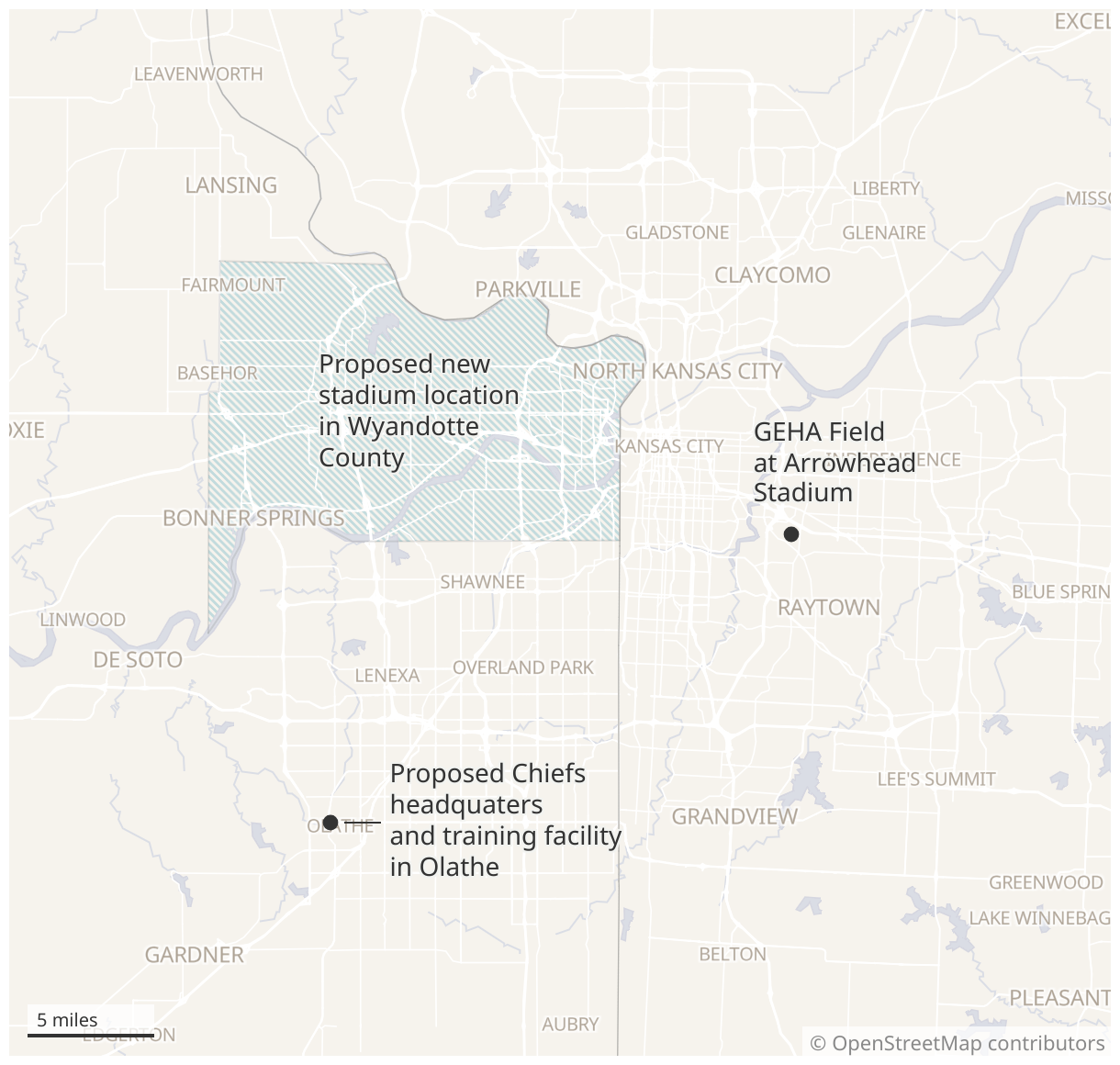
The Kansas City Chiefs rolled out plans Monday to construct a $3 billion domed stadium in Wyandotte County and a new team headquarters and practice facility in Olathe.
The plan calls for hundreds of millions of dollars of additional investment in entertainment districts surrounding both sites.
Gov. Laura Kelly and other top Kansas officials took a victory lap Monday afternoon at a celebratory event in Topeka following lawmakers’ approval of the inflammatory agreement.
“Today’s announcement will touch the lives of Kansans for generations to come,” Kelly said, calling the moment “a little bit surreal.”
“For the rest of the nation, I say take heed,” she added. “Kansas is not a flyover state. We are a touchdown state.”
According to promotional materials provided by the Kansas Department of Commerce, 60% of new stadium costs will be funded with future sales tax revenue generated by the surrounding development. The remaining 40% will be financed privately.
“We are big dreamers, and my family and I have devoted our lives to making big dreams come true,” Chiefs CEO Clark Hunt said. “The State of Kansas came to us and told us about their big dream.”
Hunt went on to thank Missouri officials for their decades of support.
“That partnership is not over, and we look forward to working together in the years ahead,” he said.
The Chiefs’ agreement with Kansas calls for games to be hosted at the new stadium beginning with the 2031 season. The Chiefs will pay $7 million in annual rent and contribute $3 million through unspecified “annual community benefit,” according to the official fact sheet.
The plan calls for investing at least $700 million in new entertainment districts surrounding the Chiefs’ facilities that will include “sports, dining, shopping, office, hotel and residential properties.”
Landing a Kansas deal
The momentous announcement of the Chiefs’ move is the culmination of a year and a half of remarkable bipartisan cooperation on the part of Kansas officials to lure the team away from its home of more than 50 years at Arrowhead Stadium.
“You don’t often see this type of bipartisanship in our politics today, but that’s how we do things here in Kansas, especially when the stakes are high,” Kelly said.
Rep. Sean Tarwater, a Stilwell Republican who helped craft the souped-up stadium incentive package, said Sales Tax and Revenue, or STAR bonds, are “a unique way to fund really big, cool, fun things.”
“It’s a way to build things and allow the people who visit the attractions to pay for it, rather than putting it on the taxpayers’ backs,” Tarwater said.
The normal version of the incentive tool only authorizes Kansas to fund up to 50% of STAR bond project construction costs through the state portion of sales tax revenue generated by the eventual development.
The supercharged stadium version gives the state permission to fund up to 70% of stadium costs with public money, compared to the 50% financing that Missouri offered. The deal approved by top Kansas lawmakers Monday only covers 60% of stadium costs with public money.
But Wyandotte County and Olathe will be expected to dedicate future local sales tax generated by the development to retiring stadium bonds, too, Lt. Gov. and Commerce Secretary David Toland told The Star after the announcement. The mayors of Kansas City, Kansas, and Olathe both attended Monday’s announcement and praised the deal.
Toland, who led negotiations with the Chiefs, said he wasn’t positive a deal had been locked in until Sunday. Seeing it come together has been inspirational, he said.
“This is bigger than us, and it’s generational, and I hope my grandkids can look back on it and be proud of the folks that came together in 2025 to bring the Chiefs to Kansas,” Toland said.
He said he expects the project, one of the largest in state history — to have a positive impact on the entire Kansas City region
“The economic development on the metro as a whole of having a new stadium that can host Super Bowls, Final Fours, big bowl games, is enormous,” Toland said. “These are things that can’t happen now in Kansas City, so the fact that this facility will exist and is designed for this type of national events is going to have a positive impact — not just in Kansas, but in Missouri as well.”
Wyandotte County stadium
The stadium STAR bond district would sit near Interstate 70 and Interstate 435, out in western Wyandotte, according to the bond agreement shared by the Department of Commerce.
Rep. Pam Curtis, a Kansas City, Kansas, Democrat, said she wasn’t convinced Missouri could have landed a deal to keep the team close.
“I don’t think our competition was really within our region. I think our competition was really outside of the region,” Curtis said. “So I’m really glad they’re staying here, and now I’m just anxious to hear about the community benefit for my county.”
Local officials will play a key role in shaping the project and its timing.
“This is only the first step. And I need to make sure the community understands that,” KCK Mayor Christal Watson told The Star after the announcement.
Any future development agreement, zoning changes or conditions of a land purchase would need to be approved by county commissioners.
Olathe and Johnson County officials will be similarly involved in green-lighting individual steps required to actualize a team headquarters, practice facility and entertainment district.
Impact in Missouri
The Chiefs have played at Arrowhead Stadium in Kansas City, Missouri, since 1972, and it’s been home to the birth of a recent football dynasty. Their current lease expires after the 2030 season.
The seismic decision comes after a year and a half of the Chiefs playing Kansas and Missouri officials off of each other to secure the most favorable stadium deal.
The move is already sending shockwaves across the Chiefs’ home state of Missouri, where officials have routinely touted ongoing negotiations to keep the team inside state lines.
“No matter how long we had to think about this as a possibility, it’s still a shock to the system,” Missouri House Speaker Jonathan Patterson, a Lee’s Summit Republican, said in a phone interview after news of the Chiefs’ move broke.
In April 2024, Jackson County voters rejected the 40-year extension of a local sales tax that would have funded a new Royals Stadium and major renovations at Arrowhead Stadium.
When the ballot question was rejected, Kansas officials seized on the opportunity to make their own pitch.
Missouri officials remained optimistic in the lead-up to the Kansas Legislative Coordinating Council’s vote that a competing incentive offer to fund up to 50% of stadium costs with public money would be enough to keep the Chiefs from crossing the border.
Patterson characterized the Chiefs’ move as a business decision, saying that a new domed stadium in Kansas was an offer that Arrowhead Stadium in Missouri could not match.
“As easy as it would be to now play the blame game here in Missouri, I think it’s best we regroup and get together as city, state and county leaders and see what we can do about maybe keeping the Kansas City Royals in Missouri,” Patterson said.
Royals CEO John Sherman offered his congratulations to the Chiefs in a statement Monday afternoon.
“On behalf of the Kansas City Royals, I want to wish the Hunt family and the entire Chiefs organization all the best on this important day,” Sherman said.
“Though a few more miles may separate us in the future, let’s continue our work as we build a world-class championship sports legacy for the Kansas City region.”
This story was originally published December 22, 2025 at 3:23 PM.