Could Kansas City split from Jackson County? Inside new plan dubbed ‘Jackxit’
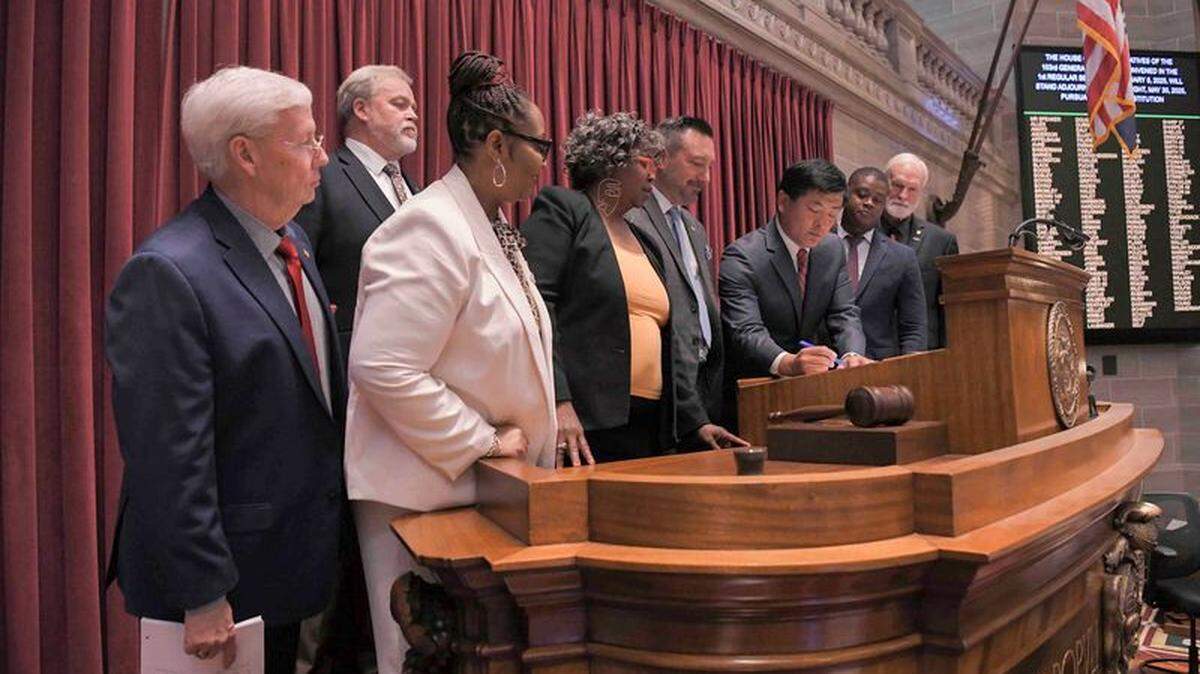
A Missouri lawmaker this week filed legislation that would allow Kansas City to separate from Jackson County, an extraordinary proposal that at least one legislator has dubbed “Jackxit.”
The legislation, filed by Rep. Mike Steinmeyer, a Sugar Creek Republican, would create a series of steps for Kansas City and Jackson County voters to ultimately decide whether the city should operate independently from the county.
“Upon such separation, the city shall continue for city purposes as a home rule city and shall not be subject to any governance by the county,” the legislation states.
The proposed constitutional amendment, if approved by lawmakers, would need to pass on a statewide ballot in 2026. That vote would trigger the creation of a “City-County Transition Committee” to craft a separation plan that would need approval from city and county voters.
Steinmeyer filed the legislation on Monday, the first day of bill pre-filing ahead of the 2026 legislative session. Steinmeyer did not respond to multiple requests from The Star and his office, through a spokesperson, said he was not available to discuss the reasoning behind his proposal.
The legislation comes at a volatile moment in Jackson County as local leaders face a laundry list of criticisms, including their handling of property assessments, the tumultuous exit of a former top executive, the future of the Kansas City Chiefs and Royals and concerns about overall dysfunction.
It also illustrates a contentious relationship between residents in eastern Jackson County, which leans more Republican, and Kansas City’s urban core, which is largely Democratic.
“We’d like to have another seat at the table and breaking away would be one way,” said Preston Smith, a former Jackson County data analyst turned taxpayer advocate, who suggested the move could bolster the political power of eastern Jackson County.
But the remarkable plan has raised eyebrows from local and state leaders in the Kansas City area. In interviews with The Star, officials expressed skepticism about the mechanics, purpose and impact of Steinmeyer’s legislation.
“I don’t know anything about Representative Steinmeyer’s proposal, but I do know separatist movements rarely work out in the long term in American and Missouri history,” Kansas City Mayor Quinton Lucas said in a statement to The Star. Lucas added that he respected Kansas City’s partners in the county and region.
“When I was a kid growing up here we used to work to build commonality where there was disagreement. I hope we can return to that some day,” he said.
One Kansas City Democratic lawmaker said Steinmeyer had not reached out to him or other Kansas City legislators about the proposal.
“I don’t think I’d be supportive of it, unless he has a good reason,” said Rep. Mark Sharp.
Meanwhile, Jackson County Executive Phil LeVota said in an interview that the legislation dealt with an issue that seemed simple, but “has so many complex and detrimental things that would happen to the area.”
“I would respect the vote of the people, but I think there’s other ways to fix problems in county government,” said LeVota, who was appointed to the position after voters recalled his predecessor, Frank White Jr.
While most of Kansas City lies in Jackson County, other parts of the city are split into Clay, Platte and Cass counties. Steinmeyer’s legislation makes no mention of those other counties, raising additional questions about how the proposal would work in practice.
Jackson County Legislature Chairman Daron McGee, who cautioned that he had not yet read the legislation, said he had a series of questions about the idea. But he suggested it would remove a “big chunk” of Jackson County’s population size.
“I don’t think we would support anything like that,” McGee said.
Inside the ‘Jackxit’ plan
In addition to requiring three successive votes, the legislation is also poised to face an uphill battle during the upcoming session. The General Assembly enters the session sharply divided on the heels of several high-profile fights over abortion, direct democracy and a gerrymandered congressional map.
However, Missouri House Speaker Jonathan Patterson, the first speaker from Jackson County since the 1800s, said Republican leaders plan to schedule the legislation for a hearing sometime next year.
“I think it’s an interesting idea,” said Patterson, a Lee’s Summit Republican. “We will definitely have hearings on it and discuss it and see what the benefits and negatives would be for eastern Jackson County and Jackson County as a whole.”
Patterson said he’s seen some people refer to the legislation as “Jackxit,” a play on Brexit, the withdrawal of the United Kingdom from the European Union. Patterson was less specific about the finer points of the legislation, including why Kansas City’s other counties were not included.
“I think all of that has yet to be worked out,” he said. “And so that’s what we’ll discuss when they have a committee hearing on it.”
While Steinmeyer’s idea has appeared novel for leaders across Kansas City, it echoes the highly controversial political makeup of the state’s other major city: St. Louis.
Often referred to as the “Great Divorce,” St. Louis voted in 1876 to split away from St. Louis County. The move has had longstanding consequences and critics often cite it as a cause of economic downturn, population loss and skewed crime statistics in St. Louis.
For some lawmakers in the St. Louis area, Steinmeyer’s effort mirrors the problems associated with their own city-county split.
“As someone who has seen the negative impacts of the great divorce in St. Louis, I think it’s a terrible idea,” said Rep. Michael Burton, a St. Louis-area Democrat, who added that regions should work together instead of competing against each other.
“Once you fracture it and break it apart, it’s hard to put back together in the right way,” he said.
Smith, the local tax activist, acknowledged that the plan is largely unheard of across the country and would be a “fairly messy affair.” However, he touted the makeup of St. Louis as a guide.
“I think that should be our template,” Smith said of St. Louis. “That should be the process we should use, because it’s already been tried and true and developed.”