Kansas & Missouri officials are sharing voter registration info. Is that normal?
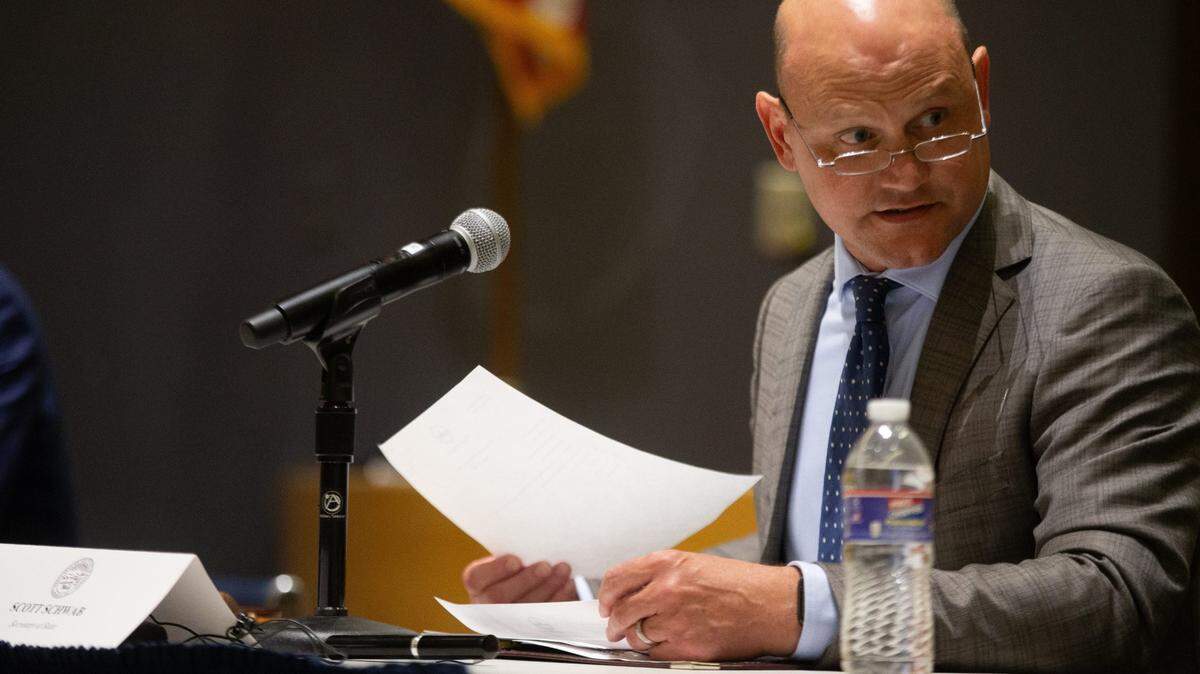
The top election officials in Kansas and Missouri have agreed to share voter registration details with each other, a piecemeal approach designed to protect elections that’s raised eyebrows from voting rights advocates.
Kansas Secretary of State Scott Schwab and Missouri Secretary of State Denny Hoskins, both Republicans, announced the agreement in separate press releases last week.
The move, called a memorandum of understanding, allows both states to share with each other information regarding the millions of registered voters in each state — and identify residents who may have moved to either side of the state line.
“By working directly with Missouri, we can reduce duplicate registrations created when residents move across the state line by updating voter registration records timely and as allowed by law,” said Schwab, who is running for governor, in a press release.
Hoskins, in a statement, framed the partnership as a way to improve the accuracy of Missouri’s voter lists, saying that the state already conducts a rigorous maintenance of its voter registration information.
“When voters move, their information should follow them—and our local election officials deserve every available tool to keep the rolls clean, current and transparent,” Hoskins said.
It’s not uncommon for states to securely share voting information with other states. But the bi-state partnership comes as Kansas and Missouri have both abandoned more centralized, multi-state efforts to combat fraud.
The shift away from a streamlined system and towards individual agreements with neighboring states comes in the wake of President Donald Trump’s false claims of fraud in the 2020 presidential election, which have fueled fears about centralized control of elections.
Now, some voting rights groups are seeking assurances that the new approach between Kansas and Missouri won’t be weaponized to discourage people from participating in elections in the name of fraud prevention.
“There’s nothing inherently wrong with sharing voter data and making sure that the voter rolls are correct and up-to-date,” said Micah Kubic, executive director of the ACLU of Kansas.
“The system isn’t the problem,” he added. “It’s making sure that the system actually is correct, actually is professionally administered, (and) does actually protect people’s data and privacy. And that is something Kansas has struggled with before.”
The Kansas Secretary of State’s office was forced to stop using an interstate voter registration system called Crosscheck in 2019 after the ACLU of Kansas reached a legal settlement on behalf of three of the 945 Kansans whose data was improperly publicized in response to a Florida open records request.
“If you were trying to maximize errors, you probably would have designed a system kind of like that one,” Kubic said of Crosscheck. “It was just a giant Excel spreadsheet that sort of assumed that anyone who had the same name was the same person.”
Court records show the Crosscheck system’s false positive rate for identifying double-registration was 99%, and state officials routinely shared sensitive voter information via unencrypted email.
Since the settlement forced the state to stop using the flawed voter data-sharing system, Kansas has opted not to join a more reliable interstate voter registration system. In September, Schwab signed onto a one-off data-sharing agreement with Texas similar to the memorandum of understanding with Missouri.
Whitney Tempel, a spokesperson for Schwab’s office, said protecting sensitive voter data will be a top priority under the new agreements.
“The Secretary of State’s office will use industry leading security standards and safeguards to ensure any information shared between the states remains secure,” Tempel said in an email. “The MOU signed by the states mandates the voter information may only be used for list maintenance purposes.”
She said if the process identifies someone who recently moved across the state line, they will be mailed a card asking them to confirm their address change before they are removed from the other state’s voter roll.
Shift away from national system
In Missouri, the new agreement is a far cry from how the state previously handled the accuracy of its voting rolls.
Up until 2023, Missouri was part of a constellation of states that used the Electronic Information Registration Information Center, a national group commonly called ERIC that allowed states to share similar information.
However, Hoskins’ predecessor, former Secretary of State Jay Ashcroft, left the national system in 2023, as Missouri joined a flurry of other Republican-led states that criticized the more national approach to information sharing.
Ashcroft did not offer specifics about a replacement program at the time, telling The Star that Missouri would work with other states “not through a large conglomeration but on a one-to-one basis.”
The shift away from ERIC raised concerns from election experts, who questioned whether Missouri’s new one-on-one approach would be as effective in combating election fraud.
The national program made it much easier for states to identify individuals registered in two states, Rick Hasan, a professor and director of the Safeguarding Democracy Project at the UCLA School of Law, previously told The Star.
“Without ERIC, either more voters are going to face disenfranchisement (and states will face new lawsuits if that risk is there) or more voters are going to vote in more than one state in an election,” Hasen said at the time. “There is no easy substitute. Having states ‘talk to each other’ without a formal mechanism with safeguards is unlikely to work.”
Hoskins spokesperson Rachael Dunn, however, defended the new effort as a better approach than ERIC in a statement to The Star on Tuesday. Dunn said that Missouri was finalizing additional agreements with other non-ERIC states.
“Most of Missouri’s bordering states were/are not members of ERIC and thus would not be of use for a realistic effort to accurately maintain voter rolls,” Dunn said.
Tempel, the Kansas SOS spokesperson, said the state has no plans to join ERIC anytime soon.
“The ERIC system required additional mailers by local election offices that the Secretary of State deemed too expensive without a funding source,” Tempel said.