Kansas and Missouri AGs could help Trump try to overturn an election loss. Here’s how
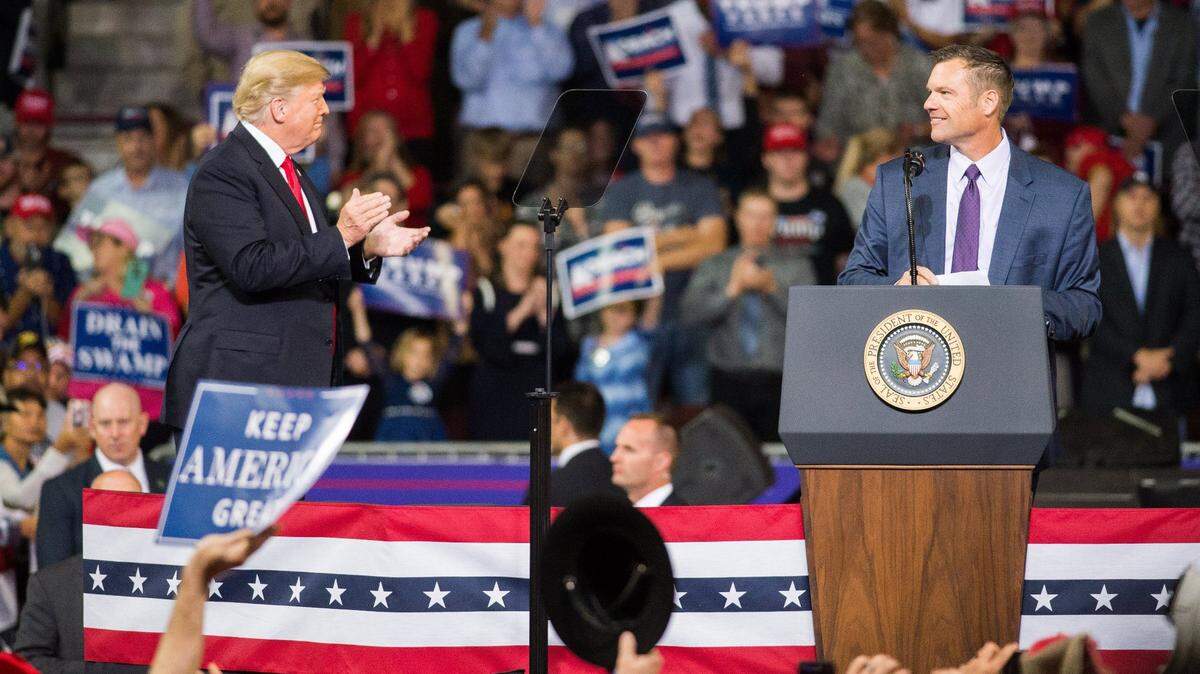
Missouri Attorney General Andrew Bailey, a staunch supporter of former President Donald Trump, possessed no power this spring to stop a New York jury from finding Trump guilty of 34 felony counts of falsifying business records.
That didn’t stop Bailey from intervening. Calling the case an “illicit prosecution,” Bailey asked the U.S. Supreme Court to push off Trump’s sentencing until after the election, in an attempt to protect the Republican presidential nominee from facing a political landmine in the middle of a heated campaign. The court declined to grant the request.
As Election Day nears, Bailey and his Kansas counterpart, state Attorney General Kris Kobach, have both demonstrated a repeated willingness to aid Trump legally. As polls indicate an extraordinarily close race in a handful of battleground states, the two Republican officials’ history suggests they would enter the fray on Trump’s behalf to contest a close loss in the courts.
The Star interviewed current and former state officials, lawmakers, attorneys and election experts about what role Bailey and Kobach may play in fighting election results after Nov. 5. Collectively, they paint a portrait of two pro-Trump officials who are unlikely to hesitate to launch or join a legal attack if the former president narrowly loses in one or more swing states.
Recent history also provides a roadmap for Bailey and Kobach. In 2020, Kansas and Missouri attorneys general Derek Schmidt and Eric Schmitt supported a baseless, last-ditch lawsuit brought by Texas that sought to overturn Trump’s loss in Pennsylvania, Michigan and other key swing states.
The U.S. Supreme Court declined to take up the challenge, but the effort played into the false belief that the election was stolen from Trump – a belief that drove a mob of Trump supporters to ransack the U.S. Capitol on Jan. 6, 2021.
“My hope is that the results would simply be clear after the election. I’m afraid we are going to have some close calls and it’s going to start again. And that scares me,” said Stephen McAllister, a former U.S. attorney and Kansas solicitor general.
McAllister previously worked under Schmidt but broke with him over the former state attorney general’s support of the 2020 Texas lawsuit. This time around, McAllister said Republican attorneys general will likely look to Kobach, who chairs the Republican Attorney General Association, for leadership in post-election litigation.
“Knowing Kris, he would want to show that he is the leader,” McAllister said. “I would think that all bodes in the direction of more likely he will be involved.”
Bailey and Kobach belong to a cadre of aggressive Republican state attorneys general who frequently sue President Joe Biden’s administration over federal rules and regulations. Policies related to transgender rights, environmental protections and student debt relief have all been targeted.
But in different ways, they both have gone beyond typical conservative litigation and provided support for Trump’s years-long attempt to rewrite the reality of the 2020 election.
Bailey, who previously worked as legal counsel to Republican Gov. Mike Parson, wasn’t a public-facing official during the last presidential election. But he has embraced the rhetoric of election denialism as he campaigns this year after Parson appointed him attorney general in 2022.
“It was absolutely stolen,” Bailey said during a candidates’ forum in May.
“The left stole that election by changing the rules of the game at the 11th hour,” Bailey said, echoing unsuccessful Republican-led litigation in 2020 that sought to fight pandemic-era election changes.
He added that “they’re going to try to steal this one” through “silencing our voices” on social media and in the mainstream media “and by packing the polling places with criminal illegal aliens that shouldn’t be here in the first place.”
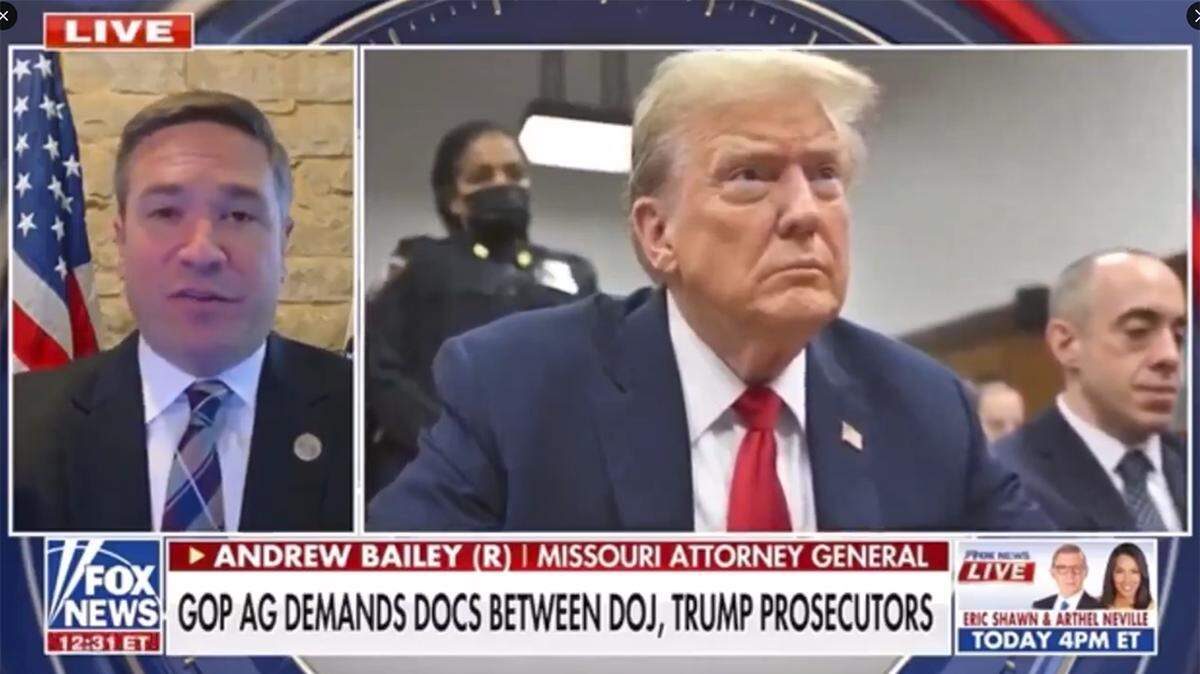
Bailey’s comments echo national Republicans, who have stoked fears of non-citizen voting.
The GOP-controlled U.S. House passed a measure this summer to require proof of citizenship to vote, but it was ignored by the Democratic-controlled Senate. In reality, it is already illegal for non-citizens to vote and such instances are rare. Experts say immigrants, whether in the United States legally or illegally, are loath to risk deportation by casting a ballot.
“If anything, Bailey is brasher than Kobach these days,” said Michael Smith, a political science professor at Emporia State University who has studied Kobach.
Kobach has dedicated much of his career to fighting virtually non-existent voter fraud, including an unsuccessful defense of Kansas’ proof of citizenship voter registration law in federal court. At a 2018 bench trial, Kobach produced fewer than 70 examples of non-citizens who registered or attempted to register to vote over 19 years in Kansas.
After co-chairing a presidential voting integrity commission early in Trump’s term, Kobach played an active role in attempting to help Trump fight his 2020 election loss. He has taken credit for helping draft the Texas lawsuit that sought to overturn election results in Pennsylvania and other swing states.
“I was one of those five attorneys, behind the scenes, drafting that lawsuit,” Kobach told a right-wing podcast last year.
Kobach, who won election as Kansas attorney general in 2022, has sidestepped questions about whether the 2020 election was stolen from Trump. In a 2022 interview with the Associated Press, Kobach said “there’s no question” fraud occurred in Michigan and Pennsylvania in the 2020 election, adding that Americans will never know “how many fraudulent ballots were cast.”
Kobach was also among a group of eight attorneys in December 2020 who received an email from pro-Trump lawyer John Eastman that discussed potential intervention by Vice President Mike Pence during the electoral college certification, according to the U.S. House’s report on the Jan. 6, 2021, attack on the Capitol. Kobach responded that the phrasing of the U.S. Constitution didn’t give Pence latitude to determine which electoral votes to count.
Spokespeople for Bailey and Kobach didn’t respond to questions for this story.
Elad Gross, Bailey’s Democratic opponent, said if elected he wouldn’t support challenges to election results in other states.
“We believe that no one should be telling Missouri how to run itself,” Gross said. “I don’t think that Missouri should be telling other people how to run their own states.”
Fueling stolen election claims
The exact shape of any post-election lawsuits remains unclear.
Election-related lawsuits fall into two categories, said David Becker, director of the Center for Election Innovation & Research, a nonprofit group that works to build confidence in elections. The main category consists of litigation that seeks to clarify the rules for elections ahead of the election.
“That used to be the only bucket,” Becker said. “Now we have a bucket of litigation that seems to be brought not to clarify rules in advance of the election, but to fuel claims that an election was stolen after an election.”
In 2020, GOP-led litigation focused in large measure on adaptations made for COVID-19. Republicans had sought to block Pennsylvania from accepting thousands of mail-in ballots that arrived after Election Day, alleging that counting the ballots violated federal law by illegally extending the date of the presidential election. The challenges went nowhere.
The pandemic has faded as a concern in 2024. Republicans this year are more focused on the specter of non-citizen voting.
Missouri state Rep. Dan Stacy, a Blue Springs Republican who chairs the Missouri House Elections and Elected Officials Committee, voiced concern about non-citizens using state-issued IDs to register to vote and cast ballots. Any evidence of non-citizen voting “would cause grave concern,” he said.
James Harris, a Jefferson City-based Republican consultant, said Bailey could easily become involved in post-election lawsuits if there’s a problem in another state. Other state attorneys general may want help from other attorneys general amid time-sensitive litigation.
“He’s been aggressive, and if he thinks something is wrong, he engages quickly,” Harris said.
But Republican attorneys general – whether Bailey, Kobach or others – who want to sue over another state’s election may face significant obstacles convincing federal courts to hear their complaints.
In 2020, the U.S. Supreme Court rejected the Texas lawsuit challenging the swing state results over standing, the legal concept of whether a party has a sufficient connection to an issue to participate in litigation. The Supreme Court found Texas didn’t have standing to sue over other states’ elections.
State attorneys general may work more carefully to avoid problems with standing this time, said McAllister, the former Kansas solicitor general. Officials who want to sue may try to recruit voters in swing states to serve as plaintiffs, on the idea that residents of those states will have a stronger standing claim. In essence, state attorneys general would act as pro bono lawyers on behalf of allegedly aggrieved swing state residents.
“That’s one of their real issues,” McAllister said of questions surrounding standing. “Because why would Kansas have any standing to complain, really, about the outcome in Pennsylvania. What they really need is Pennsylvania voters.”
Courts won’t ‘fall for this’
Bailey and Kobach both represent Republican-leaning states where they may not suffer any long-term political damage for supporting post-election legal efforts to help Trump – potentially emboldening them to act.
Bailey, in particular, appears to have solid support among Missouri voters. An August poll by Saint Louis University and YouGov found 51% of respondents planned to vote for him in the general election.
Nearly 20% of Republicans nationwide say that if Trump loses the election, he should declare the results invalid and do whatever is necessary to take office, according to the 2024 American Values Survey by the research nonprofit PRRI. Trump maintains the 2020 election was stolen, but has also, without evidence, talked up the possibility of fraud in this year’s contest.
“We have to vote and we have to make sure that we stop them from cheating because they cheat like dogs,” Trump said during an August rally in Georgia.
“Watch for the voter fraud. Because we win. Without voter fraud, we win so easily,” Trump told the Fraternal Order of Police in North Carolina in September (Trump this week in North Carolina said he had seen no evidence of election cheating).
Becker, the elections expert, said listening to candidates after the election will reveal whether they believe they won or lost. Candidates who say the process was rigged or that there was widespread fraud believe they lost, he said.
While lawsuits may try to overturn election results, Becker said they won’t succeed, adding that courts “are not going to fall for this.”
“But we’ll absolutely see it on social media,” Becker said. “We’ll absolutely see claims being made by losing candidates that is designed to fuel anger, potentially violence, and importantly, donations.”
The Star’s Matthew Kelly contributed reporting